
Swiss cheese-plant (Monstera adansonii, )
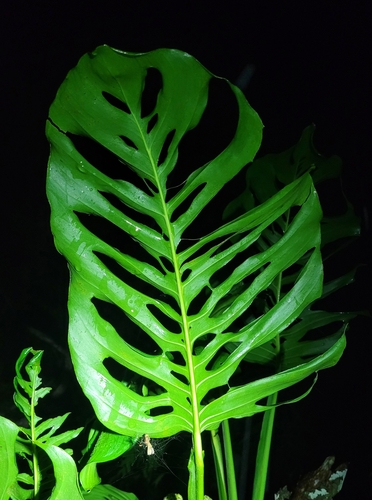
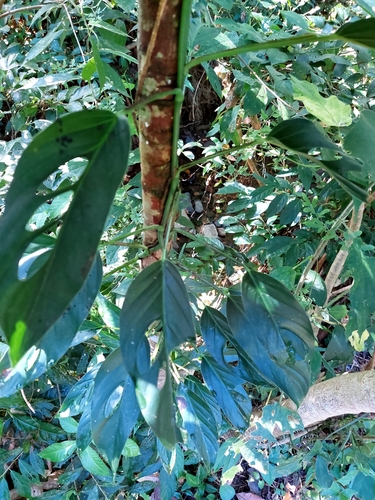
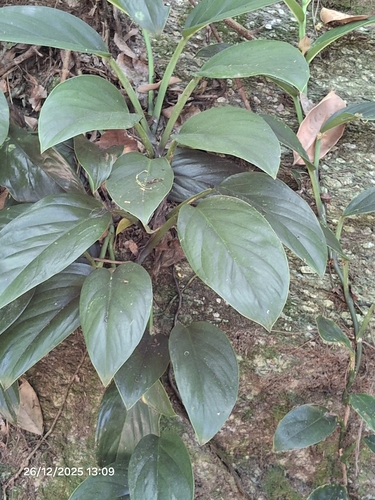
The Swiss cheese-plant (Monstera adansonii), also sold as Adanson's monstera, is a hemiepiphytic climber in the arum family, Araceae, native to tropical America. Indoors it is grown for its heart-shaped, perforated leaves, which stay smaller and softer than those of Monstera deliciosa.
Read moreMonstera adansonii, Adanson's monstera, Monkey mask, Five holes plant and Swiss cheese vine
Give plenty of ambient light without direct sun on the leaves.
Global distribution
Monstera adansonii is an accepted species from tropical America. POWO places it in the wet tropical biome, with a broad native range that includes Central America, much of tropical South America, French Guiana and the Lesser Antilles; Puerto Rico is listed as an area of introduction.
- Native7
- Introduced1
- Tropical America
- Costa Rica
- Panama
- Colombia
- Brazil
- French Guiana
- Lesser Antilles
- Puerto Rico
Hexagons: sourced regions. Green dots: native range. Statuses according to POWO (Kew).
Identity
The Swiss cheese-plant (Monstera adansonii Schott) is an accepted species in the genus Monstera, part of the arum family, Araceae. Heinrich Wilhelm Schott published the name in 1830, and IPNI traces it to the Wiener Zeitschrift für Kunst, Litteratur, Theater und Mode. 1 2
Garden centers also sell it as Adanson's monstera, monkey mask, five holes plant or Swiss cheese vine. The cheese names are handy but ambiguous: Monstera deliciosa, a far more massive species, is also called Swiss cheese plant, so the Latin binomial is the safer label. 3 4
Botanically, it belongs with the tropical climbers that bear fenestrated leaves. As a houseplant it usually stays slimmer, softer and easier to train in a hanging basket than M. deliciosa. Given a support, it behaves more as it would in the wild: the aerial roots look for something to grip and the leaves broaden.
Recognition
Perennial, evergreen and hemiepiphytic, Monstera adansonii climbs by means of stem nodes that put out aerial roots. Those roots do not parasitize the tree; they mainly help the plant cling and climb toward better light. 5 3
The leaves are simple, heart-shaped to oval, mid- to dark green and often glossy. The diagnostic feature is the internal perforation of the blade: the holes form oval windows, often in rows near the midrib, and do not necessarily reach the margin. Leaves on houseplants tend to be smaller; botanical descriptions note that adult leaves can grow much larger in tropical habitats. 5 3
Flowering is rare in the home. When it does happen in a favorable climate, it follows the aroid pattern: a white to cream spathe surrounds a yellow to cream spadix. Fruit forms in the natural cycle, but no household food use has been published; identification, ripeness and local context would be separate questions. 5
Useful taxonomy
For a fixed point of reference, rely on the binomial Monstera adansonii Schott. POWO treats it as an accepted species and lists several historical synonyms, including Dracontium pertusum, Calla pertusa and Monstera pertusa. These names may turn up in older databases, but they should not be read as different houseplants. 1 6
Things get harder with the adansonii complex. POWO and WFO recognize several infraspecific taxa under M. adansonii, notably subsp. adansonii, subsp. blanchetii, subsp. klotzschiana and subsp. laniata. The trade, for its part, often mixes "narrow form," "wide form," "laniata," "friedrichsthalii" and "obliqua" without any collection records. 1 5 7
That caution matters when buying: a variegated or heavily perforated plant is not automatically a rare species. Archipelago, Variegata, Albo and Aurea are horticultural or trade labels for variegation; the scientific name and the mature morphology are sounder guides than a seller's promise. 3 4
Habitat and range
According to POWO, the native range of Monstera adansonii is tropical America, where the species grows mainly in the wet tropical biome. WFO adds descriptions of a climber or hemiepiphyte found in evergreen forests, tropical deciduous forests and rainforests, depending on the region. 1 5
Its documented range spans Central America and tropical South America, with records from Costa Rica, Panama, Colombia, Venezuela, the Guianas, Brazil, Ecuador, Peru and Bolivia. POWO also includes French Guiana and the Lesser Antilles in the broad native range, while Puerto Rico is listed as an area of introduction. 1 6
Outside the tropics, the plant is best treated as cultivated: in pots, indoors, in a conservatory or in a warm greenhouse. No invasive status is recorded for it in the sources used here, and in frost-free tropical regions any assessment should stay local, since ecological conditions vary widely.
Indoor care
Success comes down to three things: warmth, filtered light and an airy potting mix. For monsteras grown indoors, the RHS recommends temperatures around 18–25 °C (64–77 °F), indirect or filtered light and moderate to high humidity. NC State likewise stresses bright indirect light, humidity and avoiding drops below about 10 °C (50 °F). 4 3
Water regularly, but never let it stand. A practical benchmark is 10–20 mm (0.4–0.8 in) per week in the growing season, adjusted to pot size, warmth and light; the horticultural principle is to let the surface of the mix dry before watering thoroughly. In winter, or whenever growth slows, cut back noticeably. 4
A support changes the plant's whole look. In a hanging basket, M. adansonii trails and readily produces long stems. On a moss pole, trellis or bark slab, the aerial roots anchor more firmly, the internodes often shorten and the leaves can grow larger. 4 3
Life cycle and propagation
In cultivation, this is an evergreen climber with no true dormancy. Growth slows with cold, low light or soggy potting mix, but the plant should not be forced into a dry rest like a succulent. 3
Propagation is mainly by stem cuttings with a node. The node is essential, because it carries the buds that can regrow a plant. A leaf cut without one may stay green in water for a while, but it will never produce a complete new vine. 3
Go easy on repotting. The RHS advises against oversized pots for monsteras, because a mass of wet mix around a small root system invites rot. A well-drained pot just a few centimeters (an inch or so) wider than the last one is usually enough. 4
Toxicity and precautions
Its toxicity is rated moderate and works through irritation. NC State lists Monstera adansonii as toxic to people and animals if eaten, citing calcium oxalate crystals, digestive irritation and a risk of contact dermatitis from the sap. 3
The mechanism is the one shared by aroids containing insoluble calcium oxalates: raphides are needle-shaped crystals released when the tissue is chewed or crushed. Merck describes immediate pain, irritation, excessive drooling and possible swelling in animals; MedlinePlus describes burning of the mouth or throat, drooling, vomiting and swelling in people. 8 9
The ASPCA's "Swiss Cheese Plant" entry covers Monstera deliciosa, with the same insoluble-oxalate principle and similar signs in cats and dogs. For M. adansonii, NC State remains the most direct source, so a general aroid caution applies, without treating every exposure as an emergency. 10 3
Cultivars, forms and look-alikes
Of the named cultivars, Archipelago is the one most directly cited in the horticultural sources consulted here. Other frequent labels, such as Albo, Aurea, Mint, narrow form or wide form, should be treated as trade labels unless a robust botanical or horticultural source backs them up. 3
Monstera obliqua is behind the best-known mix-up. Many plants sold as obliqua are in fact forms of adansonii or close relatives. A proper identification takes more than a photo of one leaf: maturity, petioles, sheaths, inflorescence and provenance all count. 5 7
M. adansonii also needs to be told apart from the sturdier Monstera deliciosa, and from Rhaphidophora tetrasperma, often sold as "mini monstera" but placed in another genus. The safe rule is simple: never infer the species from the word "monstera" alone, or from the number of holes in a leaf.
Main sources
- Plants of the World Online / Kew, Monstera adansonii Schott
- International Plant Names Index, Monstera adansonii Schott
- World Flora Online, Monstera adansonii Schott
- GBIF Backbone Taxonomy, Monstera adansonii Schott
- NC State Extension Gardener Plant Toolbox, Monstera adansonii
- Royal Horticultural Society, Swiss cheese plants growing guide
- Merck Veterinary Manual, houseplants with insoluble calcium oxalates
- MedlinePlus, Araceae calcium oxalate poisoning
- ASPCA, Swiss Cheese Plant toxicity entry
Frequently asked questions
Is Monstera adansonii the same as Monstera deliciosa?
No. Both belong to the genus Monstera in the family Araceae, but M. adansonii has smaller leaves, usually perforated with enclosed holes, and stays more pliable as a houseplant.
Why doesn't my Monstera adansonii have holes?
The plant may be young, kept too dark or grown without a support. More indirect light and a pole encourage more mature leaves.
Is Monstera adansonii toxic to cats and dogs?
Yes. Its toxicity is rated moderate, caused by insoluble calcium oxalates; mouth irritation, drooling, vomiting and difficulty swallowing are the signs to watch for.
Can Monstera adansonii be grown in a hanging basket?
Yes, but the plant shows its natural habit better on a support. In a hanging basket, the stems can stretch out and produce smaller leaves.
Is Monstera obliqua a form of Monstera adansonii?
No. The two names are distinct, even though the trade often mixes up heavily perforated plants. Reliable identification means looking at the mature plant and, ideally, its provenance.
Similar plants
Botanical data compiled from reference sources (RHS, Kew Gardens, POWO). This profile is for guidance only and is not a substitute for advice from a botanist or veterinarian if you have concerns about toxicity.