
Monstera esqueleto (Monstera 'Esqueleto', )

© photo
- photo 1 — Wikimedia Commons · CC BY-SA or Public Domain · Wikimedia Commons
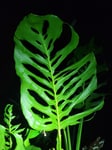
Monstera 'Esqueleto' is a horticultural name applied to a large climbing Araceae grown for green leaves whose extensive perforations resemble a rib cage. It is not an accepted botanical binomial. Long circulated as Monstera epipremnoides, the plant is now treated by specialist horticultural sources as a form or cultivar of Monstera sp. with an unknown taxonomic basis.
Read moreMonstera esqueleto, Skeleton monstera, Monstera sp. 'Esqueleto' and Monstera epipremnoides 'Esqueleto' (historical sales name)
Give plenty of ambient light without direct sun on the leaves.
Bright indirect light
© photo
Wikimedia Commons · CC BY-SA or Public Domain
Global distribution
No native range is published for Monstera 'Esqueleto', as the taxonomic basis of the horticultural name remains unknown. Costa Rica–Panama records concern the true Monstera epipremnoides, an accepted species in POWO, WFO and IPNI. That name was long misapplied to Esqueleto or used for convenience in the trade.
- Cultivated4
- Undocumented wild origin
- European botanical collections
- Tropical greenhouses and collections
- Metropolitan France
Hexagons: regions where the plant occurs. Green dots: native range.↗
Identity
Monstera 'Esqueleto' is a collection plant in the genus Monstera, family Araceae. Its name is not an accepted Latin binomial like Monstera deliciosa or Monstera adansonii. Single cultivar quotation marks reflect its current use as a horticultural name. The Aroid Cultivar Registry lists Monstera 'Esqueleto' with an unknown base species, a name given by Jody Benicek and recorded introduction in 2018. 1
That distinction matters when interpreting labels. Shops and older collections often sold the plant as Monstera epipremnoides 'Esqueleto'. However, Monstera epipremnoides Engl. is an accepted species in POWO, IPNI and WFO, published in 1905 and native from Costa Rica to Panama. 2 3 4
The cautious designation is therefore Monstera sp. 'Esqueleto', a cultivated plant with an undocumented wild origin. Its association with M. epipremnoides reflects trade history and misidentification, rather than reliable taxonomic equivalence.
Recognition
Large, glossy green leaves, often drooping and pierced by numerous openings, are its main ornamental feature. Esqueleto refers to this visual effect: the strips of blade between holes can resemble a skeleton's ribs. The Aroid Cultivar Registry describes leaves reaching about 78 cm (31 in) long and 43 cm (17 in) wide, with small perforations beside the midrib and larger ones extending toward the margin without always breaking through it. 1
Robust climbing stems produce aerial roots at the nodes, and the plant develops mature foliage when climbing a stable support. On an adult plant, internodes may appear closely spaced, leaves form a fan, and petioles remain more substantial than in many forms of M. adansonii. 1
Flowering remains rare indoors. As in other Araceae, a spathe surrounds a spadix. No food use is recommended: although certain Monstera produce aromatic fruits, a houseplant identified only by a trade name should not be treated as an edible resource.
Useful taxonomy
One distinction is firm: Monstera esqueleto is not treated as an accepted species. POWO accepts Monstera epipremnoides as a wet-tropical climber native from Costa Rica to Panama. IPNI records its original publication in Botanische Jahrbücher in 1905, and WFO also retains it as an accepted name. 2 3 4
The taxonomic revision of Monstera in Costa Rica helps separate true M. epipremnoides from misnamed cultivated plants. It describes a whitish or speckled petiole, a pinnatifid adult blade with numerous fenestrations on either side of the midrib, and inflorescence characters useful to botanists. 5
For Esqueleto, the Aroid Cultivar Registry offers a different account: an unknown base species, a presumed origin in an unidentified wild collection, presence in several European botanical gardens and a possible connection with Kew collections. Its morphological comparison is with Monstera lechleriana, rather than a formal placement in M. epipremnoides. 1
Habitat and range
Costa Rica–Panama records for true M. epipremnoides cannot automatically be assigned to Esqueleto. Taxonomic sources document the accepted species, but do not establish the exact wild origin of the plant sold as Esqueleto. 2 5
In practice, Esqueleto belongs to collections, greenhouses and tropical interiors. Its horticultural distribution involves potted plants, cuttings, private collections, botanical glasshouses and specialist sellers. In metropolitan France it is considered cultivated, rather than naturalized or invasive; this regional status does not establish its status elsewhere.
Uncertain origins do not obscure its practical requirements. It behaves as a large climbing Araceae from warm, humid conditions, needing support, airy growing medium, filtered light and stable temperatures rather than a dry windowsill environment.
Indoor cultivation
Bright indirect light suits indoor monsteras. RHS recommends a bright position without harsh direct sun and temperatures around 18–25 °C (64–77 °F). NC State describes M. epipremnoides as preferring bright indirect or filtered light, well-drained organic soil and high humidity. 7 6
Water regularly without saturating the roots. A useful adjustable reference during growth is 10–20 mm (0.4–0.8 in) per week, depending on pot size, warmth and light. Water thoroughly, then let the surface dry before repeating. An oversized pot or compact mix retains too much moisture and quickly exposes roots to rot.
Support is almost as important as watering. A moss pole, bark board or sturdy trellis provides anchorage for aerial roots. An unsupported plant may survive, but it is more likely to develop long stems, smaller leaves and a less defined outline.
Life cycle and propagation
Esqueleto is an evergreen perennial without true indoor dormancy. Growth slows chiefly in response to low light, cold, overly wet growing medium or damaged roots. Reduce watering and suspend feeding during winter slowdown, without forcing the plant to dry out completely.
Propagation uses stem cuttings with a node. The node is essential because it holds the bud capable of producing a new vine. A leaf cut without a node may stay green in water for a while but will not regenerate a complete plant. NC State also lists stem cuttings for M. epipremnoides, consistent with climbing Araceae practice. 6
After taking cuttings, maintain warmth, steady humidity and a very airy medium. Patience is normal: collection plants are often sold as small segments, and spectacular foliage develops only after rooting and a period of stable growth.
Toxicity and precautions
The retained toxicity level is moderate, through irritation. NC State reports ingestion toxicity for Monstera epipremnoides, involving calcium oxalate crystals, human irritation and risks to cats, dogs and children. 6
The mechanism is that of Araceae containing insoluble calcium oxalates. Merck describes needle-shaped raphides released when tissue is chewed or crushed, causing irritation and injury to exposed tissues. MedlinePlus describes mouth or throat burning, drooling, nausea, vomiting and possible swelling of the mouth or tongue in Araceae poisoning. 9 10
ASPCA does not provide an Esqueleto-specific entry here. Its Swiss Cheese Plant entry for Monstera deliciosa identifies the same insoluble oxalates and similar signs in dogs and cats. Keep the plant out of reach, wear gloves if sap irritates your skin, and seek veterinary or poison-control advice after ingestion with symptoms. 8 9
Look-alikes and buying
The costliest misidentification involves Monstera adansonii and its forms. A well-grown large adansonii may have many holes without sharing Esqueleto's leaf architecture, petioles or growth habit. Reliable identification requires several mature leaves, views of the stem and petioles and, if possible, the plant's history. 1
Another pitfall is the name Monstera epipremnoides. If a label says only epipremnoides, establish whether the seller means the true taxon accepted by Kew, WFO and IPNI or the trade plant long called Esqueleto. Those interpretations refer to different plants. 2 4
Choose a rooted plant, with at least one visible node if buying a cutting, unscorched leaves and no fermented smell from the growing medium. Its label should acknowledge taxonomic uncertainty. An accurate label will often use Monstera sp. 'Esqueleto' rather than an invented binomial.
Main sources
- Aroid Cultivar Registry, Monstera 'Esqueleto'
- Plants of the World Online / Kew, Monstera epipremnoides
- International Plant Names Index, Monstera epipremnoides
- WFO Plant List, Monstera epipremnoides
- Cedeño-Fonseca, Hay & Blanco, A taxonomic revision of Monstera in Costa Rica
- NC State Extension Gardener Plant Toolbox, Monstera epipremnoides
- Royal Horticultural Society, How to grow Swiss cheese plants
- ASPCA, Swiss Cheese Plant toxicity entry
- Merck Veterinary Manual, houseplants with insoluble calcium oxalates
- MedlinePlus Medical Encyclopedia, Araceae calcium oxalate poisoning
Frequently asked questions
Is Monstera esqueleto an accepted species?
No, not as Monstera esqueleto. It is treated as Monstera 'Esqueleto', a horticultural name for Monstera sp. whose botanical basis has not yet been published as an accepted species.
Is it the same plant as Monstera epipremnoides?
Caution requires treating them as different. M. epipremnoides is an accepted taxon native from Costa Rica to Panama. Esqueleto has been sold under that name, but the Aroid Cultivar Registry records an unknown base species and a closer comparison with the lechleriana complex.
How can I distinguish Esqueleto from Monstera adansonii?
Look at a mature plant. Esqueleto has larger, more drooping leaves, with small perforations near the midrib and large openings toward the margin. A single young leaf with holes is not enough.
Is Monstera 'Esqueleto' toxic to cats and dogs?
Yes. Moderate toxicity from insoluble calcium oxalates is retained as a precaution based on Araceae and Monstera sources. Keep it out of reach and seek veterinary advice after ingestion with symptoms.
Why doesn't my plant develop large leaf holes?
It may be young, short of light, grown without support or under excessive stress. Mature foliage requires strong indirect light, warmth, stable humidity and active roots.
Similar plants

If you are unsure about a plant’s toxicity, ask a botanist or veterinarian for advice.