
China rose (Rosa chinensis, )
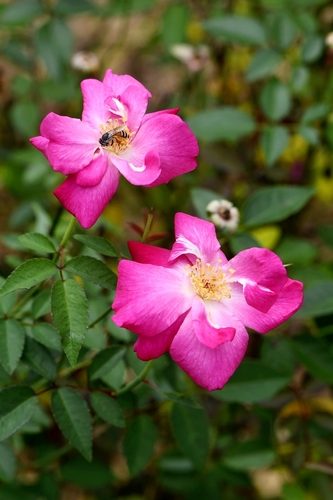
The China rose (Rosa chinensis Jacq.) is a deciduous shrub in the rose family, Rosaceae, native to China and central to the history of garden roses. Horticultural forms from this lineage gave European roses repeat flowering and brighter colors, and shaped the tea roses, hybrid teas and many modern roses.
Read moreChinese rose, Bengal rose, Monthly rose and Yue ji hua
Place in full sun, with intense direct light all day long.
Global distribution
POWO accepts Rosa chinensis Jacq. and places its native range in China, with Shaanxi, Sichuan, Hubei and Guizhou named in its summary. The horticultural range is far wider: the China rose is grown, and sometimes introduced, across many temperate and subtropical regions.
- Native4
- Introduced4
- Shaanxi
- Sichuan
- Hubei
- Guizhou
- Korea
- India
- Italy
- Australia
Hexagons: sourced regions. Green dots: native range. Statuses according to POWO (Kew).
Identity
The China rose is Rosa chinensis Jacq., a species accepted by POWO in the rose family, Rosaceae. POWO gives it a Chinese native range, including Shaanxi, Sichuan, Hubei and Guizhou, and assigns it to the temperate biome. 1
IPNI anchors the name to Jacquin's publication in Observationum Botanicarum in 1768. GBIF keeps the same binomial and lists many common names, among them China rose, Chinese rose, Bengal rose and the French rosier de Chine. 2 3
Part of the confusion is that Rosa chinensis is more than a botanical species in the taxonomic databases. In horticulture, "China rose" also covers a set of old forms, cultivars and lineages that traveled from Chinese gardens into European collections. Two levels therefore stay separate: the species Rosa chinensis and the horticultural China roses. 4 5
Recognition
According to the RHS, Rosa chinensis is an ancestor of most modern hybrid roses, with variable growth of about 1.2–1.8 m (4–6 ft), sturdy branches, glossy green leaves of 3–5 leaflets, and single crimson or pink flowers, sometimes white, about 5 cm (2 in) across. The RHS entry also gives a possible ultimate height of 1.5–2.5 m (5–8 ft) and a spread of 1–1.5 m (3–5 ft). 4
NC State paints a similar but larger picture for plants grown in a favorable climate: a rounded deciduous shrub of medium growth rate, often around 1.8–2.4 m (6–8 ft) tall and wide. It stresses the purplish red young stems, which age to green and then brown, and the prickles. 6
Leaves are compound, alternate, toothed and glossy. Young leaflets can be flushed red or purple before turning dark green above and paler beneath. That detail helps separate some China roses from old European roses with duller foliage. 6
Flowers vary a great deal from clone to clone: single with five petals, semi-double or double, lightly scented, borne alone or in small clusters. NC State gives a color range from white through pink, red and purple, with cream or yellow in some horticultural forms. 6 4
Taxonomy, cultivars and repeat bloom
POWO treats Rosa chinensis Jacq. as an accepted species, while GBIF lists many synonyms and infraspecific names tied to horticultural use, including Rosa bengalensis, Rosa indica, Rosa chinensis f. mutabilis, f. spontanea, f. viridiflora, var. minima and var. semperflorens. This synonymy explains why a collection plant may carry different labels depending on the era or the nursery. 1 3
Among the common names, the RHS gives monthly rose, and it lists Rosa indica W.T. Aiton as a horticultural synonym. Monthly rose should not be read as a promise of flowers every month: it refers to the ability of some Chinese lineages to rebloom in flushes through the mild season. 4
Historically, the species matters enormously. The RHS presents Rosa chinensis as an ancestor of most modern hybrid roses. Illinois Extension explains that China roses were already prized in China before reaching Western gardens, and were then sought for two traits: recurrent flowering and a clear crimson red that was new to European crosses. 4 5
The cultivar 'Old Blush' is often used as a teaching reference: Illinois Extension describes it as an old China rose linked to the history of repeat bloom. 'Semperflorens' also appears in NC State's entry, while 'Mutabilis', 'Viridiflora' and the miniature forms are horticultural labels to check plant by plant. 5 6 3
Habitat and range
Botanically, Rosa chinensis is a Chinese species of temperate climates. POWO gives its native range as north-central and south-central China, with a more detailed list of provinces in its summary, followed by many regions of introduction. 1
Its horticultural spread reaches far beyond the native range. POWO records introductions in Asia, Europe, Australia, the Americas and tropical or subtropical islands. GBIF, for its part, holds common names in several languages, a reflection of how widely the China rose is grown worldwide. 1 3
NC State sums up the horticultural origin as South-Central China and the distribution as worldwide in temperate zones. In the garden, then, the plant is best understood not as a local wild shrub but as a collection rose, a bed rose or a cultivated hedge. 6
No invasive status is recorded for Rosa chinensis in France; elsewhere, local guidance is the reference. The practical caution is to check the label and the rootstock: many roses sold as China roses are grafted, and suckers may belong to the rootstock rather than to the cultivar you bought. 7
Growing and siting
For Rosa chinensis, the RHS recommends fertile, humus-rich soil that is moist but well drained, in full sun. Several textures suit it, chalk, clay, loam or sand, as long as moisture stays under control and water does not stand. 4
The general RHS rose guide sets out the practical rules: plant in a sunny spot, leave space around the bush, water at the base, keep foliage dry and feed these hungry plants with organic mulch and measured applications. These points matter especially for Rosa chinensis, which is prone to leaf diseases where air does not move. 7
NC State lists full sun to light partial shade, soil rich in organic matter, a pH of about 6.0 to 8.0, good to moist drainage, and hardiness in USDA zones 6a to 9b, which roughly means winter lows down to about −23 °C (−10 °F). The same source rates it as a plant for patios, slopes, borders, butterfly gardens and hedges. 6
Flowering is best in full sun. Light afternoon shade can help in very hot climates, but deep shade gives long stems, fewer buds and leaves that dry slowly after rain. 4 7
Pruning, propagation and training
The RHS groups Rosa chinensis with the shrub roses and refers to shrub-rose pruning. In practice, keep a light hand: remove dead wood, diseased wood, crossing shoots and an overcrowded center, rather than cutting hard as you would a low modern rose. 4 8
Deadheading also steers repeat bloom. The RHS notes that removing spent flowers encourages new ones on many roses, while leaving some flowers in place lets hips form. For Rosa chinensis, decide by goal: a longer flowering season, or ornamental fruit and food for birds. 7 6
Several propagation methods are given by the RHS: softwood cuttings in spring, hardwood cuttings in late summer or fall, chip budding in summer and seed for species roses, with stratification and sometimes slow germination. NC State simply lists grafting and stem cuttings. 4 6
One point matters for cultivars: seed does not reproduce a horticultural selection true to type. To keep 'Old Blush', 'Mutabilis', 'Semperflorens' or a miniature form, rely on cuttings, grafting or a reliable grower. 5 7
Flowering, fruit and uses
The RHS describes continuous flowering from June to September for Rosa chinensis (in the Northern Hemisphere), with red, pink or white flowers followed by scarlet hips. NC State adds that the flowers may be carried in clusters of four or five and stay under about 5 cm (2 in) in its description, giving a light effect rather than a single large modern bloom. 4 6
Beyond its looks, the China rose carries real horticultural weight. China roses transformed garden-rose breeding by bringing repeat flowering into crosses with European lineages. Illinois Extension places the Chinas, Teas and Noisettes among the repeat-blooming old roses suited to warmer zones than many old European roses. 5
In the garden, the flowers work in beds, rose gardens, low hedges, pollinator plantings and for light cutting. NC State mentions bees and butterflies on the flowers and birds on the fruit. The RHS also marks the plant as good for pollinators. 6 4
The hips should be treated as ornamental here. The RHS states explicitly that the fruit of Rosa chinensis is ornamental and not intended to be eaten. Even though the hips of several roses have uses elsewhere, an identification guide for an ornamental should not turn a treated or misidentified rose into a food plant. 4
Toxicity, prickles and treatments
The ASPCA lists Rose, scientific name Rosa species, as non-toxic to dogs, cats and horses and identifies no toxic principle. The plant is therefore presented as non-toxic to pets, within the scope of true roses in the genus Rosa. 9
Caution still applies. Prickles easily injure skin, muzzles or paw pads, and eating a large amount of plant material can cause mechanical digestive discomfort. With children, the prickles, the hairs inside the hips and the risk of garden treatments also need to be considered. 9 4
Mix-ups between common names are the biggest risk. "China rose" is sometimes used in the trade for plants that are not Rosa at all, such as hibiscus or houseplants. For pet safety, check the botanical binomial: Rosa chinensis is not the same as a plant that merely has "rose" in its common name. 3 9
A non-toxic rose can still become a problem once it has received pesticides, fertilizers, fungicides or cut-flower preservatives. The sensible household advice is simple: keep pets away from treatment products, vase water and freshly pruned stems. 7 9
Diseases and monitoring
NC State warns that Rosa chinensis can suffer from black spot, powdery mildew, rust and rose rosette, and can be attacked by aphids, Japanese beetles, borers, scale, thrips, gall midges, leafhoppers and mites. The RHS also lists aphids, leafhoppers, mites, scale, caterpillars, sawflies, deer and rabbits. 6 4
Black spot is presented by Clemson as a major rose disease, favored by long, warm, wet spells. The first line of defense is cultural: less susceptible varieties, sanitation, removal of infected leaves, dry foliage, full sun and spacing for airflow. 10
Powdery mildew tends to show on young leaves, shoots and buds as a white felt, especially when temperatures are mild and nights humid. Rust causes orange spots on leaves and stems. Both call for the same groundwork: a vigorous rose, an open center, watering at the base and clearing diseased debris. 10
Keep an eye on rootstock suckers as well. On a grafted rose, a very vigorous shoot below the graft union may not be Rosa chinensis. Left in place, it can overwhelm the variety you bought and completely change the look of the bush. 7
Look-alikes and buying
As a name, China rose can be too vague to buy a plant by. Ask for the full label: Rosa chinensis, China rose, horticultural group, any form, then cultivar. The difference between a species, a botanical form and an old cultivar changes size, color, hardiness and repeat bloom. 3 4
'Old Blush' works as a historical reference but does not sum up all of Rosa chinensis. 'Semperflorens' marks a repeat-blooming lineage, 'Mutabilis' a form with shifting colors, 'Viridiflora' a green curiosity linked to phyllody, and miniatures may be sold under horticultural names far removed from the wild species. 5 6 3
In a cold garden, do not choose it the way you would a very hardy Alba or rugosa. The RHS rates Rosa chinensis H5, and NC State places it mainly in USDA zones 6–9. Where winters are colder than that, it will need a warm wall, very free-draining soil, protection around the base, or a hardier rose instead. 4 6
For a collection garden, it earns its place easily: a lighter habit than many modern roses, flowering in flushes, a story tied to repeat bloom and a direct link to the great hybrid rose lineages. In a garden run without sprays, picking a clone known to stay healthy locally and accepting a few spotted leaves is often more realistic than aiming for perfect foliage all season. 7 10
Main sources
The botanical framework comes from POWO/Kew, IPNI and GBIF for the accepted name, Jacquin's publication, the synonymy and the distribution. 1 2 3
Dimensions, species-specific growing needs, colors, flowering, hardiness and horticultural risks for Rosa chinensis draw on the RHS and NC State Extension. 4 6
The role of China roses in the history of repeat bloom and modern roses is cross-checked against the RHS and University of Illinois Extension. 4 5
Care, pruning and growing problems follow the RHS rose guides and the Clemson guide to rose diseases. 7 8 10
Pet safety follows the ASPCA entry for Rosa species, listed as non-toxic to dogs, cats and horses, with added caution for prickles, treatments and unusual ingestion. 9
Frequently asked questions
Is Rosa chinensis a species or a group of cultivars?
Rosa chinensis Jacq. is a species accepted by POWO. In gardens, the name is also used for China roses, meaning the horticultural forms and cultivars descended from this lineage. Read the full label: species, form, horticultural group and cultivar.
Why does the China rose matter for modern roses?
China roses brought repeat flowering and clearer reds into European breeding. The RHS describes the species as an ancestor of most modern hybrids, and Illinois Extension names the Chinas as a major source of repeat bloom.
Does it always repeat bloom?
Not always to the same degree. Many cultivated forms rebloom in flushes, especially in mild climates, but vigor, age, pruning, water and cultivar all change the result considerably.
Can it be grown in a container?
Yes for a young plant or a compact form, in a large, deep, well-drained pot. A mature China rose, however, soon becomes an outdoor shrub that needs sun, air and root room.
When should Rosa chinensis be pruned?
The safe approach is a light pruning in late winter or early spring, then deadheading through the season to encourage new flushes. Avoid repeated hard pruning on an old rose.
Is Rosa chinensis toxic to cats, dogs or horses?
The ASPCA lists Rose, Rosa species, as non-toxic to cats, dogs and horses. The concern lies with prickles, pesticides, fertilizers, vase water and excessive ingestion, not with any specific poison in true roses.
Are the hips edible?
Eating them is not recommended. The RHS lists the fruit of Rosa chinensis as ornamental and not intended to be eaten; garden treatments, correct identification and the irritating hairs inside rose hips also need to be taken into account.
Similar plants




Botanical data compiled from reference sources (RHS, Kew Gardens, POWO). This profile is for guidance only and is not a substitute for advice from a botanist or veterinarian if you have concerns about toxicity.