
Damask rose (Rosa × damascena, )


Damask rose (Rosa × damascena) is an old hybrid rose in the Rosaceae family, known for its strongly fragrant pink flowers. POWO treats it as an artificial hybrid of Rosa gallica and Rosa moschata. In gardens, Damask roses are deciduous, prickly shrubs grown mainly for summer flowers, rose water, rose oil and old rose collections.
Read moreDamask rose, Summer damask rose, Bulgarian rose and Turkish rose
Place in full sun, with intense direct light all day long.
Full sun; light partial shade tolerated, with fewer flowers


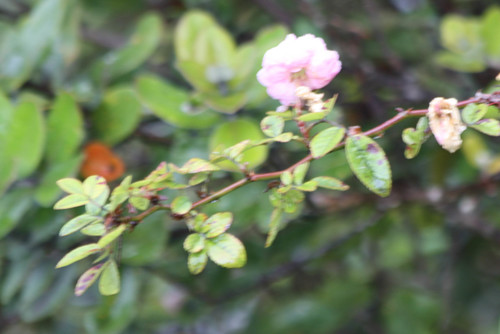
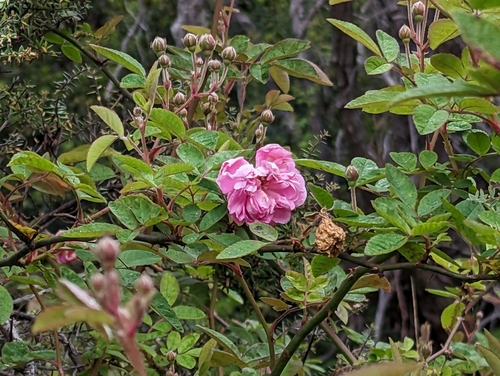
© photo
Wikimedia Commons · CC BY-SA or Public Domain
no rights reserved · cc0
(c) David Anderson, some rights reserved (CC BY) · cc-by
Global distribution
Damask rose is treated as an old horticultural hybrid not known in the wild. The listed regions represent cultivation centers, collections or perfume uses, rather than a simple native range.
- Cultivated8
- Bulgaria
- Türkiye
- Iran
- Syria
- France
- Morocco
- Saudi Arabia
- Bolivia
Hexagons: regions where the plant occurs. Green dots: native range.1
Identity
Damask rose (Rosa × damascena Herrm., 1762) is an old rose in the genus Rosa, family Rosaceae. The × sign is central to its name: it denotes a hybrid rather than a straightforward wild species. POWO treats Rosa × damascena Herrm. as an artificial hybrid and gives the parentage Rosa gallica × Rosa moschata. 1
This botanical interpretation coexists with established horticultural usage. WFO also uses Rosa × damascena Herrm., whereas GBIF and several regulatory sources retain Rosa ×damascena Mill., published in Miller's Gardeners Dictionary in 1768. The differing authorities do not alter the main identification: a strongly fragrant old hybrid rose at the heart of the Damask groups. 2 3
English names include summer damask rose, alongside Damask rose. NC State places 'Kazanlik' among the Damask roses, with names including Kazanlik rose, Summer Damask and Trigintipetala damask rose. French names such as rose de Damas refer to the same historical perfume rose. 7
Recognition
RHS characterizes Rosa × damascena as a vigorous rose about 2 m (6.5 ft) tall, with arching, prickly stems, dark green leaves and clusters of very fragrant, semi-double pink flowers about 8 cm (3 in) across. Its outline is that of a large deciduous shrub rather than a low border rose. 4
Final size depends on the clone and training. RHS gives a mature height and spread of 1.5 to 2.5 m (5 to 8 ft); NC State gives 'Kazanlik' roughly 1.5 to 2.4 m (5 to 8 ft) tall and 1.2 to 1.8 m (4 to 6 ft) wide, a comparable scale for an established plant. 4 7
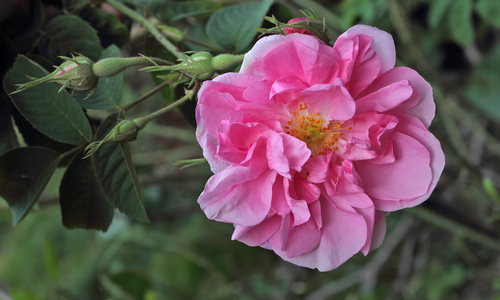
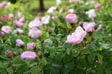
Pink, intensely fragrant flowers are the clearest visual signal. They are often flat, semi-double or double and usually clustered. NC State describes 'Kazanlik' flowers as 5 to 8 cm (2 to 3 in) across, with 16 to 25 petals and a strong Damask fragrance. Red hips follow if not all spent flowers are removed. 7
Taxonomy and parentage
For parentage, POWO treats Rosa × damascena Herrm. as an artificial hybrid of Rosa gallica and Rosa moschata. It also lists many historical synonyms, including names associated with Rosa × bifera, Rosa × calendarum, Rosa × portlandia, Rosa gallica var. damascena and Rosa × damascena f. trigintipetala. 1
Historical synonymy helps explain confusing labels in rose collections. A plant sold as Damask, Kazanlik, Trigintipetala, Autumn Damask or Quatre Saisons may belong to the same historical complex without sharing the same flowering rhythm or pruning needs. WFO includes forms such as trigintipetala and versicolor. 2
Trees and Shrubs Online provides a useful qualification: Damask rose is not known in the wild and appears to be a more or less fixed hybrid, close to Rosa gallica, with Rosa moschata as the other probable parent in the modern interpretation. It therefore has no simple native range. 8
Origins, Damascus and perfume crops
Damascus belongs to the rose's cultural history, but the name alone does not prove a wild botanical origin in Syria. Trees and Shrubs Online recounts how old names circulated through British, Mediterranean and apothecary traditions, sometimes with conflicting uses of damascena. 8
The EMA describes Rosa damascena Mill. as an upright shrub 1 to 2 m (3 to 6.5 ft) tall, with large, colorful flowers, now widely cultivated for beauty and fragrance, including around Kashan in Iran. This regulatory source focuses on plant material, but confirms its importance as a cultivated rose rather than an easily mapped wild taxon. 9
Commercial cultivation extends well beyond the places suggested by the name. NC State records 'Kazanlik' in Bolivia, grown for rose water and rose oil used in perfumery. Horticultural origin, industrial cultivation and botanical distribution therefore need to be distinguished. 7
Growing conditions and position
Growing Damask rose follows the broad requirements of shrub roses: sun, rich soil, steady moisture and drainage. RHS recommends a sunny site for roses, ideally with at least 4 hours of direct sunlight, and rich, moist but well-drained soil. 5
For Rosa × damascena, RHS allows full sun or partial shade, a sheltered position, and chalk, clay, loam or sand provided the soil stays moist but well drained. Suitable garden settings include a bright bed, an airy informal hedge or a very deep container without standing water around the roots. 4
Direct irrigation toward the soil. RHS advises watering around the base rather than wetting flowers and foliage, to reduce fungal disease and use water efficiently. For fragrant Damask roses, this also helps protect buds and petals, which mark readily in persistent rain or stagnant air. 5 12
Pruning and training
Pruning depends on which Damask you grow. RHS describes the group as loosely growing, prickly shrubs with very fragrant semi-double or double flowers, mainly in summer and sometimes with a light repeat in autumn. 4
Once-flowering shrub roses need light pruning after flowering, according to RHS: remove dead or diseased wood, crossing branches and excess old wood in the center. Its guidance applies to Alba, Centifolia, Damask, Gallica, Musk, Moss, Scots and Sweet Briar roses. 6
Hard late-winter pruning of a Summer Damask can remove wood that would carry flowers. Repeat-flowering Autumn Damask roses can be pruned more like other repeat-flowering shrub roses, with more structured work in late winter. Both need an airy framework and a balance of old canes and vigorous young shoots. 6 7
Fragrance, rose water and essential oil
Few roses are as closely associated with perfume raw materials as Damask rose. Britannica defines attar of roses as an essential oil distilled from fresh petals of Rosa damascena, Rosa gallica and other Rosaceae, and identifies rose water as a by-product of distillation. 10
Dried petals of Rosa gallica, Rosa centifolia or Rosa damascena fall under the EMA's rose flower material description. Their significance here is botanical and historical: fragrant flowers, floral water, oil or absolute, depending on the production process. This does not establish a therapeutic use or a home preparation method. 9
Scent alone cannot identify the plant. Rosa × centifolia, Rosa gallica, some Alba roses and many modern hybrids can also smell strongly of roses. A reliable purchase needs a complete label, ideally with group and cultivar, such as Rosa × damascena 'Kazanlik', rather than simply “fragrant rose.” 4 7
Toxicity, prickles and safety
ASPCA lists Rose, Rosa species as non-toxic to dogs, cats and horses, with no toxic principle identified. Damask rose accordingly falls within the non-toxic true roses for these animals. 11
Non-toxicity does not remove practical hazards. Prickles can injure skin, paws or mouths, and heavy ingestion can upset digestion. Fertilizers, treatments, contaminated mulch, vase water and concentrated fragrance products pose separate risks. RHS also describes the ornamental fruits of Rosa × damascena as unsuitable for eating and recommends protective clothing when handling the plant. 4
True roses must be distinguished from unrelated plants sharing the word “rose.” ASPCA's entry covers Rosa species, not every plant called a rose in English or French. Christmas rose, desert rose, rose of Sharon and hollyhock belong to other genera and require separate identification. 11
Diseases and monitoring
Potential pests listed by RHS for Rosa × damascena include aphids, leafhoppers, mites, scale insects, caterpillars, sawflies, deer and rabbits. Listed diseases include black spot, rust, replant disease, dieback, powdery mildew, flower balling and sometimes honey fungus. 4
Black spot is a major rose disease. Clemson describes it as common and serious, favored by prolonged warm, wet weather, with circular black marks, yellowing and leaf drop. University of Illinois notes that the fungus overwinters on canes and fallen leaves, then reaches new foliage in splashing water. 12 13
Basic disease management converges across the sources: provide air movement and sun, avoid overhead watering, collect affected leaves, remove diseased wood and space plants adequately. Clemson adds that botrytis often attacks flowers and buds, producing gray-brown mold, spots and buds that fail to open in wet conditions. Double, fragrant flowers particularly benefit from these precautions. 12
Look-alikes, groups and buying plants
Damask rose is easily confused with cabbage rose, the French rose de Mai. Both are fragrant old roses used in perfumery, but Rosa × damascena is distinct from Rosa × centifolia. Strong scent, pink flowers and a romantic trade name cannot resolve the identification. 1 10
Precision also matters with Kazanlik and Trigintipetala. NC State treats 'Kazanlik' as a Summer Damask previously called Rosa damascena 'Trigintipetala', while POWO includes trigintipetala forms in the taxon's synonymy. These are horticultural references rather than automatic proof of a local origin or distillation quality. 7 1
A useful nursery label gives at least Rosa × damascena and preferably its cultivar or form. This determines pruning, repeat flowering, space requirements and disease expectations. It also helps distinguish the taxon from the Damask group, Portland roses, Autumn Damasks and fragrant modern hybrids. 6 8
Main sources
- Plants of the World Online / Kew, Rosa × damascena Herrm.
- World Flora Online, Rosa × damascena Herrm.
- GBIF Backbone Taxonomy, Rosa ×damascena Mill.
- Royal Horticultural Society, Rosa × damascena
- Royal Horticultural Society, How to grow roses
- Royal Horticultural Society, Rose pruning: shrub roses
- NC State Extension Gardener Plant Toolbox, Rosa x damascena 'Kazanlik'
- Trees and Shrubs Online, Rosa damascena
- European Medicines Agency, assessment report on Rosa gallica, Rosa centifolia, Rosa damascena flos
- Encyclopaedia Britannica, attar of roses
- ASPCA, Rose toxicity entry
- Clemson Cooperative Extension HGIC, Rose Diseases
- University of Illinois Extension, Black Spot
Frequently asked questions
Is Rosa × damascena a wild species?
Not in practical terms. POWO treats it as an artificial hybrid of Rosa gallica and Rosa moschata, and Trees and Shrubs Online states that Damask rose is not known in the wild.
Why do some sources use Rosa damascena Mill.?
Authorities differ in usage: POWO and WFO accept Rosa × damascena Herrm., while GBIF and several regulatory or horticultural sources still use Rosa ×damascena Mill. The × sign is essential to explaining this variation.
Is Damask rose the same as cabbage rose?
No. These are two different fragrant old roses. Cabbage rose, also called rose de Mai in French, is Rosa × centifolia; Damask rose is Rosa × damascena.
Does Damask rose bloom again?
Many Summer Damask roses have one main flush in late spring or summer. Autumn Damask roses, associated with bifera or Quatre Saisons, may flower again later, but continuous modern-rose flowering should not be expected.
When should I prune a Damask rose?
For a once-flowering form, light pruning after flowering is the cautious approach. For a repeat-flowering form, more structured late-winter pruning may be added while maintaining a balanced framework.
Is Damask rose toxic to cats, dogs or horses?
ASPCA lists Rosa species as non-toxic to dogs, cats and horses. The main concerns are prickles, treatments, vase water and unusual ingestion, rather than a poison specific to true roses.
Can I make rose water from a garden rose?
Rose water is described here as a plant product, without preparation instructions. Quality floral waters, oils and absolutes come from an identified supply chain with controlled raw materials free of garden treatments.
Can Damask rose grow in a pot?
Yes, for a young plant or a very sunny terrace, using a large, deep, well-drained container. In the ground, the rose develops its framework and fragrance more fully.
Similar plants
If you are unsure about a plant’s toxicity, ask a botanist or veterinarian for advice.