
White rose of York (Rosa × alba, )


White rose of York (Rosa × alba L.) is an old European shrub rose in the Rosaceae family, treated by POWO as an accepted hybrid of R. corymbifera and R. gallica. In gardens it belongs to the vocabulary of Alba roses: large, very hardy deciduous shrubs with blue-green foliage and fragrant summer flowers, often in a single flush.
Read moreWhite rose of York, Alba rose, White rose, Great Double White and Jacobite rose


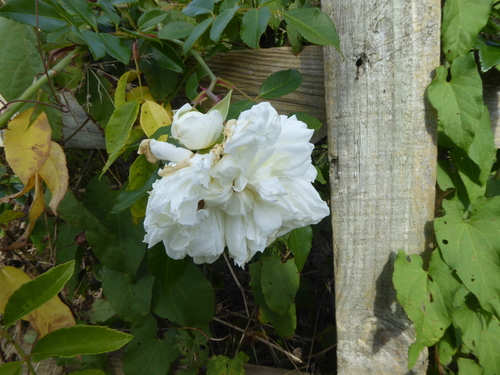
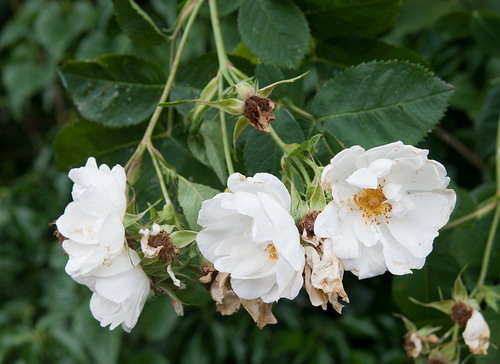
© photo
Wikimedia Commons · CC BY-SA or Public Domain
(c) jamie-aa, some rights reserved (CC BY) · cc-by
Global distribution
POWO accepts Rosa × alba as a European hybrid with the formula R. corymbifera × R. gallica. It lists France, Hungary, Spain and Switzerland in the native range, followed by several introduced territories. In gardens the plant mainly circulates as the Alba horticultural group and old cultivars.
- Native4
- Introduced4
- France
- Hungary
- Spain
- Switzerland
- Great Britain
- Bulgaria
- Romania
- United States
Hexagons: regions where the plant occurs. Green dots: native range.1
Identity
White rose of York (Rosa × alba L., 1753) is a hybrid shrub rose in the Rosaceae family. POWO accepts the hybrid and gives its parentage as R. corymbifera × R. gallica. Linnaeus published it in Species Plantarum in 1753. 1 2
The multiplication sign × identifies a hybrid rather than a simple species. That distinction matters because old roses combine hybrid taxa, horticultural groups, historical synonyms and named cultivars. These labels describe different aspects of a plant's identity.
English gardeners know the name White rose of York, but it does not identify every Alba rose. It mainly refers to historical white forms, especially 'Alba Maxima', whereas the Alba group also includes cream, pale pink and more distinctly pink roses. 4 8
Recognition
Alba roses typically grow as large deciduous shrubs. RHS describes 'Alba Maxima' as reaching about 2 m (6.5 ft), with prickly canes, pale blue-green foliage and very fragrant double flowers. The flowers are white to creamy white, sometimes with a slight pink tinge. 4
Compound, alternate leaves have toothed leaflets and often a duller, bluer surface than the glossy foliage of modern roses. Strong canes arch or form a bush, with prickle density varying between cultivars. Prickles alone therefore cannot establish the plant's identity.
Summer usually brings one main flush of fragrant flowers in clusters. They may be single, semi-double or very double. RHS gives 'Alba Maxima' flowers a width of about 10 cm (4 in) when open. Oval red rose hips may follow if some spent flowers remain. 4
Taxonomy, hybrid origin and the Alba group
For botanical identification, Rosa × alba L. provides a consistent reference. POWO accepts the hybrid, IPNI records its Linnaean publication and GBIF also lists the taxon with synonyms and vernacular names, including White Rose of York and the French Rosier blanc. 1 2 3
Parentage deserves precise wording: POWO explicitly gives R. corymbifera × R. gallica. Horticultural accounts sometimes describe a cross between Rosa gallica and a relative of Rosa canina. That agrees with the broader Canina relationship but is less precise than POWO's formula. 1 10 9
The Alba group also needs to be distinguished from the taxon. RHS describes Alba roses as large, very hardy shrubs with few to moderate prickles, gray-green leaves and clusters of fragrant double or semi-double flowers in midsummer. This horticultural definition helps gardeners without replacing botanical nomenclature. 4
Habitat and range
Europe is the native range POWO gives for this hybrid, including France, Hungary, Spain and Switzerland. Great Britain appears as an introduced territory. The historical associations of White rose of York therefore do not establish its botanical native range. 1
Garden-grown Rosa × alba is best understood as an old rose for temperate climates. Horticultural sources emphasize its hardiness, long life, relative tolerance of light shade and suitability for the back of a border, an informal hedge or a historical rose collection. 8 5
No invasive status is recorded for this rose in France. Identification is the more practical concern: a plant sold simply as a white rose could be Rosa × alba, another white garden rose, a modern hybrid or even a white form of Rosa rugosa.
Growing and pruning
Rich, moist but well-drained soil and sunshine suit garden roses. RHS generally recommends at least 4 hours of direct sun daily, soil that does not dry out completely in summer, organic mulch and watering at ground level rather than over the foliage. 5
Pruning an Alba like a modern repeat-flowering rose is a common mistake. RHS treats once-flowering Albas as shrub roses that bloom on established wood. Light pruning preserves their natural shape, with the main work done after flowering. 6
Remove dead, diseased or damaged wood, crossing branches and weak shoots. On an old shrub, take out one or two aged canes at the base. Cutting the entire framework back hard to restrict its size often spoils the arching shape and reduces the next flowering display. 6
Flowers, hips and uses
Ornamental appeal combines a substantial shrub, cool blue-green foliage, fragrant flowers, cut stems and a long place in old rose gardens. University of Illinois Extension includes Albas among old European roses noted for strong fragrance and considerable cold hardiness. 8
Double and very double flowers look impressive but are less accessible to insects than single flowers. For additional wildlife value, leave some spent flowers to form hips and combine the shrub with open-flowered plants rather than relying entirely on a densely petaled cultivar.
Treat the hips cautiously. RHS warns that the ornamental fruits of 'Alba Maxima' should not be eaten, so their presence is no recommendation for food use. Petals, floral waters and perfumery require separate consideration of cultivar identity, treatment history and suitable preparation. 4
Toxicity, prickles and safety
ASPCA lists Rosa species as non-toxic to dogs, cats and horses, with no toxic principle identified. This supports describing true roses as non-toxic to those animals, while keeping the limitation clear: a non-toxic garden plant is not automatically suitable food. 7
Practical hazards arise from physical injury and surrounding products. Prickles may injure paws, skin or mouths; large quantities of leaves or petals may upset digestion. Treatments, fertilizers, contaminated mulch and vase water pose separate risks from the rose itself.
Gloves and protective clothing are also recommended by RHS when handling 'Alba Maxima'. They are particularly useful with older plants, whose long arching canes can catch arms, faces, clothing or animals passing through the hedge. 4
Cultivars, look-alikes and buying
'Alba Maxima' is especially associated with the name White rose of York. Monticello also calls it Jacobite rose and Great Double White, describing an old rose cultivated in Europe since at least the fifteenth century. 9
'Semiplena' often represents the more open-flowered forms. 'Maiden's Blush', 'Celeste', 'Felicite Parmentier' and 'Konigin von Danemark' show that Alba roses are not all white. The name describes a historical group dominated by pale colors, rather than promising pure white flowers in every cultivar. 10 8
When buying, look for a label that gives genus, group and cultivar, such as Rosa × alba 'Alba Maxima'. An old white rose could instead be a Bourbon, Damask, Rugosa, modern hybrid or florist's rose. Keep taxon, horticultural group, cultivar and historical name distinct.
Main sources
- Plants of the World Online / Kew, Rosa × alba L.
- International Plant Names Index, Rosa alba L.
- GBIF Backbone Taxonomy, Rosa ×alba L.
- Royal Horticultural Society, Rosa × alba 'Alba Maxima'
- Royal Horticultural Society, How to grow roses
- Royal Horticultural Society, Rose pruning: shrub roses
- ASPCA, Rose toxicity entry
- University of Illinois Extension, Roses Types
- Thomas Jefferson's Monticello, White Rose
- Historic Roses Group, Albas
Frequently asked questions
Is Rosa × alba a species or a cultivar?
POWO accepts it as a hybrid taxon, rather than simply a cultivar. However, many plants sold under this name are cultivars of the Alba group, such as Alba Maxima or Semiplena.
Does White rose of York always mean Rosa × alba?
The name mainly refers to historical white forms, especially 'Alba Maxima'. Check the complete label for botanical clarity: Rosa × alba, Alba group, then cultivar.
Does this rose bloom again?
Most historical Albas bloom once in summer. Their flowers can be spectacular and very fragrant, but do not expect the repeated display of a modern repeat-flowering rose.
When should I prune Rosa × alba?
Prune a once-flowering form after flowering. Winter pruning mainly removes dead or diseased wood; severe spring pruning can remove the flowers.
Is Rosa × alba toxic to cats, dogs or horses?
ASPCA lists Rosa species as non-toxic to cats, dogs and horses. The main concerns are prickles, treatments, vase water, fertilizers and eating large amounts of plant material.
Can you eat the rose hips?
No food use is recommended here. RHS warns that the ornamental hips of Alba Maxima should not be eaten; identifying, preparing and using rose hips requires separate consideration.
Is it invasive in France?
No invasive status is recorded for France. POWO even lists France in the native range of this hybrid, but garden plants still need to be managed as horticultural cultivars.
Similar plants
If you are unsure about a plant’s toxicity, ask a botanist or veterinarian for advice.