
Cabbage rose (Rosa × centifolia, )


Cabbage rose (Rosa × centifolia) is a highly fragrant old garden rose in the Rosaceae family. POWO treats it as an artificial hybrid of Rosa canina, Rosa gallica and Rosa moschata. It has no simple wild native range: it is a cultivated rose grown for large, double, often pink flowers and their scent.
Read moreCabbage rose, Rose de Mai, Provence rose, Hundred-leaved rose, Holland rose and Old cabbage rose
Place in full sun, with intense direct light all day long.
Full sun with air circulating around the shrub


© photo
Wikimedia Commons · CC BY-SA or Public Domain
Global distribution
Rosa × centifolia is treated as an artificial horticultural hybrid with no strictly wild native range. The regions listed mainly describe cultivation, conservation or perfume use, rather than a natural distribution.
- Cultivated6
- France
- Pays de Grasse
- United Kingdom
- Netherlands
- Morocco
- North American botanical gardens
Hexagons: regions where the plant occurs. Green dots: native range.1
Identity
Cabbage rose (Rosa × centifolia L., 1753) is an old garden rose in the Rosaceae family. The × sign indicates a hybrid taxon. POWO classifies it as an artificial hybrid and gives the formula Rosa canina × Rosa gallica × Rosa moschata. 1
Cultivation, rather than a simple wild species identity, defines this rose, known for very double flowers and fragrance. Names such as Hundred-leaved rose, Provence rose and Old cabbage rose evoke a full, round flower with many petals. RHS also lists Holland rose and the French rose des peintres among its common names or horticultural synonyms. 3
The epithet centifolia literally means hundred-leaved. In horticultural usage it describes numerous petals rather than an exact botanical count of leaves. This densely filled flower explains both its ornamental prestige and its vulnerability to rain once open.
Recognition
A deciduous shrub, Rosa × centifolia usually reaches about 1-1.5 m (3-5 ft) in ordinary cultivation, sometimes more when old and lightly pruned. PFAF gives a height of roughly 1.5 m (5 ft), while Chicago Botanic Garden describes an upright shrub for full sun. 7 6
Prickles cover the stems to varying degrees according to clone, wood age and management. Alternate leaves consist of green, toothed leaflets. These are typical Rosa features: NC State describes roses as often prickly-stemmed, with alternate toothed leaves, frequently fragrant flowers and fruits called hips. 8
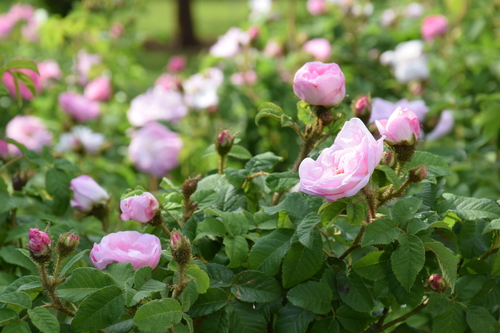
Rounded, very double flowers provide the clearest visual clue. They are often pink, with paler or deeper shades depending on the horticultural form. Chicago Botanic Garden records pink flowers in late spring and early summer in its Northern Hemisphere setting. Fragrance matters but cannot establish identity: Damask, Gallica and moss roses can also be strongly scented. 6 3
Useful taxonomy
Botanical references use Rosa × centifolia L. POWO dates its first publication by Linnaeus to 1753 and lists numerous historical synonyms, including Rosa gallica var. centifolia, Rosa × provincialis var. centifolia and several horticultural forms. This wealth of names explains differing labels in rose gardens, old catalogs and collections. 1 2
Names involving muscosa require care. POWO places several names associated with Rosa × muscosa or Rosa × centifolia var. muscosa in synonymy. Avoid automatically treating a moss rose as a separate species, or assuming every moss rose in a collection is exactly the same plant as the perfume rose known as Rose de Mai. 1
RHS uses Rosa × centifolia (Ce) with the status “Correct” and lists Rosa × centifolia 'Old Cabbage' as a synonym. The horticultural suffix and names in single quotation marks identify garden groups or cultivars; they do not establish a wild origin. 3
Origin and horticultural status
Horticultural hybrid is the most reliable description of Rosa × centifolia. PFAF says it is not known in a truly wild state and describes a garden hybrid of uncertain origin. POWO goes further by supplying the formula for the artificial cross. 7 1
That distinction matters when discussing range. Cabbage rose can be cultivated in France, the United Kingdom, North American botanical gardens, Morocco or old rose collections, but those plantings do not create a botanical native range. These occurrences are therefore described as cultivated.
French perfumery gives this plant a particularly strong cultural association. The Musées de Grasse report that centifolia roses are still grown around Grasse, although local production has fallen sharply since the industrial heyday of perfume. UNESCO documents the area's skills in growing perfume plants, understanding natural raw materials and processing them. 12 13
Growing and siting
Sunshine, rich soil, steady moisture and clear drainage are the broad requirements shared with other garden roses. RHS recommends a sunny site, ideally at least four hours of direct sun, and rich, moist but well-drained soil. PFAF also favors a sunny position and well-drained ground. 4 7
Direct irrigation toward the roots. RHS recommends watering the soil around the base without wetting flowers or foliage to reduce fungal disease and wasted water. For Cabbage rose this is especially useful: large double flowers retain moisture and may stain or rot during persistent rain. 4 9
In open ground, mature compost or a rose fertilizer in spring is often sufficient. The aim is to support flowering without producing masses of soft shoots. A container should be deep, heavy and well drained, with more frequent watering than a rose in the ground. Open-ground cultivation generally suits an old Centifolia rose best.
Pruning and training
Pruning Cabbage rose requires a different approach from a modern repeat-flowering rose. RHS places Centifolias among mainly once-flowering shrub roses and notes that old shrub roses generally flower on older wood. Hard pruning in late winter can therefore remove some of the coming flowers. 5
Keep pruning light: remove dead, diseased or damaged wood, take out crossing branches and open the center a little. On an aging shrub, remove one or two old canes near the base to encourage young growth, doing so gradually. RHS recommends balancing older wood with vigorous new shoots. 5
After flowering, deadheading improves appearance and reduces potential botrytis infection sites. Leave a few spent flowers if you want to observe hips, though many very double forms produce few or fruit irregularly. The choice depends on whether fragrance and a tidy border or the full cycle and fruits take priority.
Uses, fragrance and toxicity
Fragrant flowers drive the principal ornamental and perfume uses of Rosa × centifolia. They are valued for rose-garden bouquets and perfumery raw materials. PFAF describes essential oil obtained from the flowers and used in perfume, as well as dried petals for potpourri. The Musées de Grasse still associate centifolia roses with the region's perfume crops. 7 12
A scented garden rose does not by itself make perfume production a household process. Producing an absolute, concrete or high-quality perfume material requires specialized expertise. INRAE explains more broadly that rose scent contains many molecules and that its biosynthesis is studied through genetics and biochemistry. 14
Veterinary toxicity information is reassuring for true roses. ASPCA lists Rose, Rosa species as non-toxic to dogs, cats and horses. Practical concerns center on prickles, pesticide treatments, bouquet preservatives and the irritating hairs around hip seeds noted by PFAF. 11 7
Food and medicinal uses require a separate assessment from general growing advice. PFAF mentions flower and fruit uses, but also warns about irritating hairs around seeds and urges caution with medicinal applications. Eating a rose bought as an ornamental, treated with chemicals or poorly identified is therefore not recommended. 7
Diseases and monitoring
Old roses can still develop diseases. NC State lists botrytis, powdery mildew, leaf spots and various pests for Rosa. RHS also includes black spot, powdery mildew, rust, dieback and aphids among common shrub rose problems. 8 5
Black spot is a major concern in humid climates. University of Illinois Extension describes a disease that survives on canes and fallen leaves and spreads in splashing water, particularly when foliage remains wet in warm, humid conditions. Collect affected leaves, water at the base, space plants and ventilate the center. 10
Botrytis particularly affects buds and flowers during damp weather. Clemson describes gray-brown mold on infected flowers and buds, with buds drooping or failing to open. On a very double rose such as Cabbage rose, a few rainy days can therefore spoil an otherwise impressive display. 9
Look-alikes and related plants
Damask rose (Rosa × damascena) is an important source of confusion. Both are fragrant old roses associated with perfumery, but the names are not interchangeable. A label saying only fragrant old rose cannot establish the pruning approach, substantiate a use or identify the plant botanically.
Moss roses can also be closely related, since some historical moss rose names appear in Rosa × centifolia synonymy. Mossy growth on the calyx, flower stalks or buds is a horticultural clue, but it does not replace identification through a reliable rose collection or catalog. 1
Plants called roses do not all belong to Rosa. Christmas rose, hollyhock, rose of Sharon and desert rose belong to other genera and can have different toxicities. For pets, ASPCA's reassuring entry applies to Rosa species, not every plant with rose in its common name. 11
Main sources
- Plants of the World Online / Kew, Rosa × centifolia L.
- GBIF Backbone Taxonomy, Rosa ×centifolia L.
- Royal Horticultural Society, Rosa × centifolia
- Royal Horticultural Society, How to grow roses
- Royal Horticultural Society, Rose pruning: shrub roses
- Chicago Botanic Garden Plant Finder, Rosa x centifolia
- Plants For A Future, Rosa centifolia
- NC State Extension Gardener Plant Toolbox, Rosa
- Clemson Cooperative Extension HGIC, Rose Diseases
- University of Illinois Extension, Black Spot
- ASPCA, Rose toxicity entry
- Musées de Grasse, Conservatory of fragrant plants
- UNESCO, perfume-related skills in the Pays de Grasse
- INRAE, The scent of roses
Frequently asked questions
Is Rosa × centifolia a wild species?
Not in practical terms. POWO treats it as an artificial hybrid of Rosa canina, Rosa gallica and Rosa moschata. It is best described as an old horticultural rose rather than a wild species with a simple native range.
Why is Cabbage rose also called Rose de Mai?
The French name emphasizes spring flowering and harvesting. In French perfumery it also refers to the centifolia rose associated with the Pays de Grasse.
Is it the same as Damask rose?
No. Both are fragrant old roses associated with perfumery, but Rosa × centifolia and Rosa × damascena are different taxa.
Does Cabbage rose repeat-flower?
It is mainly treated as an old rose with a short principal flowering season in late spring or early summer. Do not expect the continuous repeat display of a modern floribunda or hybrid tea.
When should I prune Rosa × centifolia?
Prune lightly. For old shrub roses of the Centifolia group, the cautious approach is to remove dead wood and do most shaping after flowering if the outline needs correction.
Is Cabbage rose toxic to cats and dogs?
ASPCA lists Rose, Rosa species, as non-toxic to dogs, cats and horses. The main concerns are prickles, garden treatments and eating large amounts, rather than a specific poison in true roses.
Can you eat Cabbage rose petals?
Some horticultural sources mention uses for petals or hips, but eating an ornamental rose that has been treated, poorly identified or grown without food use in mind is not recommended.
Similar plants
If you are unsure about a plant’s toxicity, ask a botanist or veterinarian for advice.