
Poison sumac (Toxicodendron vernix, )
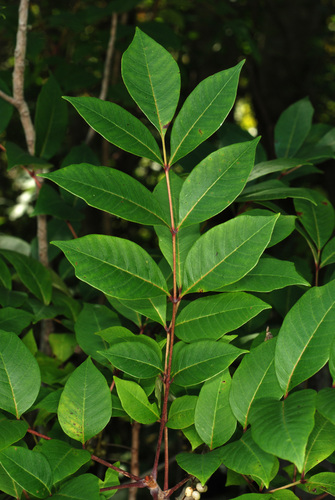
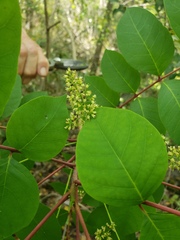
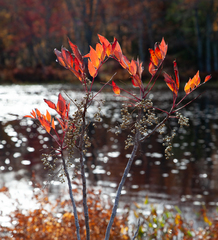
Poison sumac (Toxicodendron vernix) is a deciduous shrub or small tree in the Anacardiaceae family, confined to swamps and peat bogs in eastern North America. All parts contain urushiol, a contact allergen considered the most concentrated in the genus Toxicodendron. Its white to grayish-cream fruits, never red like those of ornamental sumacs, are a key identification feature.
Read morePoison sumac, Swamp sumac and Thunderwood
Allow a few hours of direct sun per day, preferably morning or evening.
Full sun to partial shade
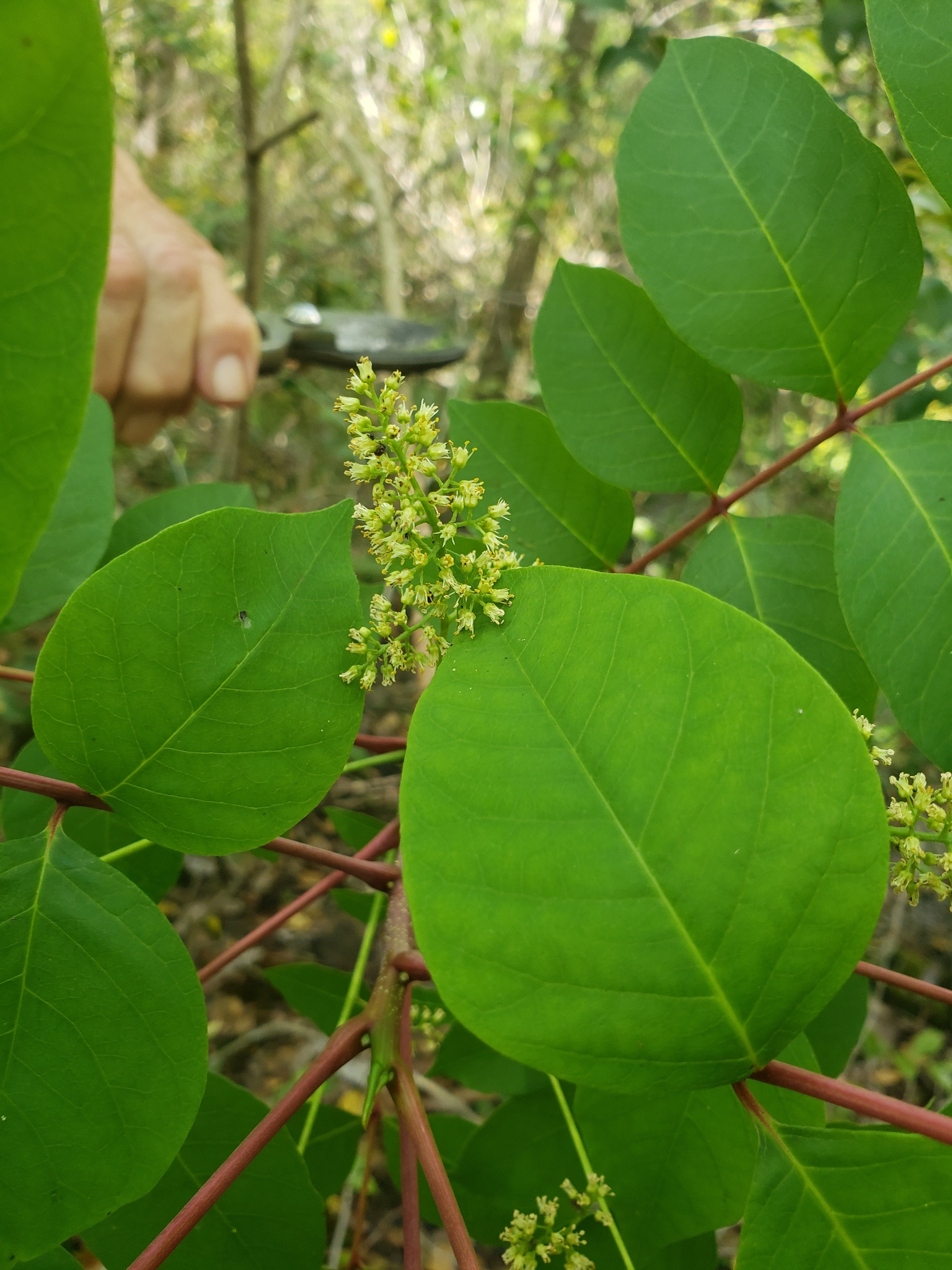

© photo
(c) Douglas Goldman, some rights reserved (CC BY-SA), uploaded by Douglas Goldman · cc-by-sa
Jody Shugart · cc0
iNaturalist User · cc-by-sa
© copyright of the Board of Trustees of the Royal Botanic Gardens, Kew.



Global distribution
Toxicodendron vernix is native to the eastern United States and extreme southeastern Canada, reaching southern Wisconsin at the western edge of its range. It is neither cultivated nor naturalized in France; its strict need for waterlogged soil makes it poorly suited to temperate European gardens.
Identity
Poison sumac (Toxicodendron vernix (L.) Kuntze, 1891), also called swamp sumac, is a deciduous shrub or small tree in the genus Toxicodendron, family Anacardiaceae. Linnaeus first described it as Rhus vernix in 1753; Otto Kuntze transferred it to Toxicodendron in 1891. 1 8
Greek toxikos (poison) and dendron (tree) form the genus name. The Latin epithet vernix means “varnish,” referring to the resin rather than a confirmed commercial use in North America. In the southern United States, another established name is thunderwood. 9 7
Contact with the urushiol of Toxicodendron vernix is thought to cause a stronger reaction than that of its two North American relatives, poison ivy (Toxicodendron radicans) and western poison oak (Toxicodendron diversilobum). 8
Recognition
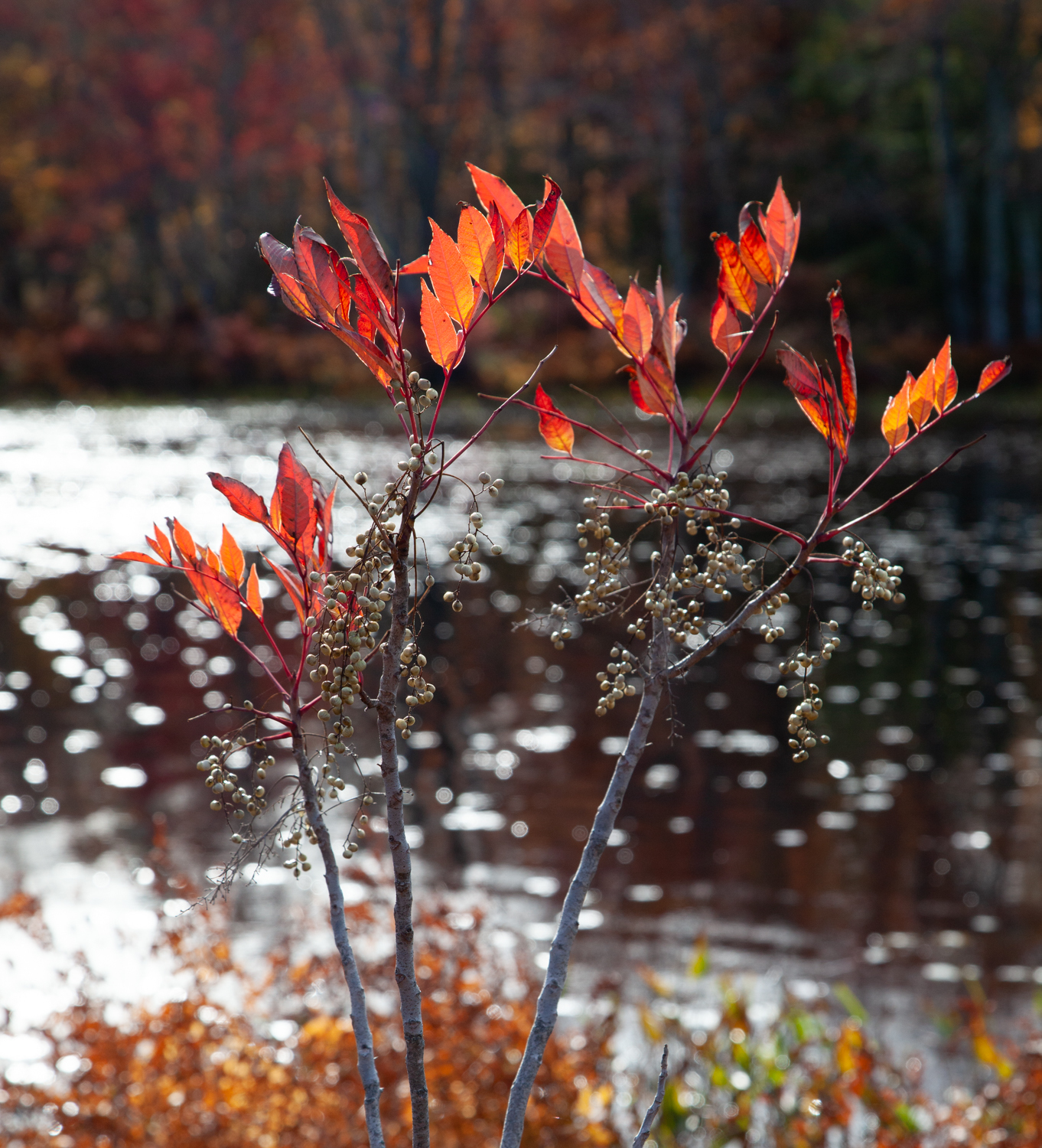
An upright habit distinguishes Toxicodendron vernix: it is a shrub or small tree usually 1–3 m (3–10 ft) tall, sometimes exceeding 9 m (30 ft) in favorable sites. Young bark is light gray and darkens with age. 2 7
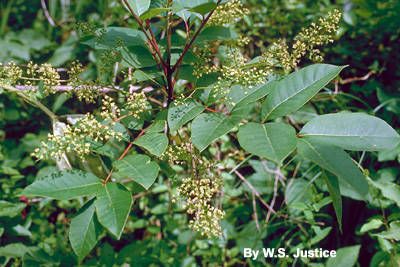
Each alternate, compound leaf carries 7–13 oval to oblong leaflets, 5–12 cm (2–5 in) long, with tapering tips and slightly wavy margins. Veins and leaf stalks often turn reddish, especially near the top of the plant. 7 8
Male and female flowers grow on separate plants: poison sumac is dioecious. Small greenish to whitish flowers, about 3 mm (0.12 in) across, open in early summer in loose axillary clusters 8–20 cm (3–8 in) long. The nearly spherical, slightly flattened drupes are white to grayish cream, 4–6 mm (0.16–0.24 in) across. Their pale color distinguishes them from ornamental Rhus sumacs, whose fruits remain bright red throughout ripening. 8 7
Useful taxonomy
Under POWO/WCVP, this species is accepted as Toxicodendron vernix (L.) Kuntze. Linnaeus published the basionym in Species Plantarum in 1753, more than a century before Kuntze’s 1891 transfer. Its botanical synonymy includes:
- Rhus vernix L. (botanical synonym)
- Rhus venenata DC. (botanical synonym)
- Rhus aequalis Pers. (botanical synonym)
Urushiol side-chain length differs among the three main North American Toxicodendron species: C13 in Toxicodendron vernix, C15 in Toxicodendron radicans and C17 in Toxicodendron diversilobum. The shorter chain may explain poison sumac’s particularly strong effect on contact. 1 7
Habitat and range
Eastern US wetlands and extreme southeastern Canada hold the native range of Toxicodendron vernix, extending west to southern Wisconsin. The IUCN lists it as Least Concern (LC), and NatureServe assigns a secure (G5) status. 5 9
Waterlogged clay or peaty soil is essential for poison sumac, which grows exclusively in swamps, peat bogs and flooded cypress swamps. Unlike the adaptable poison ivy, its strict habitat requirement gives it a much more localized distribution. 2 7
Neither cultivation nor naturalization is recorded for this species in France. Its need for waterlogged soil makes it poorly suited to temperate European gardens, and it offers no horticultural value that would justify planting it outside its natural habitat.
Life cycle and reproduction
Early to midsummer flowering occurs on separate male and female plants. White fruits ripen in late summer and remain through winter. 2
Birds appear unaffected by the urushiol in the fruits and leaves. Quail, pheasants, grouse and small mammals feed on the plant when other food is scarce, especially in winter, and disperse seeds after passage through their digestive tracts. 7
Basal suckers provide another means of vegetative spread. Shoots arise around the trunk or rootstock, often forming dense clonal colonies within a wetland. 2
Uses and risks
Every part of poison sumac contains urushiol, a resin that causes contact dermatitis in almost everyone exposed. Contact leads to redness, blisters and intense itching. Burning vaporizes urushiol into smoke, and inhalation can cause potentially fatal pulmonary edema. 7 8
For dogs, cats and horses, the ASPCA lists poison sumac as non-toxic. The contact dermatitis seen in humans is a reaction characteristic of primates. 4
Frederick Law Olmsted, later the designer of New York’s Central Park, reportedly encountered the plant as a teenager. In 1836 he is said to have accidentally rubbed poison sumac into his eyes, impairing his sight and limiting his schooling, which may have diverted him from a classical education. 7
Varieties, look-alikes and related plants
No horticultural cultivars are recorded for Toxicodendron vernix, unsurprisingly for a plant with no garden use. The main look-alikes are harmless ornamental Rhus species, including staghorn sumac (Rhus typhina) and tanner’s sumac (Rhus coriaria). 2
Fruit color offers a decisive distinction: white to grayish cream in Toxicodendron vernix, bright red in ornamental Rhus. Habitat then supports identification, since poison sumac is confined to wetlands while those Rhus species grow in ordinary dry soil. 9
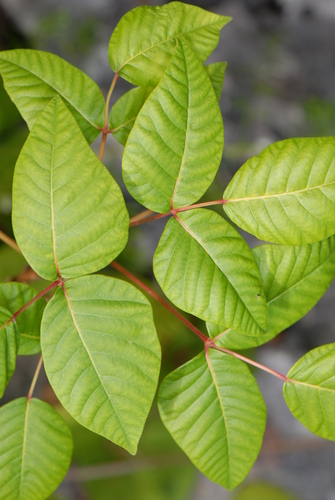
More widespread and adaptable, poison ivy (Toxicodendron radicans) can also be confused with its relative. Its leaves have just three leaflets, clearly different from poison sumac’s seven to thirteen. 1
Main sources
- Plants of the World Online / Kew, Toxicodendron vernix (L.) Kuntze
- North Carolina Extension Gardener Plant Toolbox, Toxicodendron vernix
- USDA PLANTS Database, Toxicodendron vernix plant profile (TOVE)
- ASPCA, Poison Sumac toxicity entry
- IUCN Red List, Toxicodendron vernix assessment
- Wikipedia (French), Toxicodendron vernix
- Wikipedia, Toxicodendron vernix
- Wikipedia (DE), Toxicodendron vernix
- Wikipedia (ES), Toxicodendron vernix
Frequently asked questions
Is poison sumac more dangerous than poison ivy?
Several botanists consider it so. Its urushiol has a shorter side chain, C13 rather than the C15 of poison ivy, which may explain its stronger effect on contact compared with its Toxicodendron relatives.
How can I identify poison sumac?
Look for white to grayish-cream fruits, never red, together with a habitat restricted to swamps and peat bogs that ornamental sumacs do not share.
Where does poison sumac grow?
Its native range is limited to the eastern United States and extreme southeastern Canada, exclusively in waterlogged clay or peaty soils, never ordinary well-drained ground.
Can poison sumac be confused with other sumacs?
Yes. Harmless ornamental Rhus species, such as staghorn sumac, have red fruits, unlike the white fruits of poison sumac.
Is poison sumac toxic to cats and dogs?
The ASPCA lists it as non-toxic to dogs, cats and horses. Urushiol contact dermatitis is a reaction characteristic of primates, including humans.
Can I burn poison sumac to remove it?
No. Burning vaporizes urushiol in the sap, and inhaling the smoke can cause severe respiratory distress.
Is poison sumac threatened?
No. The IUCN lists it as Least Concern and NatureServe considers it secure, despite its distribution being restricted to wetlands within its native range.
Similar plants
If you are unsure about a plant’s toxicity, ask a botanist or veterinarian for advice.