














01
Identifica o cerca
Amb una foto, o amb una cerca pel nom.

Enciclopèdia
Per a cada espècie, una fitxa completa: què necessita, d'on ve, per a què serveix, com reconèixer-la i si és perillosa per als teus animals.
4,8 a les botigues d'appsMés de 50.000 jardiners
Monstera deliciosa
Altres noms: Philodendron pertusum, Monstera borsigiana
 +15
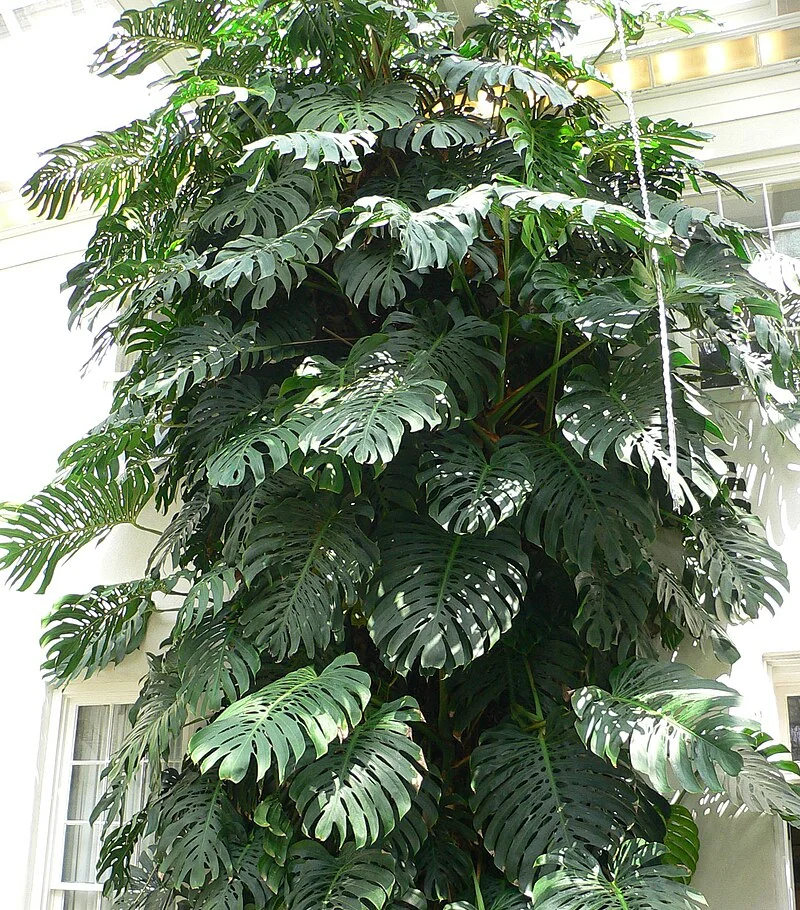
La Monstera deliciosa ve dels boscos humits del sud de Mèxic i de l'Amèrica Central. Les seves fulles grans s'esquincen i es foraden amb l'edat, i com més llum rep, més.
La Monstera deliciosa ve dels boscos humits del sud de Mèxic i de l'Amèrica Central. Les seves fulles grans s'esquincen i es foraden amb l'edat, i com més llum rep, més.
The specific epithet deliciosa means "delicious", referring to the edible fruit. The genus Monstera is named from the Latin word for "monstrous" or "abnormal", and refers to the unusual leaves with natural holes that members of the genus have. Its popular name as a houseplant of "Swiss cheese plant", or just "cheese plant", is commonly stated to refer to the "eyes" or holes that develop in its leaves similar to the holes in some Swiss-type cheeses such as Emmental cheese.
Font: Viquipèdia
This member of the arum family (Araceae) is a hemiepiphyte with aerial roots. It is able to grow up to 20 m (66 ft) high in the wild, with large, leathery, glossy, pinnate, heart-shaped leaves 25, 90 cm (10, 35.5 in) long by 25, 75 cm (10, 29.5 in) broad. The leaves on young plants are smaller and entire with no lobes or holes, but soon produce lobed and fenestrate leaves as they grow. Although it can grow very tall in nature, it only measures between 2 and 3 m (6.6 and 9.8 ft) when grown indoors.
Font: Viquipèdia
Monstera deliciosa is native to humid tropical forests, in lowlands and on lower mountains, in the south of Mexico and also in Costa Rica, Guatemala and Panama. The seeds fall to the ground, then the seedlings crawl (negative phototropism) until they meet a tree on which to attach. The many adjacent roots thus allow the plant to anchor against its new support and reach the canopy light (although it rarely grows in full sun and prefers a light dimmed by the foliage).
Font: Viquipèdia
Monstera deliciosa is commonly grown outdoors as an ornamental plant in the tropics and subtropics. The plant requires a lot of space and a rich and loose soil (ideally garden soil and compost in equal parts). If it grows in the ground it is better to plant it near a tree, where it can climb, if not against a trellis. It is a "moderately greedy plant", in that it needs to be watered just to keep the soil slightly moist. Its hardiness is 11 (that is to say the coldest at −1 °C or 30 °F).
Font: Viquipèdia
Monstera deliciosa is moderately toxic to both cats and dogs because it contains needle-like insoluble calcium oxalate crystals. These crystals may cause injury to the mouth, tongue, and digestive tract. It also causes dermatitis by direct contact with cat and dog skin.
Font: Viquipèdia
In those areas where it grows naturally, M. deliciosa is considered a delicacy due to its sweet and exotic flavor. The fruit may be ripened by cutting it when the first scales begin to lift up and it begins to exude a pungent odor. It is wrapped in a paper bag and set aside until the scales begin popping off. The scales are then brushed off or fall away to reveal the edible flesh underneath. The flesh, which is similar to pineapple in texture, can be cut away from the core and eaten.
Font: Viquipèdia
Les pestanyes de la fitxa, com a l'app: la visió general i, després, les seccions de l'article de la Viquipèdia sobre l'espècie, en la teva llengua.
Dificultat, toxicitat, llum, reg.
Descripció, distribució, cultiu: les seccions del seu article de la Viquipèdia, en la teva llengua.
Passes d'una secció a l'altra com a l'app, sense sortir de la fitxa.
Prova-ho aquí mateix: canvia de pestanya
Monstera deliciosa
Altres noms: Philodendron pertusum, Monstera borsigiana
+15La Monstera deliciosa ve dels boscos humits del sud de Mèxic i de l'Amèrica Central. Les seves fulles grans s'esquincen i es foraden amb l'edat, i com més llum rep, més.
La Monstera deliciosa ve dels boscos humits del sud de Mèxic i de l'Amèrica Central. Les seves fulles grans s'esquincen i es foraden amb l'edat, i com més llum rep, més.
The specific epithet deliciosa means "delicious", referring to the edible fruit. The genus Monstera is named from the Latin word for "monstrous" or "abnormal", and refers to the unusual leaves with natural holes that members of the genus have. Its popular name as a houseplant of "Swiss cheese plant", or just "cheese plant", is commonly stated to refer to the "eyes" or holes that develop in its leaves similar to the holes in some Swiss-type cheeses such as Emmental cheese.
Font: Viquipèdia
This member of the arum family (Araceae) is a hemiepiphyte with aerial roots. It is able to grow up to 20 m (66 ft) high in the wild, with large, leathery, glossy, pinnate, heart-shaped leaves 25, 90 cm (10, 35.5 in) long by 25, 75 cm (10, 29.5 in) broad. The leaves on young plants are smaller and entire with no lobes or holes, but soon produce lobed and fenestrate leaves as they grow. Although it can grow very tall in nature, it only measures between 2 and 3 m (6.6 and 9.8 ft) when grown indoors.
Font: Viquipèdia
Monstera deliciosa is native to humid tropical forests, in lowlands and on lower mountains, in the south of Mexico and also in Costa Rica, Guatemala and Panama. The seeds fall to the ground, then the seedlings crawl (negative phototropism) until they meet a tree on which to attach. The many adjacent roots thus allow the plant to anchor against its new support and reach the canopy light (although it rarely grows in full sun and prefers a light dimmed by the foliage).
Font: Viquipèdia
Monstera deliciosa is commonly grown outdoors as an ornamental plant in the tropics and subtropics. The plant requires a lot of space and a rich and loose soil (ideally garden soil and compost in equal parts). If it grows in the ground it is better to plant it near a tree, where it can climb, if not against a trellis. It is a "moderately greedy plant", in that it needs to be watered just to keep the soil slightly moist. Its hardiness is 11 (that is to say the coldest at −1 °C or 30 °F).
Font: Viquipèdia
Monstera deliciosa is moderately toxic to both cats and dogs because it contains needle-like insoluble calcium oxalate crystals. These crystals may cause injury to the mouth, tongue, and digestive tract. It also causes dermatitis by direct contact with cat and dog skin.
Font: Viquipèdia
In those areas where it grows naturally, M. deliciosa is considered a delicacy due to its sweet and exotic flavor. The fruit may be ripened by cutting it when the first scales begin to lift up and it begins to exude a pungent odor. It is wrapped in a paper bag and set aside until the scales begin popping off. The scales are then brushed off or fall away to reveal the edible flesh underneath. The flesh, which is similar to pineapple in texture, can be cut away from the core and eaten.
Font: Viquipèdia
01
Amb una foto, o amb una cerca pel nom.
02
Dificultat, toxicitat, llum i reg, a dalt de la fitxa.
03
Les seccions del seu article de la Viquipèdia, pestanya a pestanya, en la teva llengua.
Després de la visió general, cada pestanya recull una secció de l'article de la Viquipèdia sobre l'espècie. La galeria mostra les fulles, les flors, els fruits, el port i l'escorça per reconèixer l'espècie.
Monstera deliciosa
Altres noms: Philodendron pertusum, Monstera borsigiana
+15La Monstera deliciosa ve dels boscos humits del sud de Mèxic i de l'Amèrica Central. Les seves fulles grans s'esquincen i es foraden amb l'edat, i com més llum rep, més.
La Monstera deliciosa ve dels boscos humits del sud de Mèxic i de l'Amèrica Central. Les seves fulles grans s'esquincen i es foraden amb l'edat, i com més llum rep, més.
The specific epithet deliciosa means "delicious", referring to the edible fruit. The genus Monstera is named from the Latin word for "monstrous" or "abnormal", and refers to the unusual leaves with natural holes that members of the genus have. Its popular name as a houseplant of "Swiss cheese plant", or just "cheese plant", is commonly stated to refer to the "eyes" or holes that develop in its leaves similar to the holes in some Swiss-type cheeses such as Emmental cheese.
Font: Viquipèdia
This member of the arum family (Araceae) is a hemiepiphyte with aerial roots. It is able to grow up to 20 m (66 ft) high in the wild, with large, leathery, glossy, pinnate, heart-shaped leaves 25, 90 cm (10, 35.5 in) long by 25, 75 cm (10, 29.5 in) broad. The leaves on young plants are smaller and entire with no lobes or holes, but soon produce lobed and fenestrate leaves as they grow. Although it can grow very tall in nature, it only measures between 2 and 3 m (6.6 and 9.8 ft) when grown indoors.
Font: Viquipèdia
Monstera deliciosa is native to humid tropical forests, in lowlands and on lower mountains, in the south of Mexico and also in Costa Rica, Guatemala and Panama. The seeds fall to the ground, then the seedlings crawl (negative phototropism) until they meet a tree on which to attach. The many adjacent roots thus allow the plant to anchor against its new support and reach the canopy light (although it rarely grows in full sun and prefers a light dimmed by the foliage).
Font: Viquipèdia
Monstera deliciosa is commonly grown outdoors as an ornamental plant in the tropics and subtropics. The plant requires a lot of space and a rich and loose soil (ideally garden soil and compost in equal parts). If it grows in the ground it is better to plant it near a tree, where it can climb, if not against a trellis. It is a "moderately greedy plant", in that it needs to be watered just to keep the soil slightly moist. Its hardiness is 11 (that is to say the coldest at −1 °C or 30 °F).
Font: Viquipèdia
Monstera deliciosa is moderately toxic to both cats and dogs because it contains needle-like insoluble calcium oxalate crystals. These crystals may cause injury to the mouth, tongue, and digestive tract. It also causes dermatitis by direct contact with cat and dog skin.
Font: Viquipèdia
In those areas where it grows naturally, M. deliciosa is considered a delicacy due to its sweet and exotic flavor. The fruit may be ripened by cutting it when the first scales begin to lift up and it begins to exude a pungent odor. It is wrapped in a paper bag and set aside until the scales begin popping off. The scales are then brushed off or fall away to reveal the edible flesh underneath. The flesh, which is similar to pineapple in texture, can be cut away from the core and eaten.
Font: Viquipèdia
La toxicitat es detalla per animal: gossos, gats, cavalls. La fitxa explica per què la planta és tòxica, com protegir els teus animals i què fer en cas d'ingestió, amb contactes de centres d'informació toxicològica.
Monstera deliciosa
Altres noms: Philodendron pertusum, Monstera borsigiana
+15La Monstera deliciosa ve dels boscos humits del sud de Mèxic i de l'Amèrica Central. Les seves fulles grans s'esquincen i es foraden amb l'edat, i com més llum rep, més.
La Monstera deliciosa ve dels boscos humits del sud de Mèxic i de l'Amèrica Central. Les seves fulles grans s'esquincen i es foraden amb l'edat, i com més llum rep, més.
The specific epithet deliciosa means "delicious", referring to the edible fruit. The genus Monstera is named from the Latin word for "monstrous" or "abnormal", and refers to the unusual leaves with natural holes that members of the genus have. Its popular name as a houseplant of "Swiss cheese plant", or just "cheese plant", is commonly stated to refer to the "eyes" or holes that develop in its leaves similar to the holes in some Swiss-type cheeses such as Emmental cheese.
Font: Viquipèdia
This member of the arum family (Araceae) is a hemiepiphyte with aerial roots. It is able to grow up to 20 m (66 ft) high in the wild, with large, leathery, glossy, pinnate, heart-shaped leaves 25, 90 cm (10, 35.5 in) long by 25, 75 cm (10, 29.5 in) broad. The leaves on young plants are smaller and entire with no lobes or holes, but soon produce lobed and fenestrate leaves as they grow. Although it can grow very tall in nature, it only measures between 2 and 3 m (6.6 and 9.8 ft) when grown indoors.
Font: Viquipèdia
Monstera deliciosa is native to humid tropical forests, in lowlands and on lower mountains, in the south of Mexico and also in Costa Rica, Guatemala and Panama. The seeds fall to the ground, then the seedlings crawl (negative phototropism) until they meet a tree on which to attach. The many adjacent roots thus allow the plant to anchor against its new support and reach the canopy light (although it rarely grows in full sun and prefers a light dimmed by the foliage).
Font: Viquipèdia
Monstera deliciosa is commonly grown outdoors as an ornamental plant in the tropics and subtropics. The plant requires a lot of space and a rich and loose soil (ideally garden soil and compost in equal parts). If it grows in the ground it is better to plant it near a tree, where it can climb, if not against a trellis. It is a "moderately greedy plant", in that it needs to be watered just to keep the soil slightly moist. Its hardiness is 11 (that is to say the coldest at −1 °C or 30 °F).
Font: Viquipèdia
Monstera deliciosa is moderately toxic to both cats and dogs because it contains needle-like insoluble calcium oxalate crystals. These crystals may cause injury to the mouth, tongue, and digestive tract. It also causes dermatitis by direct contact with cat and dog skin.
Font: Viquipèdia
In those areas where it grows naturally, M. deliciosa is considered a delicacy due to its sweet and exotic flavor. The fruit may be ripened by cutting it when the first scales begin to lift up and it begins to exude a pungent odor. It is wrapped in a paper bag and set aside until the scales begin popping off. The scales are then brushed off or fall away to reveal the edible flesh underneath. The flesh, which is similar to pineapple in texture, can be cut away from the core and eaten.
Font: Viquipèdia
L'explorador de tàxons recorre la biblioteca de plantes per ordre, família i gènere. Comença per una espècie que coneguis i descobreix-ne les veïnes.
Monstera deliciosa
Altres noms: Philodendron pertusum, Monstera borsigiana
+15La Monstera deliciosa ve dels boscos humits del sud de Mèxic i de l'Amèrica Central. Les seves fulles grans s'esquincen i es foraden amb l'edat, i com més llum rep, més.
La Monstera deliciosa ve dels boscos humits del sud de Mèxic i de l'Amèrica Central. Les seves fulles grans s'esquincen i es foraden amb l'edat, i com més llum rep, més.
The specific epithet deliciosa means "delicious", referring to the edible fruit. The genus Monstera is named from the Latin word for "monstrous" or "abnormal", and refers to the unusual leaves with natural holes that members of the genus have. Its popular name as a houseplant of "Swiss cheese plant", or just "cheese plant", is commonly stated to refer to the "eyes" or holes that develop in its leaves similar to the holes in some Swiss-type cheeses such as Emmental cheese.
Font: Viquipèdia
This member of the arum family (Araceae) is a hemiepiphyte with aerial roots. It is able to grow up to 20 m (66 ft) high in the wild, with large, leathery, glossy, pinnate, heart-shaped leaves 25, 90 cm (10, 35.5 in) long by 25, 75 cm (10, 29.5 in) broad. The leaves on young plants are smaller and entire with no lobes or holes, but soon produce lobed and fenestrate leaves as they grow. Although it can grow very tall in nature, it only measures between 2 and 3 m (6.6 and 9.8 ft) when grown indoors.
Font: Viquipèdia
Monstera deliciosa is native to humid tropical forests, in lowlands and on lower mountains, in the south of Mexico and also in Costa Rica, Guatemala and Panama. The seeds fall to the ground, then the seedlings crawl (negative phototropism) until they meet a tree on which to attach. The many adjacent roots thus allow the plant to anchor against its new support and reach the canopy light (although it rarely grows in full sun and prefers a light dimmed by the foliage).
Font: Viquipèdia
Monstera deliciosa is commonly grown outdoors as an ornamental plant in the tropics and subtropics. The plant requires a lot of space and a rich and loose soil (ideally garden soil and compost in equal parts). If it grows in the ground it is better to plant it near a tree, where it can climb, if not against a trellis. It is a "moderately greedy plant", in that it needs to be watered just to keep the soil slightly moist. Its hardiness is 11 (that is to say the coldest at −1 °C or 30 °F).
Font: Viquipèdia
Monstera deliciosa is moderately toxic to both cats and dogs because it contains needle-like insoluble calcium oxalate crystals. These crystals may cause injury to the mouth, tongue, and digestive tract. It also causes dermatitis by direct contact with cat and dog skin.
Font: Viquipèdia
In those areas where it grows naturally, M. deliciosa is considered a delicacy due to its sweet and exotic flavor. The fruit may be ripened by cutting it when the first scales begin to lift up and it begins to exude a pungent odor. It is wrapped in a paper bag and set aside until the scales begin popping off. The scales are then brushed off or fall away to reveal the edible flesh underneath. The flesh, which is similar to pineapple in texture, can be cut away from the core and eaten.
Font: Viquipèdia
La fitxa dona orientacions generals. Les cures adaptades al teu test i a la teva habitació són a la pàgina de la teva planta, a El meu jardí.
No totes les espècies tenen encara una toxicitat documentada o una galeria completa. La fitxa mostra «Desconeguda» o «Dades no disponibles» en lloc d'endevinar.
En cas d'ingestió, truca a un veterinari o a un centre d'informació toxicològica. La fitxa t'ajuda a actuar ràpid, no fa cap diagnòstic.
Les dades clau (dificultat, toxicitat, llum, reg), una galeria per òrgan i la classificació de l'espècie i, després, les seccions del seu article de la Viquipèdia en pestanyes, en la teva llengua.
Obre la fitxa de l'espècie i toca la toxicitat: el risc es detalla per a gossos, gats i cavalls quan la dada existeix.
Treu-li les restes de la boca sense forçar, apunta quina part s'ha menjat i truca a un veterinari o a un centre d'informació toxicològica. La fitxa de l'espècie reuneix aquests passos i els contactes útils.
Les fitxes de les plantes del teu jardí es poden consultar sense xarxa, fins i tot al fons del jardí.
Una manera de recórrer les plantes per ordre, família i gènere. Cada nivell indica quantes espècies agrupa i en destaca una.
Algunes espècies estan menys documentades que d'altres. En lloc d'endevinar, la fitxa indica que una dada no està disponible.
Sí. L'enciclopèdia Floralens també es pot consultar al web, sense instal·lar l'app, en diverses llengües.
La fitxa descriu l'espècie. La pàgina de la teva planta, a El meu jardí, parteix d'aquesta fitxa i l'adapta al teu test, a la teva habitació i a les teves cures.
Fes una foto a una planta: la seva fitxa s'obre amb el resultat.
Una foto, més de 400.000 espècies, un resultat en menys de 5 s amb el seu índex de confiança i les seves alternatives.
Mira la identificació per fotoUn pla per planta, notificacions a l'hora que triïs i freqüències que segueixen les estacions.
Mira els recordatoris de curaHabitacions, una pàgina per planta, fotos de creixement i l'historial de cadascuna.
Mira El meu jardíLa botànica que coneix el teu jardí de memòria. Fes-li una pregunta: la resposta té en compte les teves plantes.
Mira FloraTres fotos, unes quantes preguntes i, després, una causa probable, plans de tractament per prioritat i una revisió set dies més tard.
Mira Dr. FloraPublica les teves plantes, fes una pregunta a altres jardiners i segueix els que t'inspiren.
Mira la comunitat65 insígnies en 6 famílies, 8 sèries de 6 nivells i 17 fites úniques, guanyades amb el que fas.
Mira les insígnies