
Juneberry (Amelanchier × lamarckii, )


Juneberry (Amelanchier × lamarckii) is a natural hybrid in the Rosaceae family, arising from Amelanchier arborea (or A. canadensis) and Amelanchier laevis in northeastern North America. This large deciduous shrub or small tree has coppery emerging leaves, star-shaped white flowers and edible fruit ripening from red to purplish black. Widely planted for ornament in western Europe, it has also naturalized there and can become locally invasive.
Read moreJuneberry, Serviceberry, Shadbush and Snowy mespilus


© photo
Wikimedia Commons · CC BY-SA or Public Domain
Taken Apr 18, 2021 by nbx (cc-by-sa)
Taken Apr 11, 2021 by Jaak Creemers (cc-by-sa)
Taken Apr 11, 2022 by Sylvia & Erik (cc-by-sa)
Taken Mar 15, 2004 by Photoflora - Jean-Luc TASSET (©)
Taken Apr 15, 2015 by Photoflora - Jean-Luc TASSET (©)


Global distribution
Juneberry originated in northeastern North America, from southeastern Canada to the northeastern United States, where the ranges of Amelanchier arborea (or A. canadensis) and Amelanchier laevis overlap. Planted in western Europe since the 19th century, it has naturalized and locally behaves invasively on heathland and nutrient-poor soils.
- Native2
- Introduced2
- Invasive2
- Canada (southeast)
- United States
- Germany
- United Kingdom
- Netherlands
- Poland
Hexagons: regions where the plant occurs. Green dots: native range.1
Identity
Juneberry (Amelanchier × lamarckii F.G.Schroed., 1968) is a natural hybrid in the Rosaceae family, originating through spontaneous crossing between Amelanchier arborea (or A. canadensis) and Amelanchier laevis in northeastern North America. The multiplication sign in its name identifies a hybrid, also called a nothospecies. It has never been described as a stable wild species occupying a clearly defined range. 1 8
The epithet lamarckii honors French naturalist Jean-Baptiste de Lamarck, who described the plant in 1783. Botanist Fred-Günter Schroeder established the current scientific combination in 1968, a gap of 185 years between Lamarck's description and the name used today. 6
Recognition
Coppery spring foliage crowns a large deciduous shrub or small tree, generally 2–10 m (6.5–33 ft) tall, occasionally reaching 12 m (39 ft) in rich soil according to the Royal Horticultural Society. Juneberry usually develops several stems and a shallow, spreading root system. 2 4
Emerging leaves provide a more consistent identification clue than flower or fruit shape. Their coppery to pink color explains the German name Kupfer-Felsenbirne, literally “copper rock pear.” This pigment fades within weeks as leaves turn green, before changing to orange-red with the first autumn frosts. Oval, finely toothed leaves measure 4–9 cm (1.5–3.5 in) long and 2–5 cm (0.8–2 in) wide. 6
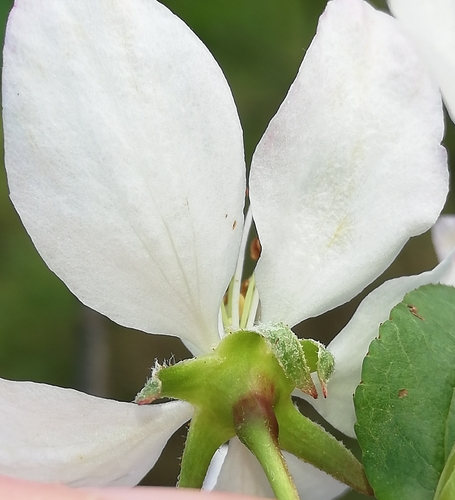
Five narrow white petals form each flower. Loose, lightly scented clusters contain 6–12 flowers, opening in spring as the leaves unfold. The Royal Horticultural Society has given Juneberry its Award of Garden Merit. 6 5
Its fruit is a small fleshy pome, 1–1.5 cm (0.4–0.6 in) across, changing from dark red when young to purplish black at full ripeness in early to midsummer. The sweet flesh recalls apples or blueberries. 6 4
Useful taxonomy
Before the genus Amelanchier was established in 1789, this plant circulated as Pyrus botryapium Vill., 1785, within the pear genus. Several names help explain older labels and nursery identifications:
- Amelanchier lamarckii var. scharnkeana (Asch. & Graebn.) F.G.Schroed., an accepted botanical variety;
- Amelanchier canadensis var. scharnkeana Asch. & Graebn., an earlier combination for the same taxon;
- Amelanchier × grandiflora Rehder, a related hybrid sometimes confused with it in nurseries.
Hybrid ancestry is a more reliable taxonomic guide than appearance alone. Most sources identify Amelanchier arborea (or A. canadensis) and Amelanchier laevis as the parents, a crossing that explains variation between populations. The accepted name, Amelanchier × lamarckii, remains the stable reference when labels differ. 1 8
Habitat and range
Northeastern North America is the region of origin, from southeastern Canada to the northeastern United States, where the parental species overlap. Nevertheless, no stable wild population is documented there today; the plant now occurs almost entirely in cultivation or as naturalized populations. 1 6
European botanical gardens introduced it in the 18th century. Market gardeners in the Netherlands and Lower Saxony grew it extensively during the 19th century, and naturalization followed in the early 20th century. Juneberry now occupies heathland, open woodland and acidic sandy soils in Belgium, the Netherlands and northwestern Germany. 6 7
Local invasive behavior is documented in the Netherlands, where it threatens heathland biodiversity, and in Poland, where it colonizes woodland and scrub around major central and southern cities. In Great Britain it is naturalized on sandy heaths and in damp acidic woods in southern England, rather than native there. 7 8 3
Life cycle and reproduction
Early spring flowering leaves Juneberry vulnerable to late frost, which can reduce an entire season's crop. Its flowers are hermaphroditic and self-fertile, with bees providing pollination. 6
Pollinated flowers develop fruit that ripens in early to midsummer. Birds quickly eat the crop and disperse the seeds, helping explain how readily the plant naturalizes beyond its original planting sites. 5
Seed propagation is slow and uneven. In practice, dividing basal suckers from a plant at least two years old yields usable plants sooner. Ground layering is possible but less common among home gardeners and generally takes 18 months to produce a fully rooted plant. 3
Uses and risks
Three seasons of ornamental interest explain Juneberry's widespread planting in western Europe: coppery spring leaves, early white flowers and orange-red autumn foliage. This combination also underlies its recognition through the Royal Horticultural Society's Award of Garden Merit. 2 5
Ripe fruit is edible, sweet and rich in iron and copper. It can be eaten raw, dried or cooked into preserves. Plants For A Future gives it the highest food-use rating and reports no known toxic hazard for the plant as a whole. 3
The documented concern is ecological: after more than a century of naturalization in some regions, Juneberry can spread into acidic heathland and compete with native vegetation. This issue is recorded in the Netherlands and Poland; comparable invasion has not been reported in metropolitan France. These regional observations should not be read as the reader's local regulations. 7
Varieties, look-alikes and related plants
Hybrid origin produces considerable variation beneath the Juneberry name. Some individuals resemble Amelanchier arborea more closely, while others lean toward Amelanchier laevis. The variety scharnkeana illustrates this taxonomic instability, having moved between several botanical combinations before its present placement. 1
Common identification problems involve:
- Amelanchier canadensis, with appreciably smaller flowers and slightly later flowering;
- Amelanchier laevis, one of the presumed parents, whose young leaves show less pronounced copper coloring;
- hawthorns (Crataegus), flowering in the same season but bearing thorns and fruits with hard stones, unlike Juneberry. 7 4
Two features together remain especially useful: copper-colored young leaves and loose clusters of 6–12 flowers, intermediate between the extremes found in its presumed parents.
Main sources
- Plants of the World Online / Kew, Amelanchier × lamarckii F.G.Schroed.
- Royal Horticultural Society, Amelanchier lamarckii details
- Plants For A Future, Amelanchier lamarckii
- Missouri Botanical Garden Plant Finder, Amelanchier lamarckii
- Wikipedia EN, Amelanchier × lamarckii
- Wikipedia DE, Kupfer-Felsenbirne (Amelanchier lamarckii)
- Wikipedia NL, Amerikaans krentenboompje
- Wikipedia PL, Świdośliwa Lamarcka
- Tela Botanica / BDTFX reference database, Amelanchier lamarckii
Frequently asked questions
Is Juneberry a species or a hybrid?
It is a natural hybrid, marked by the × sign, arising from Amelanchier arborea (or A. canadensis) and Amelanchier laevis in northeastern North America. Its current scientific name was established in 1968.
Is Juneberry fruit edible?
Yes. The ripe fruit is a small, fleshy, purplish-black pome eaten raw, dried or cooked. Its sweet flavor recalls apples or blueberries. It is rich in iron and copper, with no documented toxic risk.
Why are the young leaves copper-colored?
The emerging foliage contains coppery to pink pigments, reflected in the German name Kupfer-Felsenbirne. Leaves turn green within weeks, then orange-red in autumn.
Can Juneberry become invasive?
Locally, yes. It is documented as invasive on heathland and poor soils in the Netherlands and Poland, following decades of naturalization from ornamental plantings. No comparable invasion is documented in metropolitan France.
What soil and light does Juneberry need?
Acidic to neutral, well-drained sandy or loamy soil and full sun to light partial shade favor flowering and autumn color.
What does lamarckii mean?
The epithet honors French naturalist Jean-Baptiste de Lamarck, who described the plant in 1783. Botanist Fred-Günter Schroeder established the current scientific combination in 1968.
How can Juneberry be distinguished from its parents?
Coppery emerging foliage and loose clusters of 6–12 flowers distinguish it from Amelanchier laevis; larger size and flowers separate it from Amelanchier canadensis. The scientific name remains the most reliable reference when identification is uncertain.
Similar plants
If you are unsure about a plant’s toxicity, ask a botanist or veterinarian for advice.