
Norfolk Island pine (Araucaria heterophylla, )
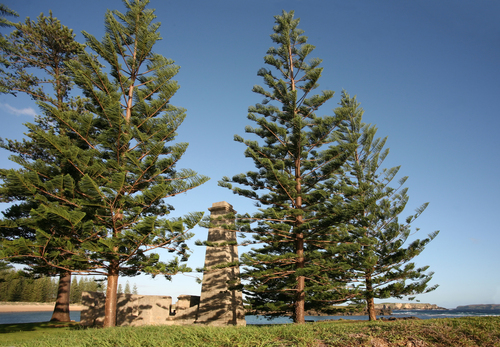
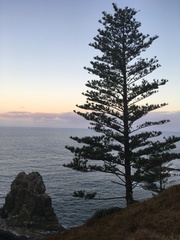
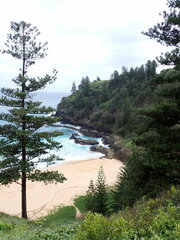
Norfolk Island pine (Araucaria heterophylla) is a large conifer in the Araucariaceae family, endemic to Norfolk Island, an Australian territory in the Pacific. Its straight trunk and symmetrical tiers of branches carry soft juvenile foliage that differs markedly from the curved, scale-like adult leaves. Widely grown as an ornamental and potted Christmas tree, it is classified as Vulnerable on the IUCN Red List.
Read moreNorfolk Island pine, Norfolk pine, Norfolk Island Araucaria, Star pine, Triangle tree and Living Christmas tree
Allow a few hours of direct sun per day, preferably morning or evening.
Full sun; light afternoon shade indoors helps prevent yellowing
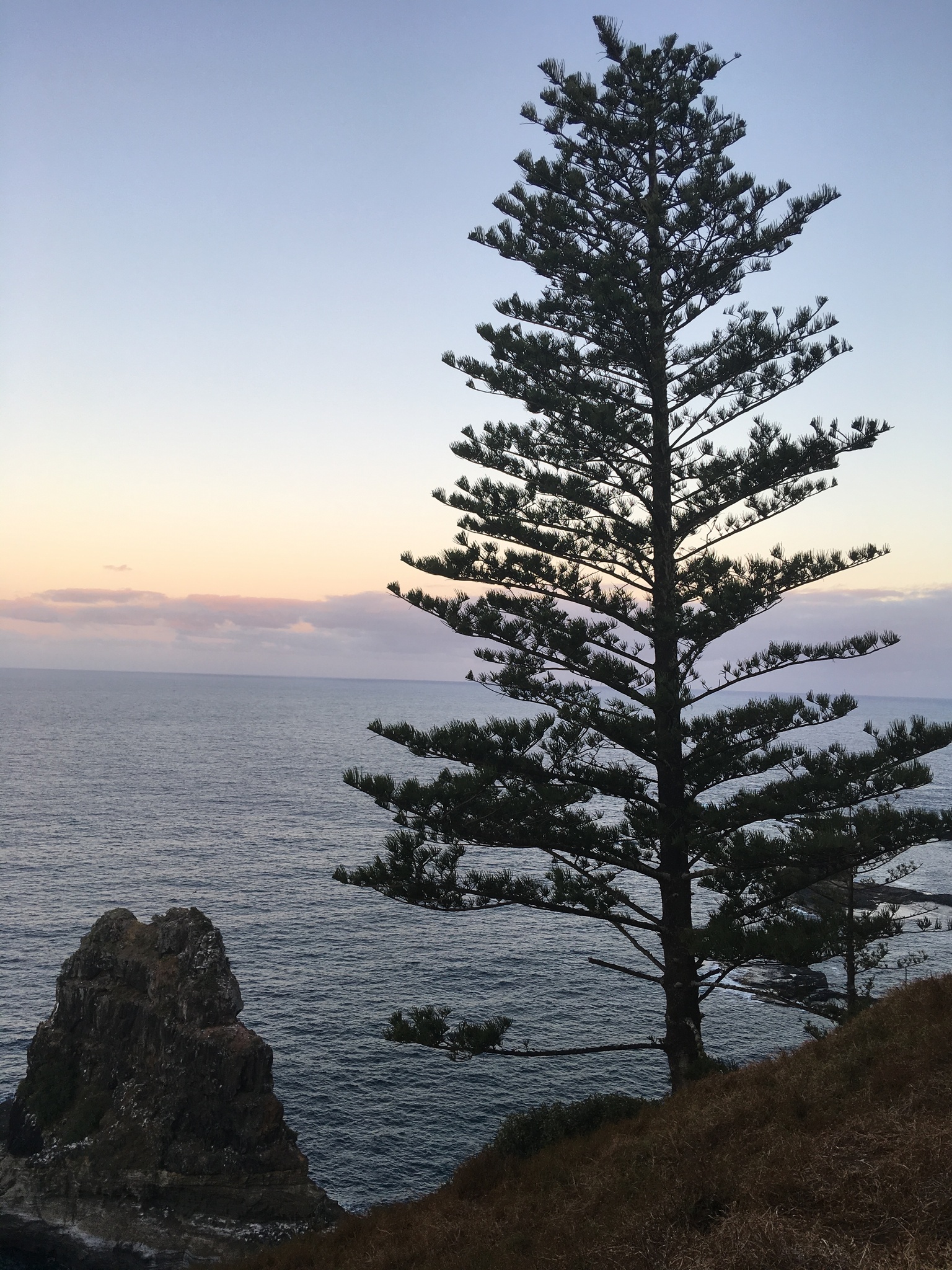
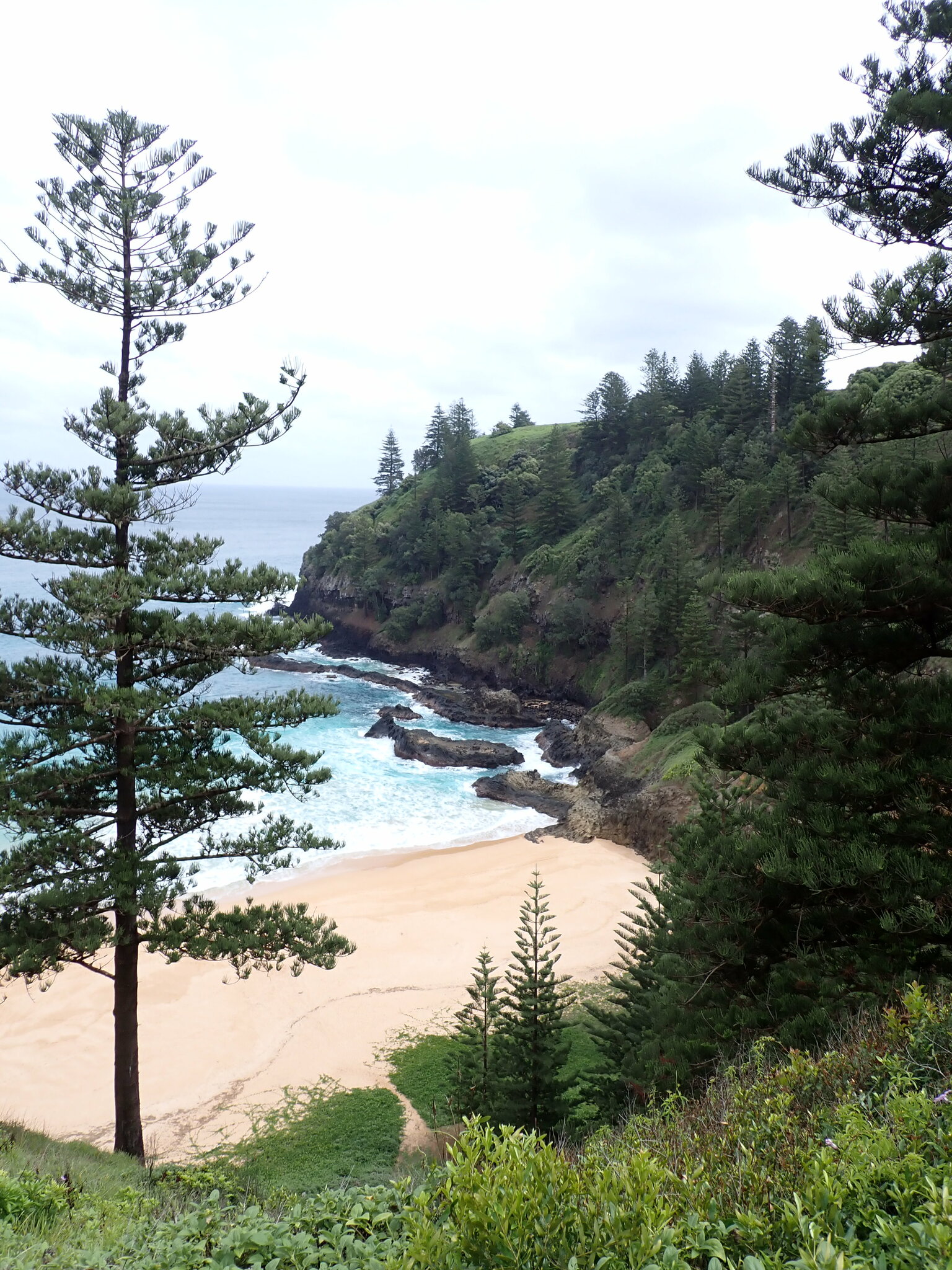


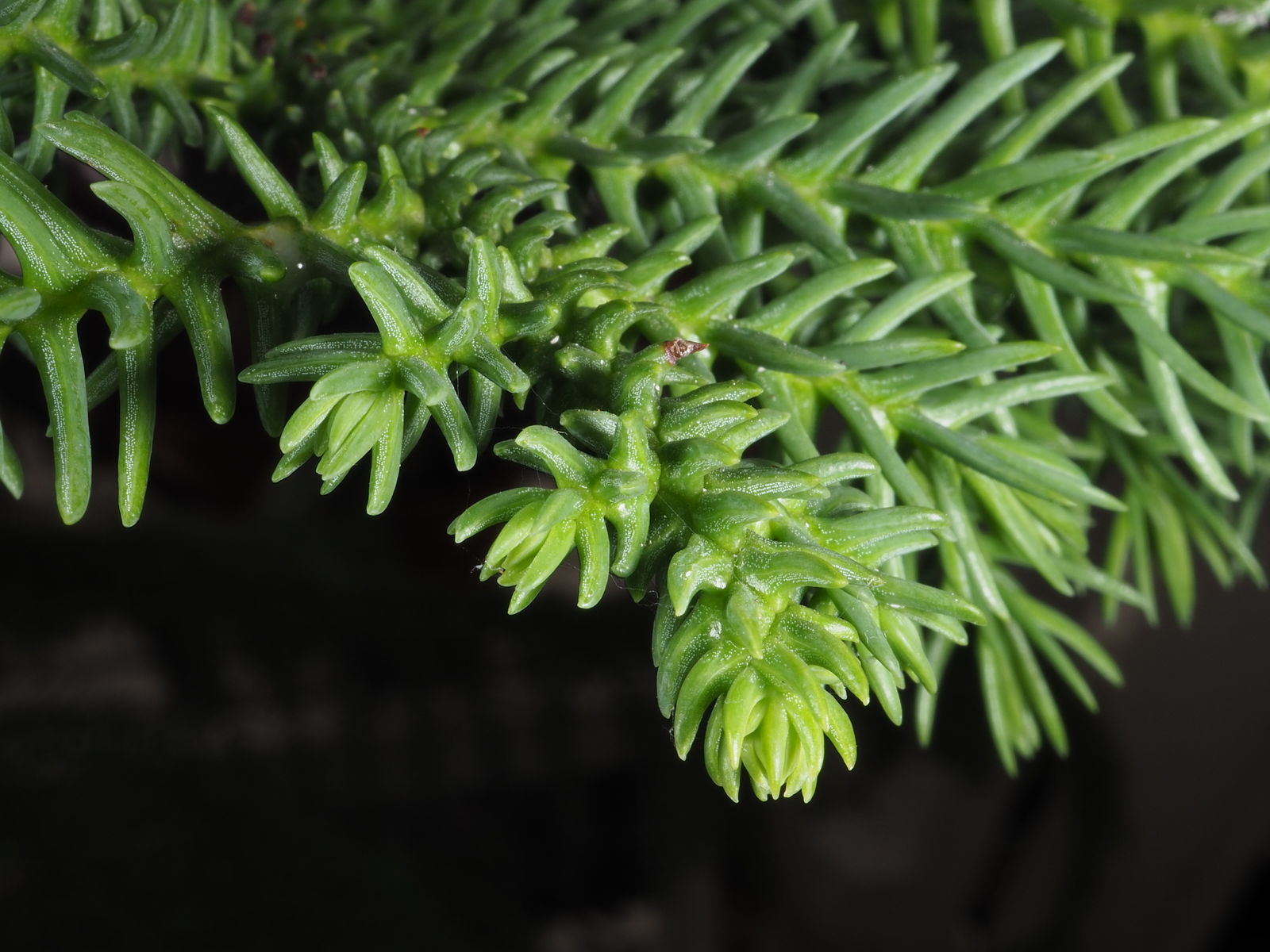

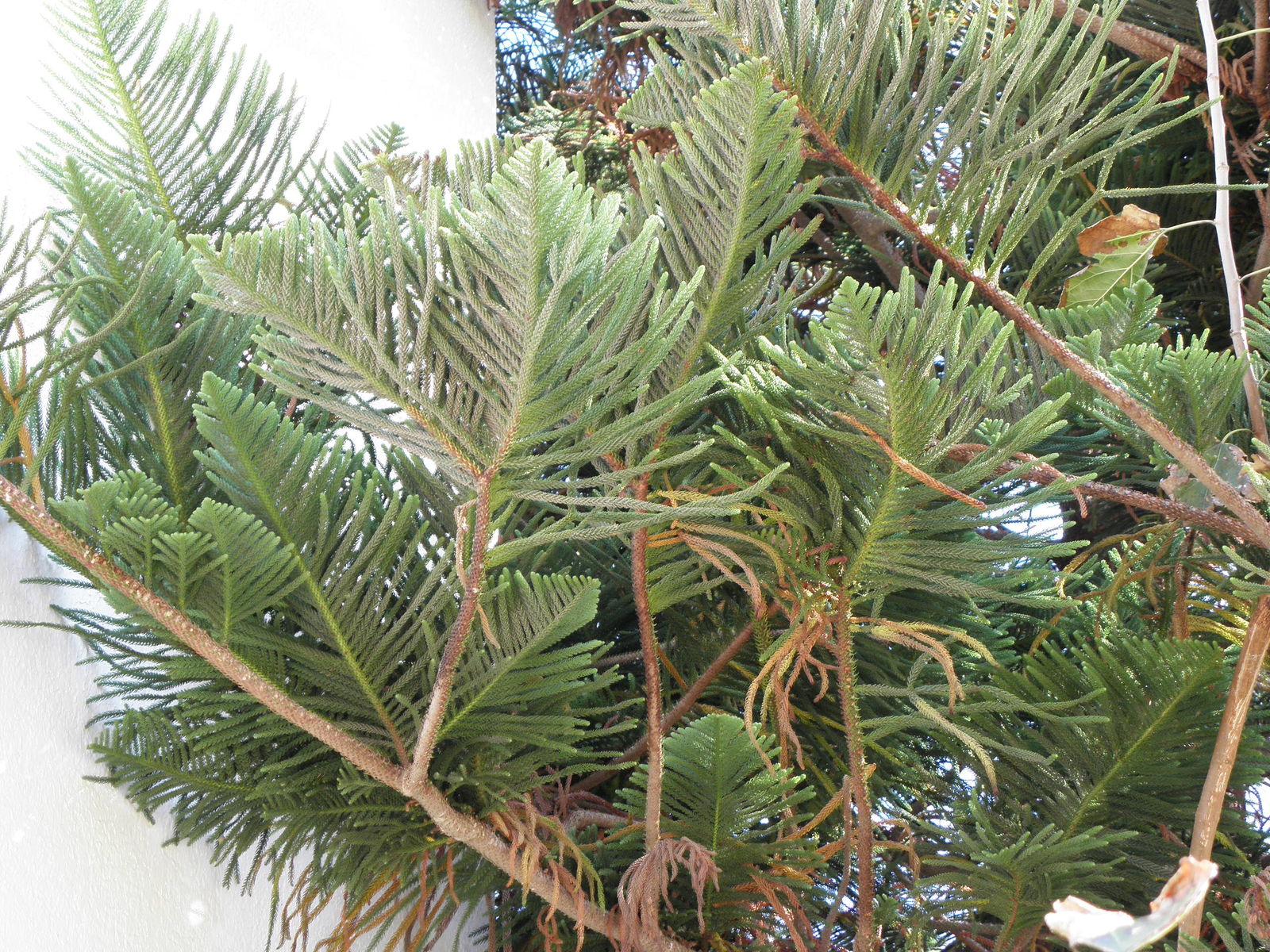
© photo
(c) bertknot, some rights reserved (CC BY-SA) · cc-by-sa
Donna Belder · cc-by
Leon Perrie · cc-by
Taken Jun 21, 2016 by Tela Botanica − Michel PANSIOT (cc-by-sa)
Taken Dec 26, 2011 by Tela Botanica − Yoan MARTIN (cc-by-sa)
Taken Sep 1, 2014 by Tela Botanica − Michel GAUBERT (cc-by-sa)
Taken Mar 7, 2012 by Tela Botanica − Yoan MARTIN (cc-by-sa)
Taken Feb 9, 2022 by Nebil Temsamani (cc-by-sa)
© copyright of the Board of Trustees of the Royal Botanic Gardens, Kew.


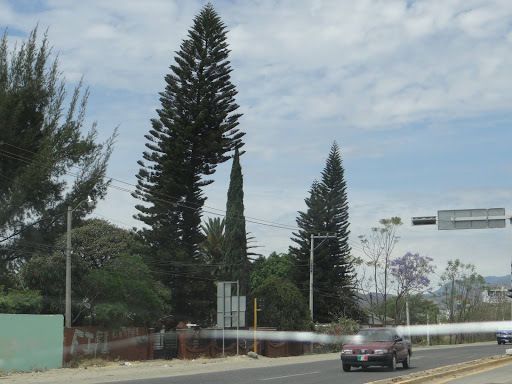


Global distribution
The native range is restricted to Norfolk Island, an Australian external territory in the Pacific, and historically neighboring Phillip and Nepean islands, where it has now disappeared or declined sharply. It is widely cultivated in frost-free Mediterranean and subtropical climates. Reports of naturalization or invasion, including in New Zealand, concern introduced populations rather than its native range.
- Native1
- Invasive1
- Norfolk Island (Australia)
- New Zealand
Hexagons: regions where the plant occurs. Green dots: native range.1
Identity
Norfolk Island pine (Araucaria heterophylla (Salisb.) Franco, 1952), also called Norfolk pine, is a large conifer in the Araucariaceae family and the genus Araucaria. Richard Anthony Salisbury first described it in 1807 as Eutassa heterophylla. Franco transferred it to Araucaria in 1952, creating the botanical name accepted today. 1 2
Although “pine” is embedded in its common name, this tree belongs neither to Pinus nor to the true pine family, Pinaceae. James Cook sighted Norfolk Island in 1774 during his second Pacific voyage. His journal described extensive forests of straight trees thought suitable for ships’ masts. After settlement in 1788, that proposed use proved impractical. 8
Recognition
Different juvenile and adult leaves explain the epithet heterophylla, meaning “different leaves.” Young shoots carry soft, awl-shaped leaves, 10–15 mm (0.4–0.6 in) long, arranged in open, star-like patterns. Adult foliage on cone-bearing branches is shorter, 5–10 mm (0.2–0.4 in), curved, scale-like and tightly overlapping. The distinction is especially useful when comparing a potted sapling with a mature outdoor tree. 8
A single straight trunk supports regular horizontal tiers, typically with five branches around the trunk. This arrangement creates the young tree’s strikingly symmetrical pyramid, explaining the names triangle tree and living Christmas tree. In its native habitat it reaches 50–65 m (165–215 ft). Slow growth in containers usually limits indoor plants to 1–3 m (3–10 ft); they do not approach the proportions of wild Norfolk Island trees. 8 5
Useful taxonomy
Older nursery names can obscure the identity of Norfolk Island pine. The main historical synonyms include the original name and a name that remained familiar in horticulture long after the current combination was established:
- Eutassa heterophylla Salisb., the basionym, 1807
- Araucaria excelsa (Lamb.) R.Br., formerly the main horticultural name
- Eutacta heterophylla (Salisb.) Link, a historical combination
Some catalogs and older gardening books still use Araucaria excelsa. The accepted name Araucaria heterophylla gives a stable point of reference, particularly when distinguishing it from Araucaria columnaris. That separate New Caledonian species is frequently sold under the same common name. 1 2
Habitat and range
Norfolk Island, between New Zealand and New Caledonia in the Pacific, contains the surviving native stronghold. The historical range also included neighboring Phillip and Nepean islands. Trees grow on basalt coastal cliffs and in inland forests under a humid subtropical climate. Norfolk Island is an Australian external territory, rather than part of mainland Australia. 8 6
Agricultural clearance and introduced species eliminated the tree from Nepean Island and sharply reduced it on Phillip Island. The IUCN classifies it as Vulnerable, and Norfolk Island National Park carries out restoration work. These conservation concerns apply to the wild populations, despite the species being familiar in cultivation around the world. 10 9
Ornamental planting extends far beyond those islands into Mediterranean and subtropical climates, from southern California to sheltered gardens on the Isles of Scilly. In New Zealand, introduced trees have naturalized along the North Island coast, where they are regarded as invasive pines. Cultivated and naturalized populations remain distinct from the restricted native range. 8
Life cycle and reproduction
Male and female cones usually develop on separate trees, making Norfolk Island pine predominantly dioecious, although occasional monoecious trees bear both sexes. Wind carries the pollen. Female cones take about 18 months to mature, and heavy crops occur intermittently, generally every 3–5 years, rather than on an annual schedule. 8 9
Rounded female cones measure 10–14 cm (4–5.5 in) across and release edible, winged seeds 2.5–3 cm (1–1.2 in) long. Seedlings have four cotyledons. Seed propagation is the usual nursery method: fresh seed germinates in about 6–8 weeks under warm, humid conditions. Cuttings can be taken from an upright leader, but a lateral branch cutting retains its horizontal growth instead of forming a straight trunk. 8 3
Uses and risks
A symmetrical outline makes this conifer a popular specimen tree in mild-climate gardens and a potted Christmas tree where frost prevents outdoor cultivation. The ASPCA lists it as non-toxic to cats, dogs and horses, supporting its use as a houseplant in homes with pets. Outdoor planting depends on frost-free conditions rather than on a particular country or hemisphere. 7 4
Commercial forestry was attempted in the 1950s, including a trial shipment to plywood manufacturers in Sydney. The project was abandoned because it was uneconomic. Small-scale woodturning remains a use for the timber, notably in Hawaii, where it is often confused with wood from the related Araucaria columnaris. 8
Indoor problems mainly involve growing conditions and physical damage. Years of inadequate light cause lower branches to yellow and drop, and those branches do not regrow. An accidentally broken terminal shoot also permanently changes the tree’s form. Maintaining the upright leader and adequate light therefore matters throughout the life of a container-grown specimen. 4
Varieties, look-alikes and related plants
Seed-grown plants dominate nursery production, and no stable horticultural cultivar is widely distributed. This contrasts with many garden conifers that are sold as numerous named selections and helps explain the relatively uniform appearance of young Norfolk Island pines on sale. 4
Cook pine, Araucaria columnaris, is the principal look-alike. Native to New Caledonia, it is often called Norfolk Island pine in Hawaii, but its trunk generally leans toward the equator. Monkey-puzzle, Araucaria araucana, has fiercely sharp leaves and tolerates about -20 °C (-4 °F), unlike this frost-sensitive species with soft juvenile foliage. A straight trunk, symmetrical young pyramid and tiers of five branches are useful combined identification clues.
Main sources
- Plants of the World Online / Kew, Araucaria heterophylla (Salisb.) Franco
- International Plant Names Index, Araucaria heterophylla (Salisb.) Franco
- Royal Horticultural Society, Araucaria heterophylla
- NC State Extension, Araucaria heterophylla
- Missouri Botanical Garden Plant Finder, Araucaria heterophylla
- Encyclopaedia Britannica, Norfolk Island pine
- ASPCA, Norfolk Island pine toxicity entry
- Wikipedia (EN), Araucaria heterophylla
- Wikipedia (FR), Araucaria heterophylla
- IUCN Red List, Araucaria heterophylla assessment
Frequently asked questions
Is Norfolk Island pine a true pine?
No. Despite its common name, Araucaria heterophylla belongs to Araucariaceae and the genus Araucaria. True pines belong to Pinus in the Pinaceae family.
Is Norfolk Island pine toxic to cats and dogs?
No. The ASPCA lists Araucaria heterophylla as non-toxic to cats, dogs and horses. Its seeds are also edible for people.
Why is my Norfolk Island pine losing its lower branches?
Several years of insufficient light cause lower branches to yellow and fall. They do not regrow; move the tree closer to bright light to protect new growth.
What happens if the growing tip breaks?
A broken leader permanently changes the tree’s shape. It does not restore a single straight trunk and may become asymmetric or bushy.
How can I distinguish Araucaria heterophylla from Araucaria columnaris?
They are often confused, especially in Hawaii. Araucaria columnaris usually leans toward the equator, while Araucaria heterophylla has a straight trunk and a more regularly pyramidal outline.
Can Norfolk Island pine stay outdoors all year?
Only in frost-free climates, generally USDA zones 10–11. Elsewhere, bring it under cover or keep it in a movable container when temperatures approach 0 °C (32 °F).
Does Norfolk Island pine flower?
No. It is a conifer and produces separate male and female cones instead of flowers, usually on different trees.
Similar plants
If you are unsure about a plant’s toxicity, ask a botanist or veterinarian for advice.