
Marguerite daisy (Argyranthemum frutescens, )
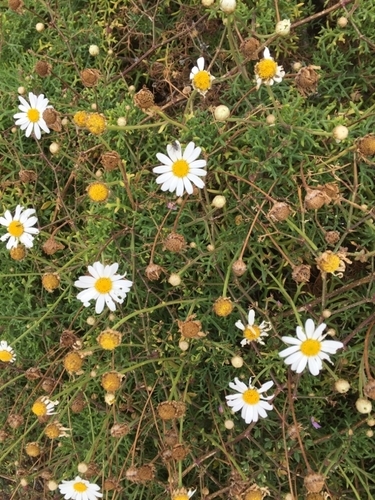
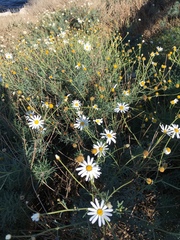

Marguerite daisy (Argyranthemum frutescens (L.) Sch.Bip.) is a subshrub in the Asteraceae family, native to the Canary Islands. Also known as Paris daisy, it has deeply divided green leaves and, in its typical wild form, white flower heads with yellow centers. Garden selections offer a wider range of flower forms and colors.
Read moreMarguerite daisy, Paris daisy, Boston daisy and Marguerite
Place in full sun, with intense direct light all day long.



© photo
Andre Hosper · cc-by-nc
W. Terry Hunefeld · cc-by-nc
Wikimedia Commons · CC BY-SA or Public Domain
Taken Feb 15, 2015 by Photoflora - Benoit BOCK (©)
Taken Apr 20, 2019 by Acuto Fla (cc-by-sa)
Taken Jul 19, 2020 by Giode Tonpino (cc-by-sa)
Taken Aug 9, 2018 by sabazius (cc-by-sa)
© copyright of the Board of Trustees of the Royal Botanic Gardens, Kew.




Global distribution
POWO/WCVP recognizes the Canary Islands as the native range and lists many introduced regions. No general national invasive status is assigned in France; introduction in Corsica, garden cultivation and regional naturalization outside the native range are distinct situations.
- Native1
- Introduced8
- Canary Islands
- Corsica
- Azores
- Italy
- California
- New Zealand
- South and Western Australia
- Victoria
- Réunion
Hexagons: regions where the plant occurs. Green dots: native range.1
Identity
Marguerite daisy (Argyranthemum frutescens (L.) Sch.Bip.) is an accepted species in the Asteraceae family according to POWO/WCVP. Its accepted name was published in 1844 in the Histoire Naturelle des Iles Canaries, based on the earlier name Chrysanthemum frutescens L. 1 2
The familiar names Paris daisy, marguerite and Boston daisy belong mainly to horticultural usage. They describe a plant grown in containers and flower beds, without implying a Parisian origin or a close relationship to every other plant called a daisy. 4 5
Common names can blur several distinct plants. Here, marguerite daisy means the Canary Islands subshrub Argyranthemum frutescens, distinct from the low-growing common daisy, Bellis perennis, the herbaceous oxeye daisy, Leucanthemum vulgare, and florist’s chrysanthemums in the genus Chrysanthemum. 1 11
Recognition
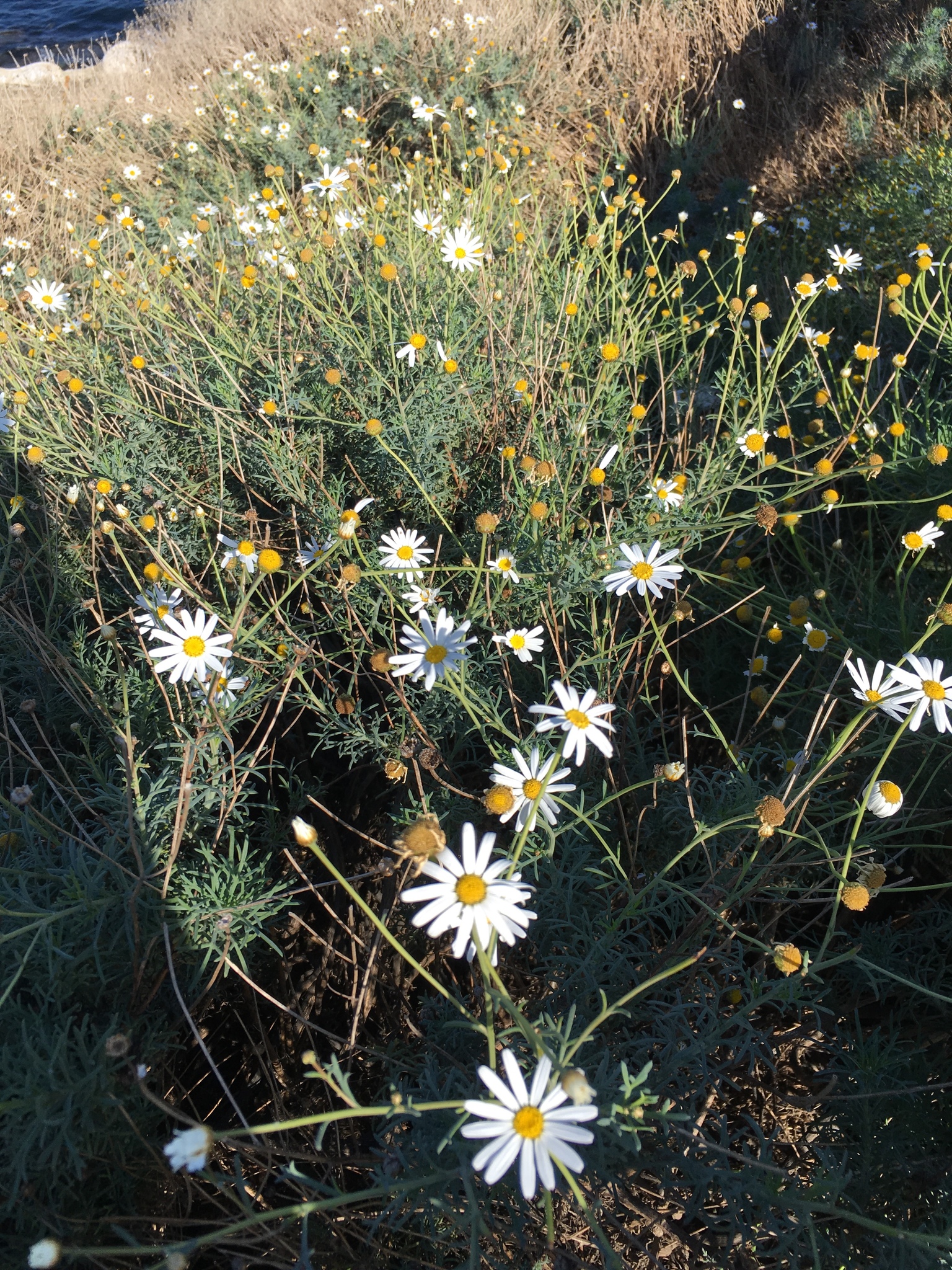
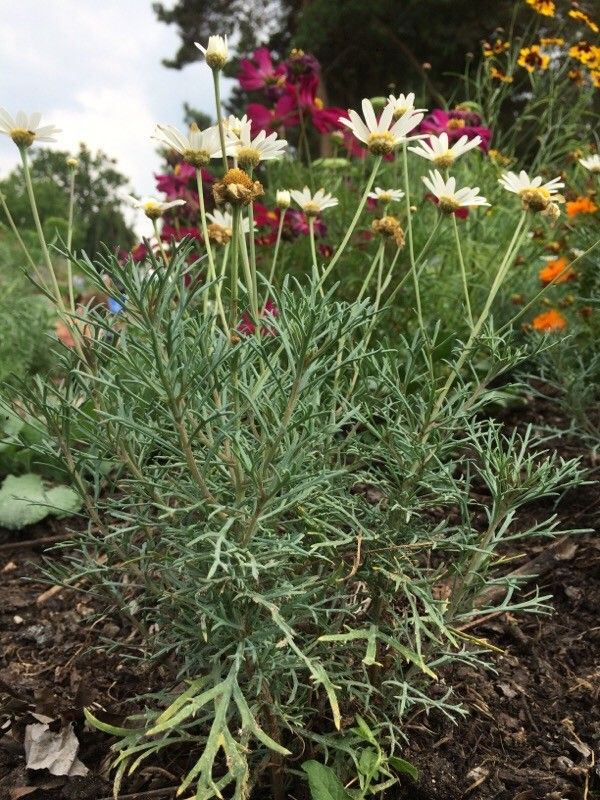
A rounded, much-branched framework gives this small evergreen or semi-evergreen subshrub its typical outline, although some plants spread more widely according to site and training. Canary Islands references generally describe a height of 30–80 cm (1–2.5 ft). RHS and Missouri Botanical Garden give cultivated sizes around 0.5–1 m (1.5–3 ft) or 60–90 cm (2–3 ft). 7 5 12
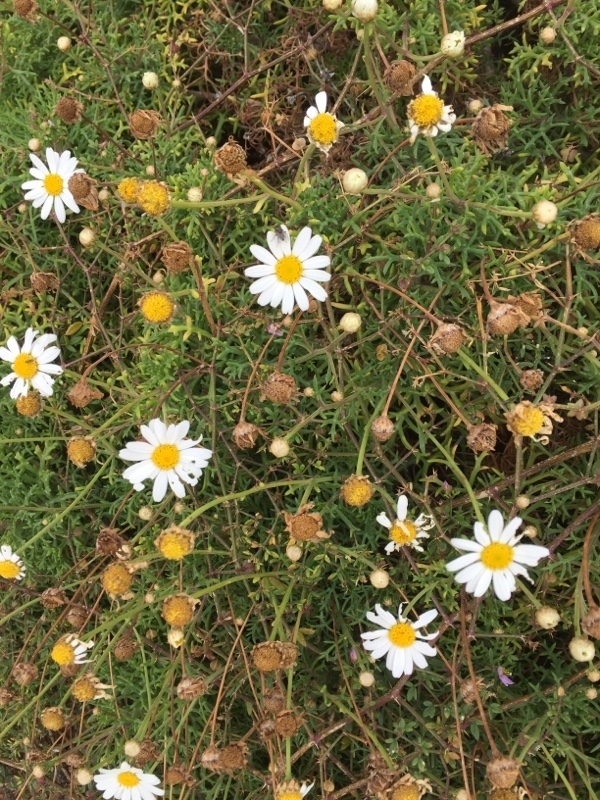
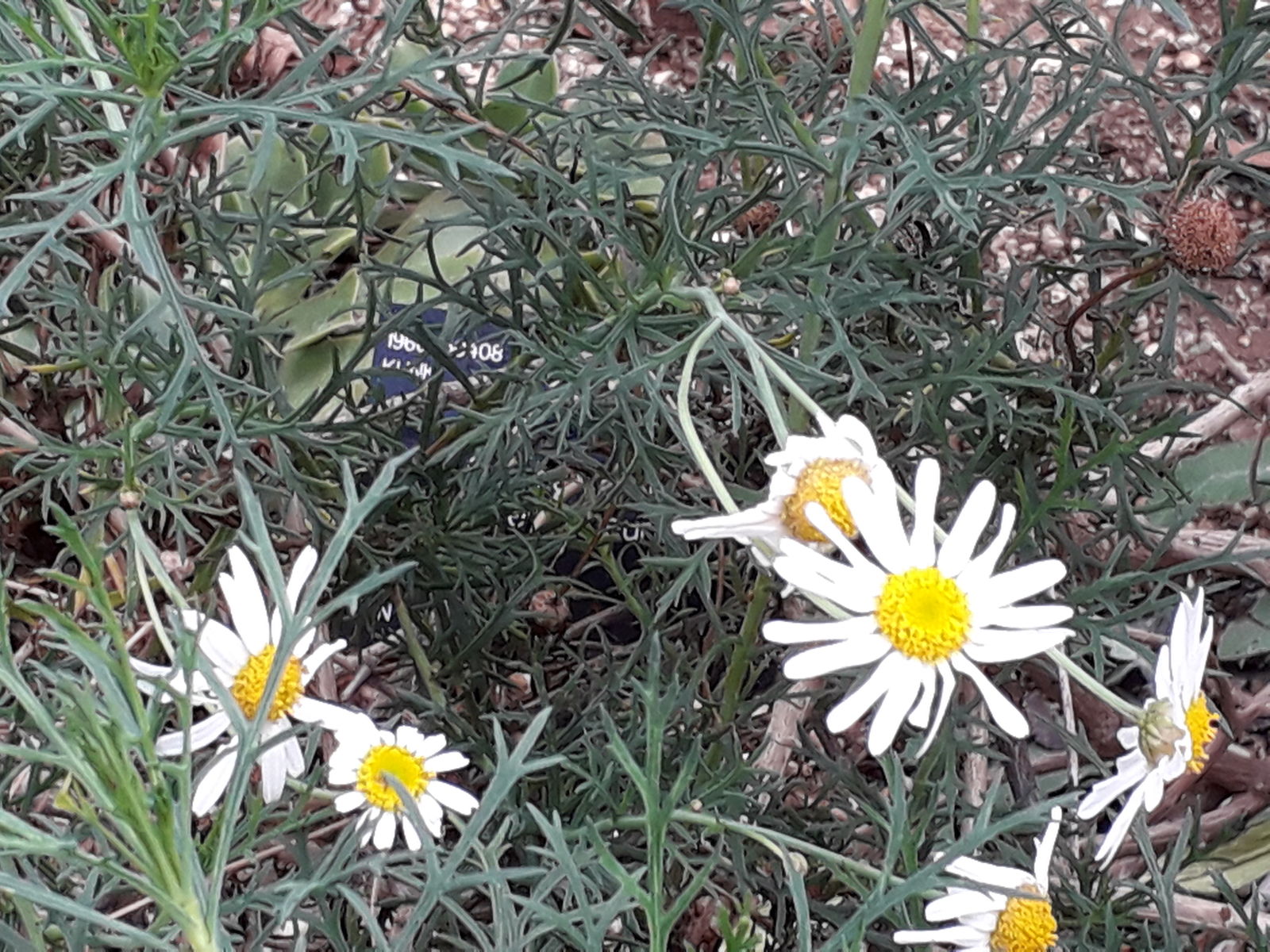
Young stems are green and fleshy. Older ones become woody, more brittle and grayish brown. The green, stalked leaves are often 5–8 cm (2–3 in) long, with an outline ranging from linear-lanceolate to obovate, and are deeply divided into narrow lobes. This finely cut foliage helps distinguish the plant from an oxeye daisy. 7 8
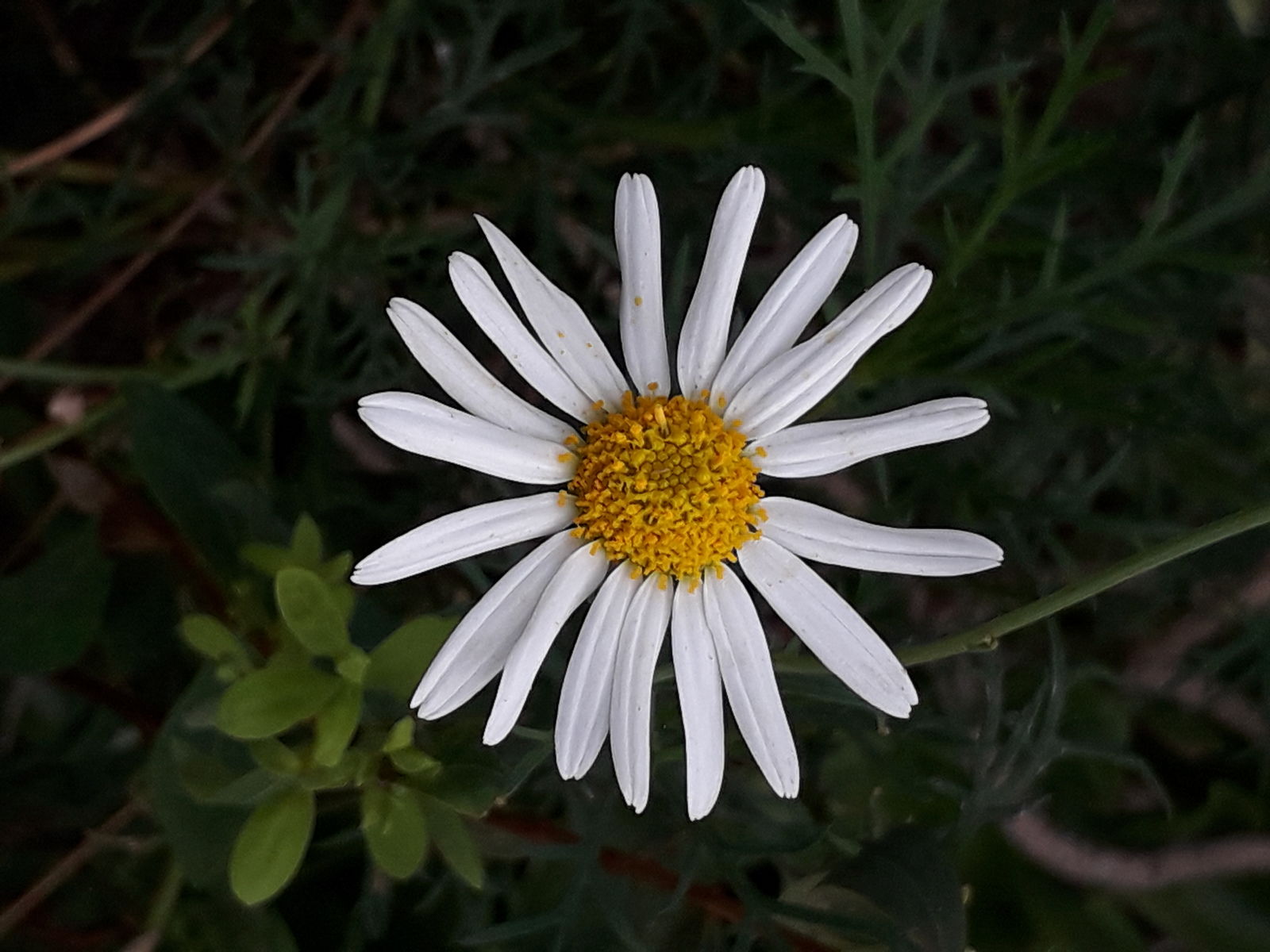
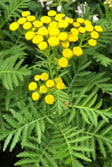
What looks like one flower is actually a flower head. In the typical wild form described by Canary Islands sources and RHS, white ray florets surround yellow tubular disc florets. Heads commonly measure 2–3 cm (about 1 in) across and form corymbs. Garden cultivars may be yellow, pink or double, so color alone cannot establish identity. 7 5 12
Taxonomy, names and look-alikes
The binomial Argyranthemum frutescens provides the consistent taxonomic reference. POWO accepts the species in Asteraceae and lists two principal homotypic synonyms at species level: Chrysanthemum frutescens L. and Pyrethrum frutescens (L.) Willd. These names are based on the same nomenclatural type. 1 3
Older references and general toxicity pages may therefore contain the word “chrysanthemum.” That historical synonym does not automatically make this species equivalent to a modern florist’s chrysanthemum. For cultivation and distribution information, retain the accepted name Argyranthemum frutescens. 1 2
Variation within the species is substantial. POWO lists seven accepted infraspecific taxa, and Flora Canaria explains that differences in habit, leaves and distribution have led to the description of several subspecies. A nursery pot may represent the botanical species, a Canary Islands subspecies, a cultivar or a horticultural hybrid; these categories should remain distinct. 1 7
Habitat and range
The Canary Islands constitute the native range recognized by POWO/WCVP. Flora Canaria describes the species as a Canary Islands endemic common at low and middle elevations, especially in cardonal-tabaibal succulent scrub and warm-climate woodland. 1 7
Island-level details need more careful interpretation. CanariWiki chiefly covers A. frutescens subsp. frutescens, reporting it as naturally present on Tenerife, with other subspecies or introduced populations on several islands. A statement about one subspecies cannot simply be applied to the whole species. 8 1
Beyond the Canaries, POWO lists introductions in Corsica, Italy, California, Réunion, South Australia, Victoria and Western Australia, among other regions. NZPCN also records the plant as exotic and naturalized in New Zealand, with naturalization dated to 1940. 1 10
Invasive status depends on the territory concerned. Gardening Responsibly Australia places the species in a lower-risk category, while also noting naturalization in South and Western Australia and subspecies regarded as environmental weeds in those states. No general invasive status is assigned here for mainland France; POWO lists Corsica as an introduced region. These French distinctions do not determine planting rules elsewhere. 9 1
Cultivation, life cycle and propagation
Mild gardens can support marguerite daisy as a woody perennial; where frost occurs it is often grown as an annual. RHS rates it H2, recommends full sun and moderately fertile, well-drained soil, and advises taking cuttings when temperatures fall below 0 °C (32 °F). 5
Flowering lasts a long time but follows the local climate. Flora Canaria reports flowering mainly in winter and spring in the Canaries, sometimes nearly year-round in favorable conditions. For temperate gardens, RHS describes flower heads from late spring into fall, while Missouri Botanical Garden notes that intense summer heat can slow flowering. 7 5 12
Cuttings provide the main reliable horticultural propagation method. RHS recommends softwood cuttings in spring, or semi-ripe cuttings from nonflowering shoots in summer, 5–10 cm (2–4 in) long. Flora Canaria also mentions seed and hardwood cuttings in its Canary Islands context. Use local seasons rather than fixed calendar months when applying this guidance. 5 7
A wet crown, frost, bare aging growth, leaf miners, aphids and red spider mites under cover are familiar cultivation problems. RHS specifically mentions leaf miners and crown gall. The greenhouse pests cited in horticultural sources favor keeping plants airy and well lit, without forcing soft growth through excessive fertilizer. 5 12
Uses, edibility and toxicity
Beds, containers, courtyard gardens and mild coastal or Mediterranean-style plantings are the main ornamental settings for this species. RHS also notes tolerance of coastal winds, which helps explain its use beside the sea where conditions are mild, drainage is good and plants remain frost-free. 5
POWO records environmental and food uses without specifying a plant part, preparation method or safety context in the consulted account. Canary Islands references mention older folk uses, but CanariWiki stresses that such material is no substitute for medical treatment. These accounts do not support recommending consumption, tea or medicinal use. 1 8
Animal toxicity remains uncertain for this exact species. The selected references contain no exact ASPCA entry for Argyranthemum frutescens. ASPCA’s “Daisy” page covers Chrysanthemum species and lists those daisies as toxic to dogs and cats; Chrysanthemum frutescens is a historical synonym of marguerite daisy. 11 1
A cautious approach is therefore appropriate: do not treat Argyranthemum frutescens as food or as a plant confirmed safe for pets, and do not assume it is interchangeable with toxic bouquet chrysanthemums. Seek veterinary advice after significant ingestion or if symptoms develop. 11 4
Cultivars and related plants
Garden marguerites sold as Argyranthemum include double, yellow, pink and compact forms. RHS retains entries such as double white-flowered, double yellow and 'Gill’s Pink'; Missouri Botanical Garden names 'Jamaica Primrose' and 'Vancouver'. These horticultural labels do not designate separate wild species. 5 12
White-and-yellow flower heads cause confusion across Asteraceae. Possible look-alikes include herbaceous oxeye daisy, Leucanthemum vulgare; low-growing common daisy, Bellis perennis; bouquet plants in Chrysanthemum; some African daisies in Osteospermum; and blue marguerite in Felicia. The full scientific name remains the best safeguard against common-name ambiguity. 1 11
When choosing a plant, look for a slightly woody base, deeply divided leaves and daisy-type heads on a bushy plant. Check for an Argyranthemum frutescens label or a cultivar assigned to the genus. In a cold climate, a promise of a fully hardy perennial should prompt closer scrutiny. 5 12
Main sources
- Plants of the World Online / Kew, Argyranthemum frutescens (L.) Sch.Bip.
- International Plant Names Index, Argyranthemum frutescens (L.) Sch.Bip.
- WCVP / Plants of the World Online, Argyranthemum frutescens
- Trefle, species data, Argyranthemum frutescens
- Royal Horticultural Society, Argyranthemum frutescens
- Perenual, horticultural traits, Cobbitty daisy
- Flora de las Islas Canarias, Argyranthemum frutescens
- Gobierno de Canarias / CanariWiki, Magarza común
- Gardening Responsibly Australia, Argyranthemum frutescens
- New Zealand Plant Conservation Network, Argyranthemum frutescens
- ASPCA, Daisy toxicity entry for Chrysanthemum species
- Missouri Botanical Garden Plant Finder, Argyranthemum frutescens
Frequently asked questions
Is marguerite daisy the same as oxeye daisy?
No. Oxeye daisy is Leucanthemum vulgare. Marguerite daisy, Argyranthemum frutescens, is a Canary Islands subshrub often grown in containers or frost-free beds.
Why do older references use Chrysanthemum frutescens?
Chrysanthemum frutescens is the basionym and a homotypic synonym. POWO/WCVP accepts the name Argyranthemum frutescens.
Is marguerite daisy frost hardy?
Only to a limited extent. RHS rates it H2 and recommends taking cuttings when frost threatens. In cold regions, including colder parts of France, it is often grown as an annual.
Can I eat Argyranthemum frutescens?
Consumption is not recommended. POWO records food use, but the selected references do not identify a plant part, dose or safe preparation method.
Is marguerite daisy toxic to cats and dogs?
The selected references contain no exact ASPCA entry for Argyranthemum frutescens. ASPCA lists daisies in Chrysanthemum as toxic, and Chrysanthemum frutescens is an old name for this species. A cautious status is therefore retained rather than an assurance of safety.
Is marguerite daisy invasive?
It has no general invasive designation in France. However, POWO lists it as introduced in several regions, and NZPCN records it as an exotic naturalized plant in New Zealand. Check the status in your territory before planting it in the ground.
Similar plants
If you are unsure about a plant’s toxicity, ask a botanist or veterinarian for advice.