
Aji pepper (Capsicum chinense, )
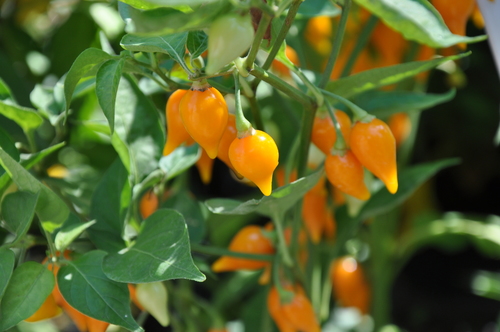

Aji pepper (Capsicum chinense) is a subshrub in Solanaceae, native to the Amazon basin. Despite its epithet, it has no botanical connection with China. The species includes some of the hottest cultivated peppers and usually bears clusters of flowers at each node rather than solitary blooms.
Read moreAji pepper, Scotch bonnet, Bondamanjak and Aji


© photo
(c) Stefano, some rights reserved (CC BY-NC-SA) · cc-by-nc-sa
Wikimedia Commons · CC BY-SA or Public Domain
Wikipedia · CC BY-SA
Taken Nov 18, 2022 by Netanel H (cc-by-sa)
Taken May 10, 2021 by Monteiro Bianca (cc-by-sa)
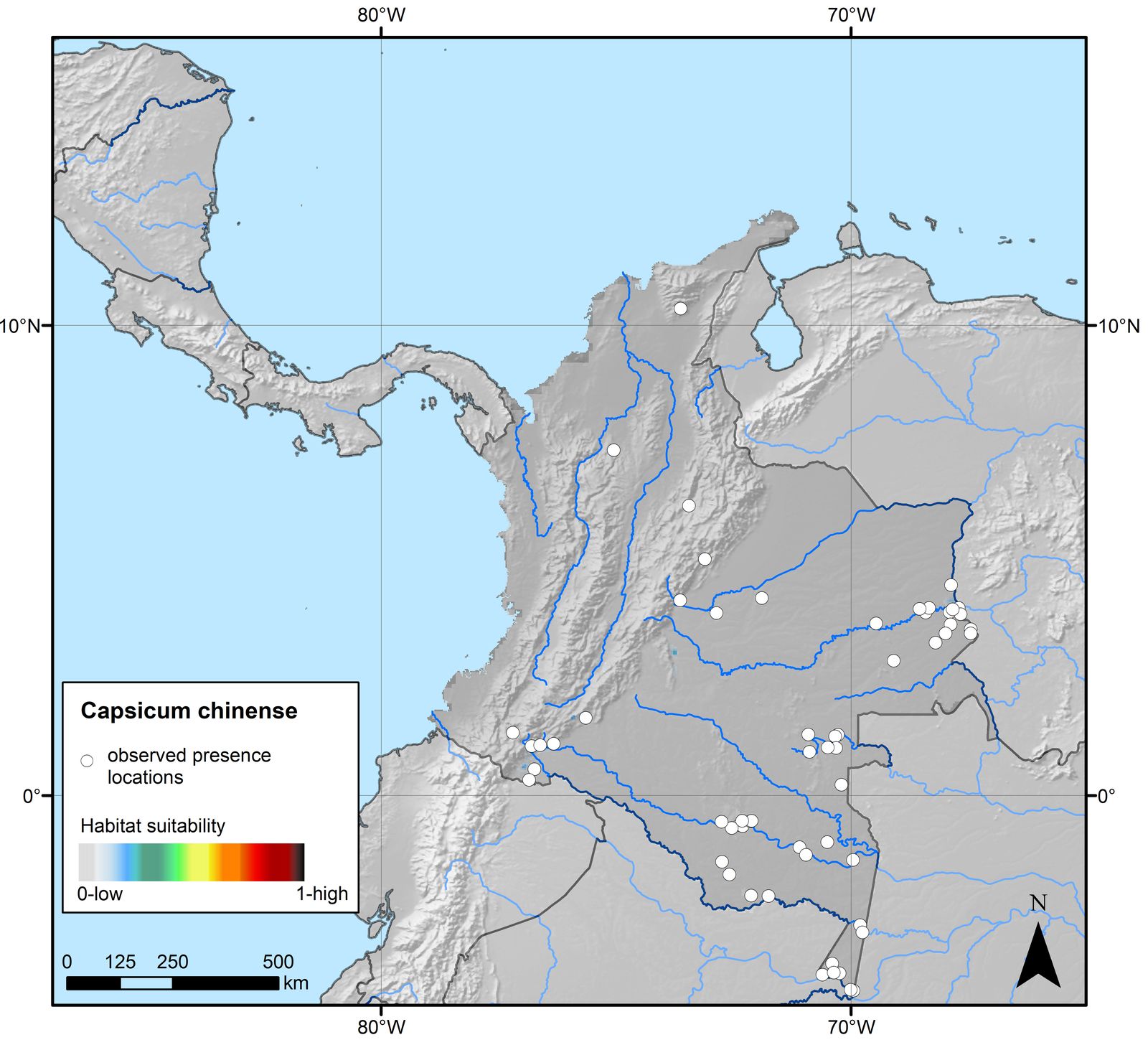
© copyright of the Board of Trustees of the Royal Botanic Gardens, Kew.


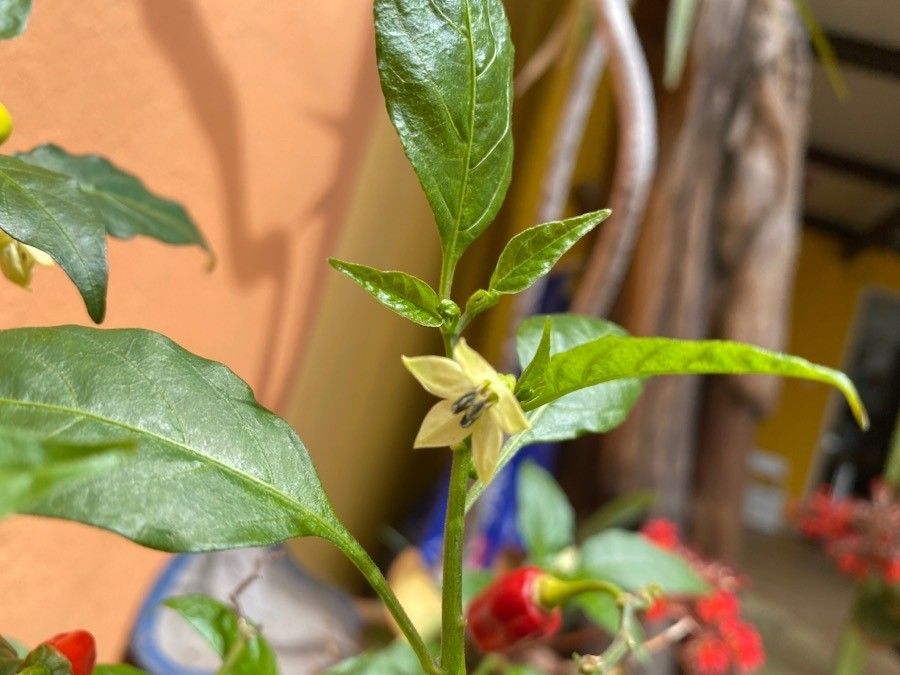


Global distribution
The native range of Capsicum chinense lies in the Amazon basin, from southern Guyana to northern Brazil and southwestern Suriname. Domestication and horticultural spread, particularly through the Caribbean and Yucatán, extended cultivation far beyond this South American origin.
- Native3
- Introduced1
- Guyana
- Suriname
- Northern Brazil
- Caribbean
Hexagons: regions where the plant occurs. Green dots: native range.1
Identity
Aji pepper (Capsicum chinense Jacq., 1777), also known in French-speaking Caribbean usage as piment antillais or bondamanjak, is a subshrub in Capsicum, family Solanaceae. It is one of the genus’s five domesticated species, alongside Capsicum annuum, Capsicum baccatum, Capsicum frutescens and Capsicum pubescens. 1 7
The epithet chinense can mislead gardeners. Nikolaus Joseph von Jacquin published the name in 1777, wrongly believing the plant came from China after receiving a specimen from a Chinese merchant. Its true origin lies in tropical South America, thousands of kilometers from Asia. 6 8
Recognition
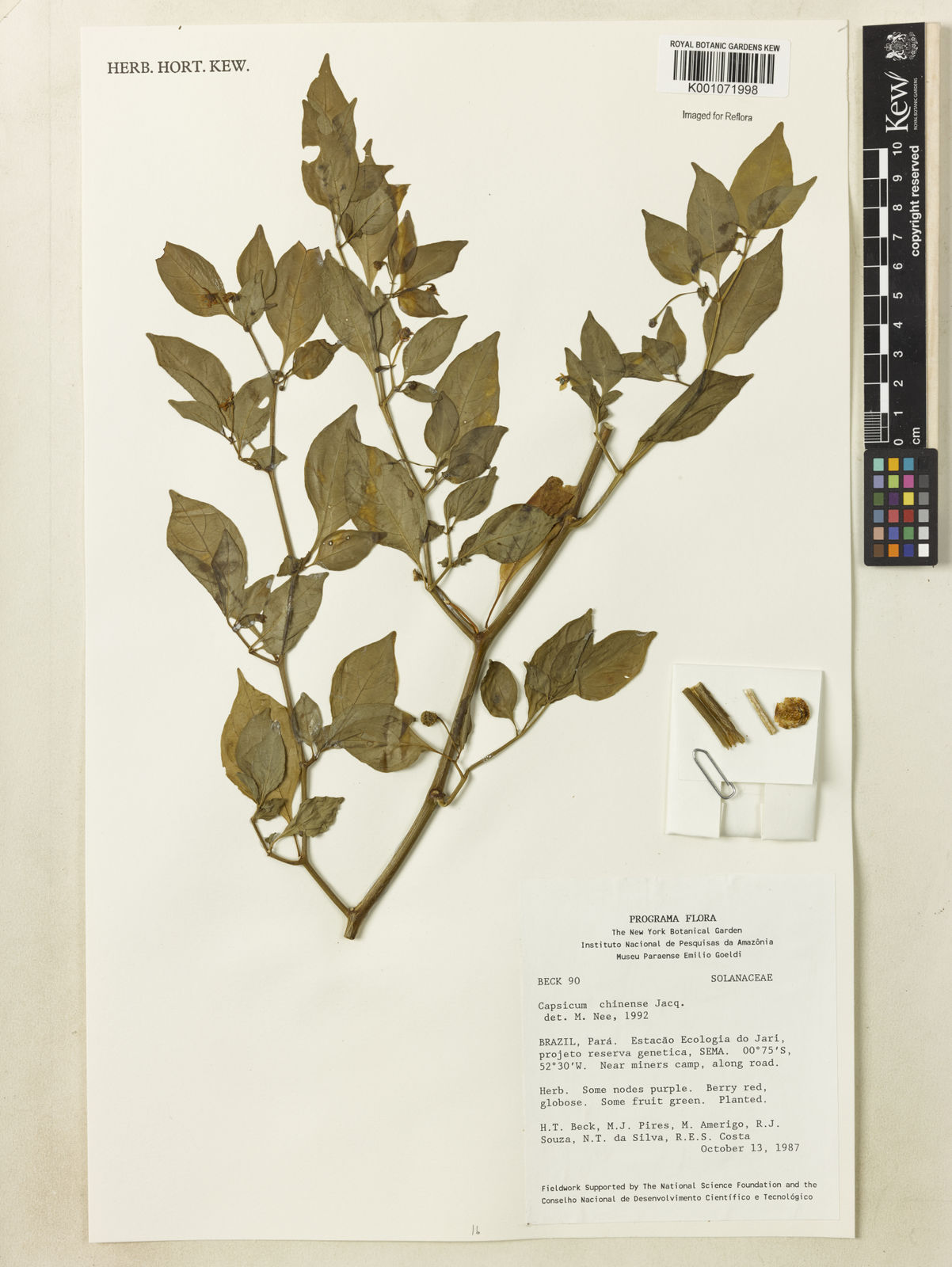
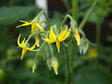
Flowering provides the strongest distinction from Capsicum annuum: aji pepper bears two to five white flowers per node, compared with one in the common sweet pepper. The small, five-petaled corollas cluster in the leaf axils. 6 9
Simple, bright green leaves often have a crumpled or puckered surface, contrasting with the smooth foliage of an ordinary sweet pepper. Habanero forms make compact bushes about 50 cm (20 in) tall, while vigorous cultivars can exceed 1.5 m (5 ft) in consistently tropical conditions. 6 8
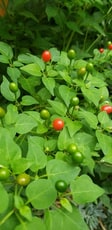
Fruit shape varies greatly. Some cultivars have small, smooth berries only 6 mm (0.24 in) across; others produce wrinkled, elongated fruits reaching 10 cm (4 in). This variation in size and shape explains why color alone cannot identify the species with certainty. 8
Useful taxonomy
POWO recognizes Capsicum chinense Jacq. as the accepted name. Historical names have described the same species or very close forms, including one published by Philip Miller in 1768, accounting for a substantial synonymy: 1 2
- Capsicum sinense Murray (historical botanical name)
- Capsicum annuum var. chinense (Jacq.) Alef.
- Capsicum cerasiforme Mill.
- Capsicum dichotomum Vell.
- Capsicum luteum Lam.
- Capsicum toxicarium Poepp.
Despite the long list, the accepted binomial remains the stable reference. Horticultural groups such as habanero, Scotch bonnet and ají dulce describe uses and fruit forms rather than separate botanical taxa. 3 4
Habitat and range
The Amazon basin, from southern Guyana to northern Brazil and southwestern Suriname, forms the native range recognized by POWO. Humid woodland and forest edges provide habitat there, explaining the plant’s need for consistently tropical growing conditions. 1
Domestication and horticultural distribution carried it far beyond South America, notably to the Caribbean and the Yucatán Peninsula, where it became an important food crop. The name habanero comes from Havana, a trading port through which peppers traveled to Europe, rather than indicating that the species originated in Cuba. 6 5
Life cycle and reproduction
In tropical climates, aji pepper is a perennial subshrub, sometimes becoming woody at the base after several years. Where winters provide insufficient warmth, it is grown as an annual or overwintered under frost-free cover. 8 9
From sowing to the first harvest generally takes 120–150 days, longer than in Capsicum annuum. Cool-climate cultivation therefore requires an early protected sowing. Propagation is almost entirely from seed; seed collected from a hybrid cultivar does not always reproduce the same fruit the following year. 8
Uses and risks
Fruits chiefly serve as condiments, fresh, in sauces or in marinades, in Caribbean, Yucatecan and several South American cuisines. Some cultivars, including Pepper X, rank among the hottest peppers ever measured, with a 2023 record of 2.69 million Scoville heat units. Others, such as ají dulce, retain the fruity fragrance without the heat. 6
The veterinary safety of Capsicum chinense for cats and dogs is not established by the cited sources. The risk comes from capsaicinoids, concentrated in hot fruits. Contact irritates the mouth, eyes and skin; substantial ingestion causes digestive upset in children. 9
Capsaicinoids concentrate chiefly in the internal partitions and placenta surrounding the seeds rather than in the flesh itself. Removing these tissues before preparation substantially reduces heat compared with leaving the fruit intact, without changing its flavor. 9 8
Varieties, look-alikes and related plants
Habanero, Scotch bonnet, bhut jolokia or ghost pepper, Carolina Reaper and Pepper X are among the best-known cultivars of the species, all selected for heat. Caribbean ají dulce, by contrast, remains mild despite a very similar aroma. 6
The world heat record has passed between cultivars of the same species: first bhut jolokia, then Carolina Reaper from South Carolina and finally Pepper X, measured at 2.69 million Scoville heat units in 2023. Cultivar selection therefore changes heat far more than the geographic origin of a particular plant. 6
Frequent look-alikes include:
- Capsicum annuum, distinguished chiefly by one flower per node;
- Capsicum frutescens, often more upright, with small fruits that also stand erect;
- Capsicum baccatum, a South American ají recognizable by its spotted corolla.
When buying plants, ask for the cultivar rather than relying on fruit color or shape, both highly variable features. Flowers per node remain the clearer distinction: two to five in Capsicum chinense, compared with one in Capsicum annuum. The scientific name together with the cultivar name provides a reference that stays consistent between markets. 8 3
Main sources
- Plants of the World Online / Kew, Capsicum chinense Jacq.
- International Plant Names Index, Capsicum chinense
- GBIF Backbone Taxonomy, Capsicum chinense
- Wikidata, Capsicum chinense (Q311071)
- Wikipedia FR, Habanero pepper
- Wikipedia EN, Capsicum chinense
- Wikipedia ES, Capsicum chinense
- Plants For A Future, Capsicum chinense
- NC State Extension, Capsicum chinense
Frequently asked questions
Are habanero and cayenne the same pepper species?
No. Cayenne usually belongs to Capsicum annuum, while habanero, Scotch bonnet and most very hot peppers belong to Capsicum chinense.
Why does Capsicum chinense have a name meaning Chinese?
Jacquin named it in 1777, mistakenly believing it came from China after receiving a specimen from a Chinese merchant. Its actual origin is the Amazon basin in South America.
Is aji pepper poisonous to cats and dogs?
The cited sources do not establish safety for cats and dogs. Hot fruits can irritate the mouth and digestive tract.
How can Capsicum chinense and Capsicum annuum be distinguished in a garden?
The most reliable feature is the number of flowers per node: two to five in Capsicum chinense, compared with one in Capsicum annuum.
Are there mild Capsicum chinense cultivars?
Yes. Ají dulce is a common example, sharing habanero’s fruity aroma without its burning heat.
Similar plants
If you are unsure about a plant’s toxicity, ask a botanist or veterinarian for advice.