
Safflower (Carthamus tinctorius, )
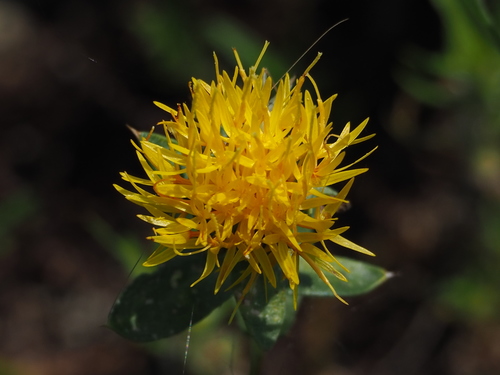

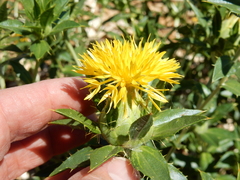
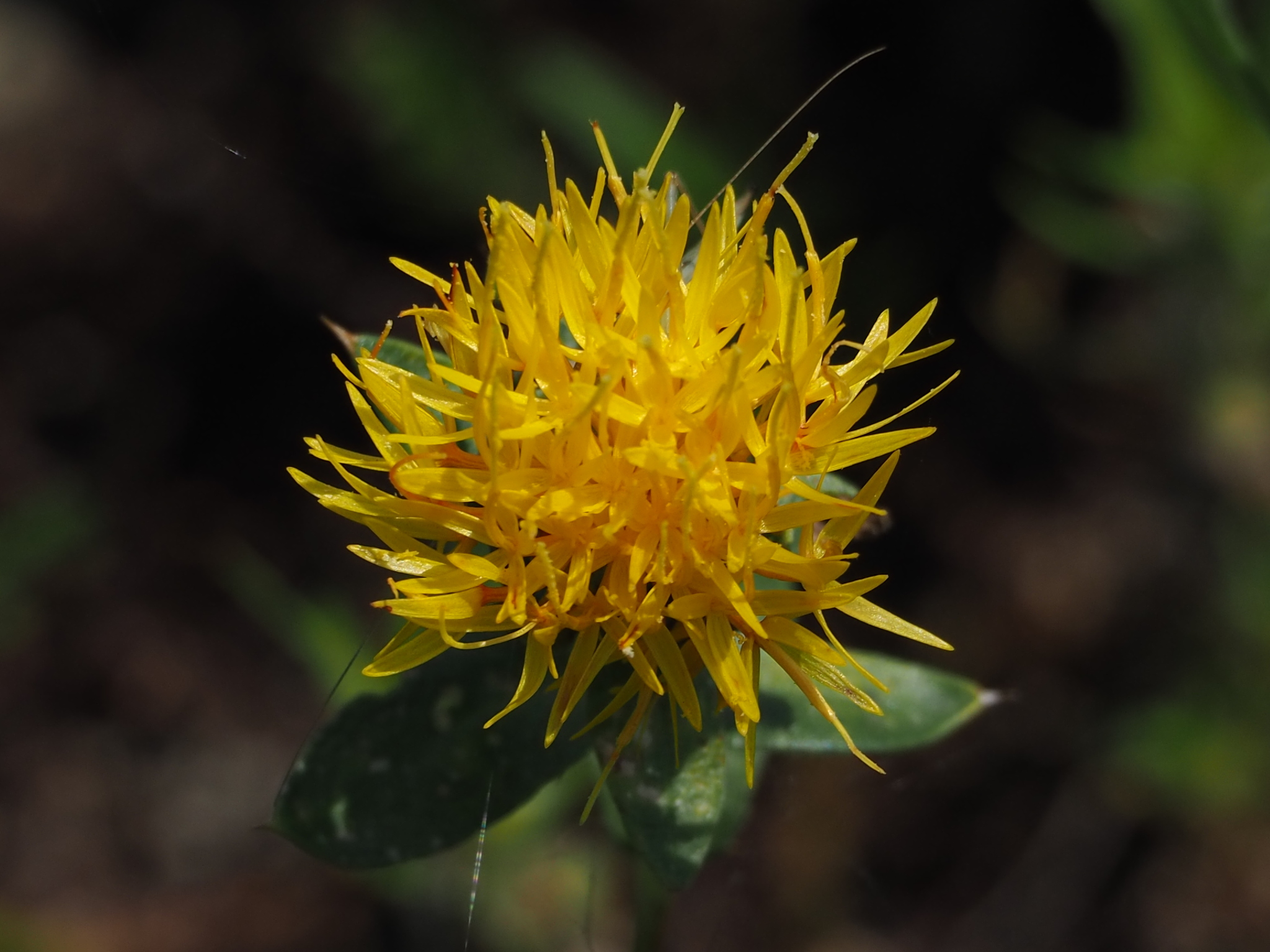
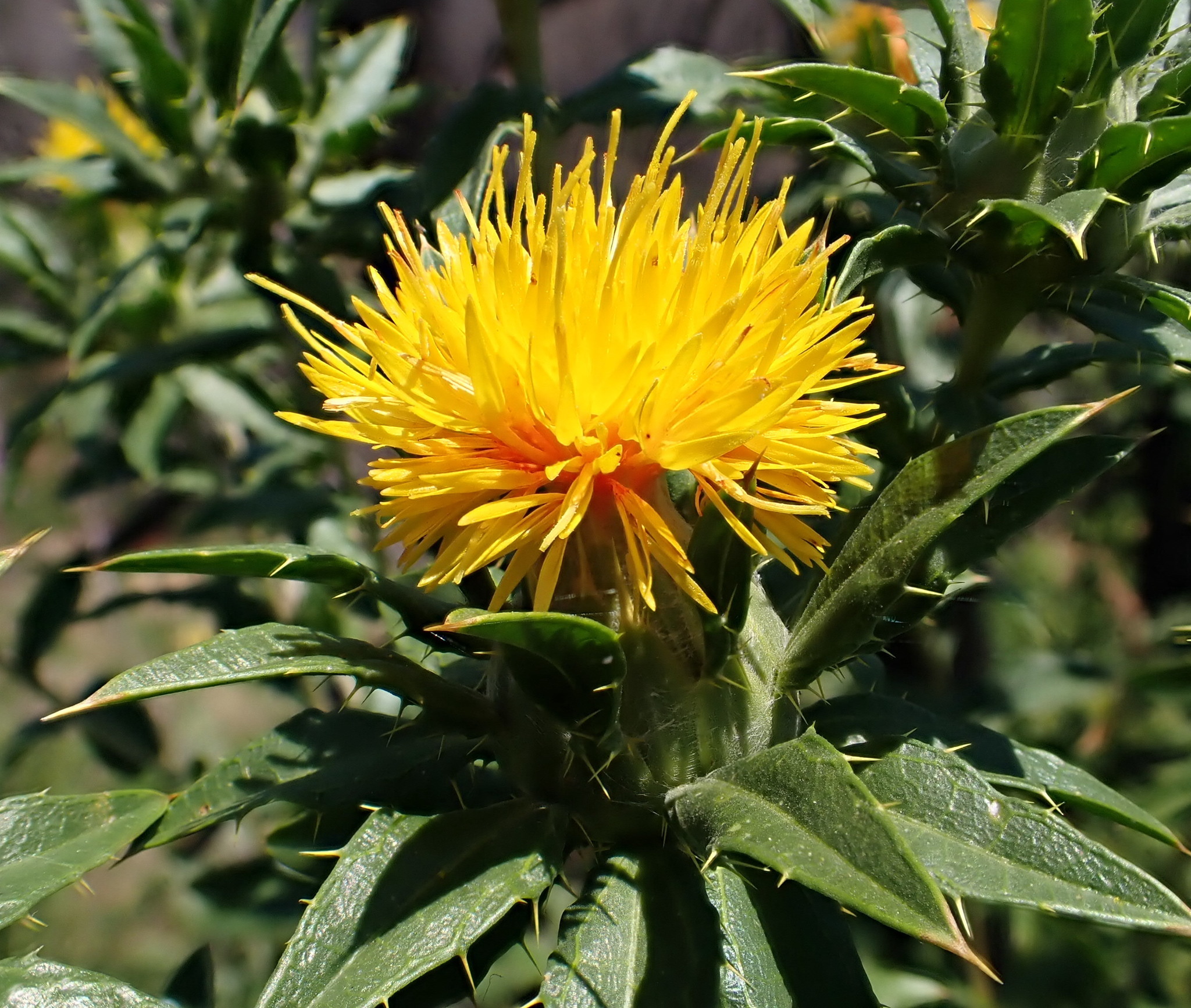
Safflower (Carthamus tinctorius) is a thistle-like annual in Asteraceae, known only in cultivation. Originating in central and eastern Türkiye and Iran, it has a much-branched stem topped by globular yellow-orange heads that turn red and are surrounded by spiny bracts. Grown since antiquity for flower dyes, it is now chiefly cultivated for seed oil.
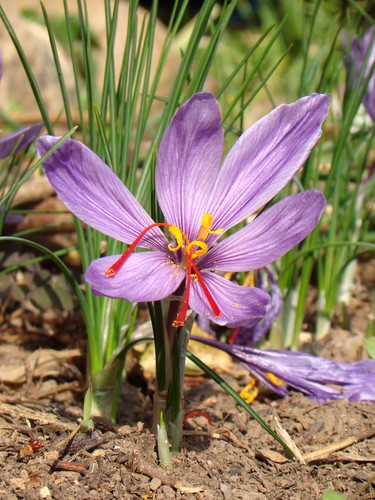
Read moreSafflower and False saffron



© photo
no rights reserved, uploaded by 葉子 · cc0
Mike Palmer · cc0
Ed Alverson · cc-by
Taken Aug 15, 1987 by Photoflora - Jean-Luc TASSET (©)
Taken Jul 12, 2020 by Gerda Teunissen (cc-by-sa)
Taken May 8, 2019 by natalia scrobota (cc-by-sa)
Taken Jul 12, 2022 by Debra Sweeney (cc-by-sa)
© copyright of the Board of Trustees of the Royal Botanic Gardens, Kew.




Global distribution
The presumed origin of Carthamus tinctorius lies in central and eastern Türkiye and Iran, where it is known only in cultivation, probably derived from wild Carthamus persicus. Cultivated since antiquity, it has spread to many arid and semi-arid countries without ever becoming persistently naturalized outside cultivated fields.
- Native2
- Introduced1
- Türkiye
- Iran
- France
Hexagons: regions where the plant occurs. Green dots: native range.1
Identity
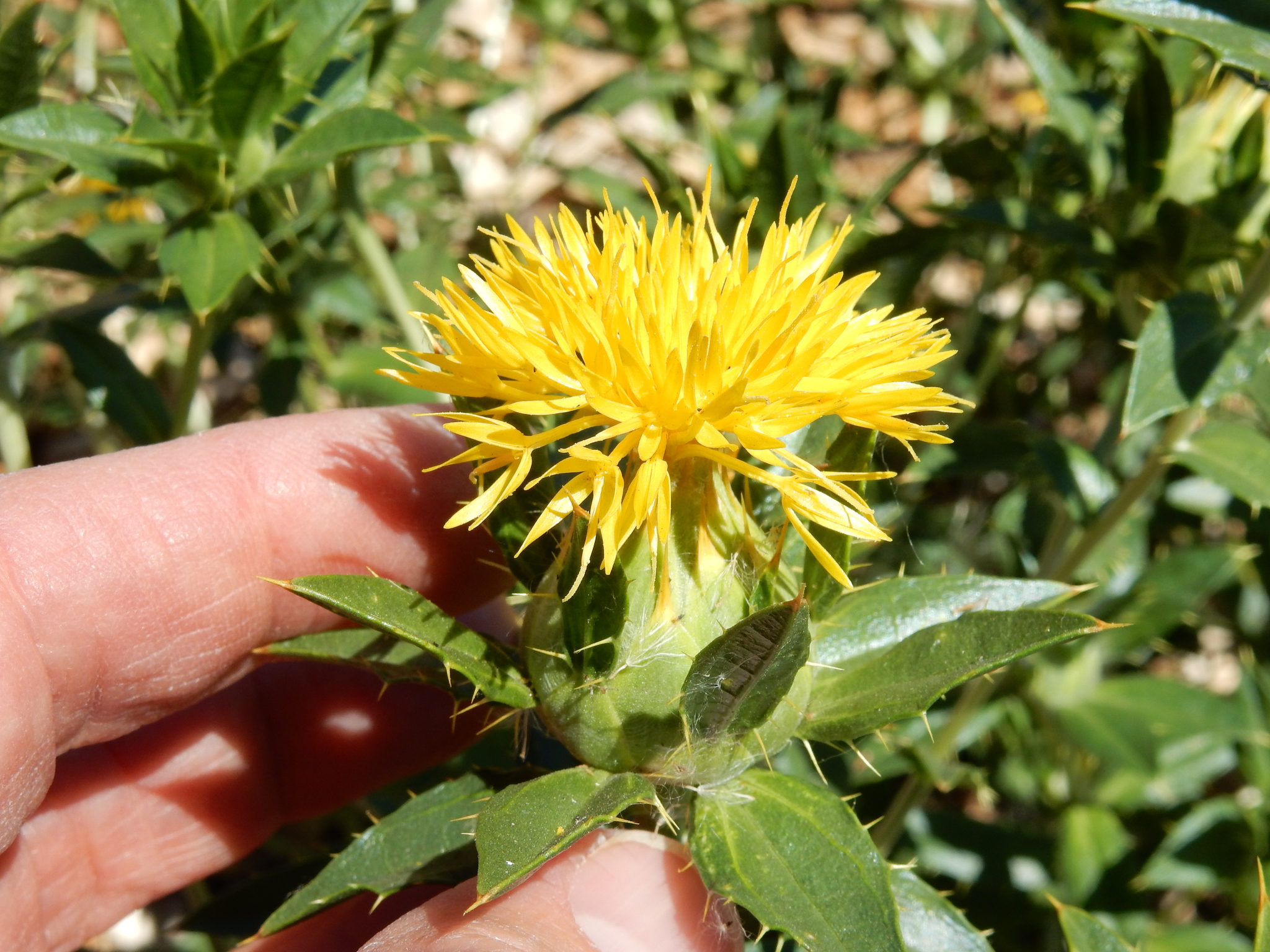
Safflower (Carthamus tinctorius L., 1753) has globular flower heads 2–4 cm (0.8–1.6 in) across, surrounded by spiny bracts. They clearly distinguish it from true saffron (Crocus sativus), an Iridaceae plant harvested for three stigmas per flower rather than entire heads. Also called false saffron, safflower is a much-branched, thistle-like annual in Asteraceae. Known only in cultivation, it originates in central and eastern Türkiye and Iran, according to POWO, and is thought to derive from wild Carthamus persicus. 1 3
Common French names meaning dyer’s saffron and bastard saffron recall an old fraud: merchants substituted dried safflower heads for true saffron, obtained from Crocus sativus stigmas. The epithet tinctorius records its use as a dye; carthamus comes from medieval Latin carthamo, itself borrowed from Arabic qurtum. 8
Recognition
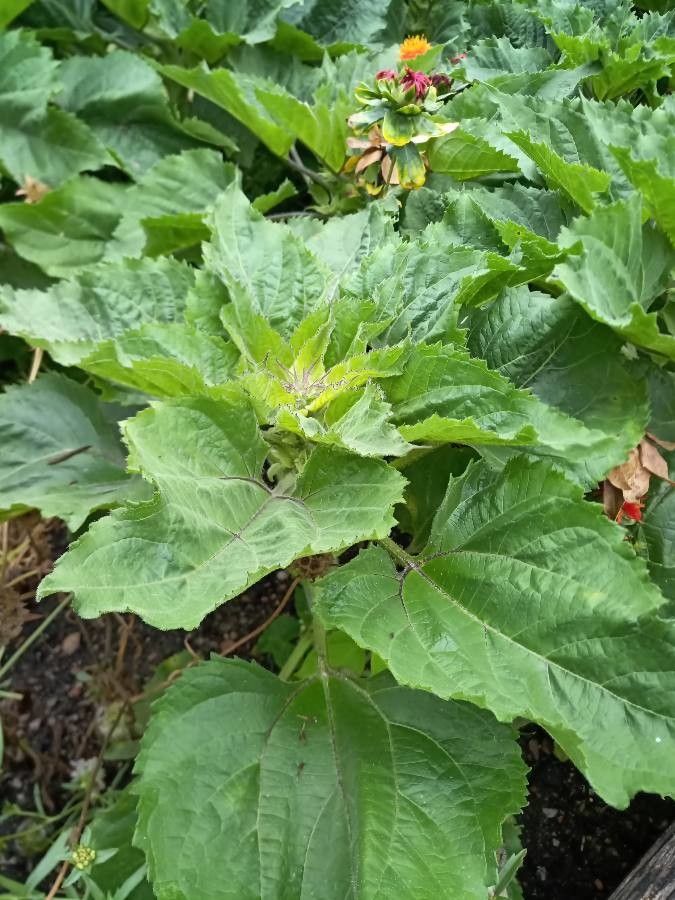
An upright, whitish, much-branched stem reaches 30–150 cm (12–59 in) tall, each branch carrying several heads. Sessile, lance-shaped to elliptical leaves measure 7–15 cm (3–6 in) long and 2.5–6 cm (1–2.4 in) wide. Their toothed, spiny margins become more pronounced on upper leaves. 3 4
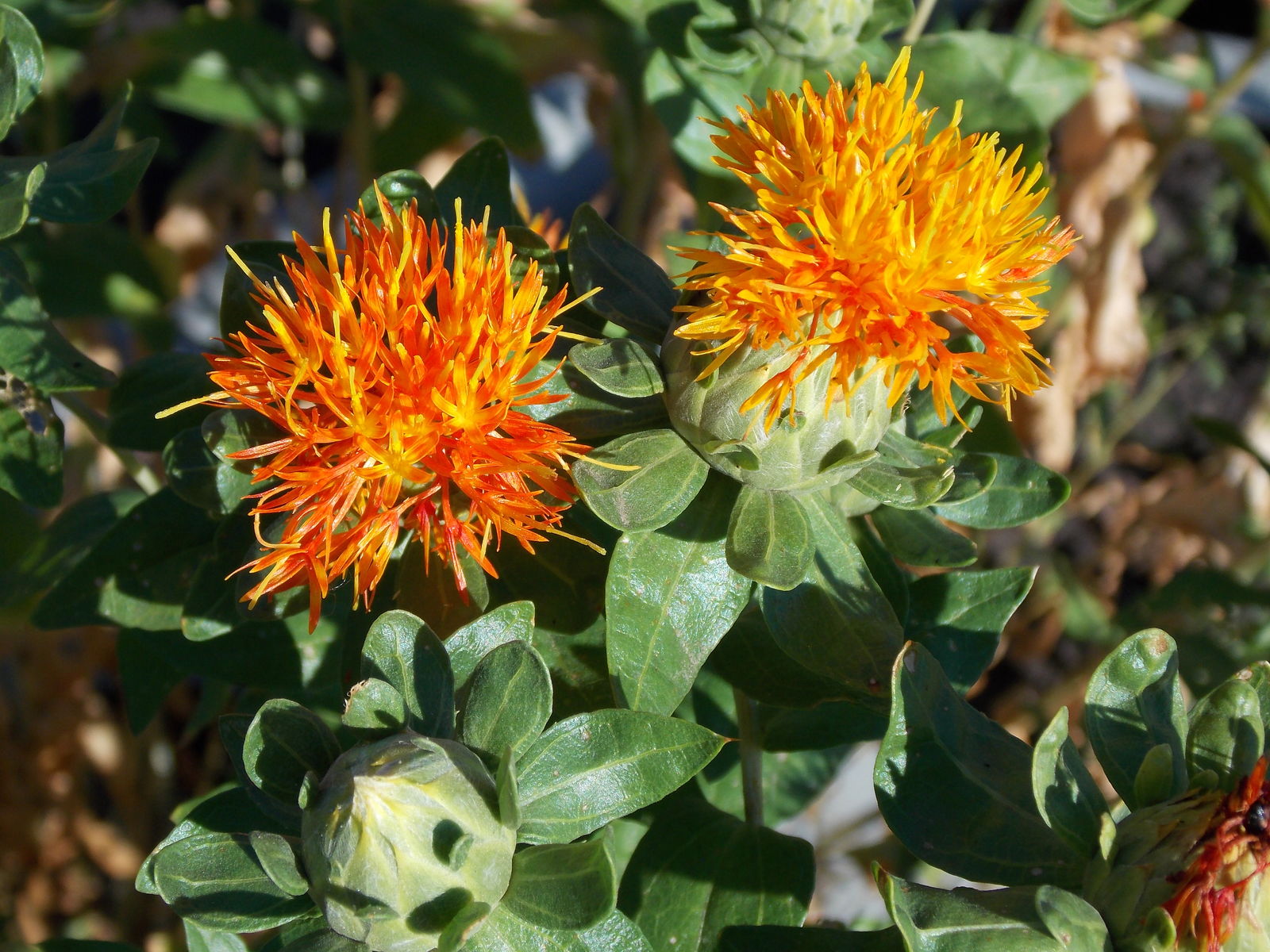
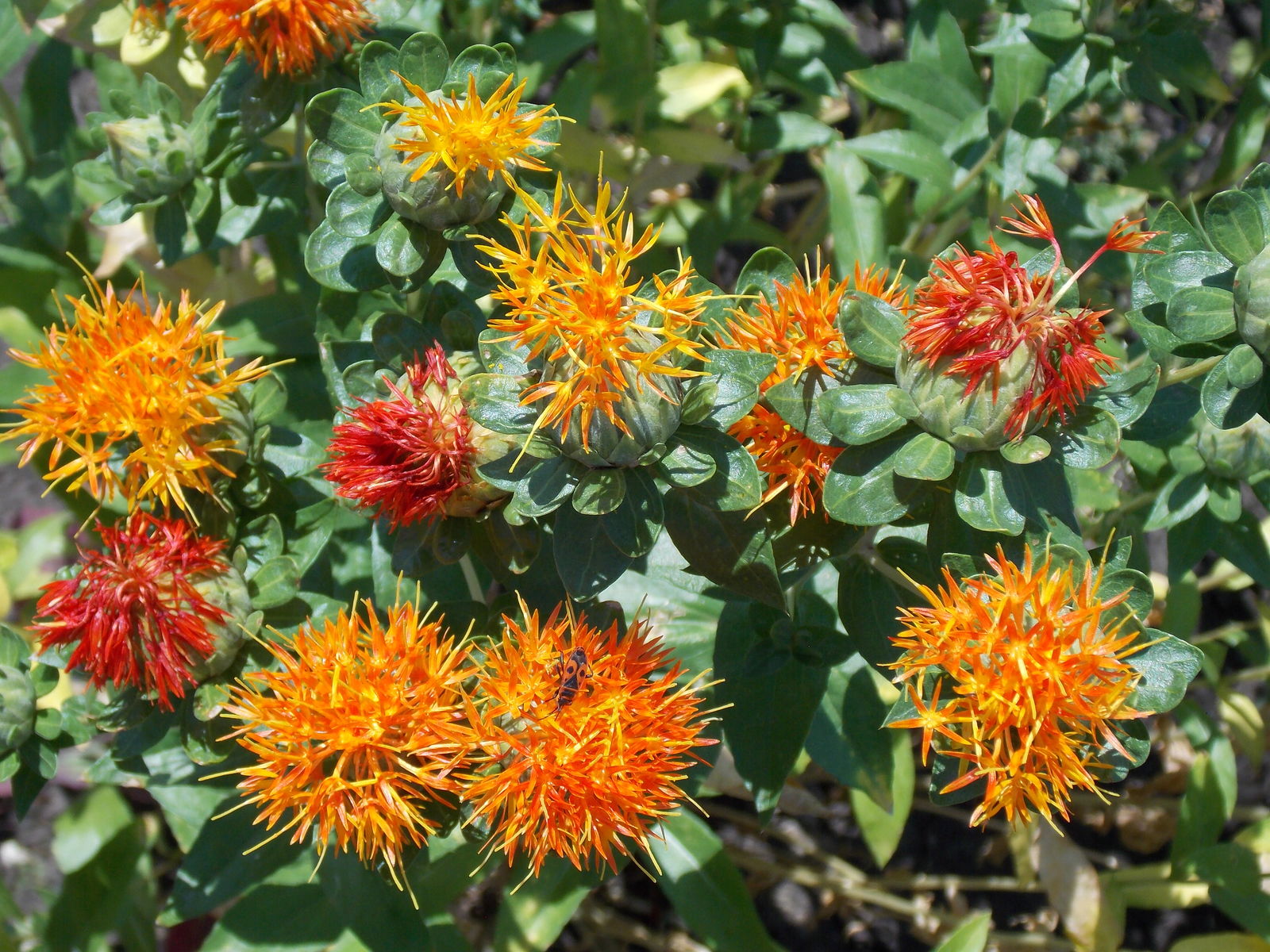
Globular flower heads 2–4 cm (0.8–1.6 in) across have thistle-like spiny bracts. Florets open yellow to orange, then turn red as the head ages; each head produces 15–50 seeds. 4 3
A deep taproot anchors the plant and explains its drought tolerance. This same organ separates safflower from ordinary thistles with shallower roots. White to gray, egg-shaped achenes measure 6–8 mm (0.24–0.31 in) long and lack the feathery pappus found in most other Asteraceae. 4
Useful taxonomy
POWO/WCVP accepts Carthamus tinctorius L., the only member of the genus cultivated on a large scale. Two botanical varieties organize current production: spiny var. tinctorius, closer to the presumed wild ancestor, dominates oilseed growing; spineless var. inermis Kitam. makes hand harvesting heads for dyes and dried bouquets easier.
About twenty Mediterranean species belong to Carthamus. In France, safflower remains the only one offered in the horticultural trade. Its full scientific name therefore provides the stable reference when sales names cause confusion. 6 1
Habitat and range
The presumed native region in central and eastern Türkiye and Iran has arid conditions with seasonal rainfall. A deep taproot helps the plant thrive on poor soils. Cultivated since antiquity, it has spread through Central Asia, India, North America and Europe without ever forming truly wild populations there. 1 3
France has a long history of growing safflower for medicinal and dye uses. It occasionally self-seeds near fields but never establishes persistently outside cultivation. 6
Present-day production is concentrated in Kazakhstan, Russia, India and Mexico, with continental or semi-arid climates comparable to that of the presumed region of origin. 4
Life cycle and reproduction
For spring sowing, soil warmed to around 15 °C (59 °F) allows emergence in three to eight days. Young plants remain in a rosette for two to three weeks before stem elongation. Only at that stage do they tolerate brief frosts to −7 °C (19 °F); this tolerance disappears as stems lengthen and branch. 4
Summer flowering is followed by achene ripening over 30–35 days. From sowing to harvesting dry heads, the full cycle lasts 110–150 days, depending on climate and sowing time. 3
Propagation is exclusively by seed, sown shallowly in its final position. The deep taproot establishes in the first season and tolerates late transplanting poorly. 3
Uses and risks
Textile dye was its earliest major use. Chemical analyses identified safflower dyes on Egyptian textiles from the 12th Dynasty, 1991–1785 BCE; flower garlands decorated 18th-Dynasty mummies, including Tutankhamun’s. Two pigments underlie this use: red carthamin and yellow carthamidin, both extracted from florets without a mordant. 8
Oilseed production now dominates. Seeds provide an edible oil rich in unsaturated fatty acids, used for cooking, cosmetics and, in high-oleic varieties, biodegradable lubricants. Dried flower heads are also sold as inexpensive food coloring and a visual saffron substitute. 7 8
The cited ASPCA reference leads to the general plant list without a safflower-specific entry. It does not establish veterinary safety. The ASPCA gives a general warning that eating plant material can cause digestive upset in cats and dogs. 5
Varieties, look-alikes and related plants
Cultivated types differ chiefly in spines and seed-oil composition, with selections rich in either oleic or linoleic acid. None is a separate species; the full species and variety name remains the taxonomic reference. 4
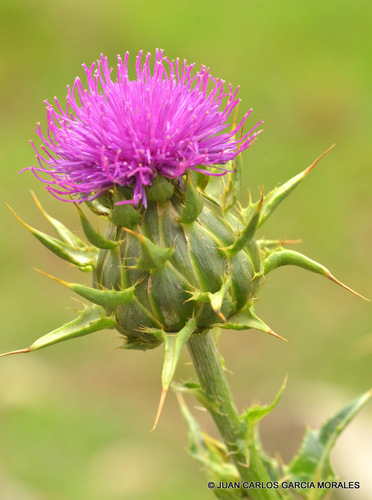
True saffron (Crocus sativus) is the principal source of confusion. Its three red stigmas per flower are picked by hand, making production far more expensive than harvesting whole safflower heads. Other spiny Asteraceae, such as Cynara cardunculus and Silybum marianum, have superficially similar habits but much larger, purplish heads, unlike safflower’s yellow-orange ones. 7
Main sources
- Plants of the World Online / Kew, Carthamus tinctorius L.
- Royal Horticultural Society, Carthamus tinctorius (safflower)
- Plants For A Future, Carthamus tinctorius
- North Dakota State University Extension, Safflower Production
- ASPCA, Toxic and Non-Toxic Plants List (general index)
- INPN/MNHN, Carthamus tinctorius L., 1753
- PMC, Genetic diversity, clinical uses and pharmacological properties of safflower
- Purdue University NewCROP, Safflower
Frequently asked questions
Is safflower the same plant as saffron?
No. Safflower (Carthamus tinctorius, Asteraceae) and saffron (Crocus sativus, Iridaceae) belong to different families. Whole dried safflower heads provide an inexpensive coloring, while true saffron consists of the three red stigmas from each crocus flower.
Is safflower poisonous to cats and dogs?
The cited ASPCA reference provides no safflower-specific entry and does not establish its safety for cats or dogs. The ASPCA gives a general warning that eating plant material can cause digestive upset in these animals.
What are safflower flowers used for today?
Dried heads chiefly provide inexpensive food coloring and a visual substitute for saffron in cooking. Historically, they first supplied red and yellow textile dyes, before synthetic dyes reduced this use during the 20th century.
Why is safflower now mainly grown for its seeds?
The seeds yield an edible oil rich in unsaturated fatty acids, used in cooking, cosmetics and, for high-oleic types, biodegradable lubricants. This use has largely overtaken dye production worldwide.
Is safflower invasive in France?
No. Long grown for dyes and medicinal uses, it occasionally self-seeds near fields but does not establish wild populations outside cultivation.
Why do some safflower varieties lack spines?
Spineless selections, known as var. inermis, make hand harvesting flower heads for dried arrangements and dyes easier. Spiny types, closer to the presumed wild ancestor, remain favored for oilseed production.
How can safflower be distinguished from an ordinary garden thistle?
Globular yellow-orange heads that turn red, surrounded by spiny bracts but without a large purple ruff, distinguish safflower from common thistles. The much-branched whitish stem and achenes lacking a feathery pappus confirm the identification.
Similar plants
If you are unsure about a plant’s toxicity, ask a botanist or veterinarian for advice.