
Harlequin glorybower (Clerodendrum trichotomum, )
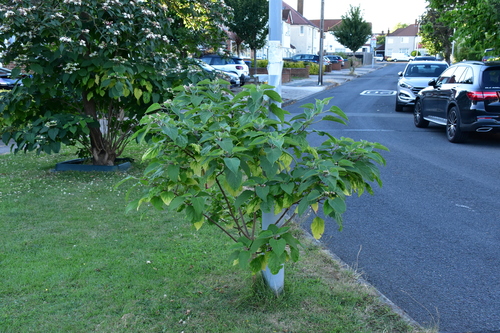

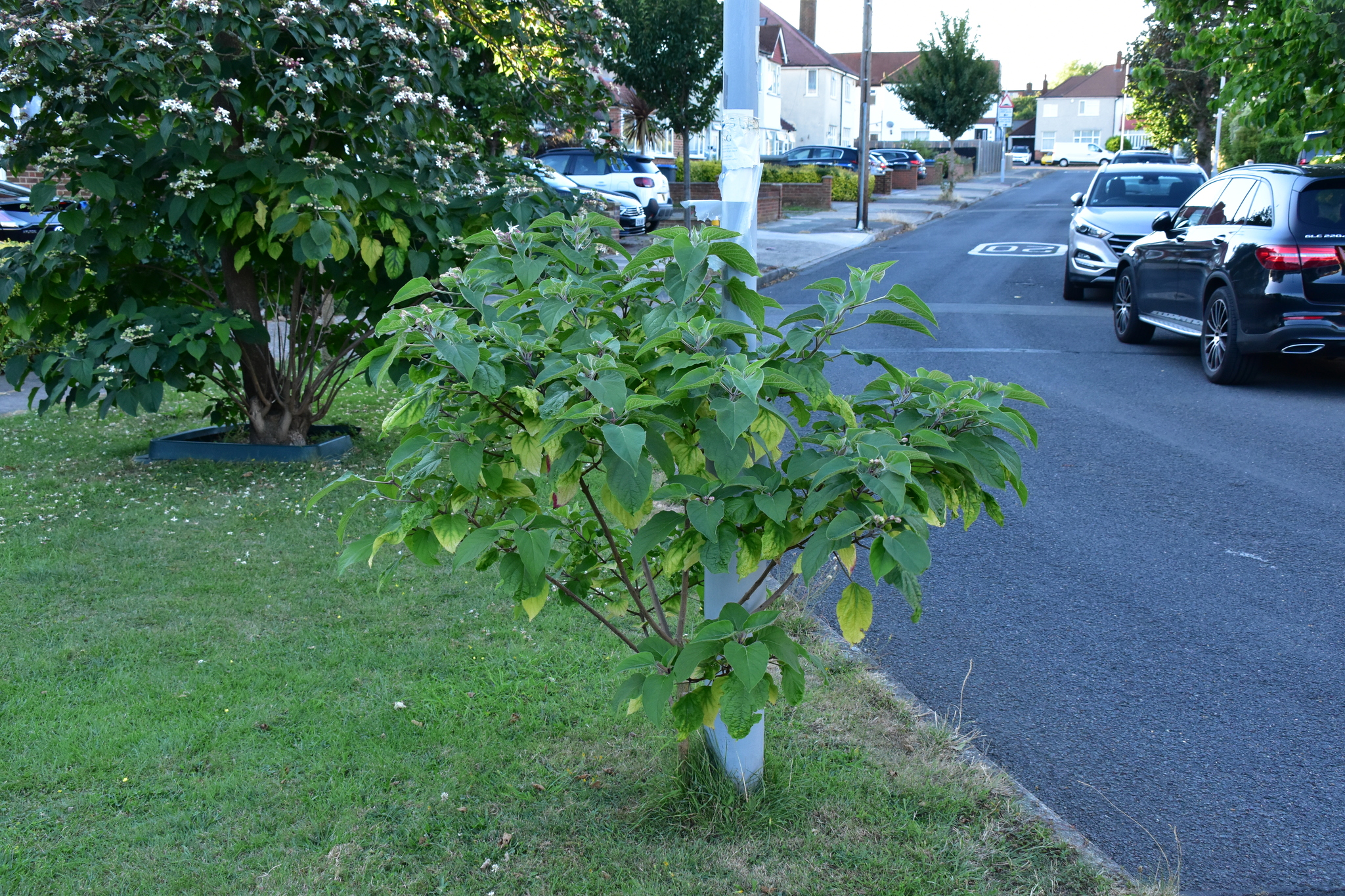
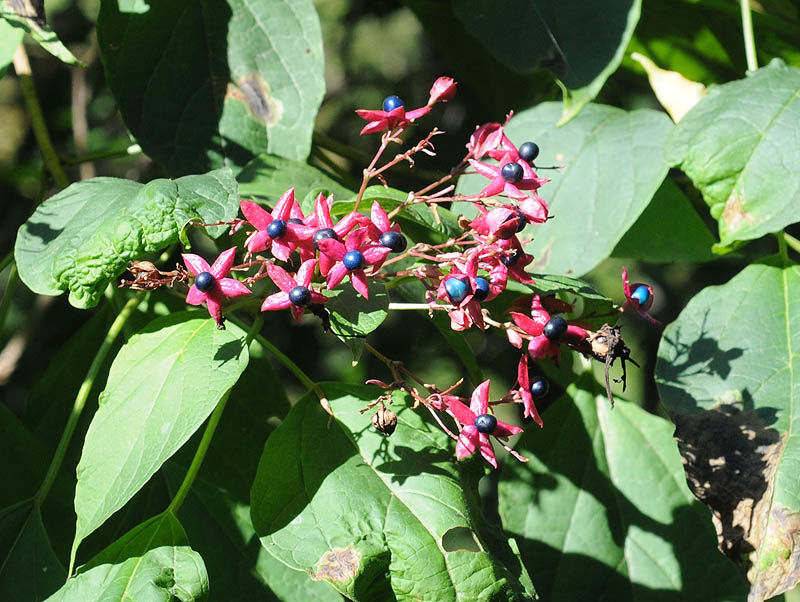
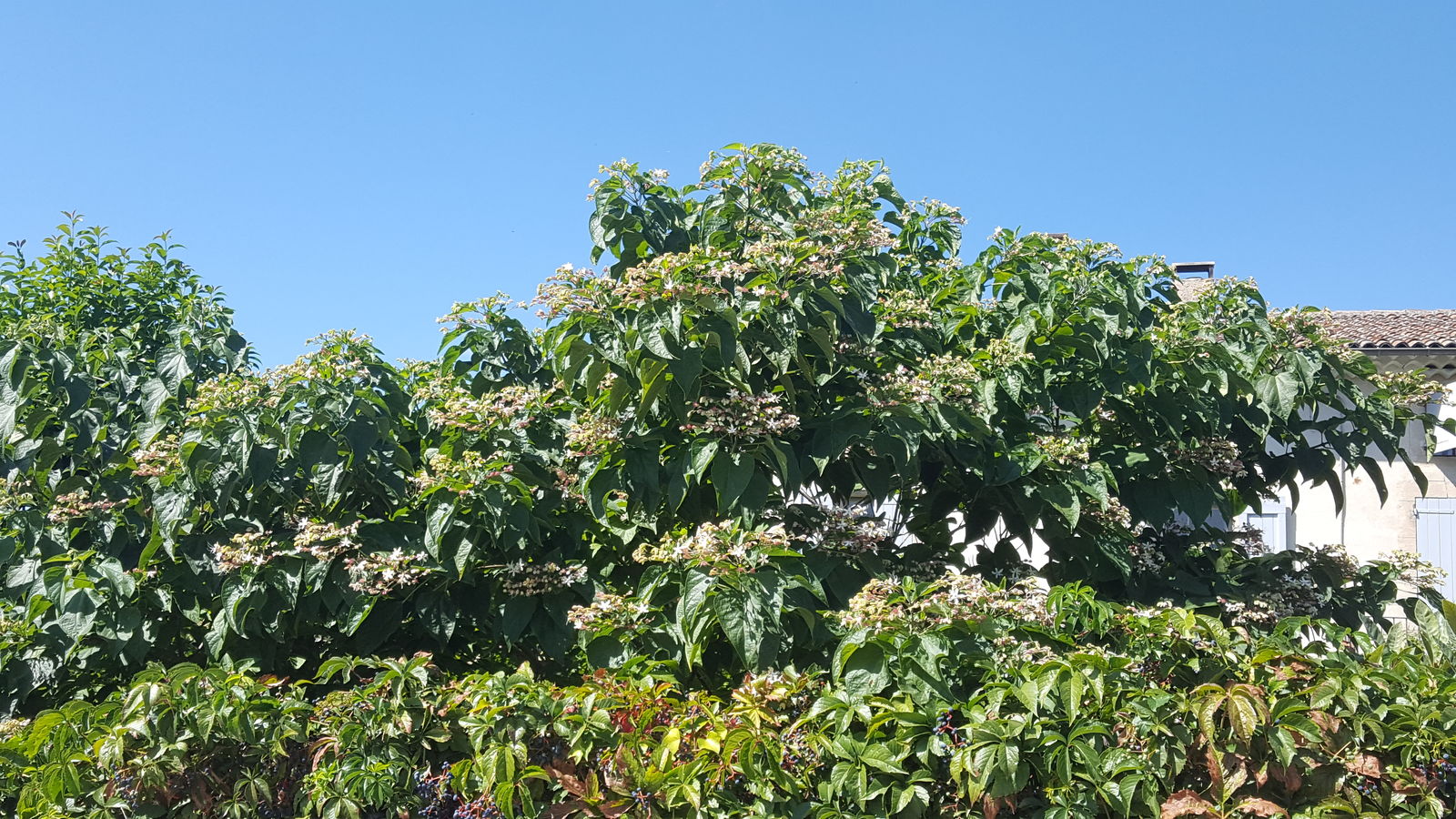
Harlequin glorybower (Clerodendrum trichotomum) is a deciduous shrub or small tree in the Lamiaceae family, native to China, Korea, Japan, Taiwan, India and the northern Philippines. Its highly fragrant white flowers sit within a red calyx and give way to small turquoise-blue drupes that persist into fall.
Read moreHarlequin glorybower, Peanut butter tree and Glorytree


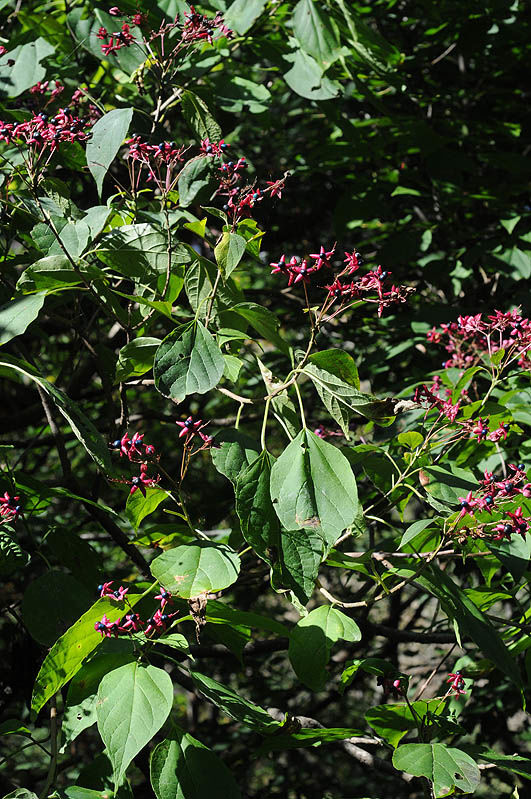
© photo
jamie-aa · cc0
Wikimedia Commons · CC BY-SA or Public Domain
Wikipedia · CC BY-SA
Taken Aug 12, 2020 by Diego Alex (cc-by-sa)
Taken Oct 25, 2020 by Diego Alex (cc-by-sa)
Taken Aug 22, 2021 by Manuel Hernández (cc-by-sa)
Taken Mar 26, 2022 by Annemarie Ahrens-Stehle (cc-by-sa)
Taken Jul 28, 2022 by Tristan Jaton-Maria (cc-by-sa)
© copyright of the Board of Trustees of the Royal Botanic Gardens, Kew.




Global distribution
The native range of Clerodendrum trichotomum extends from central and southern China to Korea, Japan, Taiwan, India and the northern Philippines. Cultivated in Europe since about 1800, it is widely planted in the southeastern United States, although UF/IFAS rates it as a high invasion risk in Florida.
- Native6
- Introduced1
- Invasive1
- Central and southern China
- Korea
- Japan
- Taiwan
- India
- Northern Philippines
- Arkansas (United States)
- Florida (United States)
Hexagons: regions where the plant occurs. Green dots: native range.1
Identity
Harlequin glorybower (Clerodendrum trichotomum Thunb., 1784), also called peanut butter tree or glorytree, is a shrub or small tree in the genus Clerodendrum, family Lamiaceae. POWO, IPNI and GBIF agree on this accepted name, published by Carl Peter Thunberg. 1 2 3
The genus name combines Greek klêros, referring to chance, a lot or the clergy, with déndron, meaning tree. The epithet trichotomum means “three-branched,” referring to the three-forked cymes of the inflorescence. Depending on the interpretation of the Greek root, the name can be read as chance tree or clergy tree. 6
Recognition
Young green, four-angled, slightly downy stems develop into a deciduous shrub 2 to 8 m (7 to 26 ft) tall. Opposite, oval, soft leaves commonly measure 10 to 23 cm (4 to 9 in) long. When crushed, they release a recognizable peanut butter odor, a useful identifying feature in the field. 4 5
White, tubular, highly fragrant flowers open in flattened cymes on long stalks in the axils of the upper leaves. Their surrounding green calyx gradually turns red as the fruit ripens. The contrast between white corolla, red calyx and young turquoise drupe is the clearest visual combination for identifying the species. 4 12
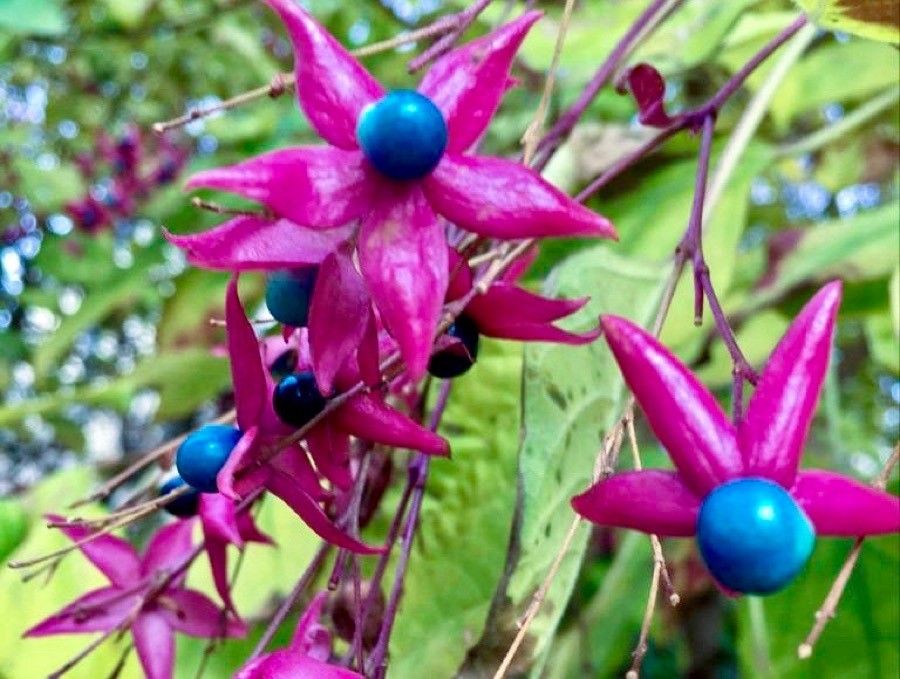
Each small turquoise-blue drupe turns dark blue at maturity and remains supported by its persistent red calyx. A plant growing alone flowers normally but generally does not set fruit: the flowers are not self-fertile, and at least two plants are needed to obtain fruit. 4 13
Taxonomy and names
Current classifications in POWO, IPNI and GBIF place Clerodendrum trichotomum in the Lamiaceae, order Lamiales. Some older references, including the University of Copenhagen arboretum account, still use the former family placement, Verbenaceae. 1 11
The World Checklist of Vascular Plants places several historical varieties, including var. fargesii, var. ferrugineum and var. esculentum, in the synonymy of the typical species. Horticultural practice nevertheless continues to treat var. fargesii separately, with its own RHS entries and its cultivar Carnival. 1 4
About 400 species belong to Clerodendrum, most of them tropical. Only two, C. trichotomum and Clerodendrum bungei, were already cultivated as hardy shrubs in pre-Linnaean Europe, one considered lucky and the other unlucky. 12
Habitat and range
Central and southern China, Korea, Japan, Taiwan, India and the northern Philippines form its native range. It occupies woodland edges and scrub in humid temperate to subtropical climates. 1 11
European cultivation dates to about 1800. The species has become widespread in British gardens, where two of its forms hold the RHS Award of Garden Merit. 11 4
In the United States, the Russian botanist Karl Maximovich introduced it to Arkansas as early as the 1860s, and it remains widely planted in the Southeast. UF/IFAS nevertheless rates it as a high invasion risk in Florida, with a predictive score of 9 on its scale and a recommendation against planting. Globally, the IUCN assesses it as Least Concern. 13 7 8
Life cycle and flowering
Summer heat brings the first flowers, at a time when few other shrubs still offer color, and flowering continues until the first frosts. Flowers form on the current season’s wood, so spring pruning is compatible with normal flowering in seasonal temperate conditions. 12
The drupe’s distinctive blue pigment, trichotomine, was isolated and chemically characterized in 1978. Rare in the plant kingdom, it accounts for the fruit’s unusual turquoise color. 10
Propagation uses seed or semi-ripe cuttings taken in early summer and rooted under mist. The plant transplants readily and regenerates easily from its roots, which also explains its tendency to send up suckers around the original plant. 12 11
Uses and risks
Fragrance and late flowers are the main reasons for planting this ornamental shrub. It works in informal hedges, as a specimen near a sheltered wall or among other shrubs. Its flowering arrives when relatively few other shrubs are in bloom, a seasonal difference that draws flower-visiting insects. 9 11
No toxic compound is documented for this species in cats, dogs, horses or children, but caution remains appropriate if it is ingested. In parts of East Asia, young leaves are traditionally eaten cooked after boiling to remove their characteristic odor. 11
Its main concern is ecological rather than toxicological. It naturalizes readily and is considered a high invasion risk in Florida by UF/IFAS, while two forms remain RHS award winners in the United Kingdom. Recommendations therefore depend on regional climate and ecological pressure: recognition in British gardens does not override the warning against planting in Florida. 7
Varieties, cultivars and look-alikes
Compact growth, bronze young leaves and especially fragrant flowers distinguish variety fargesii (Dode) Rehder from the typical species. It is also reputed to be hardier. Its variegated cultivar Carnival shares its RHS Award of Garden Merit. 4
The North American cultivar Stargazer has variegated leaves and yellow-edged flowers, a horticultural label distinct from variety fargesii. 6
The closest commonly confused plant is Clerodendrum bungei, the other species of the genus long grown in Europe for its hardiness. Crushed leaves smelling of peanut butter, the persistent red calyx and the turquoise-blue drupe remain the most reliable field marks of C. trichotomum. 12 5
Main sources
- Plants of the World Online / Kew, Clerodendrum trichotomum Thunb.
- International Plant Names Index, Clerodendrum trichotomum Thunb.
- GBIF Backbone Taxonomy, Clerodendrum trichotomum Thunb.
- Royal Horticultural Society, Clerodendrum trichotomum
- NC State Extension Gardener Plant Toolbox, Clerodendrum trichotomum
- Oregon State University Landscape Plants, Clerodendrum trichotomum
- UF/IFAS Assessment of Non-Native Plants in Florida, Clerodendrum trichotomum
- IUCN Red List, Clerodendrum trichotomum assessment (2022)
- Missouri Botanical Garden Plant Finder, Clerodendrum trichotomum
- Iwadare, Shizuri, Yamada & Hirata, 1978, synthesis of trichotomine, Tetrahedron
- University of Copenhagen, Arboretum Hørsholm, Clerodendrum trichotomum plant description
- JC Raulston Arboretum, NC State University, Clerodendrum trichotomum plant profile
- University of Arkansas Division of Agriculture, Plant of the Week, Harlequin Glorybower
Frequently asked questions
Is harlequin glorybower invasive?
That depends on the climate. In France it is not classified as an invasive alien species, but UF/IFAS considers it a high invasion risk in Florida. Wherever it grows, it readily produces root suckers, so watch the area around the base.
Why do the leaves smell like peanut butter?
Crushed leaves naturally release this odor, a trait described by several North American university plant resources. It is not a sign of disease and helps confirm identification.
Do I need two plants to get fruit?
Yes. Clerodendrum trichotomum flowers are not self-fertile. A solitary plant flowers but generally fails to fruit because it lacks cross-pollination.
Is harlequin glorybower toxic to cats and dogs?
No veterinary toxic compound is documented for this species. Caution is still appropriate if it is eaten, even though young leaves are traditionally consumed cooked in parts of East Asia.
How does variety fargesii differ from the typical species?
Variety fargesii is more compact, with bronze young leaves and even more fragrant flowers. It is also considered hardier, explaining its popularity in the United Kingdom, where both it and its cultivar Carnival have received the RHS Award of Garden Merit.
Where should I plant harlequin glorybower?
Choose full sun to partial shade, preferably sheltered by a wall, in fertile, well-drained soil. Shelter supports flowering and reduces frost damage to the current season’s wood.
How can I distinguish it from other Clerodendrum species?
The combination of a peanut butter smell from crushed leaves, a persistent red calyx and a turquoise-blue drupe distinguishes it, especially from Clerodendrum bungei, the other species long cultivated in Europe.
Similar plants
If you are unsure about a plant’s toxicity, ask a botanist or veterinarian for advice.