
Venus flytrap (Dionaea muscipula, )
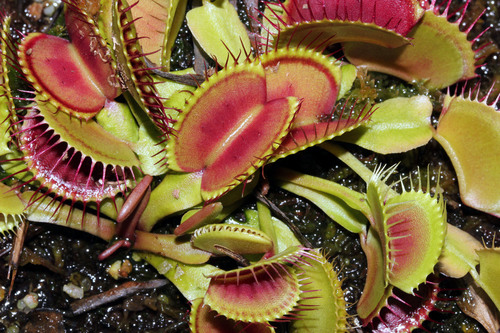
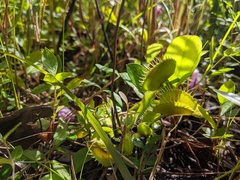
Venus flytrap (Dionaea muscipula) is a carnivorous perennial in the Droseraceae and the only species in its genus. Native to a small area of coastal wetlands in North Carolina and South Carolina, it catches prey with a hinged trap at the end of each leaf. Repeated stimulation of sensitive hairs triggers closure in about one tenth of a second.
Read moreVenus flytrap




© photo
(c) David Hill, some rights reserved (CC BY) · cc-by
Austin Pursley · cc0
Chris Wyse · cc0
Taken Jul 20, 2019 by Blumenfee (cc-by-sa)
Taken Aug 12, 2022 by manuseitz (cc-by-sa)
Taken Oct 2, 2021 by Nathalie V (cc-by-sa)
Taken Feb 18, 2022 by David Lavoie (cc-by-sa)
Taken Jul 30, 2021 by Ceren Devitt (cc-by-sa)
© copyright of the Board of Trustees of the Royal Botanic Gardens, Kew.


Global distribution
Dionaea muscipula is native to a small part of the coastal plains of North Carolina and South Carolina, within about 100 km (62 mi) of Wilmington. Naturalized populations from old plantings are reported in Florida and New Jersey bogs. Elsewhere, it is grown as an ornamental collector’s plant.
- Native2
- Introduced2
- United States (North Carolina)
- United States (South Carolina)
- United States (New Jersey)
- United States (Florida)
Hexagons: regions where the plant occurs. Green dots: native range.1
Identity
Venus flytrap (Dionaea muscipula J.Ellis, 1773) is a carnivorous perennial in the Droseraceae. In good light, an adult rosette stands 5–15 cm (2–6 in) tall and spreads 8–18 cm (3–7 in), excluding the flower stalk. It is the only species in the genus Dionaea, closely related to sundews (Drosera) and the aquatic waterwheel plant (Aldrovanda vesiculosa). Its moving snap trap shares an evolutionary origin with the trapping structures of those relatives. 1 6
Venus, the Roman goddess, gives the plant its English name. The genus name refers to Dione, associated with Venus in classical mythology; the Latin epithet muscipula means a mousetrap or flytrap. Botanist John Ellis described the plant in a letter to Linnaeus in 1768, before valid botanical publication in 1773. North Carolina colonial governor Arthur Dobbs had already reported it in 1759 as “Catch Fly Sensitive.” 7
Recognition
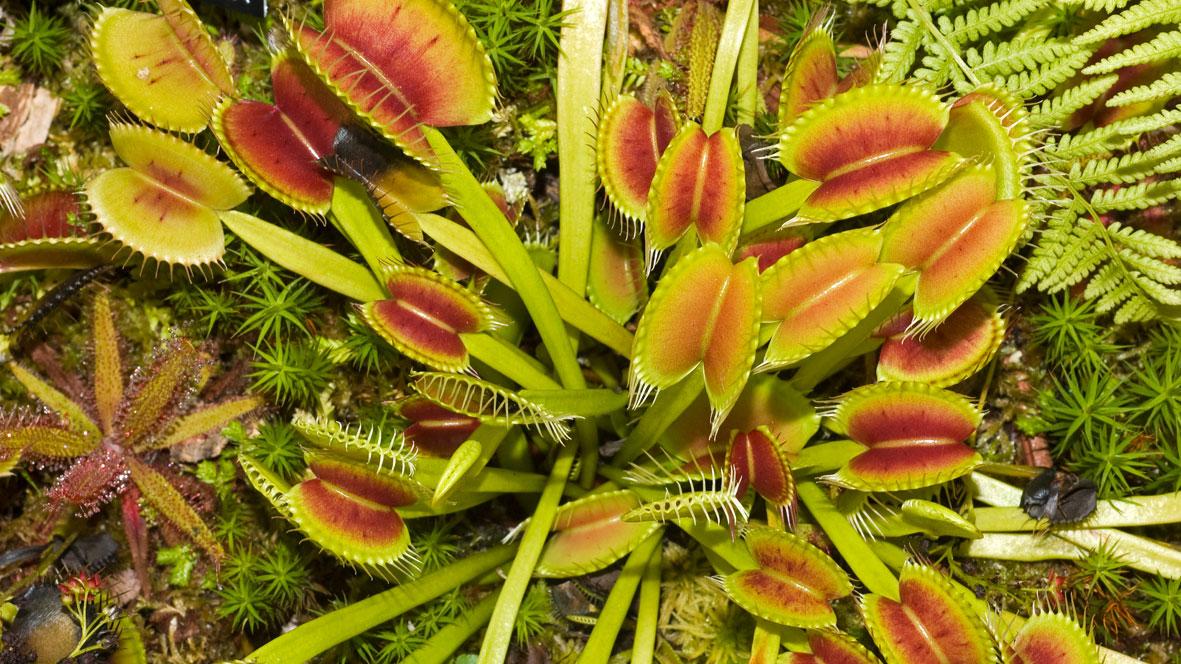
Between 4 and 7 leaves usually form the rosette. Each has a flattened, photosynthetic stalk ending in a hinged trap. Direct sunlight colors the trap interior dark red, while shade leaves it green. Marginal bristles interlock when the trap closes, forming a cage. Very small prey can slip through, saving the plant the energy needed for a full digestive cycle. 2 3
Three stiff trigger hairs stand on each lobe. A single touch does not normally close the trap: two hairs must be touched, or one hair touched twice, within roughly twenty seconds. This repeated-contact mechanism helps distinguish moving prey from a lone raindrop or windblown fragment. Closure itself takes about one tenth of a second, among the fastest movements known in plants. 7 6
After 3–6 closures, an individual trap stops working and turns black. New leaves replace aging traps as the rosette continues to grow. A well-lit specimen remains only 5–15 cm (2–6 in) tall when the flower stalk is excluded, so the active traps occupy a small space close to the ground. 3
Useful taxonomy
Only one accepted species belongs to Dionaea. Six historical names nevertheless appear in nineteenth-century botanical literature and should be distinguished from the accepted name. The following synonym list records those names and their authors:
- Dionaea corymbosa Raf.
- Dionaea sensitiva Salisb.
- Dionaea sessiliflora Raf.
- Dionaea uniflora Raf.
- Drosera sessiliflora Raf.
- Drosera uniflora Raf., illegitimate name
Historical synonyms no longer have a commercial role; they mainly occur in old catalogs and herbarium records. Use the accepted name, Dionaea muscipula, for searches and purchases. Different historical combinations do not indicate six additional flytrap species, nor do they identify the named cultivars now offered by nurseries. 1
Habitat and range
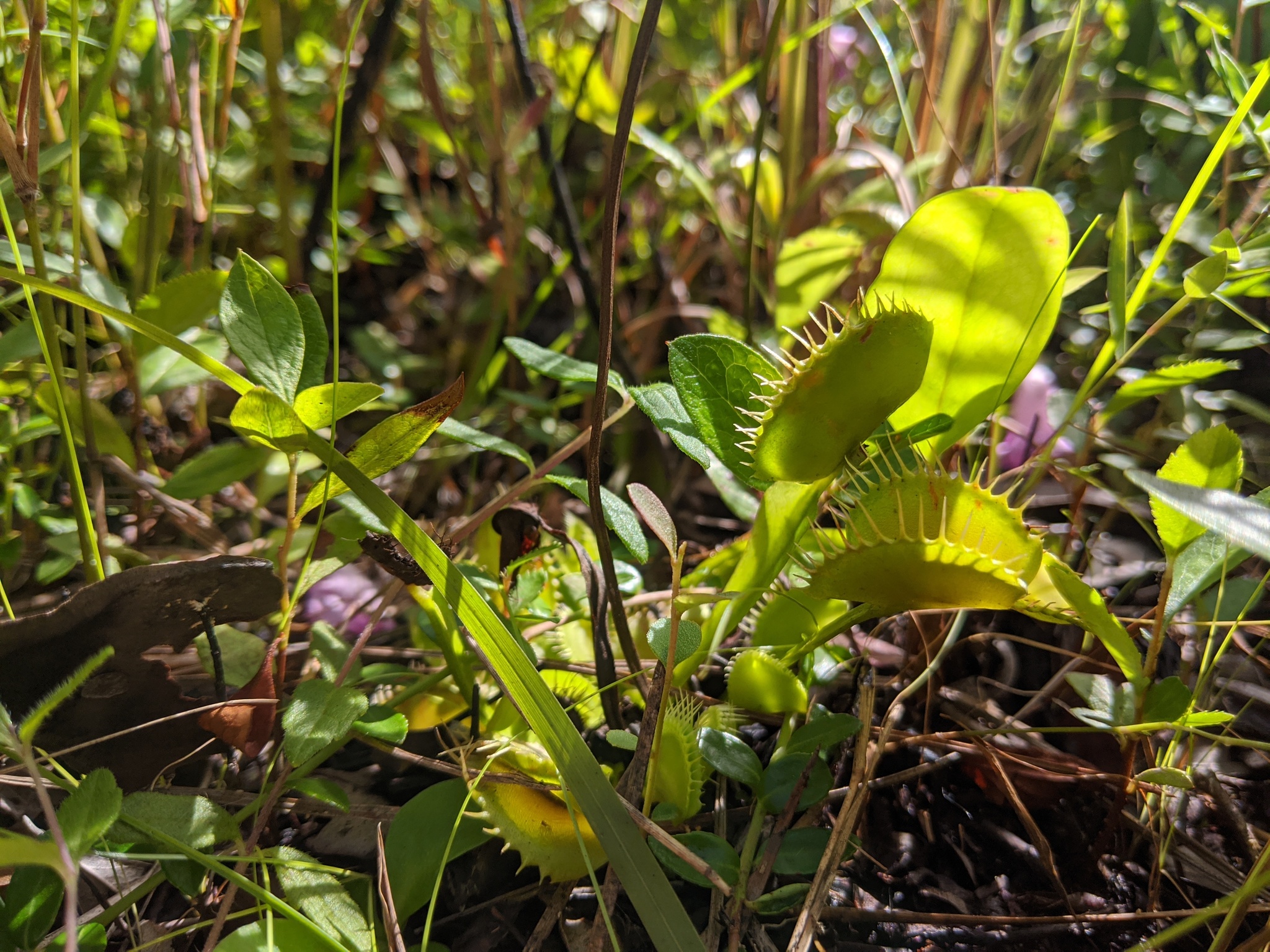
Coastal North Carolina and South Carolina hold the small native range, within roughly 100 km (62 mi) of Wilmington. Venus flytrap grows in open light in longleaf pine savannas and bogs. The ground is acidic and sandy, with little nitrogen or phosphorus, conditions that help explain the plant’s reliance on nutrients obtained from prey. 1 3
Periodic fire keeps its savanna habitat open. Without burning, shrubs and tall grasses can shade the ground and crowd out the small rosettes. Naturalized populations originating from older plantings are also reported beyond the native range, notably in Florida and New Jersey bogs. Those introduced sites do not enlarge the original Carolina range. 8
The IUCN assessment lists the species as Vulnerable. Drainage, development and the interruption of regular fires have reduced wild populations across its native range since the 1970s. Loss of suitable open wetland conditions therefore matters alongside the direct removal of individual plants. 5 8
Traps, flowering and reproduction
Digestive glands release enzymes after the trap closes around prey. Digestion takes 5–10 days, after which the trap reopens, leaving the insect’s empty outer shell. Each closure wears out the trap: after about 3–6 cycles, its tissue blackens and no longer closes. An old black trap is therefore part of normal leaf turnover. 7 2
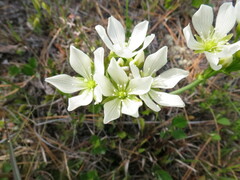
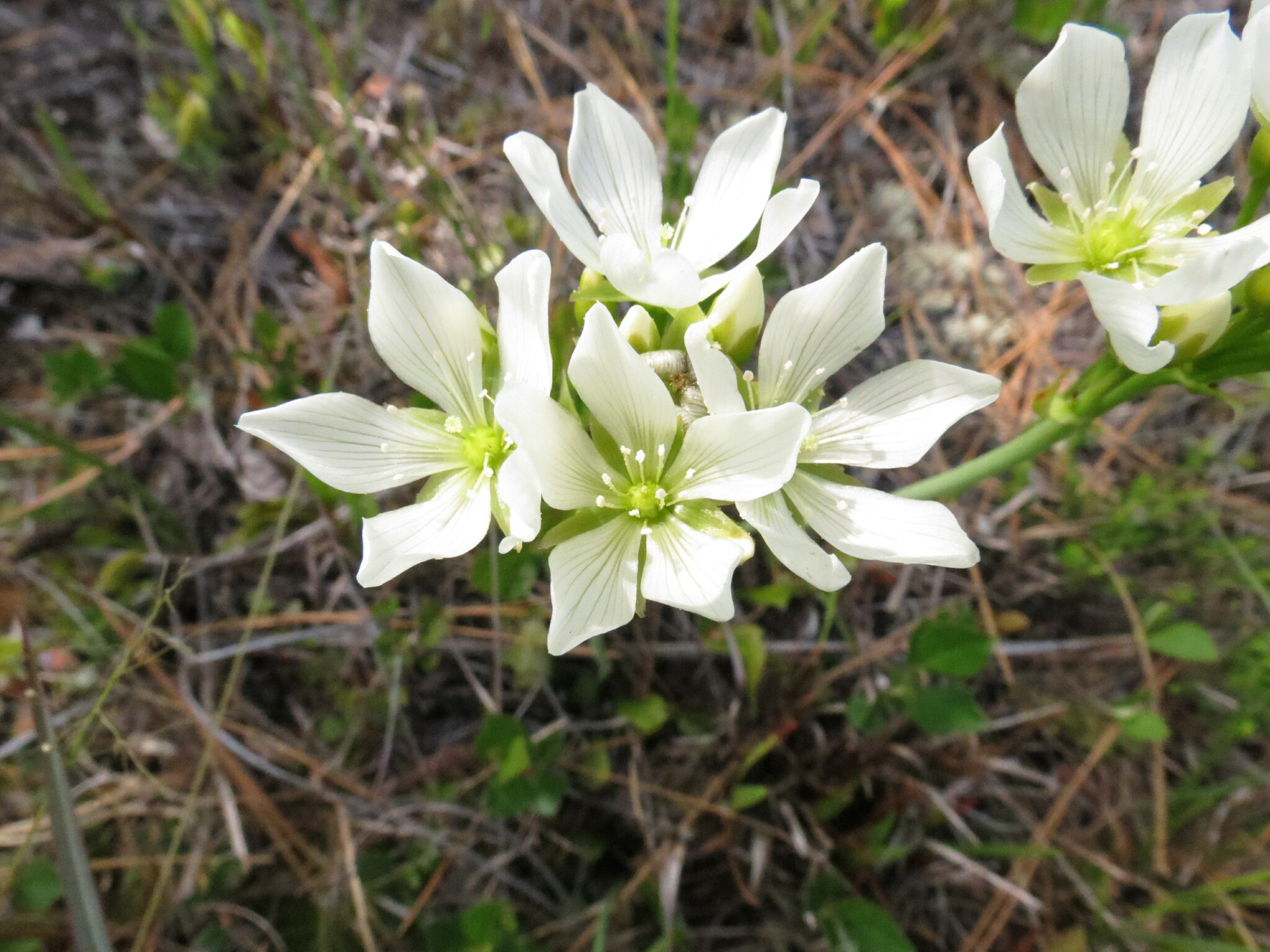
Spring flowers are white and grouped in a small cluster on a leafless stalk held well above the traps. This separation keeps visiting pollinators away from the plant’s trapping leaves. The flower stalk also explains why measurements of the whole flowering plant can greatly exceed the height of the low rosette. 3
Wild plants reproduce by seed and by natural division of the rhizome. In cultivation, rhizome division produces an identical plant within one growing season. Seedlings need roughly 4–5 years to reach their first flowering, whereas tissue culture supplies most nursery stock. These are different ways to multiply the same botanical species. 3
Uses and risks
Collectors grow Venus flytrap as an ornamental in terrariums, cool greenhouses or bright positions with a water tray. There is no known toxicity to people or household pets. ASPCA lists it as non-toxic to cats, dogs and horses, so its unusual insect-catching mechanism should not be mistaken for a chemical poisoning risk. 4 3
Conservation is the main risk surrounding its trade. North Carolina made wild poaching a felony in 2014, following decades of collection for horticulture. The IUCN assessment lists the species as Vulnerable. Most commercially sold plants come from tissue culture; checking that nursery origin helps avoid supporting the removal of plants from wild populations. 5 8
Varieties, look-alikes and related plants
Named cultivars vary in trap shape and color. Akai Ryu has entirely dark red foliage; B52 and South West Giant produce traps considerably larger than the wild type. Dentate Traps has short, toothed marginal projections instead of the usual threadlike bristles. These selections all remain Dionaea muscipula, whatever their size or pigmentation. 2
Dried or artificial flytrap replicas sold as curiosities or key rings can be mistaken for something that will grow, but they are unrelated to cultivating a living plant. Among true carnivorous plants, sundews (Drosera) and pitcher plants (Sarracenia) share bog habitats. They use sticky surfaces or passive pitchers to catch prey, respectively, rather than moving jaws. 6
Main sources
- Plants of the World Online / Kew, Dionaea muscipula J.Ellis
- Royal Horticultural Society, Dionaea muscipula - Venus flytrap
- North Carolina Extension Gardener Plant Toolbox, Dionaea muscipula
- ASPCA, Venus Fly Trap toxicity entry
- IUCN Red List, Dionaea muscipula assessment (2000)
- Royal Botanic Gardens Kew, Venus flytrap - how does it work?
- Encyclopaedia Britannica, Venus flytrap
- U.S. Fish & Wildlife Service, Venus Flytrap — Under Endangered Species Act review, June 2017; archived 21 May 2021
Frequently asked questions
Is Venus flytrap dangerous to cats or dogs?
No. ASPCA lists Dionaea muscipula as non-toxic to cats, dogs and horses. The only potential issue described here is mechanical contact if a young animal puts a paw or nose in an active trap.
Why does a trap close without catching an insect?
Debris, a drop of water or a curious finger can stimulate two trigger hairs and cause an empty closure. A trap usually reopens within a day if it detects no prey movement, but each unnecessary closure uses one of its 3–6 available cycles.
Can you water Venus flytrap with tap water?
Not unless the water is very soft and low in lime. Minerals and chlorine in tap water can damage its fine roots. Rainwater, reverse-osmosis water or demineralized water are suitable for long-term use.
Do you need to feed Venus flytrap by hand?
Outdoors or in a greenhouse, the insects it catches are enough. Indoors, an occasional small live insect can make up for a lack of prey. Never give it meat or liquid fertilizer, which can rot the trap.
Why does my Venus flytrap decline every winter?
A missing dormant period is often the problem. It needs several months of winter rest below 10 °C (50 °F). Keeping it warm and brightly lit year-round gradually exhausts it over two or three seasons.
How does Dionaea muscipula differ from sundews?
Both genera belong to the Droseraceae and share an evolutionary ancestry. Sundews capture prey with sticky tentacles, whereas Dionaea has a moving, jawlike trap. Dionaea muscipula is the only species in its genus.
Can you legally collect a wild Venus flytrap?
Wild collection is restricted in its native range. In North Carolina, poaching has been a felony since 2014. The species is listed as Vulnerable by the IUCN. Choose nursery-propagated plants, typically produced through tissue culture, rather than plants collected from the wild.
Similar plants
If you are unsure about a plant’s toxicity, ask a botanist or veterinarian for advice.