
Southern sword fern (Nephrolepis exaltata, )
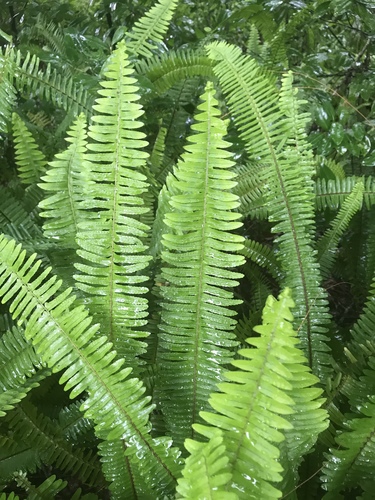
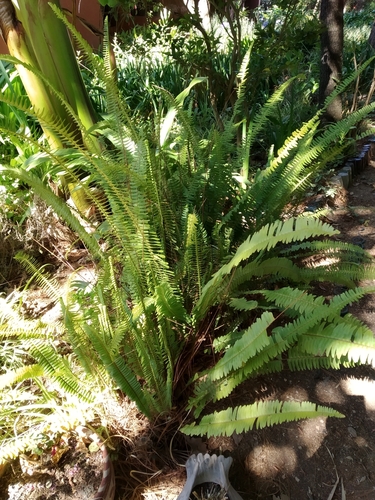
The southern sword fern (Nephrolepis exaltata (L.) Schott) is an evergreen tropical fern, widely grown as a houseplant for its arching, light green fronds. It never flowers; it spreads by spores, division and runners, and both the ASPCA and NC State list it as non-toxic to cats and dogs.
Read moreBoston fern, Boston sword fern, Sword fern and Feather palm
Place in indirect light or in a shaded room.
Global distribution
POWO and Trefle place the native range of Nephrolepis exaltata in the tropical and subtropical Americas. The same sources list several areas of introduction, including the Azores, the Canary Islands, Hawaii, India, Portugal, Queensland and Western Australia; no invasive status is recorded for France.
- Native6
- Introduced4
- Florida
- Texas
- Mexican Gulf coast
- Caribbean
- Central America
- Northern and eastern Brazil
- Hawaii
- Portugal
- Queensland
- Western Australia
Hexagons: sourced regions. Green dots: native range. Statuses according to POWO (Kew).
Identity
In the horticultural and taxonomic databases consulted, Nephrolepis exaltata (L.) Schott is the southern sword fern in its broad sense, the species behind the familiar Boston fern. The accepted name rests on a Linnaean basionym, Polypodium exaltatum, which Schott transferred to Nephrolepis in 1834. 1 2
The name Boston fern owes more to the nursery trade than to geography. It points above all to the cultivated form 'Bostoniensis', with its weeping habit, which became the classic indoor hanging-basket fern. English-language sources also use southern sword fern, Boston sword fern, sword fern and feather palm. 3 4 5
Its family placement calls for a word of caution. POWO, Trefle and NC State put Nephrolepis exaltata in the Polypodiaceae, while some secondary references still list it under Nephrolepidaceae or Lomariopsidaceae. When two sources disagree, that shift in family usually explains the gap; the fern itself is the same. 1 6 7
Recognition
Long, narrow, pinnate fronds in light to mid green form a dense evergreen clump. The RHS describes N. exaltata as a large clump of arching fronds, sometimes up to 2 m (6.5 ft) long on exceptional plants, although in cultivation the usable height is more like 0.5–1 m (1.6–3.3 ft). 7
Each frond carries numerous narrow pinnae, often oblong or slightly sickle-shaped. In 'Bostoniensis', fronds start out fairly upright, then arch and hang as they age, which is why it has always suited hanging baskets. 3 4
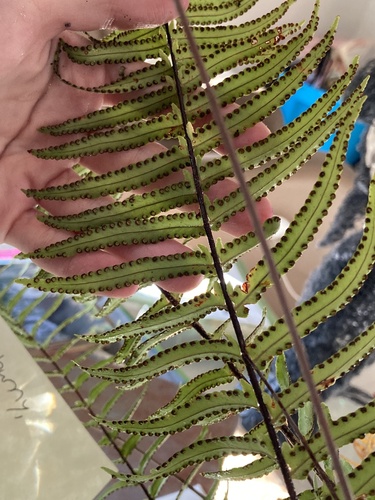
Do not mistake the sori under some fertile fronds for pests. These spore-bearing structures are perfectly normal on a fern. The plant can also send out stolons, or runners, that root into small plantlets around the clump. 8 7
Useful taxonomy
The working name is Nephrolepis exaltata (L.) Schott. POWO and Trefle treat it as an accepted name at species rank and also list two subspecies: N. exaltata subsp. exaltata and N. exaltata subsp. hawaiiensis. 1 2
At the garden center, a label may give the species, a cultivar or just "Boston fern." Names such as 'Bostoniensis', 'Dallas', 'Fluffy Ruffles', 'Florida Ruffle', 'Golden Boston', 'Rooseveltii', 'Tiger Fern' and 'Whitmanii' belong to that horticultural layer. They describe habit, frond shape or foliage color, not separate species. 3 4 9
Other Nephrolepis sold or naturalized alongside it cause the most important mix-ups. IFAS cites Nephrolepis cordifolia and N. brownii as invasive sword ferns in Florida. Runners alone therefore do not prove you have N. exaltata; look at the whole plant. 10 8
Habitat and range
POWO and Trefle place the native range in the tropical and subtropical Americas: the southern United States, the Mexican Gulf coast, Central America, the Caribbean and parts of South America. Trefle lists Florida, Texas, Louisiana, the Bahamas, Bermuda, Colombia, Costa Rica, Cuba, Ecuador, Jamaica and Brazil, among others. 1 2
The same databases record many introductions, including the Azores, the Canary Islands, Hawaii, India, Morocco, Portugal, Queensland and Western Australia. That spread reflects the southern sword fern's long horticultural history; on its own, it does not establish an invasive status in any particular country. 2 1
Horticultural sources tie the species to damp, shaded, organic sites: woodland understory, hammocks, stream banks, swamps and other sheltered spots. In a pot, that ecology translates into filtered light, a moist mix and far less tolerance of dry air than a succulent. 8 11
Life cycle, spores and propagation
Being a fern, Nephrolepis exaltata produces neither flowers nor seeds. Any "flowers" or "fruit" fields found in generic horticultural datasets should be set aside for an accurate description. The reproductive structures that matter are spores, borne in sori under the fertile fronds. 8 9
At home, vegetative propagation is simplest: divide a rooted clump or detach a plantlet formed on a runner. The RHS mentions spores for the species and division for 'Bostoniensis', and Wisconsin Extension notes that horticultural cultivars stay truer through vegetative propagation. 7 3 4
Runners are a useful trait to know about, but in a mild climate they are no reason to let the plant escape. Indoors, they mostly serve to refresh a hanging basket or to pass on a young plantlet. 8
Indoor growing
Indirect light, light shade and steady moisture suit the southern sword fern best. For the species, the RHS gives partial shade, acidic to neutral soil and "moist but well-drained" conditions. IFAS production guidelines likewise call for warm, bright but sheltered conditions, with close attention to humidity. 7 12
Balancing water and air is the tricky part. A root ball that dries out turns the pinnae brown; a saturated one invites root rot. The databases and horticultural sources consulted list spider mites, mealybugs, scale insects and root rot among the likely problems. 9 8
In a home, a bright bathroom, a heated sunroom or a window facing away from the midday sun works better than a scorching sill. A heating vent, direct sun and cold drafts are the three mistakes that quickly turn a green clump into dry fronds. 11 4
Uses and risks
Its recognized use is ornamental: a hanging basket, a wide pot, a sunroom, a warm greenhouse, a shaded patio where frost never reaches, or a bright humid room. The references consulted do not support any food use, so no edible or medicinal claim is made here. 7 11
For pets, the ASPCA lists the "Boston Fern" entry for 'Bostoniensis' as non-toxic to dogs and cats. For the species N. exaltata, the ASPCA "Feather Palm" entry gives dogs, cats and horses as non-toxic, and NC State also marks these animals as unaffected. 13 14 5 8
That wording is deliberately careful: non-toxic does not mean edible. A large ingestion, vomiting or odd behavior always warrants a call to the vet, especially since other ferns or plants sold under similar names can behave differently. 14 10
Cultivars and look-alikes
Of all the names, 'Bostoniensis' is the one to know. The RHS describes it as a tender evergreen fern, upright at first and then weeping, reaching about 90 cm (3 ft). Wisconsin Extension explains that it is the classic horticultural form behind the Boston fern name. 3 4
Most other trade names play on the frond: 'Dallas' for a more compact plant, 'Fluffy Ruffles' and 'Florida Ruffle' for textured fronds, 'Golden Boston' for a paler tint, 'Tiger Fern' for variegation, 'Rooseveltii' and 'Whitmanii' for older or collector selections. Treat these as horticultural labels to check, not as a full taxonomic guarantee. 4 9
For the garden, the riskiest mix-up is a related species rather than a cultivar. IFAS warns about invasive sword ferns, notably Nephrolepis cordifolia and N. brownii, which can pass for Boston ferns. If you are buying for outdoor planting in a mild climate, the full scientific name and the origin of the stock matter more than the label "sword fern." 10
Main sources
- Plants of the World Online / Kew, Nephrolepis exaltata (L.) Schott
- GBIF Backbone Taxonomy, Nephrolepis exaltata
- Royal Horticultural Society, Nephrolepis exaltata
- Royal Horticultural Society, Nephrolepis exaltata 'Bostoniensis'
- NC State Extension Gardener Plant Toolbox, Nephrolepis exaltata
- ASPCA, Boston Fern toxicity entry
- ASPCA, Feather Palm toxicity entry
- University of Wisconsin Extension, Boston Fern, Nephrolepis exaltata 'Bostoniensis'
- University of Florida IFAS Gardening Solutions, Boston Fern
- University of Florida IFAS Gardening Solutions, invasive sword ferns
Frequently asked questions
Is the southern sword fern toxic to cats?
The ASPCA and NC State list it as non-toxic to cats and dogs. That does not make it a food; keep an eye out after a large ingestion or any unusual symptom.
What are the brown dots under the fronds?
On a healthy frond they are usually sori, the structures where spores form. Scale insects look irregular, can move or feel sticky, and do not follow the frond's pattern so neatly.
Does it have seeds or flowers?
No. Nephrolepis exaltata is a fern; it does not flower or set seed, and it reproduces by spores and vegetative spread.
Where does Nephrolepis exaltata come from?
The taxonomic sources consulted give a tropical and subtropical American native range, with many horticultural introductions elsewhere.
Is the southern sword fern invasive?
None of the references consulted supports giving it an invasive status. The data show only that the species has been introduced in several tropical regions, and that N. exaltata must be told apart from N. cordifolia.
How do you propagate it?
Indoors, the easiest method is to divide a clump or detach a plantlet formed on a runner. Spores work too, but they are slower and less true to the cultivar.
Similar plants
Botanical data compiled from reference sources (RHS, Kew Gardens, POWO). This profile is for guidance only and is not a substitute for advice from a botanist or veterinarian if you have concerns about toxicity.