
Delta maidenhair fern (Adiantum raddianum, )

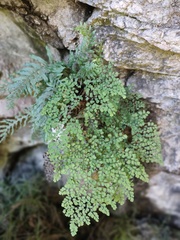

Delta maidenhair fern (Adiantum raddianum C.Presl) is a tropical fern in the Pteridaceae, native from Mexico through tropical America. Widely grown indoors, it needs indirect light, a consistently moist root ball and, above all, stable air humidity.
Read moreDelta maidenhair fern, delta maidenhair, Maidenhair fern and Pacific maidenhair
Place in indirect light or in a shaded room.
Bright indirect light, light shade or partial shade
© photo
(c) Pat Enright, some rights reserved (CC BY-NC), uploaded by Pat Enright · cc-by-nc
Tom Ferguson · cc0
iNaturalist User · cc-by
© copyright of the Board of Trustees of the Royal Botanic Gardens, Kew.


Global distribution
POWO/WCVP and Trefle place the native range of Adiantum raddianum from Mexico through tropical America. Records from Europe, France, Réunion, Hawaii and New Zealand reflect introduction, naturalization or cultivation, rather than its original range.
- Native7
- Introduced4
- Mexico
- Guatemala
- Costa Rica
- Colombia
- Brazil
- Peru
- Trinidad and Tobago
- Metropolitan France
- Réunion
- Hawaii
- New Zealand
Hexagons: regions where the plant occurs. Green dots: native range.1
Identity
Delta maidenhair fern (Adiantum raddianum C.Presl) is a perennial fern in the Pteridaceae. POWO/WCVP accepts the name, published in Tentamen Pteridographiae in 1836, with a native range from Mexico through tropical America. 1 2
The French names capillaire de Raddi and adiante de Raddi distinguish it from other maidenhairs sold under similar names. Venus hair fern is useful in everyday speech but too ambiguous for species identification, since it often denotes Adiantum capillus-veneris. 2 7
The genus name derives from Greek adiantos, commonly explained by the way water runs off the fronds. The epithet raddianum honors Giuseppe Raddi, the Italian botanist associated with Brazilian plant collections. 6 9
Recognition
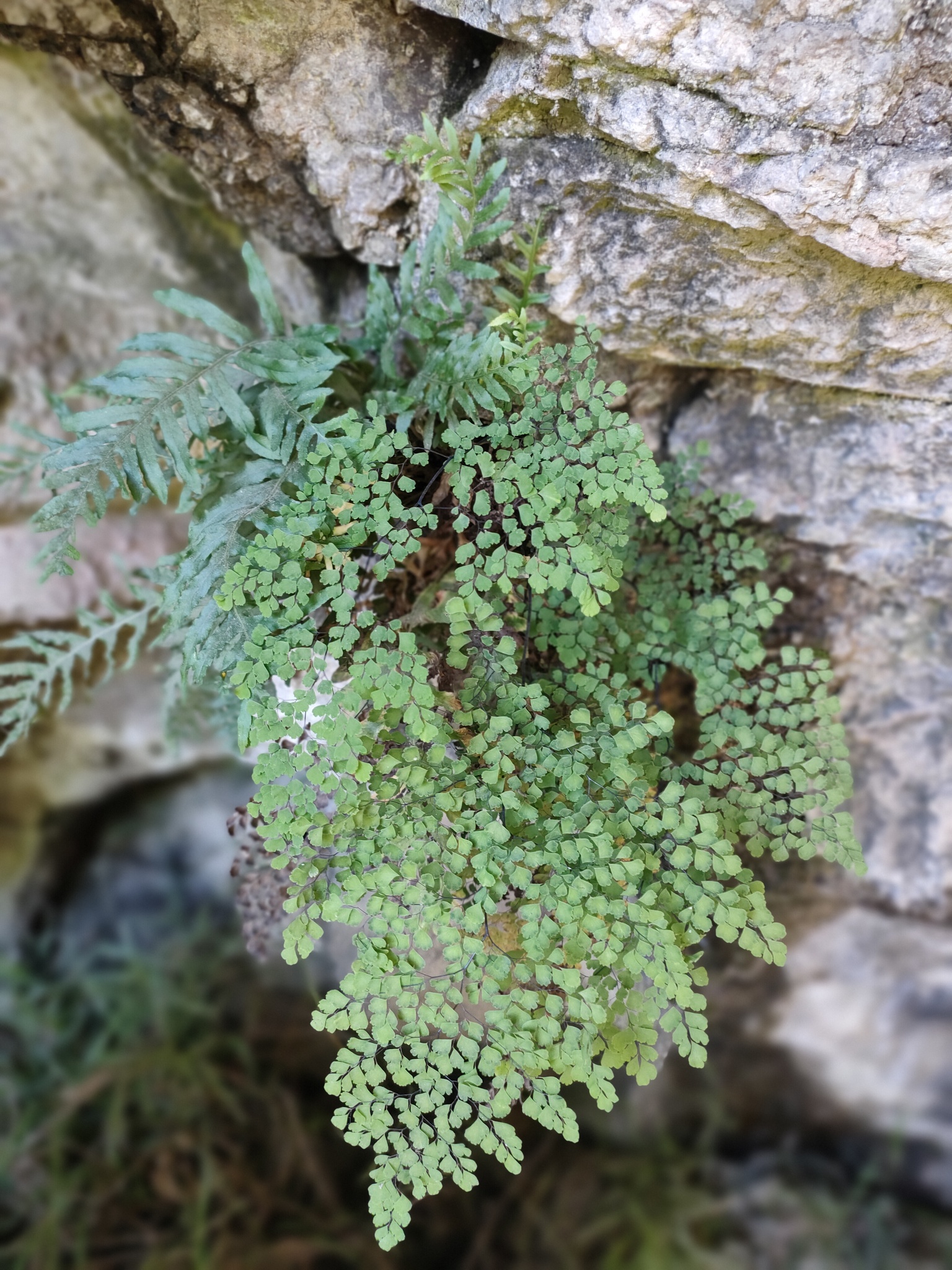
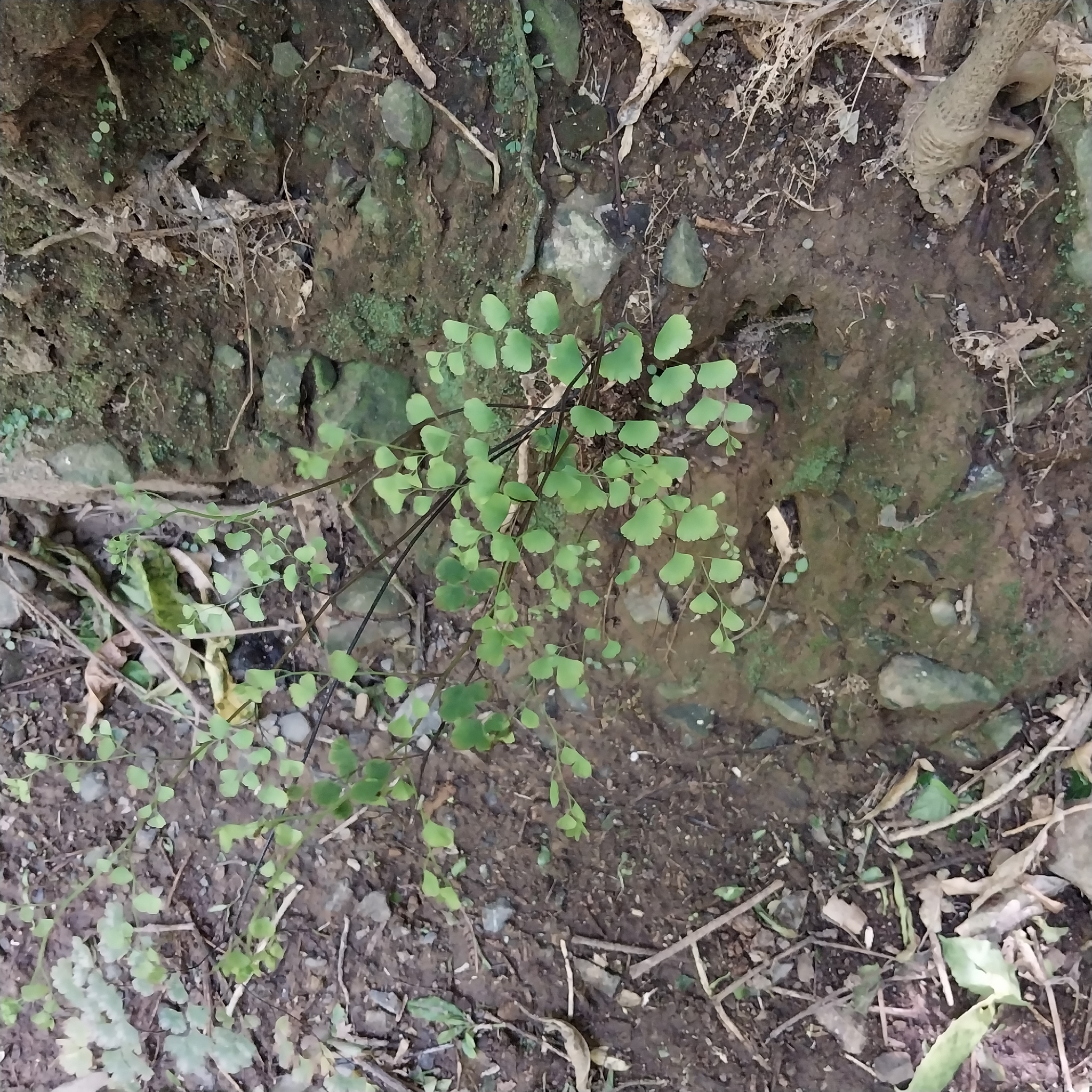
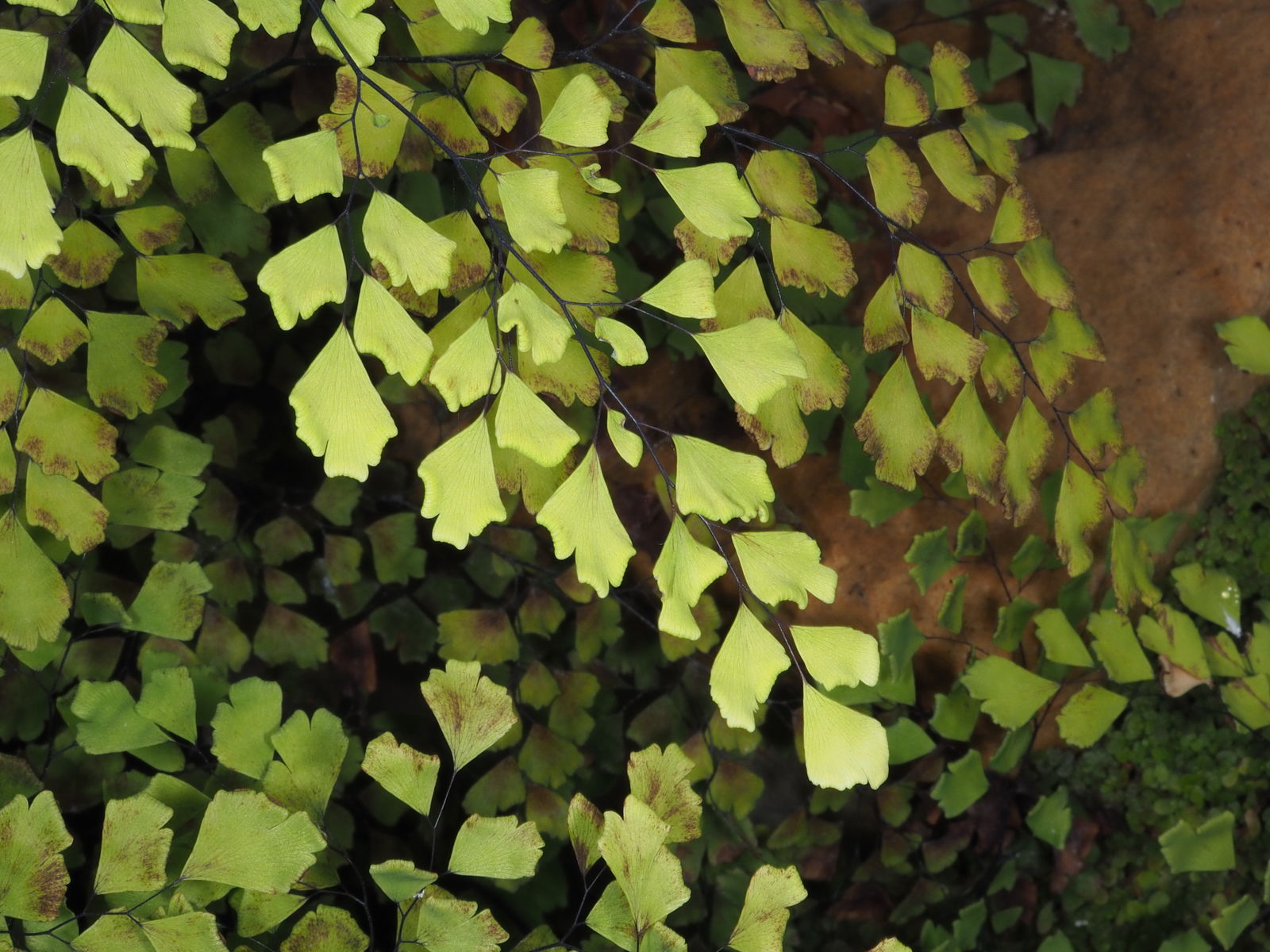
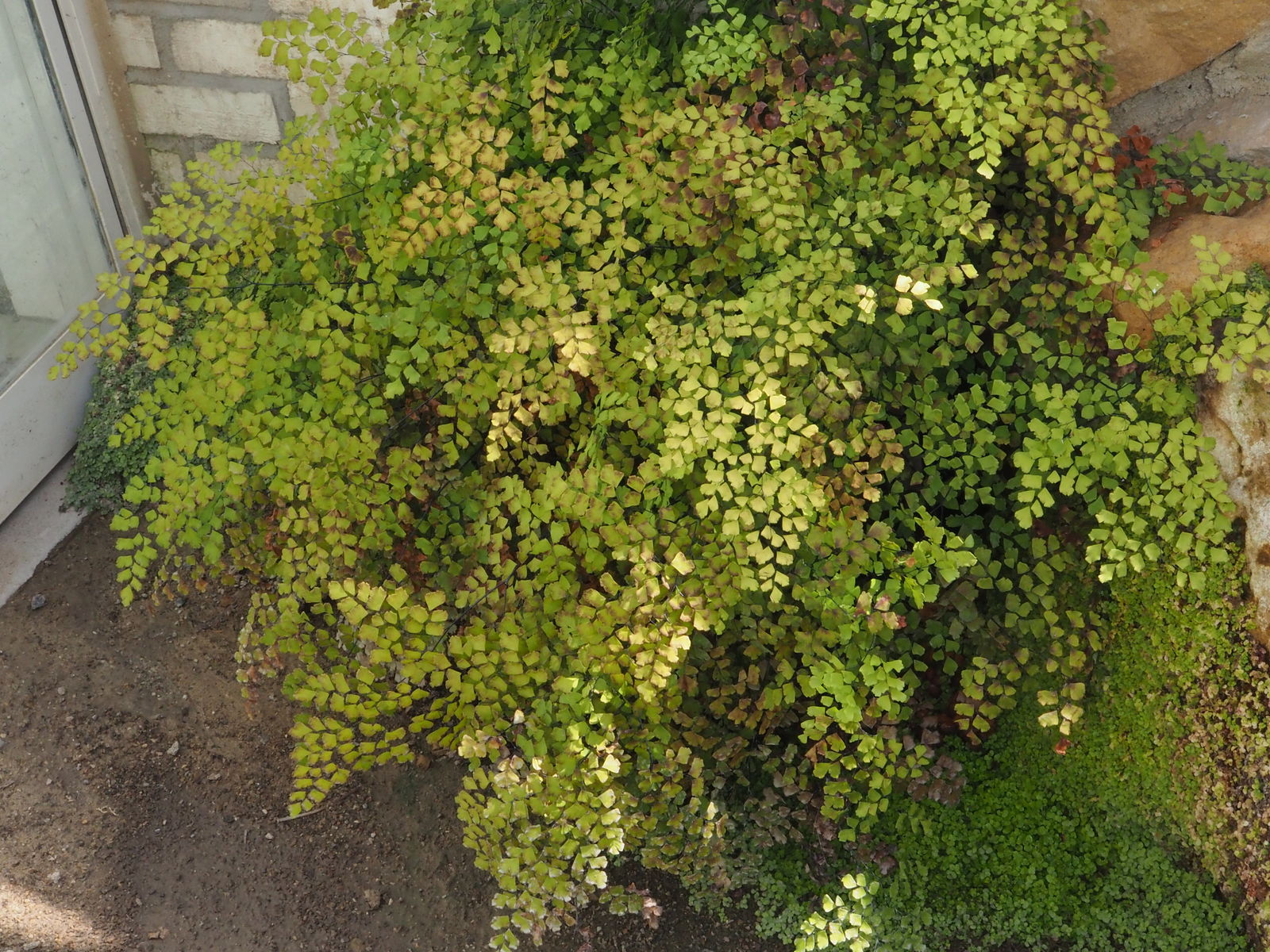
Delta maidenhair fern forms an airy clump from a short creeping rhizome. Its delicate, triangular to broadly oval fronds are often divided several times, with green, fan-shaped or triangular pinnules. Stalks and rachises are glossy black or very dark brown, almost threadlike. 6 9
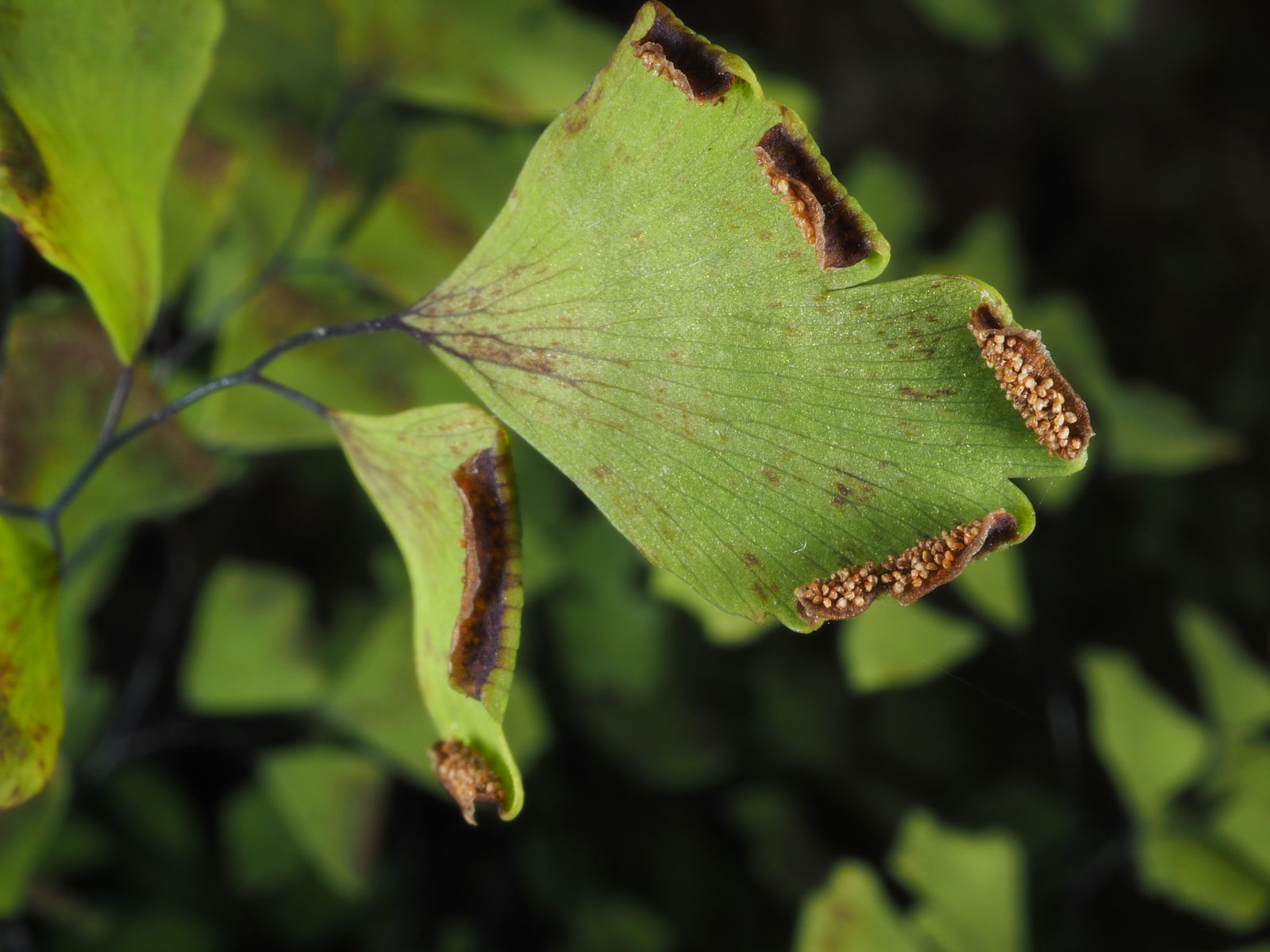
Sori sit along the pinnule edges beneath folded margins. These are its reproductive structures: a fern has neither flowers nor fruit. Generic horticultural databases can mistakenly list those features; the botanical and specialist horticultural accounts distinguish them from the fern’s spores. 6 8
In a pot, its characteristic appearance is a cloud of small green segments on dark stems. An unusually compact or upright clump, or one with weakly lobed segments, may be another Adiantum or a particular cultivar. 4 6
Taxonomy and names
The stable botanical name is Adiantum raddianum C.Presl. POWO lists several historical synonyms, including Adiantum cuneatum Langsd. & Fisch., A. rubellum, A. decorum, A. elegantissimum, A. mexicanum and A. werckleanum. 1 3
These synonyms account for some confusion in horticulture. A catalog label may mix species, older name, cultivar or simply “maidenhair fern.” The common name alone is insufficient: check the binomial and then any cultivar name. 4 5
Confusion with Adiantum capillus-veneris is especially common in French, where both can be called cheveu de Vénus. NC State also notes similarities to A. pedatum and A. x mairisii, while Flora of New Zealand describes confusion with A. aethiopicum in naturalized fern floras. 6 9
Habitat and distribution
POWO/WCVP places the native range from Mexico through tropical America. Trefle lists native regions in Central America, the Caribbean and South America, followed by numerous introductions in Europe, Macaronesia, Africa, Asia, Hawaii, Réunion and New Zealand. 1 3
In native or naturalized settings, Adiantum raddianum occupies moist banks, slopes, rocks, cliffs, walls and open woodland. Flora of New Zealand also records it on walls and in urban habitats, reflecting its ability to establish in humid microclimates outside its native range. 9
No invasive alien status is assigned to it in mainland France by the available references. Tropical territories require greater caution: Borbonica lists the taxon as potentially invasive in Réunion, while other databases record island naturalizations. 11 10
Growing indoors
Although sold as a houseplant, this fern does not tolerate dry air. The RHS recommends a house or conservatory, peat-free houseplant compost, bright indirect light, good ventilation and high humidity. 4
Moisture and aeration need to work together. The root ball must never dry completely, yet it must not sit in standing water. NC State describes moist to wet soil and roots that must not dry out; a bathroom can suit it if there is enough light. 6
An east-facing window, a very bright pole-facing window, a bright kitchen or a bathroom with genuine daylight suits it better than a dry, heated living room. Direct sun, radiators, air conditioning and cold drafts cause conspicuous damage: pinnules brown, then whole fronds dry out. 4 8
Life cycle and propagation
Like all ferns, Adiantum raddianum never flowers. Spores beneath fertile segments are its reproductive structures. In cultivation, rhizomes can also be divided in local spring, a more accessible method than raising spores at home. 4 6
The RHS recommends sowing spores as soon as ripe in gentle warmth, or dividing rhizomes in early spring. Divide carefully: a piece that is too small or lacks active roots dries readily, particularly when the air is insufficiently humid. 4
A clump that has lost its fronds is not always dead. With a firm rhizome, removing dry fronds, gradually rehydrating the root ball and maintaining humidity may allow recovery. If the rhizome is dry and brittle, or soft from excess water, recovery is much less likely. 8 4
Uses, edibility and toxicity
Its established use is ornamental, in pots, hanging containers, humid conservatories, warm greenhouses, terrariums and bright bathrooms. POWO mentions medicinal uses without identifying a plant part, dose, preparation or context; this establishes no food use or treatment recommendation. 1 4
The non-toxic designation for cats and dogs warrants qualification. Perenual marks it non-toxic to animals, and a recent secondary source refers to the ASPCA for Adiantum raddianum. However, no direct species-specific ASPCA page has been located. Its status in horses remains unresolved, without direct ASPCA evidence. 8 12
Non-toxic does not mean edible. Eating large amounts of fronds may cause mechanical or digestive discomfort, and confusion with another houseplant remains possible. Keep it as a decorative plant rather than a kitchen ingredient, and seek veterinary advice if an animal develops signs after ingestion. 12 7
Cultivars and lookalikes
NC State lists Brilliantelse, Fritz Lüthi and Kensington Gem as cultivars or selections of Adiantum raddianum. RHS horticultural names also include Fragrantissimum, Grandiceps, Pacottii, Triumph, Crested Majus and Mayi; some have accepted status, while others remain unresolved. 6 5
These names mainly describe differences in density, segment size, habit or frond texture. They do not denote separate species. When buying, check the scientific and cultivar names, a root ball that has not dried out, fresh fronds and rachises free of mealybugs. 4
Common lookalikes are other maidenhairs: Adiantum capillus-veneris, often called Venus hair fern; A. pedatum, hardier and palmate; A. aethiopicum, similar in some floras; and A. hispidulum, sometimes sold as rosy maidenhair. For an indoor plant, these distinctions affect hardiness, tolerance of household air and the meaning of its common name. 6 9
Main sources
- Plants of the World Online / Kew, Adiantum raddianum C.Presl
- GBIF Backbone Taxonomy, Adiantum raddianum C.Presl
- Trefle, species data, Adiantum raddianum
- Royal Horticultural Society, Adiantum raddianum
- RHS content, Adiantum raddianum species and cultivars
- NC State Extension Gardener Plant Toolbox, Adiantum raddianum
- NC State Extension Gardener Plant Toolbox, Adiantum
- Perenual, horticultural traits, Adiantum raddianum
- Flora of New Zealand, Adiantum raddianum C.Presl
- EPPO Global Database, Adiantum raddianum
- SINP de La Réunion / Borbonica, Adiantum raddianum
- Plant Compendium, Maidenhair Fern pet safety
Frequently asked questions
Is Delta maidenhair fern a good houseplant?
Yes, if the room stays humid and bright without direct sun. In a dry apartment, it is more demanding than pothos or Boston fern.
Why do its leaves brown so quickly?
Dry air, a dried-out root ball, a radiator or direct sun are the usual causes. The plant needs stable humidity, rather than occasional watering alone.
Is it the true Venus hair fern?
Venus hair fern is an ambiguous common name. The precise name is Adiantum raddianum; Adiantum capillus-veneris is a different species also frequently called Venus hair fern.
Is it toxic to cats and dogs?
The available references support a cautious non-toxic status for cats and dogs. Perenual and secondary sources refer to the ASPCA, but no direct species-specific ASPCA page has been located.
Can you eat Delta maidenhair fern?
No food use is recommended. POWO mentions unspecified medicinal uses, which establish neither an edible part nor a safe preparation.
Is it invasive in France?
No national invasive status is assigned in mainland France. Sources nevertheless record introductions and naturalizations, with concern in Réunion and several tropical islands.
Similar plants

If you are unsure about a plant’s toxicity, ask a botanist or veterinarian for advice.