
African oil palm (Elaeis guineensis, )


African oil palm (Elaeis guineensis) is one of two species in the genus Elaeis, in the Arecaceae family. Native to moist open forests of West and Central Africa, this single-stemmed palm has become the world’s leading source of vegetable oil. Its dense fruit bunches supply both palm oil and palm kernel oil.
Read moreAfrican oil palm, Oil palm and Macaw-fat
Place in full sun, with intense direct light all day long.
Strictly full sun; does not tolerate shade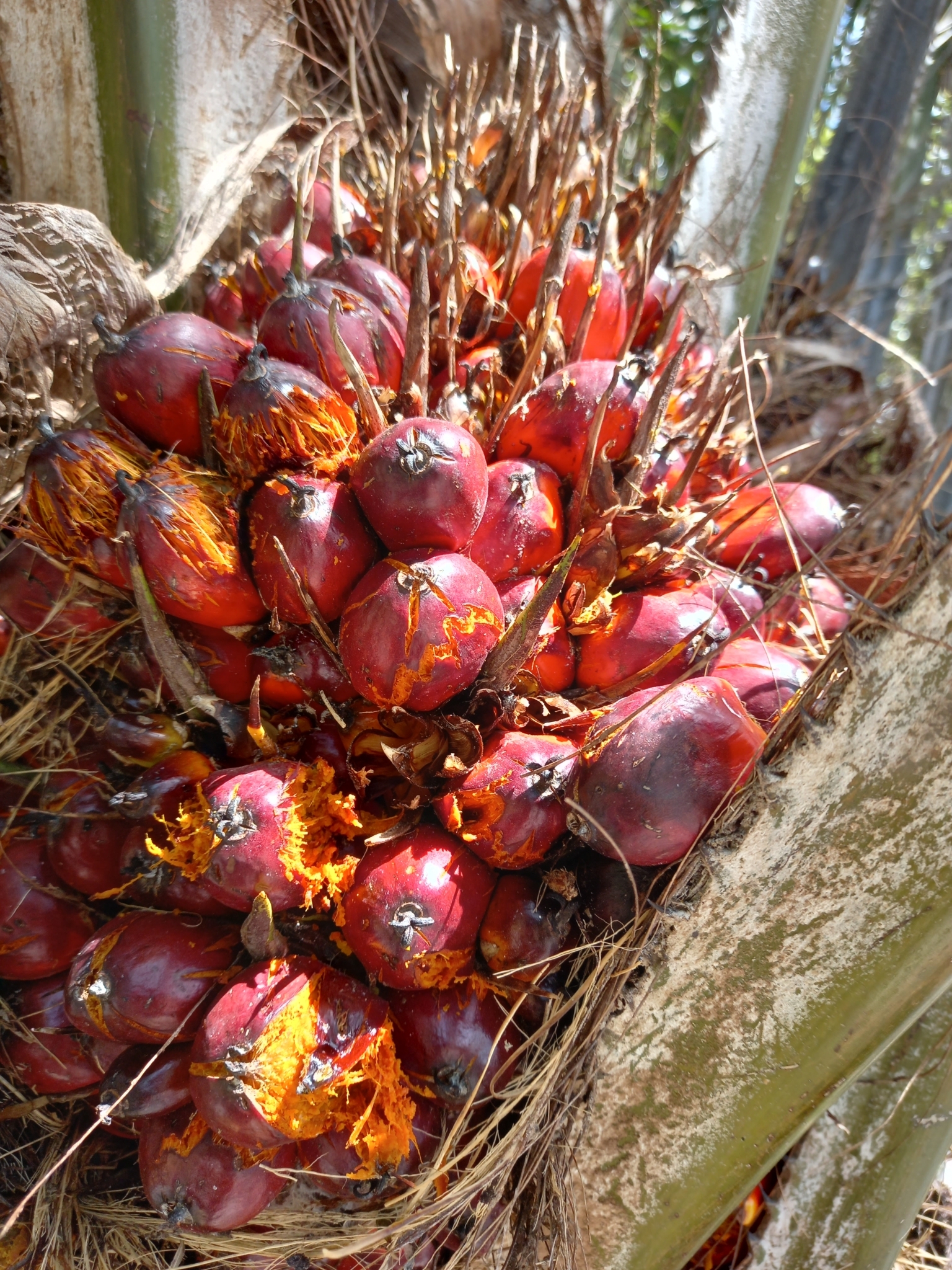


© photo
(c) Fabrício Mil Homens Riella, some rights reserved (CC BY), uploaded by Fabrício Mil Homens Riella · cc-by
portioid · cc-by-sa
Wikimedia Commons · CC BY-SA or Public Domain
Taken Nov 28, 2019 by Tela Botanica − Sylvain Piry (cc-by-sa)
Taken Apr 17, 2019 by OTS - J. González (cc-by-nc-sa)
Taken Sep 21, 2019 by Wales Sidney (cc-by-sa)
© copyright of the Board of Trustees of the Royal Botanic Gardens, Kew.




Global distribution
Elaeis guineensis is native to the Atlantic coast of West and Central Africa, from Senegal and The Gambia to Angola, a stretch of about 6,000 km. Its long association with old West African agricultural landscapes sometimes makes it difficult to distinguish wild populations from those favored by people.
- Native5
- Introduced1
- Senegal
- Côte d’Ivoire
- Nigeria
- Cameroon
- Angola
- Costa Rica
Hexagons: regions where the plant occurs. Green dots: native range.1
Identity
African oil palm (Elaeis guineensis Jacq., 1763), also called Oil palm or Macaw-fat, is one of only two species in the genus Elaeis, in the Arecaceae family. French naturalist Michel Adanson was the first Westerner to describe it and bring seeds back from West Africa, before Jacquin’s formal botanical description. 4 1
The epithet guineensis refers to the broad West African coastal region that 18th-century European naturalists called “Guinea,” rather than to the modern country alone. Its common name describes its main use: producing vegetable oil, now the most widely consumed in the world. 5 4
Recognition
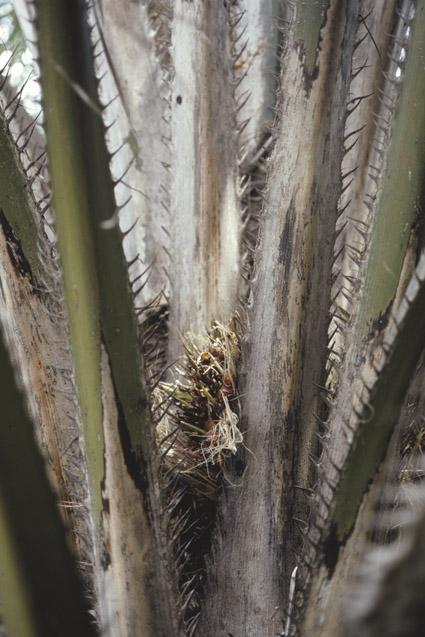
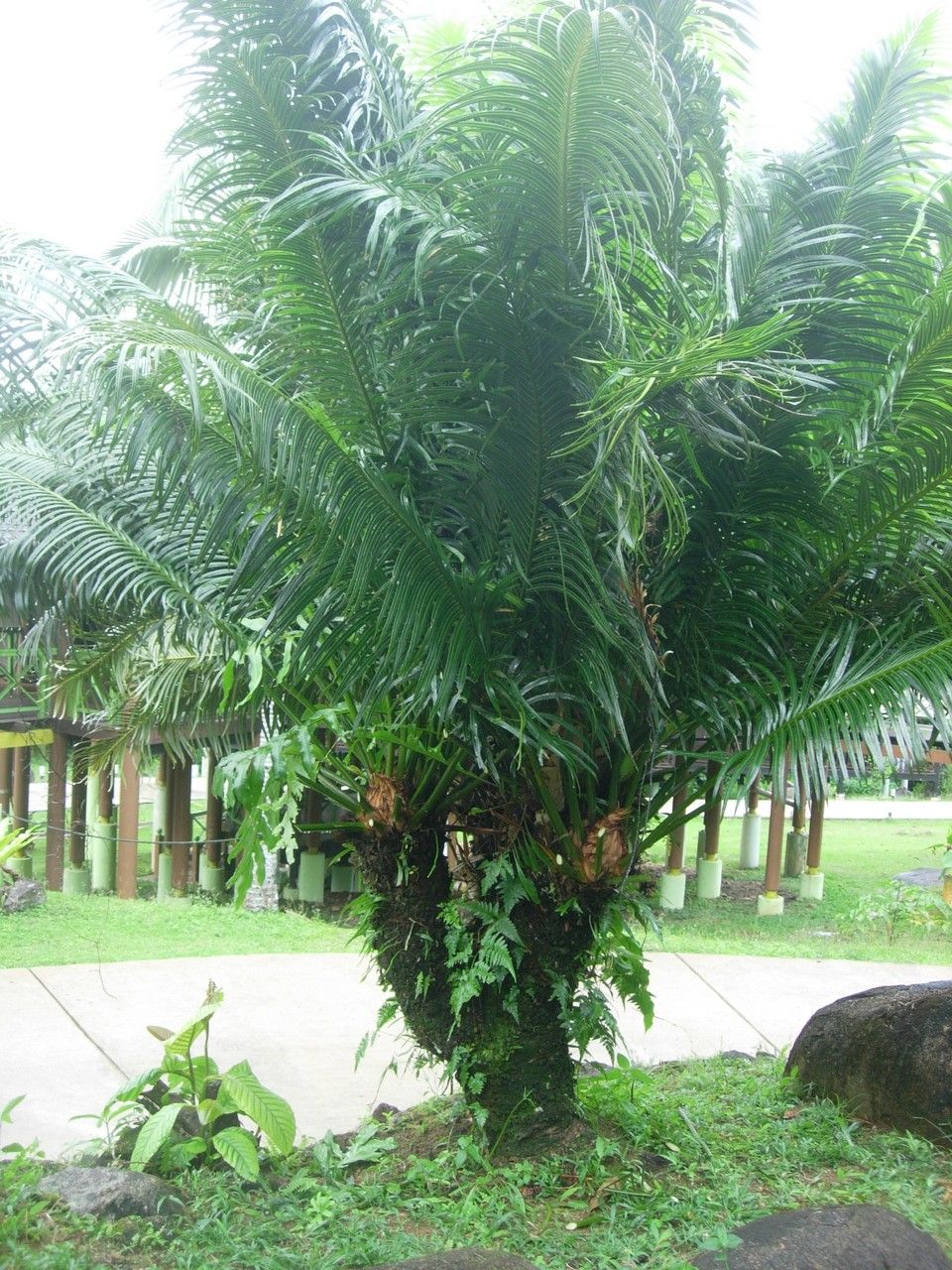
A single, ringed trunk bears the scars of fallen leaves and has no lateral branches. African oil palm can reach 20 m (66 ft) in the wild. Plantation palms are replaced well before that height because manual harvesting of the bunches would become impractical. 4 6
Crowns carry pinnate fronds 3–7 m (10–23 ft) long, densely arranged around the terminal bud; a young palm produces around 30 new leaves a year. Fruit forms in large, compact bunches, often containing several hundred fruits and weighing 5–30 kg (11–66 lb), depending on palm age. 4 6
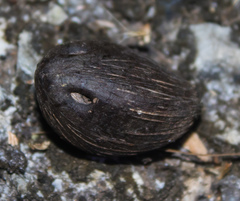
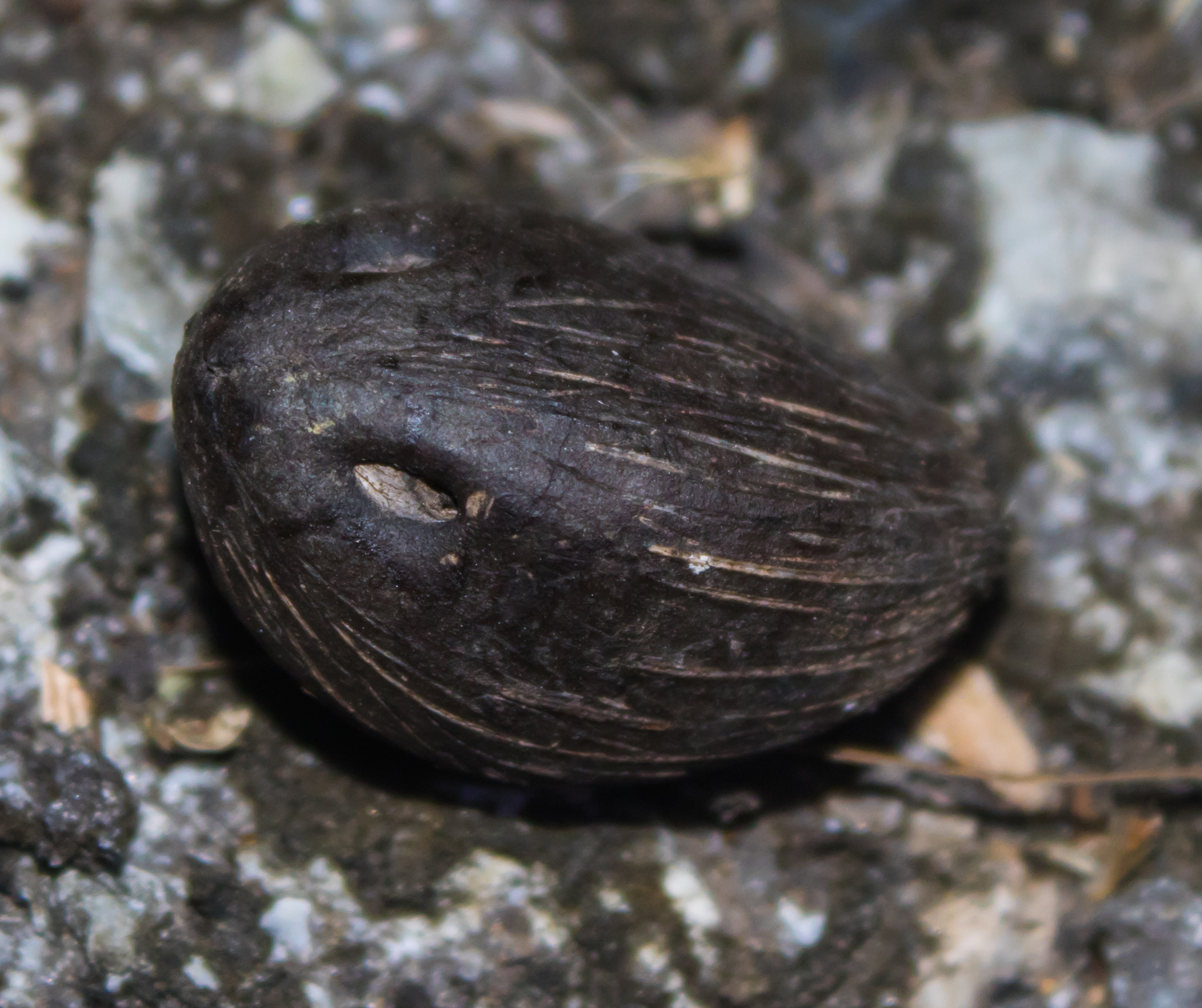
Each fruit combines an oily pulp, or mesocarp, yielding palm oil, with a hard shell enclosing the kernel that yields palm kernel oil. In the most common form, immature black fruit turns orange and then red as it reaches full ripeness. 4 7
Useful taxonomy
Only two species belong to Elaeis: African Elaeis guineensis and tropical American Elaeis oleifera (Kunth) Cortés, sometimes called corozo. They hybridize in cultivation; the cross, known as OxG, is particularly sought after in Latin America. 4 3
The Dura, Pisifera and Tenera fruit types were first described as formal botanical varieties, then understood as fruit forms controlled by a single shell-thickness gene. Shell thickness remains central to modern breeding, with almost all current commercial planting material belonging to Tenera. 4 3
Habitat and range
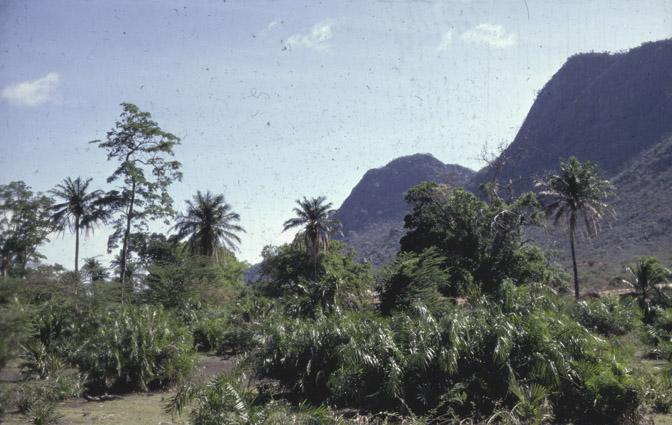
Along the Atlantic coast of West and Central Africa, its native range extends from Senegal and The Gambia to Angola, covering about 6,000 km (3,700 miles). The species grows in moist open forest, often on poorly drained sandy soils, beside rivers and in clearings below 700 m (2,300 ft). 5 6
Old agricultural landscapes in West Africa have long included oil palms. As a pioneer favored by clearings and human-disturbed soil, the species can be difficult to distinguish there as genuinely wild populations or populations simply tolerated and encouraged by people. 6 7
Southeast Asia nevertheless supplies most world production, outside the native range. Dutch colonists introduced four plants to the Bogor botanical garden in Java in 1848, and the species reached Malaysia in 1910. These few founding palms partly explain the narrow genetic base of modern plantations. 4 5
Life cycle and reproduction
Monoecious African oil palms produce separate male and female inflorescences, which rarely open at the same time on one plant. This favors cross-fertilization. Fruit development from pollination to full maturity takes 5–6 months. 4 5
Natural pollination depends almost entirely on insects. Deliberate introduction of the weevil Elaeidobius kamerunicus to Southeast Asia in 1980–1981 ended the costly hand-pollination campaigns within a few seasons. 4 5
Seeds are soaked in warm water for 24 hours and germinate in 2–5 months, depending on whether commercial nurseries apply a heat treatment to break dormancy; that method raises success to about 80%. Field-planted palms begin producing at around 3 years, reach full yield at 7–8 years, and remain commercially productive for about 25 years before replacement. 6 7
Uses and risks
Oil production dominates its uses. A single bunch supplies palm oil from the pulp and palm kernel oil from the kernel at a ratio of about 9 to 1. These oils are used mainly in processed food and cosmetics, with soapmaking a secondary industrial outlet. 7 5
Traditional West African uses also include palm wine, made by fermenting sap from a cut inflorescence, and heart of palm, harvested from the terminal bud. Removing that bud kills this single-stemmed palm because it produces no lateral shoots. 5 7
No data classify Elaeis guineensis as toxic to humans or domestic animals; the Useful Tropical Plants Database records no documented hazards. The main documented environmental risk is recent expansion of monoculture plantations in Southeast Asia, associated with tropical forest and natural habitat loss. This is a separate issue from the species’ ecology in its native range. 7 4
Varieties, look-alikes and related plants
Three fruit types define the most useful commercial distinction: thick-shelled Dura, with a low oil yield; shell-free Pisifera, generally female-sterile; and Tenera, their thin-shelled, thick-pulped hybrid, dominant in plantations since the 1960s. 4 3
Interspecific OxG hybrids with Elaeis oleifera are gaining ground in Latin America because they grow more slowly in height and tolerate bud rot better. Their oil yield is often lower than that of pure Tenera. 3 4
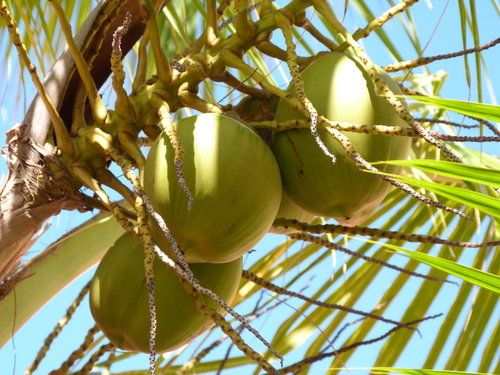
Its closest look-alike is Elaeis oleifera, whose much shorter, often reclining trunk contrasts with the African species’ upright stem. Young plants can also resemble coconut palms. Fruit separates them clearly: compact bunches of egg-shaped fruit in African oil palm, versus individual, much larger coconuts in Cocos nucifera. 4
Main sources
Frequently asked questions
Is African oil palm toxic to cats or dogs?
No data classify Elaeis guineensis as toxic to domestic animals or humans. No documented cases are recorded in the reference databases.
What is the difference between palm oil and palm kernel oil?
Palm oil comes from the fruit’s pulp (mesocarp), while palm kernel oil comes from the kernel inside the shell. One bunch supplies both oils, at a ratio of about 9 to 1 in favor of palm oil.
What do Dura, Pisifera and Tenera mean?
These are three fruit types defined by shell thickness. Dura has a thick shell, Pisifera has none, and Tenera, their hybrid, combines a thin shell with abundant pulp. Tenera is the main type planted today.
Where does African oil palm originally come from?
Its native range follows the Atlantic coast of West and Central Africa from Senegal to Angola. Almost all current production nevertheless comes from Southeast Asia, where the species was introduced in the 19th century.
How long does it take to produce the first harvest?
The first harvest generally comes 3 years after field planting, with full production at about 7–8 years. Commercial cultivation then lasts around 25 years.
Why are oil palm plantations replanted regularly?
As palms age, their trunks become too tall for efficient manual harvesting of fruit bunches. Plantations are therefore renewed about every 25 years, regardless of palm health.
Does African oil palm look like a coconut palm?
Both have a single ringed trunk and feather-shaped leaves, but their fruit is very different. Oil palm fruit grows in large, tight bunches, while coconuts are individual and much larger.
Similar plants
If you are unsure about a plant’s toxicity, ask a botanist or veterinarian for advice.