
Cavendish banana (Musa acuminata, )
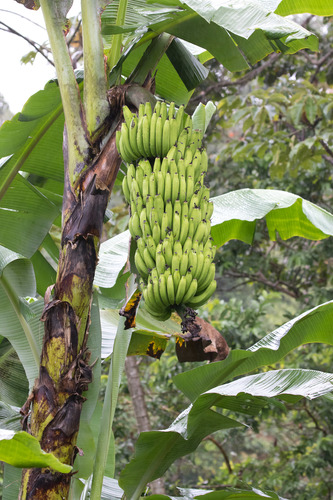
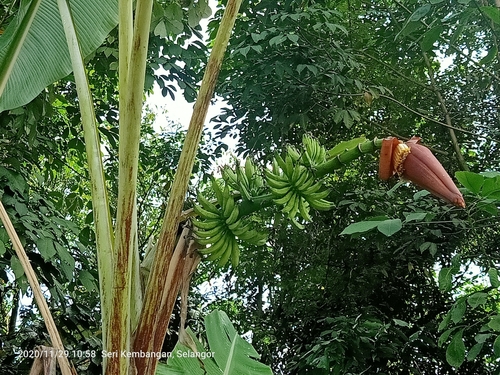
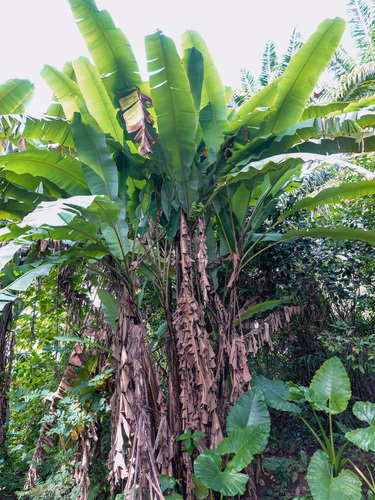
The Cavendish banana (Musa acuminata) is a herbaceous perennial in the family Musaceae, native to South and Southeast Asia from the Indian subcontinent to New Guinea. Domesticated some 7,000 years ago, it is the direct or partial ancestor of nearly every dessert banana grown worldwide, from the Cavendish group to small diploid varieties.
Read moreWild banana, Edible banana and Dwarf banana
Allow a few hours of direct sun per day, preferably morning or evening.
Global distribution
The native range of Musa acuminata covers South and Southeast Asia, from the Indian subcontinent to the Malesian region (Malaysia, Indonesia, the Philippines), with populations as far as New Guinea. Domesticated locally, the species was later carried by people to every tropical region of the world, including the French West Indies, where the Cavendish dominates commercial production.
- Native5
- Introduced2
- India
- Malaysia
- Indonesia
- Philippines
- Papua New Guinea
- Australia
- East Africa
Hexagons: sourced regions. Green dots: native range. Statuses according to POWO (Kew).
Identity
The Cavendish banana (Musa acuminata Colla, 1820), also called wild banana, is a herbaceous perennial in the family Musaceae. Its pseudostem contains no wood: it is built from leaf sheaths rolled tightly one around the other, which botanically makes the plant one of the largest herbs in the world rather than a tree. 1 2
The Italian botanist Luigi Aloysio Colla described Musa acuminata in 1820. The species is now recognized as the direct or partial ancestor of nearly all cultivated dessert bananas, including the Cavendish group, which has filled fruit stands around the world since the 1950s. 3 4
Recognition
Depending on subspecies and growing conditions, the pseudostem commonly stands 2–8 m (6.5–26 ft) tall, with a spread of 1.5–3 m (5–10 ft). The paddle-shaped leaves are often several meters long and tear easily along the midrib in wind. That ragged look helps an untrained eye tell a banana from a tree, whose stiffer foliage holds up against the wind. 5 6
The inflorescence hangs from the tip of the flowering stalk. Purple bracts shelter rows of creamy white flowers: female flowers near the base, which set the fruit, and male flowers in the terminal bud. In the wild form, the fruit holds many hard seeds 5–6 mm (about 0.2 in) across, whereas store-bought bananas never contain any: they come from sterile triploid clones unable to produce a viable seed. 5 4
Useful taxonomy
Several wild subspecies make up Musa acuminata, strung along a geographic gradient from the Indian subcontinent to New Guinea and northern Queensland:
- Musa acuminata subsp. banksii grows in New Guinea
- Musa acuminata subsp. errans grows in the Philippines
- Musa acuminata subsp. malaccensis grows in Malaysia and Sumatra
- Musa acuminata subsp. microcarpa grows in Borneo
- Musa acuminata subsp. siamea grows in Cambodia, Laos and Thailand
- Musa acuminata subsp. zebrina grows in Java
These wild populations, errans and zebrina in particular, are the direct parents of the diploid AA cultivars. Hybridization, combined with selection for sterility and parthenocarpy, then produced the triploid AAA groups of dessert bananas and, with input from Musa balbisiana, the AAB and ABB groups of plantains. 7 3
Habitat and range
South and Southeast Asia hold the native range of Musa acuminata: from India and Sri Lanka through Myanmar, Thailand, Vietnam, Malaysia, Indonesia and the Philippines, with populations reaching New Guinea. Depending on elevation, the plant grows in moist ravines, forest edges, swamps and wooded slopes, from sea level up to 1,200 m (3,900 ft). 4 1
Domesticated about 7,000 years ago in New Guinea and the Wallacea region, the species ranks among the earliest known examples of plant domestication, probably first for its fiber and edible male flowers, before the seedless fruit was selected. 7 4
Beyond its original range, people spread banana growing to every tropical region, the French West Indies included. Cavendish cultivars, derived solely from Musa acuminata, dominate commercial production in Martinique and Guadeloupe. 6 8
Life cycle and reproduction
Flowering comes once a pseudostem reaches maturity, often after 9–15 months of growth; the bunches of fruit then form in about four months. After harvest the pseudostem dies, and the plant regrows straight away from a basal sucker off the same underground rhizome, which keeps the clump going without any new germination. 5 4
For plants in the ground, dividing off a basal sucker in spring, with a piece of rhizome and a few active roots, preserves the parent plant's traits better than seed and usually establishes within 2–4 weeks in warm weather. Seed remains an option with fertile wild forms, but the hard seeds are slow to germinate, and sterile cultivars simply do not produce any. 4
Where it grows wild, the ripe fruit draws a wide range of animals, fruit bats, birds, squirrels, civets and primates, which disperse the seeds and make the wild banana a pioneer species of forest gaps. 3
Uses and risks
Ripe fruit is eaten from fertile wild forms and sterile cultivars alike, its sweet flesh replacing the astringent pulp of the unripe fruit. Male flowers are eaten raw or roasted, much like an artichoke, and the tender heart of the pseudostem is cooked like a bamboo shoot. 4
Unlike many tropical houseplants, the Cavendish banana has no known toxicity to cats, dogs or horses: the ASPCA lists it among food plants that pose no toxic risk. 9
Pests and diseases are the real threats. The banana weevil (Cosmopolites sordidus) tunnels into the pseudostem, while black Sigatoka and Fusarium wilt, or Panama disease, now seriously endanger commercial Cavendish plantings, which are genetically uniform from one continent to the next. 6 5
Varieties, look-alikes and related plants
Cultivars derived solely from Musa acuminata fall into groups by their number of chromosome sets. The diploid AA group includes early dessert bananas such as 'Pisang Mas'; the triploid AAA group contains Cavendish and its dwarf selections such as 'Dwarf Cavendish', which holds an RHS award and is grown in conservatories where winters are too cold for it outdoors. 6 4
The ornamental subspecies Musa acuminata subsp. zebrina, often sold as blood banana, stands out for its purple-mottled foliage rather than for the quality of its fruit. 7
Three close relatives cause most mix-ups:
- Musa balbisiana, the other wild parent of cultivated bananas, carries the B genome and bears more angular fruit;
- Musa x paradisiaca, the hybrid between the two species, gave rise to plantains;
- Ensete ventricosum, the Abyssinian or false banana, has a similar habit but produces no usable basal suckers.
Hard seeds of 5–6 mm (about 0.2 in) in the ripe fruit remain a more reliable clue than the cultivar's genetic background, which a nursery label rarely spells out: no commercial cultivar, Cavendish included, produces them.
Main sources
- Plants of the World Online / Kew, Musa acuminata Colla
- Royal Horticultural Society, Musa acuminata 'Dwarf Cavendish' (AAA Group)
- Missouri Botanical Garden Plant Finder, Musa acuminata
- Plants For A Future, Musa acuminata
- ASPCA, Banana toxicity entry
- Integrated Taxonomic Information System, Musa acuminata (TSN 42390)
- D'Hont et al., 2012, Nature, the banana (Musa acuminata) genome and the evolution of monocotyledonous plants
- Perrier et al., 2011, PNAS, multidisciplinary perspectives on banana (Musa spp.) domestication
- USDA PLANTS Database, Musa acuminata (MUAC)
Frequently asked questions
Is a banana plant a tree?
No. Musa acuminata is a herbaceous perennial. Its pseudostem is made of tightly rolled leaf sheaths with no wood, which botanically makes it one of the largest herbs in the world rather than a tree.
Why do supermarket bananas have no seeds?
Store-bought cultivars such as Cavendish are sterile triploid clones produced by human selection. The wild fruit of Musa acuminata, by contrast, holds many hard seeds 5 to 6 mm (about 0.2 in) across.
Is Musa acuminata toxic to pets?
No. The ASPCA lists the banana as non-toxic to cats, dogs and horses. It is a food plant, unlike many tropical houseplants.
Can you grow a banana plant in a temperate climate?
In the ground, only a few cold-hardy species of Musa handle the cold. Musa acuminata suffers below 10 °C (50 °F) and is better grown in a large container, moved into a conservatory or heated greenhouse for winter wherever temperatures drop that low.
What is the difference between Musa acuminata and Musa balbisiana?
Musa acuminata carries the A genome, the source of dessert bananas. Musa balbisiana carries the B genome, brought in through hybridization in plantains and some cooking bananas, which are more drought-resistant.
Where was the banana first domesticated?
Archaeological and genetic evidence places the earliest domestication in New Guinea and the Wallacea region about 7,000 years ago, probably for fiber and male flowers before the seedless fruit was selected.
Similar plants
Botanical data compiled from reference sources (RHS, Kew Gardens, POWO). This profile is for guidance only and is not a substitute for advice from a botanist or veterinarian if you have concerns about toxicity.