
Provision tree (Pachira aquatica, )
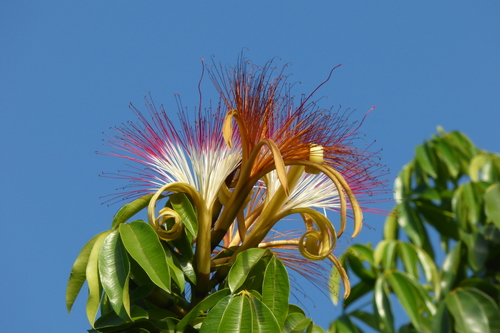
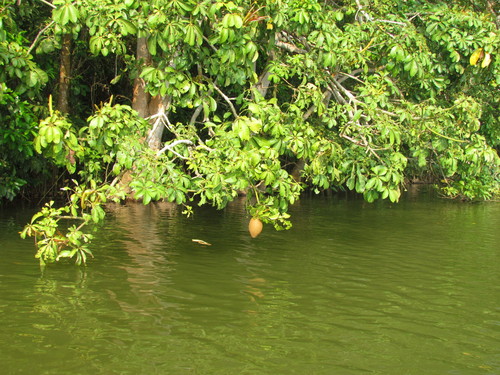
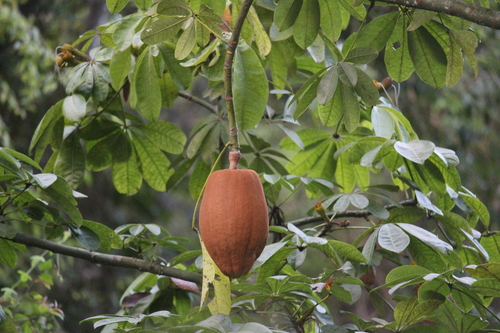
The provision tree (Pachira aquatica), also called Guiana chestnut, is a tropical tree in the mallow family, Malvaceae, native to the swamps of Central and South America. Often sold with a braided trunk as a money tree, it is grown indoors for its glossy palmate foliage; its seeds are edible once roasted, and the species is not toxic to pets.
Read moreGuiana chestnut, Money tree and Malabar chestnut
Global distribution
The native range of Pachira aquatica runs from Mexico to northern South America, through Central America, the Amazon basin and the Guianas. Widely grown as a houseplant, the tree has also been introduced to tropical Asia; these areas of cultivation should be kept apart from its American native range.
- Native6
- Introduced1
- Mexico
- Guatemala
- Costa Rica
- Brazil
- French Guiana
- Venezuela
- United States (Florida)
Hexagons: sourced regions. Green dots: native range. Statuses according to POWO (Kew).
Identity
The provision tree (Pachira aquatica Aubl., 1775), also known as Guiana chestnut, is a tropical tree in the mallow family, Malvaceae, genus Pachira. Its trade name, money tree, comes from the prosperity symbolism attached to it in Asia, where it is sold as a good-luck plant. 1 2
In temperate countries, the species is best known as a houseplant, usually offered with a distinctive braided trunk. Glossy palmate leaves make it an easy large foliage plant to recognize, and it has the uncommon advantage of being non-toxic to pets. 3 4
Recognition
Look first at the palmate foliage: each leaf carries 5 to 9 leaflets, obovate to elliptic, dark green and shiny, spreading like the fingers of a hand at the tip of a long stalk. A whole leaf can span about 30 cm (12 in). 2 5
On a large tree, the flower settles any doubt. It is striking, with narrow petals and a long brush of white, red-tipped stamens measuring 7–10 cm (3–4 in), for an open flower about 20 cm (8 in) across. The fruit is a large brown woody capsule, up to 30 cm (12 in) long, that splits into five valves around rounded seeds. 5 6
Grown indoors, the provision tree stays an upright shrub of 2–3 m (6.5–10 ft), with a base that is often swollen and green on young plants. In its tropical range, it is a true swamp tree that can reach about 18 m (60 ft). 2 3
Useful taxonomy
Aublet described the species as Pachira aquatica in 1775. The genus has been reshuffled many times, and several older names are still in circulation; the main synonyms to know are:
- Bombax aquaticum (Aubl.) K.Schum.
- Carolinea princeps L.f.
- Pachira macrocarpa (Schltdl. & Cham.) Walp.
- Pachira longifolia Hook.
- Pachira aquatica var. surinamensis Decne.
The stable reference remains the accepted scientific name, Pachira aquatica, because trade names such as money tree describe a way of training the plant, not a distinct species or botanical variety. 1 7
Habitat and range
Wild Pachira aquatica grows in the swamps and flooded forests of tropical America, from Mexico to northern South America, through Central America, the Amazon basin and the Guianas. It is a wetland plant that copes with waterlogged soil for part of the year. 1 2
Adapted to riverbanks and floodplains, the tree develops a swollen trunk base and a root system that tolerates temporary saturation. That explains why it accepts generous watering in a pot, provided water does not sit in the heart of a braided trunk. 5 3
Widely grown as an ornamental and a good-luck plant, the provision tree has spread across tropical Asia, notably Taiwan and Japan, and to Florida. These areas of cultivation should be kept apart from its American native range. 8 2
Life cycle and reproduction
Flowering happens mainly in the warm season, from December to March in the tropical Northern Hemisphere. The large night-opening flowers are rich in nectar and draw bats and moths, which pollinate them in the wild. Indoors, blooms are a rare bonus and not the point of growing the plant. 5 2
Once pollinated, the flower develops into a large woody capsule that opens into five valves and releases rounded seeds about 1.3 cm (0.5 in) across. In nature these seeds float and are carried by water, one more adaptation to flooded ground. 5 6
The easiest way to propagate it is to sow a large fresh seed, which germinates quickly in warm, moist mix and yields a seedling with the typical swollen base. Stem cuttings with a node also work, given warmth and bright indirect light, but they produce plants without that swollen base. Growers also braid several young plants together at this stage, while their trunks are still pliable, to create the commercial money tree shape. 3 5
Uses and risks
Outside the tropics, Pachira aquatica is grown mainly as an ornamental, a large indoor foliage plant with a braided trunk; in frost-free climates, roughly USDA zones 10 to 12, it can also grow outdoors. In the tropics, the tree provides shade and helps stabilize riverbanks, and its seeds are eaten: roasted or cooked, they taste somewhat like chestnuts or peanuts, hence the names Guiana chestnut and Malabar chestnut. 6 5
For households with animals, the provision tree is one of the safest large houseplants: the ASPCA lists it, as Guiana chestnut, as non-toxic to cats, dogs and horses. No toxic substance is reported for pets, which makes it a sensible choice in a home with animals. Raw seeds remain unpleasant and are better cooked before eating. 4 6
Varieties, look-alikes and related plants
Unlike many houseplants, the provision tree has no stable variegated cultivars. The form sold in stores comes down to horticultural training: braiding several young trunks, which is not a botanical trait of the species. Before buying, check that the braided trunk is firm, the roots are healthy and the leaflets are even. 3
The most frequent mix-up involves a close relative:
- Pachira glabra, very often sold as Pachira aquatica, but distinct in its smaller fruit and a different flower base;
- Pachira insignis, another large American species in the same genus.
Palmate leaves with 5–9 leaflets, a swollen trunk base and the large five-valved capsule remain the most reliable clues that a plant sold as a money tree really is Pachira aquatica. 2 1
Main sources
- Plants of the World Online / Kew, Pachira aquatica Aubl.
- Royal Horticultural Society, Pachira aquatica
- Missouri Botanical Garden, Pachira aquatica
- USDA PLANTS Database, Pachira aquatica Aubl.
- Plants For A Future, Pachira aquatica
- Useful Tropical Plants, Pachira aquatica
- Tropicos / Missouri Botanical Garden, Pachira aquatica Aubl.
- ASPCA, Guiana chestnut (Pachira aquatica) non-toxic plant entry
Frequently asked questions
Is Pachira aquatica toxic?
No. The ASPCA lists the provision tree (under the name Guiana chestnut) as non-toxic to cats, dogs and horses. It is one of the few large houseplants with no known ingestion risk for pets.
Why is the Pachira aquatica trunk braided?
Braiding is a horticultural technique. Several young, pliable trunks are woven together to create the decorative money tree silhouette, associated with good luck in Asia. It is not a botanical trait of the species.
Are Pachira aquatica seeds edible?
Yes, once roasted or cooked. The rounded seeds from the capsule taste somewhat like chestnuts or peanuts, hence the names Guiana chestnut and Malabar chestnut. Raw, they are not very pleasant and are better cooked.
How much light does a provision tree need?
Bright but indirect light gives the best foliage. The plant tolerates a few hours of gentle sun, but harsh direct afternoon sun scorches the leaflets.
How big does Pachira aquatica get?
Indoors, it stays a shrub 2 to 3 m (6.5 to 10 ft) tall. In its tropical native range, it is a swamp tree that can reach about 18 m (60 ft).
Which plant is confused with Pachira aquatica?
The most frequent mix-up involves Pachira glabra, a close relative often sold under the same name. Its smaller fruit and the base of the flower tell them apart.
Similar plants
Botanical data compiled from reference sources (RHS, Kew Gardens, POWO). This profile is for guidance only and is not a substitute for advice from a botanist or veterinarian if you have concerns about toxicity.