
Rubber plant (Ficus elastica, )
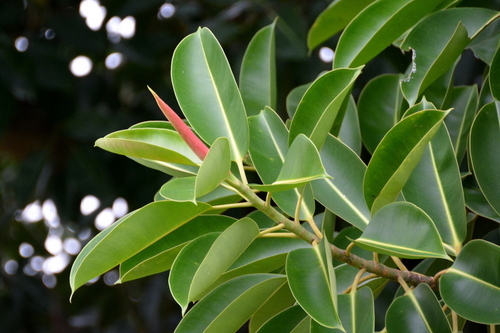
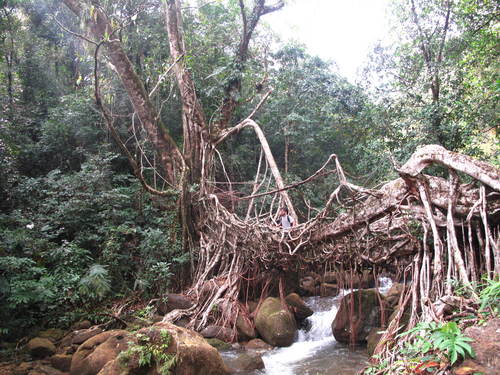
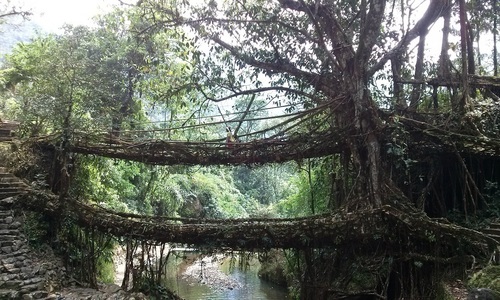
The rubber plant (Ficus elastica), also called the Indian rubber tree, is a large fig in the mulberry family, Moraceae, native to the humid forests of northeastern India and Southeast Asia. In the wild it grows into a strangling hemiepiphytic tree tens of meters tall; indoors it stays an upright shrub with thick, glossy, evergreen foliage.
Read moreIndian rubber tree, Rubber fig and Rubber tree
Global distribution
The native range of Ficus elastica covers northeastern India, Nepal, Bhutan, Myanmar, southern China and the Malay Archipelago. Widely grown, it has naturalized beyond that range, notably in Florida and on several tropical islands; these introduced areas should be kept distinct from the native range.
- Native6
- Introduced2
- India
- Nepal
- Bhutan
- Myanmar
- Indonesia
- Malaysia
- Sri Lanka
- United States (Florida)
Hexagons: sourced regions. Green dots: native range. Statuses according to POWO (Kew).
Identity
The rubber plant (Ficus elastica Roxb. ex Hornem.), or Indian rubber tree, is a large fig in the mulberry family, Moraceae, and belongs to the genus Ficus. Its common name recalls the old use of its latex to make rubber within its native range, long before the Pará rubber tree became the standard crop for that purpose. 1 2
Across much of the temperate world the species is best known as a tough houseplant, sold as rubber plant, rubber tree or rubber fig. Its thick, smooth and highly glossy leaves make it a large foliage plant that is easy to recognize and forgiving to grow. 3 4
Recognition
Foliage gives Ficus elastica away first: broad, oval to elliptic, leathery and shiny leaves, 10 to 30 cm (4 to 12 in) long, arranged alternately along an upright stem. The midrib is prominent, flanked by many parallel side veins. 4 5
One detail helps a great deal with identification. Each new leaf emerges rolled inside a sheathing red stipule, which shields the bud, then drops and leaves a thin ring scar on the stem. Cut the plant and it bleeds a white latex, typical of figs. 2 1
Grown indoors, the rubber plant stays an upright shrub of 2 to 3 m (6.5 to 10 ft), sometimes branching after pruning. In its tropical range it is a true tree that can exceed 30 m (100 ft), with a thick trunk and aerial roots dropping toward the ground. 4 3
Useful taxonomy
Described as Ficus elastica Roxb. ex Hornem. in the early 19th century, the species sits in a huge genus, and several older or horticultural names are still in circulation. The main synonyms worth knowing are:
- Ficus elastica var. elastica
- Ficus elastica var. belgica hort.
- Ficus karet (Miq.) King
- Ficus skytinodermis Summerh.
- Macrophthalma elastica Gasp.
The accepted scientific name, Ficus elastica, remains the stable reference, since cultivar names such as Robusta or Tineke refer to horticultural selections, not to distinct species or botanical varieties. 1 6
Habitat and range
In the wild, Ficus elastica grows in the humid tropical forests of northeastern India, Nepal, Bhutan, Myanmar, southern China (Yunnan) and the Malay Archipelago. It occupies lowlands and lower mountain slopes, on moist soils in a humid atmosphere. 1 2
Like many tropical figs, it often starts life as a hemiepiphyte: a seed germinates in the fork of a host tree, and the young plant sends roots down to the ground. As they thicken, these roots can grip the supporting trunk, which places the species among the strangler figs. 4 5
Planted widely for ornament, and formerly for its latex, the rubber plant has naturalized outside its range, notably in Florida and in several tropical and subtropical regions. These introduced areas should be kept separate from its Asian native range. 6 2
Life cycle and reproduction
Its flowers are hidden, as in every Ficus: they sit inside a hollow fig, and pollination depends on tiny specialized wasps. Outside the native range, without these pollinators, fruit is rare and the plant practically never self-seeds. 2 4
When figs do form, they are small, borne in the leaf axils and yellowish green; unlike those of the common fig, they are not valued as food. Flowering indoors is therefore a curiosity and never the point of growing the plant. 5 3
In cultivation, propagation relies on stem cuttings with a node or on air layering, which is especially handy for renewing a plant that has grown too tall and bare at the base. Either way, let the latex dry before potting, or the cut will keep oozing and heal poorly. A cutting taken just below a node, kept warm in bright indirect light, forms its first roots in three to six weeks. Air layering involves nicking the stem, wrapping it in damp sphagnum moss and waiting for roots to appear before severing the new plant. 3 5
Uses and risks
Today Ficus elastica is grown mainly for ornament, as a large indoor foliage plant or, in the tropics, as a shade and street tree. Its historical value came from its latex, tapped locally for rubber before Pará rubber plantations took over. 2 6
That same latex is a mild irritant. On contact it can cause redness and itching on sensitive skin; swallowed, it may irritate the mouth and cause minor digestive upset. The ASPCA lists the rubber plant as toxic to cats and dogs, with signs that are usually moderate, so it makes sense to keep it away from pets and young children and to wear gloves when pruning. 7 8
Varieties, look-alikes and related plants
The many forms on sale are not separate species. Robusta is the classic form with large dark green leaves; Tineke, Ruby and Tricolor are variegated cultivars that need more light to hold their colors; Abidjan is chosen for very dark foliage. Before buying, check the cultivar name, the state of the roots and how even the foliage is. 3
The most frequent mix-ups involve:
- Ficus lyrata, the fiddle-leaf fig, with large violin-shaped leaves;
- Ficus benghalensis, the banyan, another tree-sized strangler fig;
- Ficus benjamina, with much smaller leaves and a weeping habit.
Thick, oval, very glossy leaves, the red stipule and the white latex remain the most reliable clues that a plant sold as a rubber plant really is Ficus elastica. 4 1
Main sources
- Plants of the World Online / Kew, Ficus elastica Roxb. ex Hornem.
- Royal Horticultural Society, Ficus elastica, rubber plant
- Missouri Botanical Garden, Ficus elastica
- Encyclopaedia Britannica, India rubber plant
- Plants For A Future, Ficus elastica
- USDA PLANTS Database, Ficus elastica Roxb. ex Hornem.
- ASPCA, Indian rubber plant (Ficus elastica) toxicity entry
- Merck Veterinary Manual, houseplants and ornamentals toxic to animals
Frequently asked questions
Is the rubber plant toxic?
Its white latex is a mild irritant to the skin, eyes and digestive tract. The ASPCA lists the rubber plant as toxic to cats and dogs, with signs that are usually mild, so keep it out of reach of pets and young children.
Why is my rubber plant dropping leaves?
Lower leaves usually fall after a change of position, a cold draft, or too much or too little water. Keeping temperature and watering steady limits this stress, which is common after purchase or a move.
Is Ficus elastica really used to make rubber?
Its latex was tapped locally as a source of rubber, hence its common names. World production now relies on the Pará rubber tree (Hevea brasiliensis), and Ficus elastica is grown mainly as an ornamental.
Which plants are confused with Ficus elastica?
Mix-ups mostly involve the fiddle-leaf fig (Ficus lyrata), with its lyre-shaped leaves, and the banyan (Ficus benghalensis). The very glossy oval leaves and white latex remain reliable clues.
How much light does a rubber plant need?
Bright but indirect light gives the best foliage. It tolerates partial shade at the cost of leggier growth, and harsh direct sun scorches the leaves.
How big does Ficus elastica get?
Indoors it commonly reaches 2 to 3 m (6.5 to 10 ft). In its tropical native range it is a large tree that can exceed 30 m (100 ft) and send down strangling aerial roots.
Are the variegated rubber plants separate species?
No. Tineke, Ruby and Tricolor are cultivars selected for their variegation, not distinct species. They need a little more light to keep their colored leaves.
Similar plants

Botanical data compiled from reference sources (RHS, Kew Gardens, POWO). This profile is for guidance only and is not a substitute for advice from a botanist or veterinarian if you have concerns about toxicity.