
Prayer plant (Maranta leuconeura, )
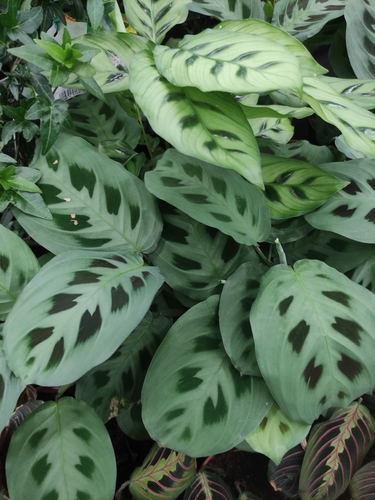
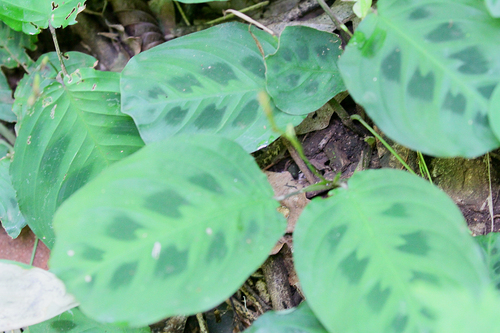
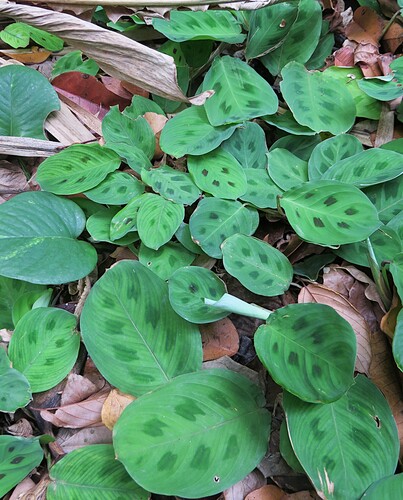
The prayer plant (Maranta leuconeura), often sold simply as maranta, is a rhizomatous herbaceous perennial in the arrowroot family, Marantaceae, native to the humid forests of Brazil. It forms a low clump of boldly marked oval leaves that fold upward each evening like a pair of hands in prayer, which gave the plant its common name.
Read moreMaranta, Herringbone plant and Rabbit's foot
Global distribution
The native range of Maranta leuconeura lies in the humid forests of central and eastern Brazil. Widely grown as a foliage plant, the species is found in pots and greenhouses far beyond that range; these areas of cultivation should be kept apart from its Brazilian homeland.
Identity
The prayer plant (Maranta leuconeura É.Morren, 1874), also sold as maranta, is a rhizomatous herbaceous perennial in the genus Maranta, part of the arrowroot family, Marantaceae. Its common name describes a striking habit: every evening the leaves rise and press together like hands in prayer, then open out again in the morning. 1 2
Most people meet this species as a houseplant with strongly graphic foliage. The oval leaves carry sharply drawn veins, silvery white or bright red depending on the variety, which make it one of the most recognizable and widely grown members of the Marantaceae. 3 4
Recognition
Low and sprawling, Maranta leuconeura forms a clump that rarely tops 20–30 cm (8–12 in) and widens through a rhizome running just at the soil surface. The leaves are broad, oval, velvety and smooth-edged, roughly 10–12 cm (4–5 in) long, on short stalks. 4 5
The giveaway is the pattern of the veins: silvery white or bright red lines radiating from the midrib across a dark green blade. The underside is often tinged gray-green to purple, which sharpens the contrast when the leaf stands up. 4 6
A second clue is the nyctinastic movement: leaves lie flat by day and lift at dusk. This daily motion, easy to watch with the naked eye, sets the plant apart from an ordinary foliage plant at once. 2 4
Useful taxonomy
Édouard Morren described the species as Maranta leuconeura in 1874. The genus name honors the Venetian botanist Bartolomeo Maranta. Several infraspecific and horticultural names still circulate, and all of them belong to this one species:
- Maranta leuconeura var. erythroneura G.S.Bunting
- Maranta leuconeura var. kerchoveana É.Morren
- Maranta leuconeura var. massangeana É.Morren
- Maranta massangeana (É.Morren) hort.
- Maranta kerchoveana É.Morren
The stable reference is the accepted scientific name, Maranta leuconeura, because tags such as erythroneura or kerchoveana refer to varieties and horticultural selections, not to separate species. 1 5
Habitat and range
Home for Maranta leuconeura is the humid tropical forest of central and eastern Brazil. There it grows on the ground in the shaded understory, in cool, covered soil, out of direct sun. 1 4
As a plant of the lowest layer, it carpets the ground as it spreads: the creeping stem roots at each node, letting it cover a small patch of leaf litter bit by bit. That groundcover strategy explains its dense habit in cultivation. 2 6
Horticulture has carried the species far beyond its range, into pots and greenhouses in Florida, Europe and East Asia. Those areas of cultivation need to be kept distinct from the Brazilian range where it grows wild. 4 7
Life cycle and reproduction
Indoors, flowering is sparse and uncommon. When it happens, in late spring or summer, the plant bears small white to mauve flowers on thin upright spikes. They are modest and beside the point, since the plant is grown for its leaves. 4 3
Leaf movement sets the rhythm of the plant's day. It is controlled by a swelling at the base of the leaf stalk, the pulvinus, which changes its turgor with the cycle of light and dark. The leaves lift at night and return to horizontal by day, a cycle that depends on adequate light. 2 4
Growers mostly propagate it by division at repotting, splitting the clump so each piece keeps roots and stems. Stem cuttings with a node also work, provided the cut is made below a node, where the roots will form. Kept warm, in soft water or moist mix, a cutting puts out its first roots in three to four weeks. Division remains the more reliable route, as it gives an already structured clump from the start. 7 6
Uses and risks
Use of Maranta leuconeura is essentially ornamental: it is a houseplant valued for its colorful foliage and its nightly movement. In humid tropical climates it can serve as a shade groundcover; where winters are cool or frosty, it is grown in pots as a low clump. 5 7
On the safety side, it has a rare advantage: the ASPCA lists the prayer plant as non-toxic to cats, dogs and horses. No signs of poisoning are described, which makes it one of the safest popular foliage plants for a home with pets or young children. The real challenge is cultural: dry air or hard water quickly browns the leaf edges. 8 4
Varieties, look-alikes and related plants
None of the forms on the market is a separate species. var. erythroneura has bright red veins on a dark ground; var. kerchoveana has brown, chevron-like blotches on green; var. leuconeura has silvery white veins. The trade name Massangeana covers a dark form with silver veins. Before buying, check the variety name, the state of the roots and how even the foliage looks. 3
The most frequent mix-ups involve other Marantaceae:
- Goeppertia (formerly Calathea), with patterned leaves and the same nightly movement;
- Ctenanthe, with longer, often variegated leaves;
- Stromanthe, with distinctly purple undersides.
A low, spreading habit, radiating veins and the daily leaf movement remain the surest signs that a plant sold as maranta really is Maranta leuconeura. 4 1
Main sources
- Plants of the World Online / Kew, Maranta leuconeura É.Morren
- Royal Horticultural Society, Maranta leuconeura var. erythroneura
- Royal Horticultural Society, Maranta leuconeura var. kerchoveana
- Missouri Botanical Garden, Maranta leuconeura
- Encyclopaedia Britannica, prayer plant
- Plants For A Future, Maranta leuconeura
- ASPCA, prayer plant (Maranta leuconeura) non-toxic entry
- University of Florida IFAS, Maranta leuconeura culture guide
Frequently asked questions
Is Maranta leuconeura toxic?
No. The ASPCA lists the prayer plant as non-toxic to cats, dogs and horses. It is one of the few popular foliage houseplants with no known poisoning risk for pets.
Why do Maranta leaves fold up at night?
This nyctinastic movement is driven by a swelling at the base of the leaf stalk, the pulvinus, which responds to the cycle of light and darkness. The leaves rise and close together at night, then lie flat again by day.
Why are the leaf edges turning brown?
Brown tips and margins usually come from air that is too dry or from hard, mineral-rich water. Raising humidity to 60–80% and watering with soft water limits this common problem in heated homes.
What light does Maranta leuconeura need?
Bright but indirect light gives the most colorful leaves. Direct sun fades and scorches the blade, while light that is too low dulls the veins and disrupts the nightly movement.
How do you propagate Maranta leuconeura?
The easiest way is to divide the clump at repotting, keeping roots and stems on each piece. Stem cuttings with a node also work, with roots appearing in three to four weeks.
Which plants are mistaken for Maranta leuconeura?
Mix-ups mostly involve calatheas, now placed in the genus Goeppertia, and Ctenanthe. All belong to the Marantaceae and share patterned foliage and moving leaves.
How big does Maranta leuconeura get?
In a pot the plant stays low and spreading, around 20–30 cm (8–12 in) tall, with a clump somewhat wider than it is high. It spreads by its rhizome rather than growing upward.
Are the red-veined varieties different species?
No. The varieties erythroneura, kerchoveana and leuconeura all belong to Maranta leuconeura. They differ in the color of their veins and markings, not in species.
Similar plants

Botanical data compiled from reference sources (RHS, Kew Gardens, POWO). This profile is for guidance only and is not a substitute for advice from a botanist or veterinarian if you have concerns about toxicity.