
Cleavers (Galium aparine, )
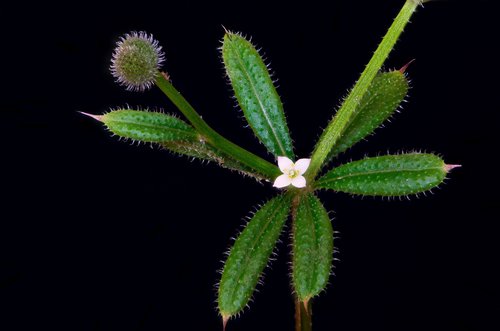
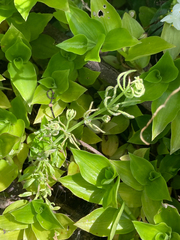
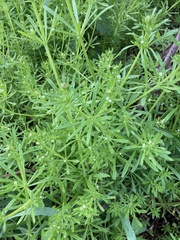
Cleavers (Galium aparine) is an annual herb in the Rubiaceae family, found across temperate Europe, North Africa and Asia as far as Japan. Its square stems and leaves bear tiny hooked hairs that catch on clothing, animal fur and surrounding vegetation, allowing it to scramble without tendrils. Common in hedges, disturbed ground and cereal fields, it also has documented uses as a cooked wild vegetable and a coffee substitute made from roasted fruits.
Read moreCleavers, Goosegrass, Clivers, Catchweed, Catchweed bedstraw and Sticky willy
Give plenty of ambient light without direct sun on the leaves.
Partial shade to full sun
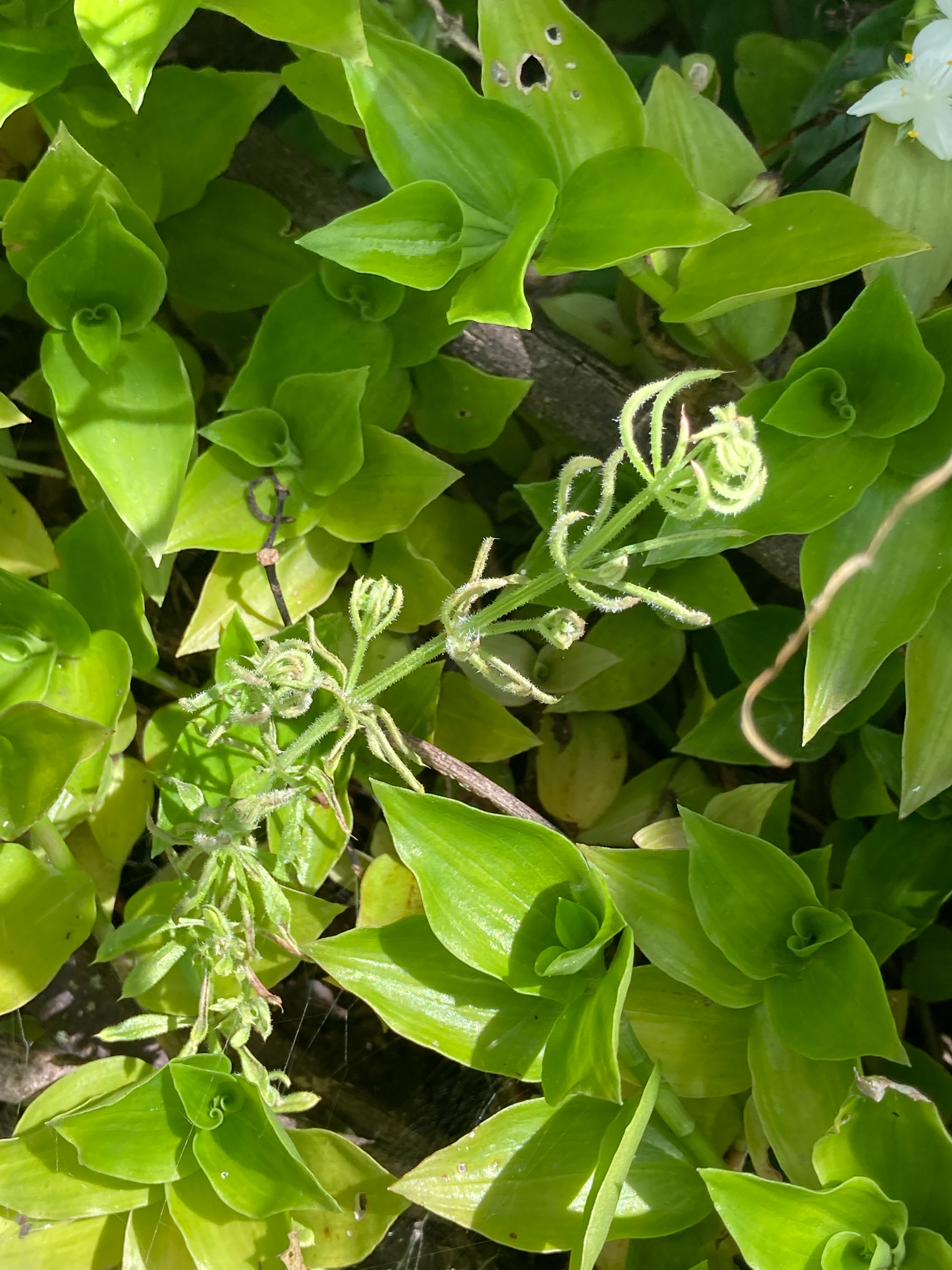
© photo
(c) Magnus Hagdorn, some rights reserved (CC BY-SA) · cc-by-sa
Richard Littauer · cc0
iNaturalist User · cc0
(c) zebedeugalinha, some rights reserved (CC BY) · cc-by
(c) Gavin Slater, some rights reserved (CC BY) · cc-by

Global distribution
Cleavers (Galium aparine) is an annual with hooked hairs, whorled leaves and tiny flowers; explore its habitat, traditional uses and similar bedstraws.
- Native4
- Introduced2
- Invasive2
- France
- United Kingdom
- Spain
- Japan
- Canada
- New Zealand
- United States
- Australia
Hexagons: regions where the plant occurs. Green dots: native range.1
Identity
Cleavers (Galium aparine L., 1753), also called catchweed bedstraw, goosegrass, clivers, catchweed or sticky willy, is an annual herb in the Rubiaceae family. Its hooked hairs catch at the slightest contact: stems, leaves and fruits all share this distinctive feature. Carl Linnaeus described the species in Species Plantarum in 1753. The genus name comes from the ancient Greek gala, milk: Dioscorides had already used it for Galium verum, traditionally used to curdle milk. 4 1
The epithet aparine also has Greek roots, from apairo, to seize or grasp. It describes the tiny hooks covering the stems, leaves and fruits. They catch on clothes, animal coats and neighboring plants, allowing a stem without tendrils or clinging roots to scramble through the vegetation around it. 4
Recognition
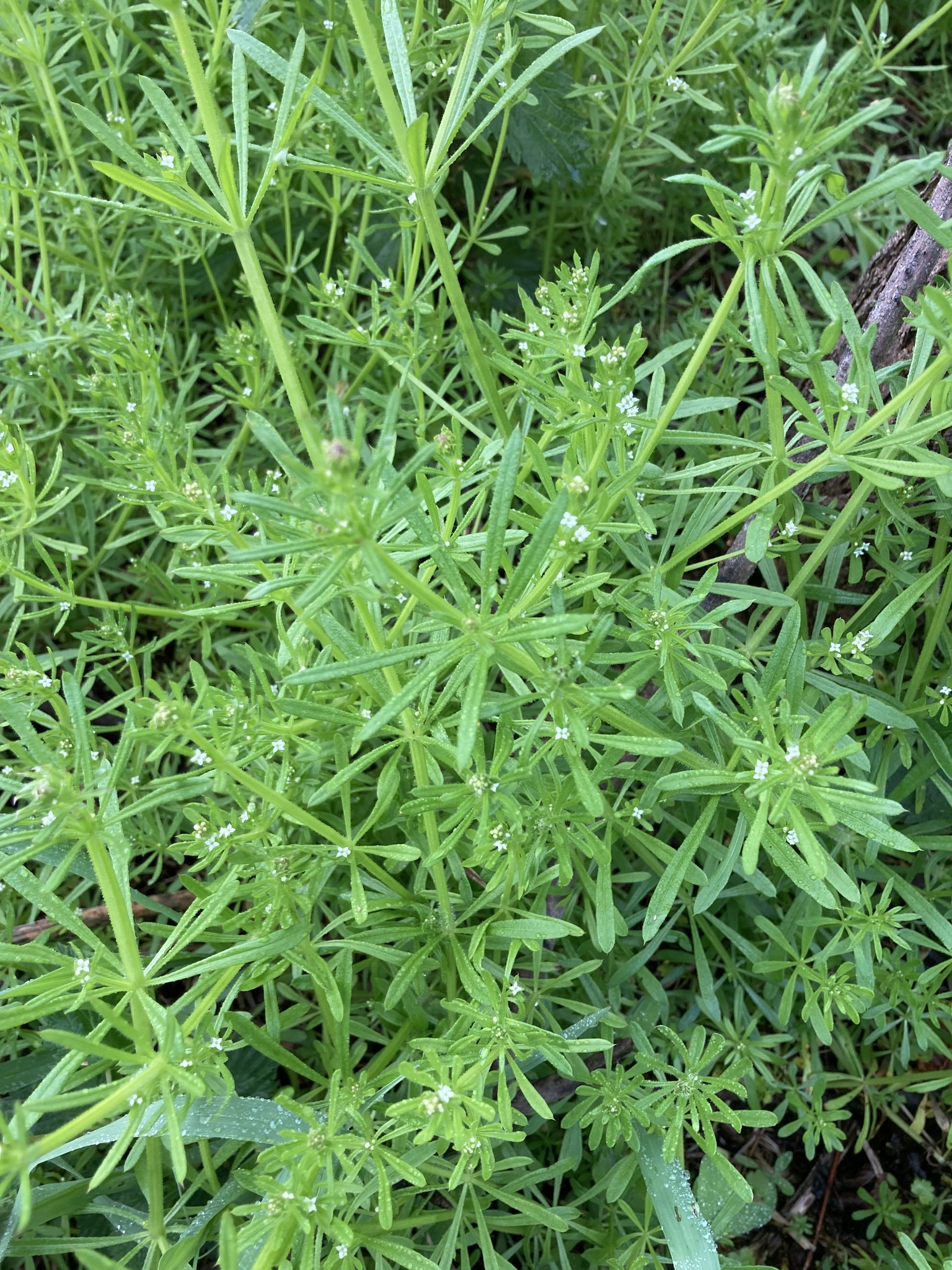
Slender, square stems have small backward-pointing prickles along all four angles. Without tendrils or clinging roots, they cannot stand upright beyond a few tens of centimeters. Supported by a hedge or neighboring crop, they climb or trail to 1.2 m (4 ft), sometimes farther in favorable conditions. 4 3
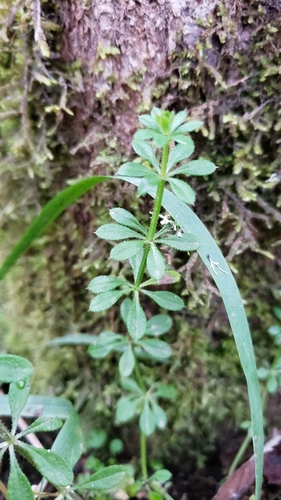
Narrow, lance-shaped leaves grow in whorls of six to eight at each node. Hooked hairs edge the leaves too, extending the gripping surface of the stem. Tiny flowers, barely 2–3 mm (0.08–0.12 in) across, have four greenish-white petals. They appear in groups of two or three in the leaf axils from late winter to summer, depending on the region. 3 2
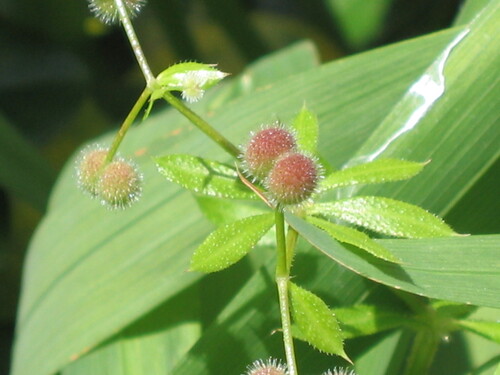
Each fruit forms a small globe 3–7 mm (0.12–0.28 in) across, covered in hooked hairs and comprising one or two tightly joined achenes. This clinging fruit is a more useful field feature than the inconspicuous flower, and remains recognizable after flowering has finished. 5 4
Useful taxonomy
For this species, Plants of the World Online accepts Galium aparine L., published in 1753, in the Rubiaceae family and Rubioideae subfamily. 1
Regional French names include rièble, grateron, gratte-langue, saigne-langue and ne-me-quitte-pas. These all refer to the same plant and the familiar sensation of its hooks catching against skin or clothing; they are regional names rather than separate botanical taxa. 5
Several hundred species belong to Galium. They can be confused unless the fruit and the scent of crushed or dried material are examined. The complete binomial, Galium aparine, therefore provides a more reliable identification reference than a shared common name on its own. 1
Habitat and range
Macaronesia, Europe, North Africa and temperate Asia as far as Japan make up the native range recorded by POWO. Beyond that range, Galium aparine has become widely naturalized in North and South America, Australia and New Zealand. 1 4
Across France, cleavers grows throughout the country, from hedgerows to cereal fields. 6 In the United States, where it was introduced, USDA records it as a weed of field crops, including corn and soybeans. 7
Cleavers favors heavy soils rich in nitrogen and phosphorus, with a pH of 5.5–8. In these fertile conditions it occupies hedges, woodland edges and disturbed ground, especially cereal fields, orchards and vineyards. Dense growth in cultivated land often signals excessive fertilization rather than a need to feed the plant. 4 5
Life cycle and reproduction
Germination starts early, in late winter, or in fall among populations that behave as winter annuals. Each plant commonly produces 300–400 seeds, which remain viable in soil for only two or three years. Rapid replenishment of this seed bank explains why a single season of cutting cannot eradicate an established population. 3
Dispersal relies mainly on epizoochory, transport on the outside of animals. Hooked fruits cling to fur, clothing and farm equipment, traveling much farther than a fruit simply falling beside its parent. Seeds can also survive passage through livestock, extending dispersal along grazing routes. As a pioneer, cleavers recolonizes burned ground from buried seeds, making prescribed burning an ineffective means of control. 3 8
Uses and risks
Young shoots gathered before the fruits harden can be cooked as a vegetable, much like spinach. The hooks make the raw plant unpleasant to eat. Ripe fruits can be dried and roasted as a coffee substitute with less caffeine, a practice documented in both France and Britain. 4 5
Its chemical constituents include iridoid glycosides such as asperuloside, flavonoids, coumarins and an anthraquinone derivative that deters some caterpillars. These constituents provide context for traditional uses as a diuretic infusion and a poultice for small wounds. No food toxicity is documented in the cited account; traditional use does not itself establish a treatment's effectiveness. 4
The documented contact risk is mechanical irritation. On sensitive skin, repeated contact with the hooked hairs can produce small scratches. These may resemble an allergic rash, although the irritation described here comes from the hairs scratching the skin. 4
Varieties, look-alikes and related plants
No horticultural selections of cleavers are described: it remains a spontaneous crop weed rather than a plant domesticated for ornament. Its relative Galium odoratum, by contrast, is cultivated as groundcover in shaded woodland settings. 2
Other members of Galium can be mistaken for cleavers in the field:
- Galium spurium bears smaller fruits on a stem that is often more slender, and occurs in the same crops as cleavers;
- Galium odoratum lacks hooked stem hairs and develops a freshly cut hay scent when dried;
- Galium verum has distinctly yellow flowers and smooth fruits without hooked hairs.
The absence of a noticeable scent in fresh Galium aparine, together with hooks across the whole plant, provides the most useful combination of field characters for separating these species.
Main sources
- Plants of the World Online / Kew, Galium aparine L.
- Plants For A Future, Galium aparine
- University of Wisconsin Extension, Catchweed Bedstraw, Galium aparine
- Wikipedia EN, Galium aparine
- Wikipedia FR, Gaillet gratteron
- Inventaire National du Patrimoine Naturel, Galium aparine L.
- USDA PLANTS Database, Galium aparine plant profile
- Fire Effects Information System, Galium aparine species review
Frequently asked questions
Is cleavers poisonous?
No reference source documents food toxicity or a toxic constituent affecting humans or domestic animals. Its known risk is mechanical: repeated contact with the hooked hairs can cause minor irritation on sensitive skin.
Can you eat cleavers?
Yes. Young shoots are cooked as a vegetable before the fruits harden. Ripe fruits, dried and roasted, serve as a coffee substitute with less caffeine.
Why does cleavers stick to clothes?
Its stems, leaves and fruits carry small hooked hairs. These mainly help disperse fruits externally on passing animals, a process called epizoochory.
How can you tell cleavers from sweet woodruff?
Sweet woodruff, Galium odoratum, lacks hooked hairs on its stems and smells of freshly cut hay when dried. Cleavers has no noticeable scent when fresh.
Can cleavers become a problem in crops?
Yes, in cereal fields, orchards and vineyards. Its stems tangle with crops and can interfere with harvesting; each plant produces 300 to 400 seeds that quickly replenish the soil seed bank.
What does Galium aparine mean?
Galium comes from the Greek gala, milk, referring to the related Galium verum and its traditional use for curdling milk. Aparine comes from Greek apairo, to seize, describing the hooked hairs.
Does cleavers grow in France?
Yes. It occurs throughout France in hedges, disturbed ground and especially cereal fields, on soils rich in nitrogen and phosphorus.
Similar plants
If you are unsure about a plant’s toxicity, ask a botanist or veterinarian for advice.