
Lady's bedstraw (Galium verum, )
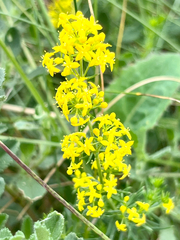
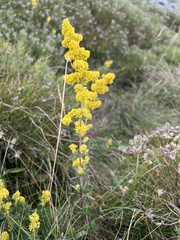
Lady's bedstraw (Galium verum) is a herbaceous perennial in the Rubiaceae family, common in dry, calcareous grassland in Europe, North Africa and temperate Asia. Its square stems carry narrow, whorled leaves and an abundance of yellow summer flowers. The plant was traditionally used to dye fabrics and fill straw mattresses.
Read moreLady's bedstraw and yellow bedstraw
Allow a few hours of direct sun per day, preferably morning or evening.
Full sun to light partial shade; flowering is denser in full sun
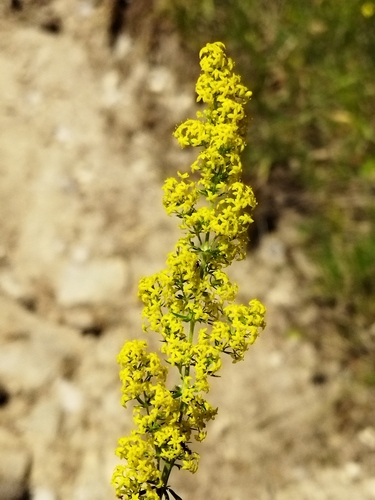

© photo
(c) Pekka Malinen, some rights reserved (CC BY-NC-SA), uploaded by Pekka Malinen · cc-by-nc-sa
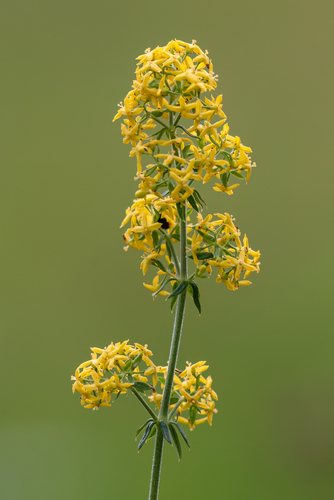
Kieran Roy Powell · cc0
Mirko Ubović · cc0
(c) SteveM4560, some rights reserved (CC BY) · cc-by
(c) Benjamin Flatt, some rights reserved (CC BY) · cc-by
Global distribution
The native range of Galium verum covers most of Europe, North Africa and temperate Asia, from the Near East to Japan and Kamchatka. It has also naturalized beyond this range, particularly in North America and Oceania, without a regulated noxious-weed status there.
- Native5
- Introduced3
- France
- United Kingdom
- Germany
- Russia
- Japan
- United States
- Canada
- New Zealand
Hexagons: regions where the plant occurs. Green dots: native range.1
Identity
Lady's bedstraw (Galium verum L., 1753), also known as yellow bedstraw, is a herbaceous perennial of the genus Galium in the Rubiaceae family. Carl von Linnaeus described it under this same binomial in 1753, and Plants of the World Online still accepts the name. 1 4
The genus name Galium comes from the Greek gala, milk, alluding to a long-standing use of these plants as vegetable rennet. For Galium verum itself, that use remains disputed: old trials indicate that the plant alone does not really coagulate milk, despite the legend attached to its French name. 5 4
Recognition
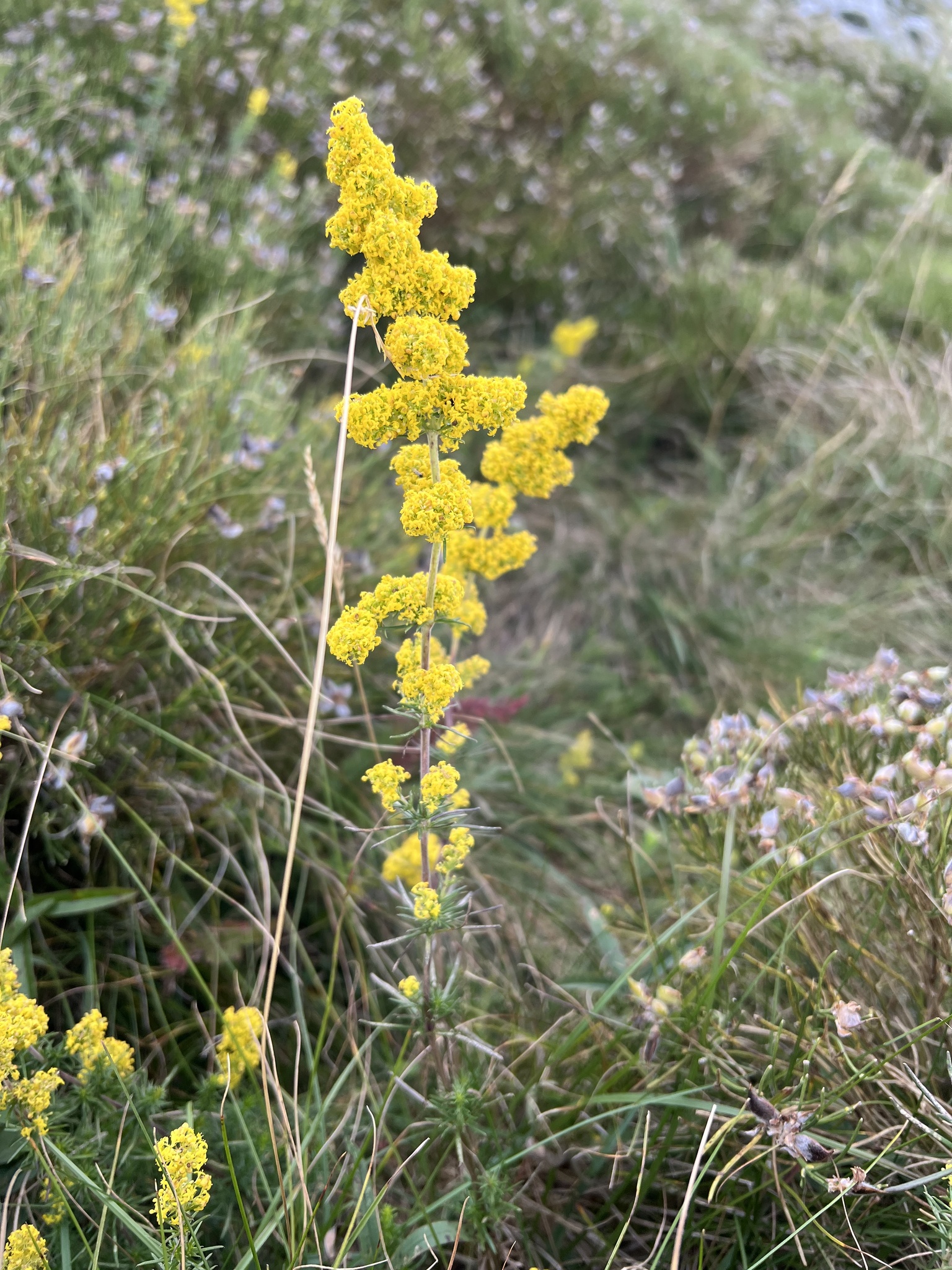
Sturdy, square stems stand upright or lean over, usually reaching 15 cm to 1.20 m (6 in to 4 ft) depending on the population and climate. Narrow, linear leaves measure 1–3 cm (0.4–1.2 in) long and only 2 mm (0.08 in) wide. They grow in whorls of six to twelve at each stem node. 4 5
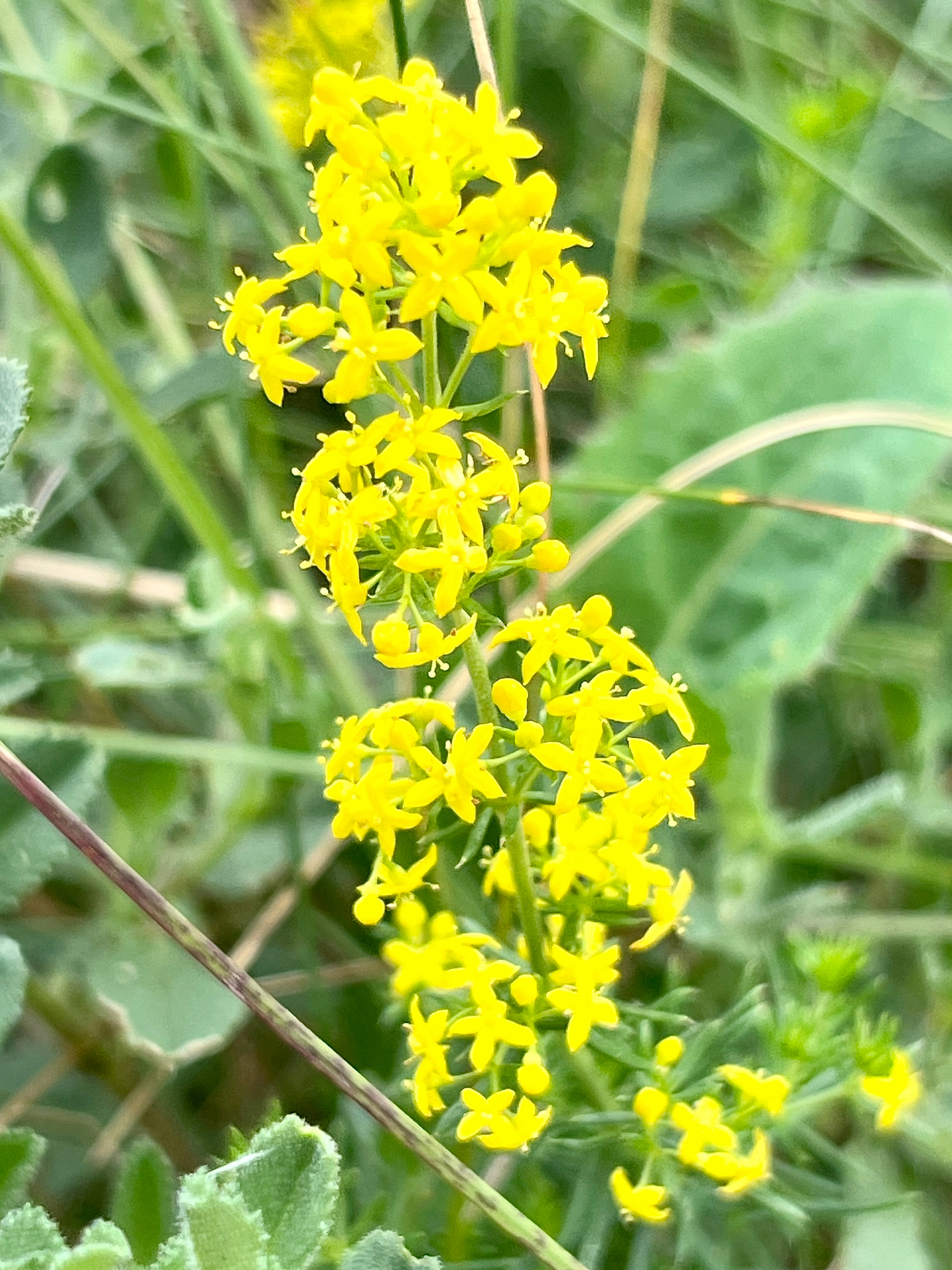
The bright yellow flowers are just 2–3 mm (0.08–0.12 in) across, but their dense panicles extend well beyond the foliage. A flowering clump in dry grassland looks like a golden cloud from a distance. When dried, the whole plant smells of freshly cut hay because of its coumarin, a useful feature for recognizing a herbarium specimen long after collection. 2 4
Useful taxonomy
The four recognized subspecies of Galium verum listed by Plants of the World Online occupy distinct geographical ranges:
- Galium verum subsp. verum, the most widespread in Europe;
- Galium verum subsp. wirtgenii, in central and eastern Europe and western Siberia;
- Galium verum subsp. asiaticum, in the Russian Far East and eastern Asia;
- Galium verum subsp. glabrescens, in Iran, Iraq, Türkiye and Syria.
The genus Galium includes several hundred species. Two relatives also occur in France: Galium aparine, the clinging cleavers, and Galium odoratum, the woodland sweet woodruff. Flower color separates Galium verum from these relatives: its flowers are yellow, an uncommon color in a genus where most species flower white. 8
Habitat and range
The native range spans most of Europe, North Africa and temperate Asia, from the Near East to Japan and Kamchatka. It has also naturalized in New Zealand, Canada and the northern United States. It has also naturalized in Tasmania. 4 7
In France, lady’s bedstraw grows in dry, calcareous grassland, banks, woodland edges, hedges and roadsides, from sea level to 2700 m (8860 ft) depending on the mountain range. Poor, well-drained soil favors flowering. In rich, moist ground, more vigorous perennials quickly outcompete it. 5 3
Life cycle and flowering
Flowering generally extends from early summer to early fall in temperate Northern Hemisphere regions, lasting three to four months depending on latitude and elevation. In Britain, Plants For A Future places it in midsummer; Missouri Botanical Garden records it into early fall in the American Midwest. The nectar-rich flowers attract many pollinators, especially bees and hoverflies. 2 3
Galium verum also spreads vegetatively. Creeping underground rhizomes regularly produce new stems, forming dense, continuous carpets rather than isolated plants, even where few seeds germinate. Seed reproduction and rhizome growth work together: a clump established for several seasons occupies far more ground than a single first-year plant. 3
Uses and risks
The cited reference sources document no toxicity of Galium verum for humans or common domestic animals: neither Kew, Plants For A Future nor Missouri Botanical Garden reports it. Absence of documented toxicity should be read as the scope of these references rather than a guarantee of safety in every circumstance. 2 3
Traditionally, the dried plant was used to stuff straw mattresses. Its fragrant coumarin repels fleas, explaining the English name lady’s bedstraw and its association with the legend of the Nativity bed. Flowers yielded a yellow dye, while roots yielded a red dye resembling that of madder, another Rubiaceae. Roasted seeds also served as a coffee substitute. 4 2
Varieties, look-alikes and related plants
Galium verum is a wild species without a stable horticultural cultivar in wide circulation. Specialist nurseries mainly sell plants derived directly from grassland populations. 3
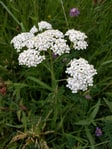
The most frequent look-alike is Galium mollugo, which shares its square stems and hedgerow or bank habitat but has white flowers rather than yellow ones. The hooked annual Galium aparine of hedges and crops and the shaded-woodland perennial Galium odoratum, with its comparable hay scent, belong to the same genus. Their habitat and habit nevertheless distinguish them clearly from Galium verum, which grows in sunny, dry places. 4
In the field, compare the small flowers: 2–3 mm (0.08–0.12 in) across in these three species, but bright yellow in Galium verum and white in Galium mollugo and Galium aparine.
Main sources
- Plants of the World Online / Kew, Galium verum L.
- Plants For A Future, Galium verum - Lady's Bedstraw
- Missouri Botanical Garden PlantFinder, Galium verum
- Wikipedia EN, Galium verum
- Wikipédia FR, Gaillet jaune
- Wikidata, Galium verum (Q156854)
- USDA PLANTS Database, Galium verum profile (GAVE)
- Integrated Taxonomic Information System, Galium verum (TSN 34936)
Frequently asked questions
Is lady’s bedstraw poisonous to cats and dogs?
The reference sources cited here document no toxicity for humans or common domestic animals. This describes the available documentation rather than proving safety in every circumstance.
Can lady’s bedstraw really curdle milk?
Its traditional use survives in its French name, but historical trials showed that the plant alone does not actually coagulate milk. The legend remains attached to the name rather than to a confirmed effect.
How does Galium verum differ from Galium mollugo?
Both have square stems and similar habitats, but their flowers differ clearly: bright yellow in Galium verum and white in Galium mollugo.
Where does it grow in France?
It grows in dry, calcareous grassland, banks, woodland edges, hedges and roadsides, from sea level to 2700 m (8860 ft) in the mountains.
What was lady’s bedstraw traditionally used for?
The dried plant filled straw mattresses, its hay scent and coumarin repelling fleas. Flowers yielded a yellow dye, roots a red dye, and roasted seeds a coffee substitute.
How can it be propagated in a garden?
Sow directly in local spring or divide established clumps and rhizomes. Division is faster for obtaining flowers in the same growing season.
Can it spread too much in a garden?
Its creeping rhizomes form dense carpets if not contained. Mowing after flowering but before seed formation is generally sufficient to limit its spread.
Similar plants

If you are unsure about a plant’s toxicity, ask a botanist or veterinarian for advice.