
Herb robert (Geranium robertianum, )
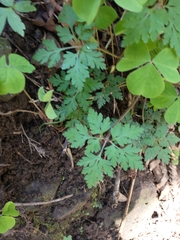

Herb robert (Geranium robertianum) is a small annual or biennial in the Geraniaceae family, common in France on calcareous soils, walls and lightly shaded woodland. Reddish stems and a strong odor when crushed make it recognizable, but it is often confused with ornamental pelargoniums, which are botanically distinct and toxic to animals.
Read moreHerb robert, Robert's geranium and stinky Bob
Give plenty of ambient light without direct sun on the leaves.
Full sun to moderate shade
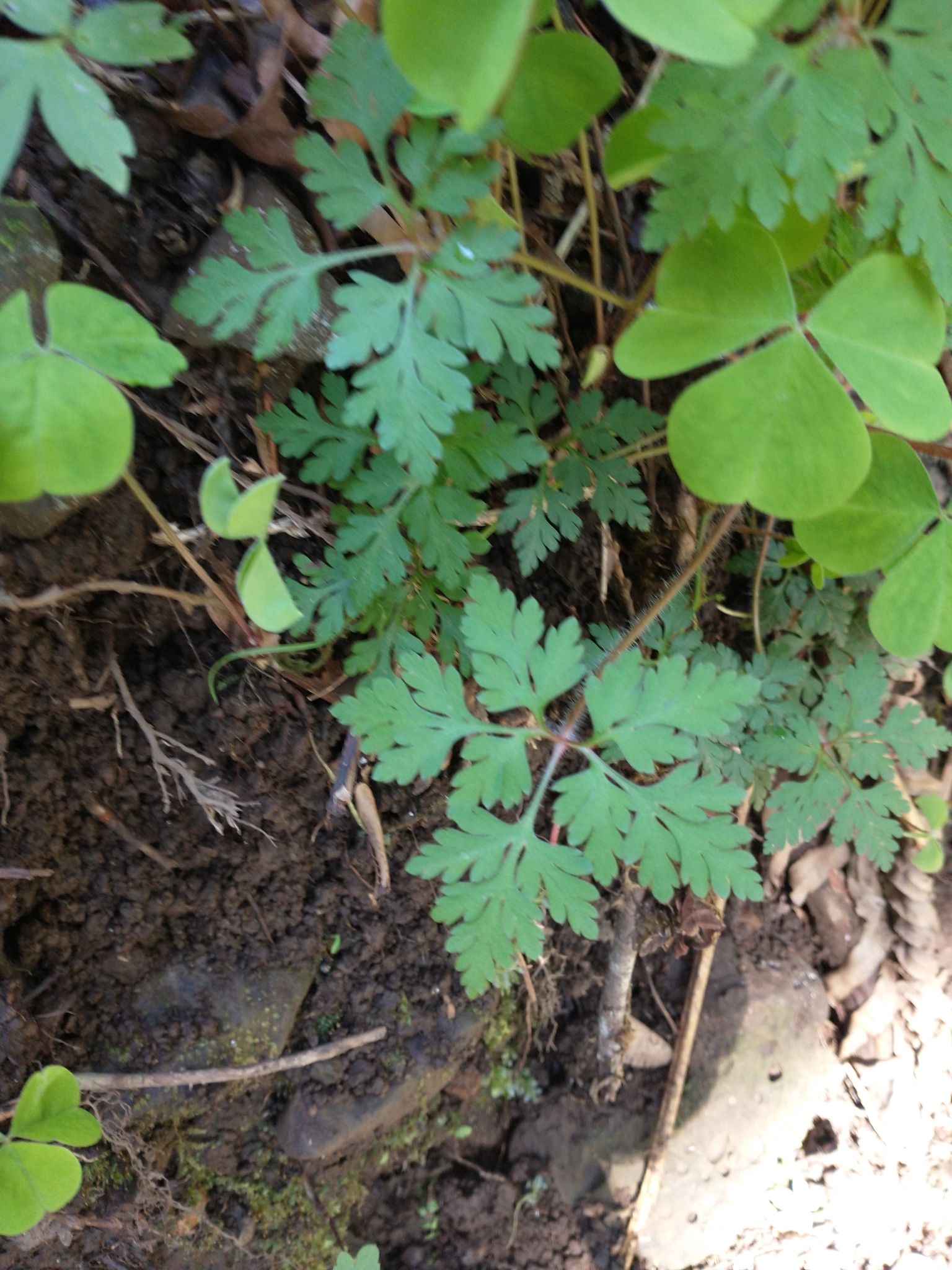
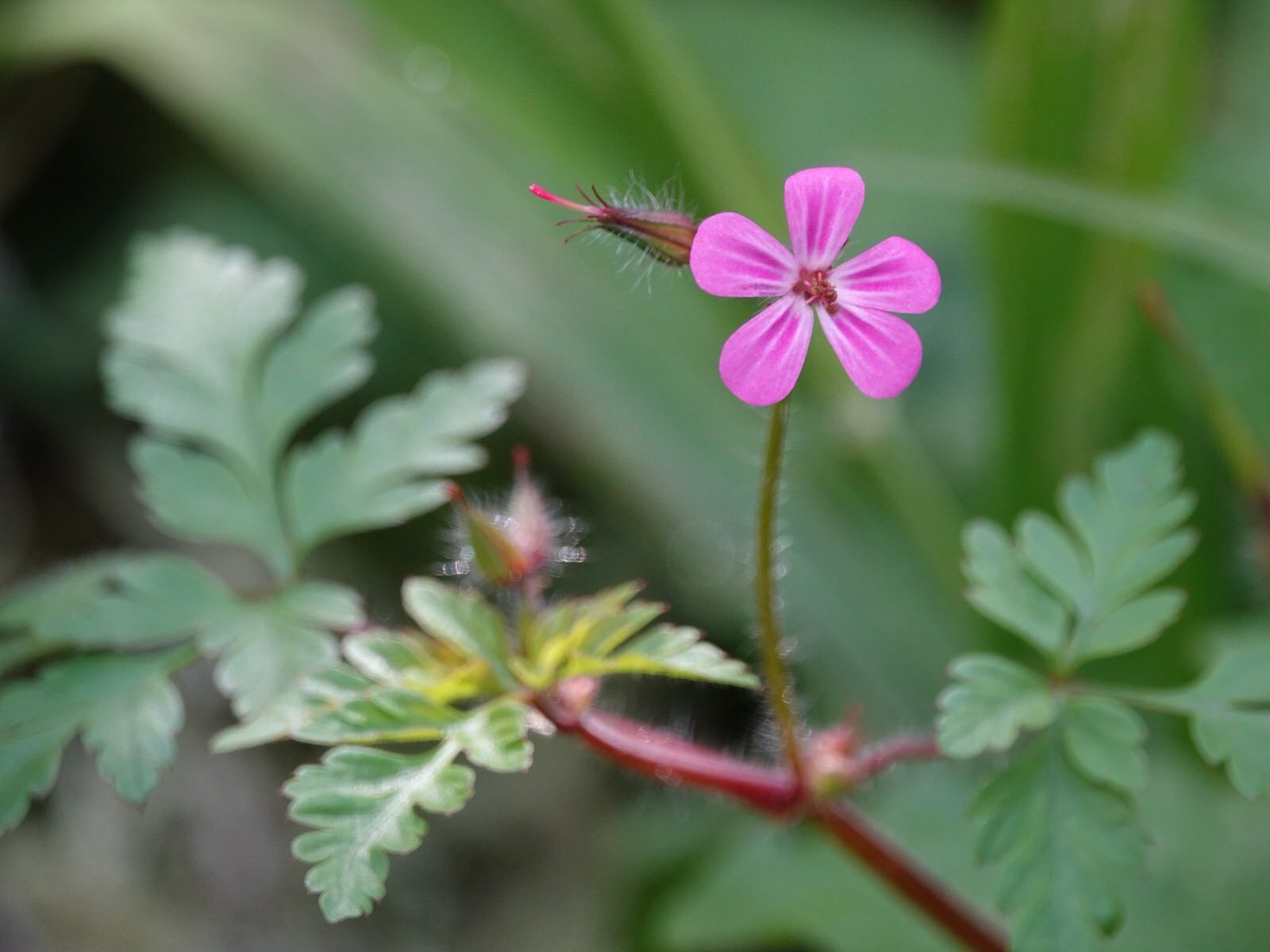
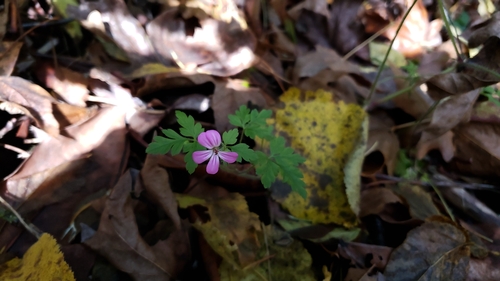
© photo
Gilles San Martin · cc0
Drew Meyer · cc0
Jacqui Geux · cc-by
(c) Gavin Slater, some rights reserved (CC BY) · cc-by
Global distribution
POWO accepts Geranium robertianum L. with a native range covering the temperate Northern Hemisphere, Macaronesia and North Africa south to Ethiopia. It is native to mainland France and Corsica, and considered native in parts of North America, although it is listed as a noxious weed in several Pacific Northwest counties.
- Native9
- Invasive1
- Mainland France
- Corsica
- British Isles
- Central and northern Europe
- Iberian Peninsula and Italy
- Macaronesia
- North Africa and Ethiopia
- Russia and western Siberia
- Eastern North America
- United States, Pacific Northwest
Hexagons: regions where the plant occurs. Green dots: native range.1
Identity
Herb robert (Geranium robertianum L., 1753), also known as Robert's geranium, is a small annual or biennial in the Geraniaceae family. It shares a genus with other wild cranesbills but is botanically distinct from ornamental pelargoniums, often sold as geraniums. Its reddish stems, 10–50 cm (4–20 in) tall, and strong crushed-leaf odor help distinguish it in the field. No major toxic principle is documented in this species, unlike pelargoniums, which the ASPCA lists as toxic. 8 Plants of the World Online accepts the species within Geranium, order Geraniales. 1
French names including herbe à Robert, herbe rouge and the Alsatian bec de grue point to two recognizable features: reddish stems and the elongated fruit. The origin of Robert remains disputed between a corruption of Latin ruber, red, and an association with Saint Rupert of Salzburg, said to have used the plant to treat bleeding. 5
The English nickname stinky Bob describes it well. Its strong, unpleasant smell when the leaves are crushed is a more reliable identifying feature than its outline, which resembles several other cranesbills. The odor fades as the plant dries. 4
Recognition
A basal rosette of deeply divided leaves develops before flowering stems rise. Stems commonly reach 10–50 cm (4–20 in) and can double that height under good conditions. Slender and hairy, they swell at the nodes and often turn bright red in full sun. 5 4
Alternate leaves are divided into three to five deeply cut lobes. Lower leaf blades can reach 11 cm (4.3 in) across. Their sharp smell when crushed is at least as useful as their divided outline for confirming identification. 4
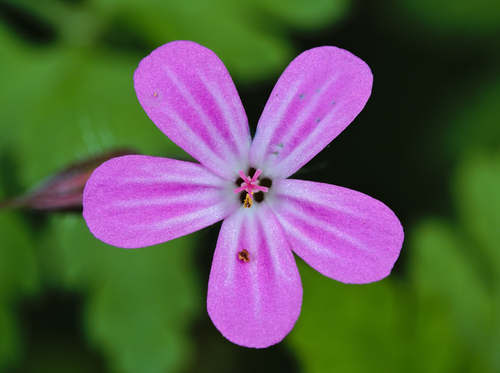
Pink to purple flowers have white streaks at the petal bases and measure 12–16 mm (0.5–0.6 in) across. Ten stamens with purple anthers stand in two whorls. In northern temperate climates, flowering can run from April to October, depending on conditions. 4 5
Useful taxonomy
Three British forms were long distinguished by POWO: Geranium robertianum subsp. celticum Ostenf., a green annual with pale flowers on limestone; Geranium robertianum subsp. maritimum (Bab.) H.G.Baker, a prostrate, reddish biennial on shingle beaches; and the common inland form. They are now grouped as synonyms within the aggregate species, although British floras continue to distinguish them in the field. 1 4
Other historical forms and varieties also appear in the synonymy, including Geranium robertianum var. inodorum DC. and var. rubrum Lej.. These describe differences in hairiness, color or odor rather than separate taxa. For garden identification, the species name Geranium robertianum is more useful than these historical, synonymized varieties. 1
Habitat and range
POWO records a native range covering the temperate Northern Hemisphere, Macaronesia and North Africa south to Ethiopia. 1 It is native throughout mainland France and Corsica, occurring in every department on nutrient-rich soils. 5
Few small annuals occupy such a broad range of habitats: calcareous woodland and edges, hedges, walls, scree, sunny shingle beaches and limestone pavements. It grows from sea level to 700 m (2,300 ft) in England and 2,400 m (7,900 ft) in Kashmir, often on calcareous soil. 4
In North America, it is considered native in some areas but is a Class B noxious weed in several Washington State counties. It forms dense colonies in moist forests as well as on dry rocky outcrops and is reported to release compounds that suppress neighboring plants. 7 4
Life cycle and reproduction
Seeds germinate in spring or autumn. Depending on the population, herb robert grows as an annual or biennial, with an overwintering rosette in forms that pass through winter before flowering. 5 6
Seed dispersal is explosive. The beak-shaped fruit splits abruptly and throws seeds about 1 m (3.3 ft), sometimes only a few tens of centimeters, or roughly a foot, depending on conditions. 4 5 King County notes that seeds remain viable for more than 6 years and can also travel several meters, or many feet, in mud or on shoes, helping explain rapid colonization outside the native range. 7
Uses and risks
Traditional uses involve the fresh aerial parts, rich in tannins, essential oil and geraniin: infusions for diarrhea, bleeding or urinary infections, and external applications to bruises. None of these uses replaces current medical advice. 5 6
The plant is edible raw but unappealing, with an earthy, bitter and astringent taste. PFAF assigns a culinary rating of 0 out of 5, compared with 2 out of 5 for medicinal use. 6 Crushed leaves are also reputed to repel mosquitoes and wasps, explaining their traditional presence near terraces. 5
No toxic principle is documented for Geranium robertianum in cats, dogs or humans. The main concern is confusion with ornamental pelargoniums, often sold as geraniums. The ASPCA classifies them as toxic because of their geraniol and linalool. This shared common name does not make them the same botanical plant as herb robert. 8
Varieties, look-alikes and related plants
The most thoroughly described look-alike is Geranium purpureum Vill., a distinct species accepted by POWO, sometimes called petit Robert in French. Its flowers are much smaller, 5–9 mm (0.2–0.35 in) rather than 12–16 mm (0.5–0.6 in), with yellow instead of purple anthers. Crushed foliage lacks a marked odor. 2 4
Other cranesbills sometimes cause confusion: Geranium lucidum, with glossy leaves not divided into separate lobes, and Geranium columbinum, lacking the long sepal tips characteristic of the group. RHS describes white-flowered 'Celtic White' as a long-valued rock-garden plant, grown for its aromatic foliage and prolonged flowering rather than a practical use. 4 3
Main sources
- Plants of the World Online / Kew, Geranium robertianum L.
- Plants of the World Online / Kew, Geranium purpureum Vill.
- Royal Horticultural Society, Geranium robertianum (wd)
- Wikipedia (EN), Geranium robertianum
- Wikipédia (FR), Géranium Herbe à Robert
- Plants For A Future, Geranium robertianum
- King County Noxious Weeds, Herb Robert identification and control
- ASPCA, Geranium (Pelargonium species) toxicity entry
Frequently asked questions
Is herb robert toxic?
No major toxic principle is documented for Geranium robertianum in cats, dogs or humans. The confusion risk concerns ornamental pelargoniums, often sold as geraniums, which the ASPCA lists as toxic.
Why does herb robert smell so bad?
Crushed foliage gives off a sharp, unpleasant odor, explaining the English nickname stinky Bob. This is a reliable identification feature, and the smell fades after the plant dries.
Is herb robert invasive?
It is native and not classified as invasive in France. In the United States Pacific Northwest, however, it is a Class B noxious weed because it forms dense forest colonies. That regional designation is not a worldwide legal status.
How does herb robert differ from Geranium purpureum?
Geranium purpureum has much smaller flowers, 5–9 mm (0.2–0.35 in) rather than 12–16 mm (0.5–0.6 in), yellow rather than purple anthers, and no marked odor when its leaves are crushed.
Can herb robert be eaten?
The leaves are edible raw but unappealing, with an earthy, bitter, astringent taste. PFAF gives the plant a culinary rating of 0 out of 5, compared with 2 out of 5 for traditional medicinal use.
How are herb robert seeds dispersed?
The beak-shaped fruit ejects seeds explosively for about 1 m (3.3 ft). Seeds remain viable for several years and can also travel in mud or on footwear.
Can herb robert grow in a rock garden?
Yes. The white-flowered cultivar Celtic White has long been grown in rock gardens and borders for its aromatic foliage and prolonged flowering, from April to October in the northern temperate example.
Similar plants
If you are unsure about a plant’s toxicity, ask a botanist or veterinarian for advice.