
Ivy geranium (Pelargonium peltatum, )
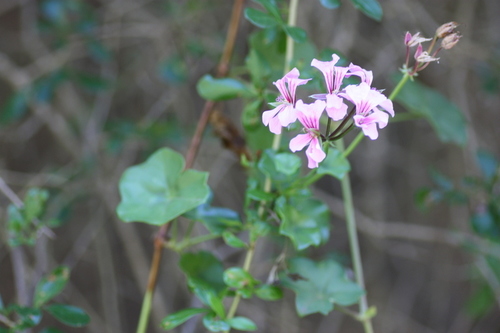

Ivy geranium (Pelargonium peltatum) is a trailing subshrub in the Geraniaceae family, native to South Africa. Its flexible stems carry fleshy, slightly peltate, ivy-shaped leaves and colorful flower umbels through summer. This frost-tender perennial is a familiar cascading plant for window boxes.
Read moreIvy geranium, Ivy-leaved geranium, Hanging geranium, Ivyleaf geranium, Ivy-leaved pelargonium and Cascading geranium



© photo
(c) Marco Schmidt, some rights reserved (CC BY-NC-SA), uploaded by Marco Schmidt · cc-by-nc-sa
Wikimedia Commons · CC BY-SA or Public Domain
Wikipedia · CC BY-SA
Taken Nov 13, 2020 by Marcelo Villena Rojas (cc-by-sa)
Taken Oct 17, 2020 by Hunter A (cc-by-sa)
Taken Sep 22, 2022 by mer jury massei (cc-by-sa)
Taken Jul 7, 2020 by Pl@ntNet (cc-by-sa)
Taken Jul 5, 2022 by Terezka Czech (cc-by-sa)
© copyright of the Board of Trustees of the Royal Botanic Gardens, Kew.




Global distribution
Native to the Cape provinces of South Africa. Grown worldwide in balcony and window-box displays, ivy geranium has locally naturalized in mild climates, including the Mediterranean Basin, Australia and California. These introduced populations are distinct from its native South African range.
- Native1
- Introduced3
- South Africa
- Spain
- Australia
- United States (California)
Hexagons: regions where the plant occurs. Green dots: native range.1
Identity
Ivy geranium (Pelargonium peltatum (L.) L'Hér., 1789), also called ivy-leaved pelargonium or cascading geranium, is a trailing subshrub in the Geraniaceae family. It is one of the world's widely grown ornamental plants for balconies and patios. 1 4
Despite the garden name, this plant is not a true Geranium. L'Héritier separated Pelargonium from that genus in 1789. Many true geraniums are hardy border perennials, whereas pelargoniums are frost-tender plants from southern Africa. 2 3
Flexible stems make ivy geranium a familiar container plant, cascading over edges and flowering from spring until frost. Its habit suits window boxes and hanging baskets especially well. 2 6
Recognition
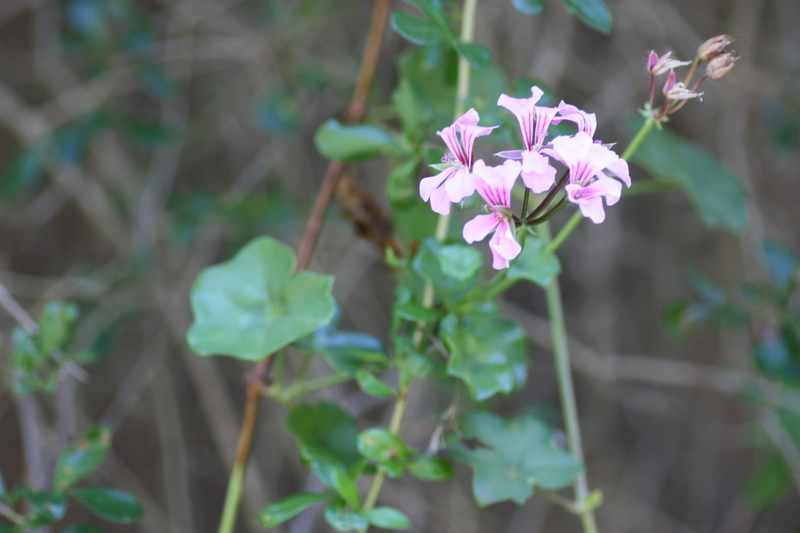
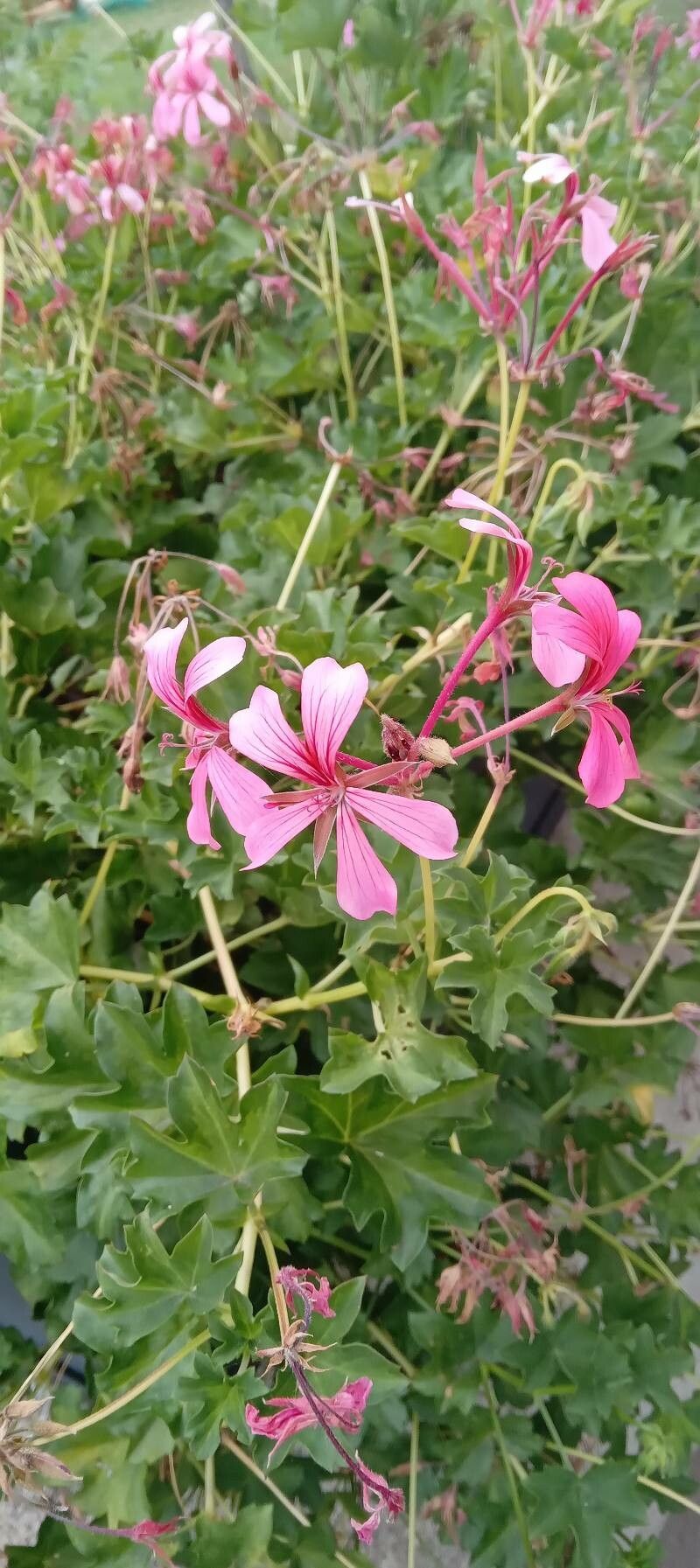
Smooth, glossy, fleshy leaves and flexible trailing stems identify Pelargonium peltatum. Stems extend from 40 cm (16 in) to more than 1 m (3.3 ft). The leaves have five shallow lobes resembling ivy leaves, which explain the common name. 3 4
The epithet refers to a precise feature: the leaf is slightly peltate, meaning its stalk attaches a little inside the blade's margin rather than at the notch. A darker semicircular band is sometimes visible on the blade. 1 3
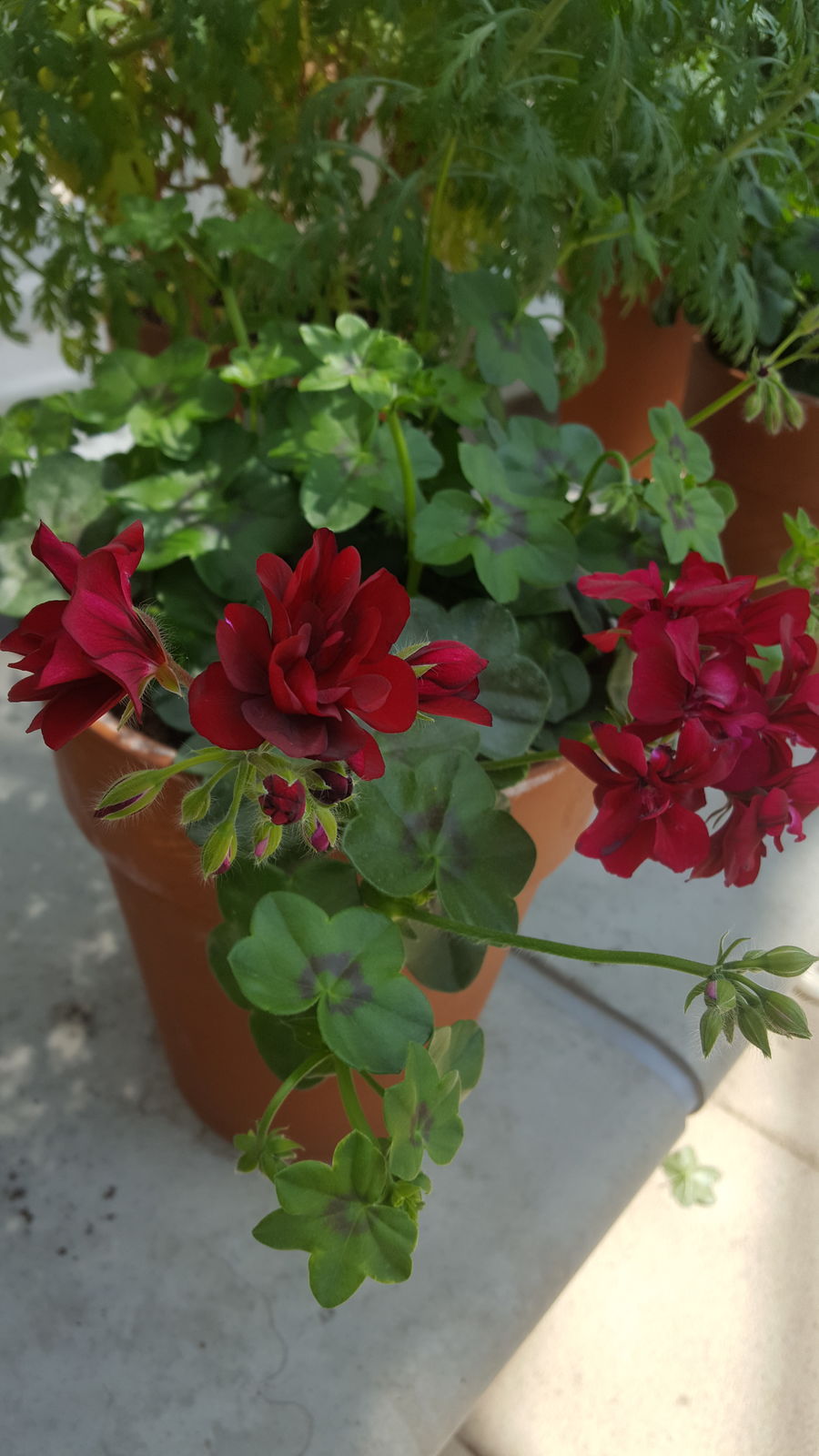
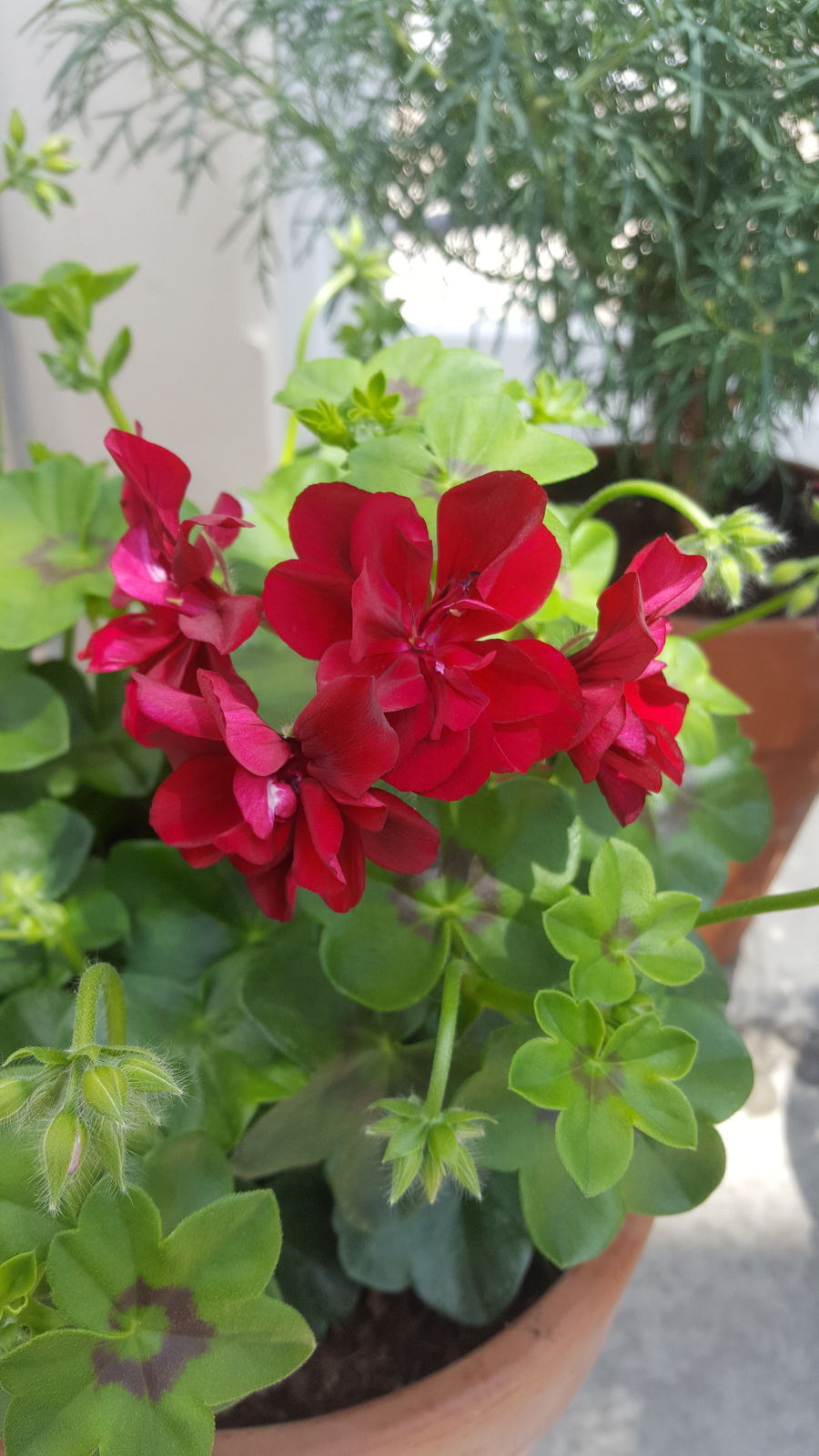
Loose umbels carry 2–10 flowers, white, pink, mauve or red according to cultivar. Each flower has bilateral symmetry and a nectar spur fused to its stalk. This less obvious feature separates pelargoniums from true geraniums with regularly symmetrical flowers. 4 2
Useful taxonomy
Linnaeus first described the species as Geranium peltatum L. L'Héritier transferred it to Pelargonium in 1789; the accepted name is Pelargonium peltatum (L.) L'Hér. Several older scientific names occur in the literature:
- Geranium peltatum L., original name
- Pelargonium scutatum Sweet, historical synonym
- Pelargonium hederifolium Salisb., historical synonym
- Geraniospermum peltatum (L.) Kuntze, historical combination
- Dibrachya peltata (L.) Eckl. & Zeyh., historical combination
The accepted scientific name, Pelargonium peltatum, provides a stable reference. Trade names such as Ville de Paris, Decora and Cascade denote horticultural selections rather than separate species or botanical varieties. Most garden-center ivy geraniums are hybrids derived from this species. 1 7
Habitat and range
In South Africa's Cape provinces, ivy geranium grows in thickets, on rocky slopes and along dry edges under Mediterranean to subtropical conditions. Within its native range, it flowers almost year-round, most strongly from August to October, during Southern Hemisphere spring. 1 3
Mild, dry conditions suit this plant. It tolerates heat and brief drought but is damaged by frost, explaining its success on sunny balconies. Full sun and a freely draining growing medium are central to its cultivation. 2 6
Cultivation has spread ivy geranium worldwide, with local naturalization in mild regions including the Mediterranean Basin, Australia and California. These introduced populations are distinct from its native South African range. 7 5
Life cycle and reproduction
As a frost-tender perennial, Pelargonium peltatum remains green and flowers almost continuously in mild climates. In cold regions it is grown seasonally or sheltered from frost through winter. It is an evergreen, nondormant species rather than a herbaceous plant with winter dormancy. 3 2
Nectar-bearing umbels are adapted to pollination by long-tongued insects and butterflies in its native range. After flowering, the dry fruit develops the elongated beak characteristic of Geraniaceae. Its resemblance to a stork's bill explains the genus name, from Greek pelargós, meaning stork. 4 1
Gardeners usually propagate it from stem cuttings with a node in late summer. Take a stem 8–15 cm (3–6 in) long, let the cut dry for a few hours and root it in barely moist, freely draining mix. Roots develop in two to four weeks in warmth. Seed is possible, mainly for developing varieties, because hybrid seedlings do not reliably reproduce the parent. Easy propagation has helped balcony cultivars spread widely. 2 5
Uses and risks
Cascades of summer flowers make Pelargonium peltatum chiefly an ornamental for tubs, window boxes and hanging baskets. Its long, generous flowering, heat tolerance and easy propagation make it a balcony and patio staple. 2 6
Keep pets from eating the plant. ASPCA classifies Pelargonium garden geraniums as toxic to cats and dogs. Leaf oils, including geraniol and linalool, can cause digestive upset, depression and contact dermatitis. It is not considered dangerous to people, but containers should still be kept out of pets' reach. 8 5
Varieties, look-alikes and related plants
Garden-center forms are cultivars and hybrids, rather than separate species. Ville de Paris is the classic pink balcony type; Decora and Cascade are vigorous trailing series. Tornado and Great Balls of Fire are modern, more compact, self-cleaning selections. Before buying, check for strong stems, an even habit and no rust beneath the leaves. 2
Common look-alikes include:
- Pelargonium x hortorum, zonal geranium, with upright growth and velvety leaves marked by a dark zone;
- true geraniums of the genus Geranium, hardy border perennials with regularly symmetrical flowers;
- Pelargonium grandiflorum, the source of florist geraniums.
Trailing stems, fleshy ivy-shaped leaves and the nectar spur fused to the flower stalk remain the most useful features for identifying Pelargonium peltatum sold as ivy geranium. 3 1
Main sources
- Plants of the World Online / Kew, Pelargonium peltatum (L.) L'Hér.
- Royal Horticultural Society, Pelargonium peltatum - ivy-leaved geranium
- Missouri Botanical Garden, Pelargonium peltatum
- Encyclopaedia Britannica, geranium (genus Pelargonium)
- Plants For A Future, Pelargonium peltatum
- NC State Extension, Pelargonium peltatum
- USDA PLANTS Database, Pelargonium peltatum (L.) L'Hér.
- ASPCA, Geranium (Pelargonium) toxicity entry for cats and dogs
Frequently asked questions
Is ivy geranium toxic to cats and dogs?
ASPCA classifies Pelargonium garden geraniums as toxic to cats and dogs. Leaf oils, including geraniol and linalool, may cause digestive upset, depression and contact dermatitis. Keep containers beyond pets’ reach.
Is ivy geranium a true geranium?
No. Garden and balcony geraniums belong to Pelargonium, separated from Geranium in 1789. True geraniums are often hardy border perennials, while pelargoniums are frost-tender southern African plants.
Can ivy geranium survive winter outdoors?
It is frost-tender and killed by freezing. In mild climates, USDA zones 9–11, it may remain outdoors; elsewhere, overwinter it in a bright, cool, frost-free place for spring regrowth.
Why is my ivy geranium not flowering?
Insufficient sunlight or excess nitrogen are common causes. Provide full sun for at least six hours daily and a low-nitrogen geranium fertilizer. Removing spent flowers encourages further flowering.
How do I propagate ivy geranium from cuttings?
In late summer, take an 8–15 cm (3–6 in) stem with at least one node. Let the cut dry, then place it in barely moist, freely draining mix. Roots develop in two to four weeks in warmth and light.
How does ivy geranium differ from zonal geranium?
Ivy geranium (Pelargonium peltatum) has trailing stems and fleshy ivy-shaped leaves suited to hanging containers. Zonal geranium (Pelargonium x hortorum) grows upright, with velvety leaves marked by a dark zone.
How often should I water ivy geranium?
Water two or three times a week in midsummer, allowing the growing medium’s surface to dry between waterings. Short dry spells are tolerated, but standing water causes crown rot.
Similar plants
If you are unsure about a plant’s toxicity, ask a botanist or veterinarian for advice.