
black walnut (Juglans nigra, )
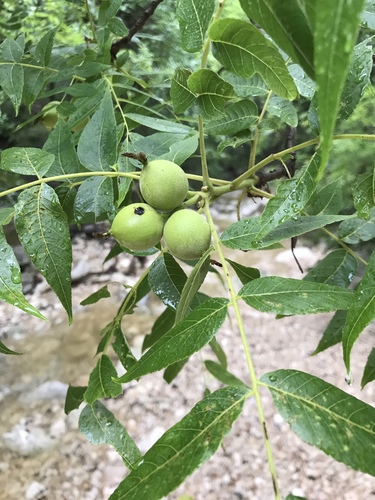
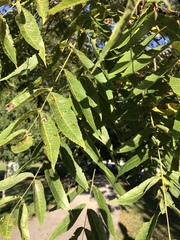
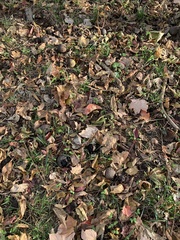
Black walnut (Juglans nigra) is a large deciduous tree in the Juglandaceae, native to central and eastern North America. Almost black bark fissured into diamond patterns, very long compound leaves and a nut husk that never splits distinguish it from Persian walnut. Its dark heartwood is among North America’s most prized timbers.
Read moreblack walnut and eastern black walnut
Allow a few hours of direct sun per day, preferably morning or evening.
Full sun; tolerates partial shade in understory when young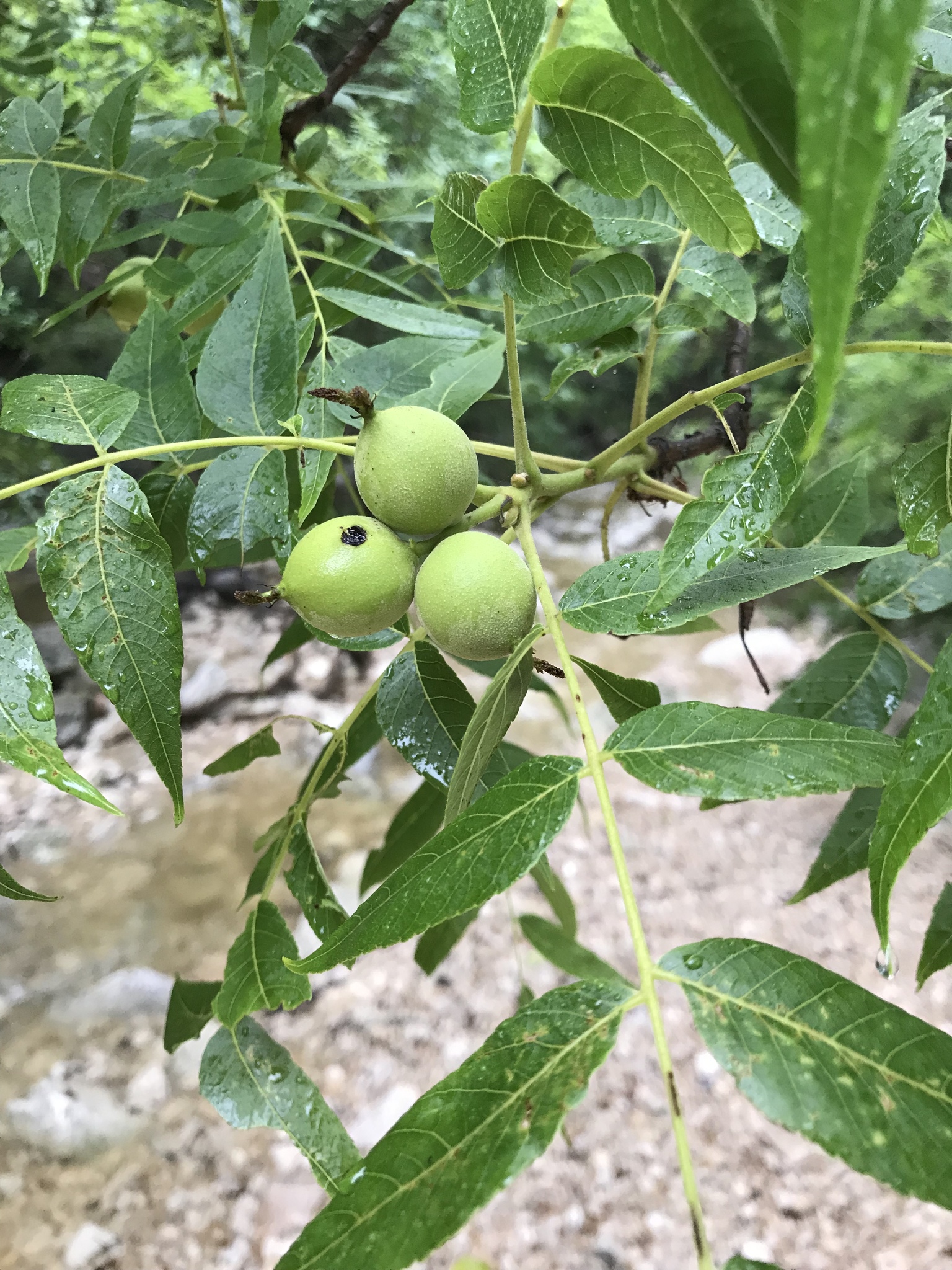


© photo
(c) George Afghan, some rights reserved (CC BY-NC), uploaded by George Afghan · cc-by-nc
June Mire · cc0
Carrie Seltzer · cc0
Taken Jul 19, 2022 by Jim Knopf (cc-by-sa)
Taken Jun 18, 2022 by Jarod Dedeo (cc-by-sa)
Taken Oct 30, 2016 by Tela Botanica − A. Michael BAINES (cc-by-sa)
Taken May 3, 2021 by Otter MacAilein (cc-by-sa)
Taken Jul 3, 2022 by Tristan Jaton-Maria (cc-by-sa)
© copyright of the Board of Trustees of the Royal Botanic Gardens, Kew.




Global distribution
Juglans nigra is native to central and eastern North America, from southeastern Canada, including southern Ontario, to northern Florida, and west to Texas and North Dakota. Widely planted outside that range for timber and nuts, notably in western Europe, it is not considered invasive there.
- Native2
- Introduced1
- United States
- Canada
- New Zealand
Hexagons: regions where the plant occurs. Green dots: native range.1
Identity
Almost black bark, deeply fissured into small, closely set diamonds, identifies black walnut (Juglans nigra L., 1753), also called eastern black walnut. This large deciduous tree belongs to Juglans in the Juglandaceae and is native to central and eastern North America. Unlike Persian walnut, Juglans regia, its nut husk never splits at maturity. 1 3
Latin Jovis glans, “Jupiter’s acorn,” gave the genus its name. Romans used the expression for Persian walnut before Linnaeus adopted it for the genus. The epithet nigra refers to the almost black heartwood and bark, an immediate contrast with its European relative. 1
Recognition
Mature trees commonly reach 15–30 m (49–98 ft) with crowns 15–21 m (49–69 ft) across. Trunk diameter can exceed 1.8 m (6 ft) in old specimens. Trunks enlarge quickly during the first twenty years, supported by the establishing taproot, before growth slows markedly once the framework is well developed. 3 2
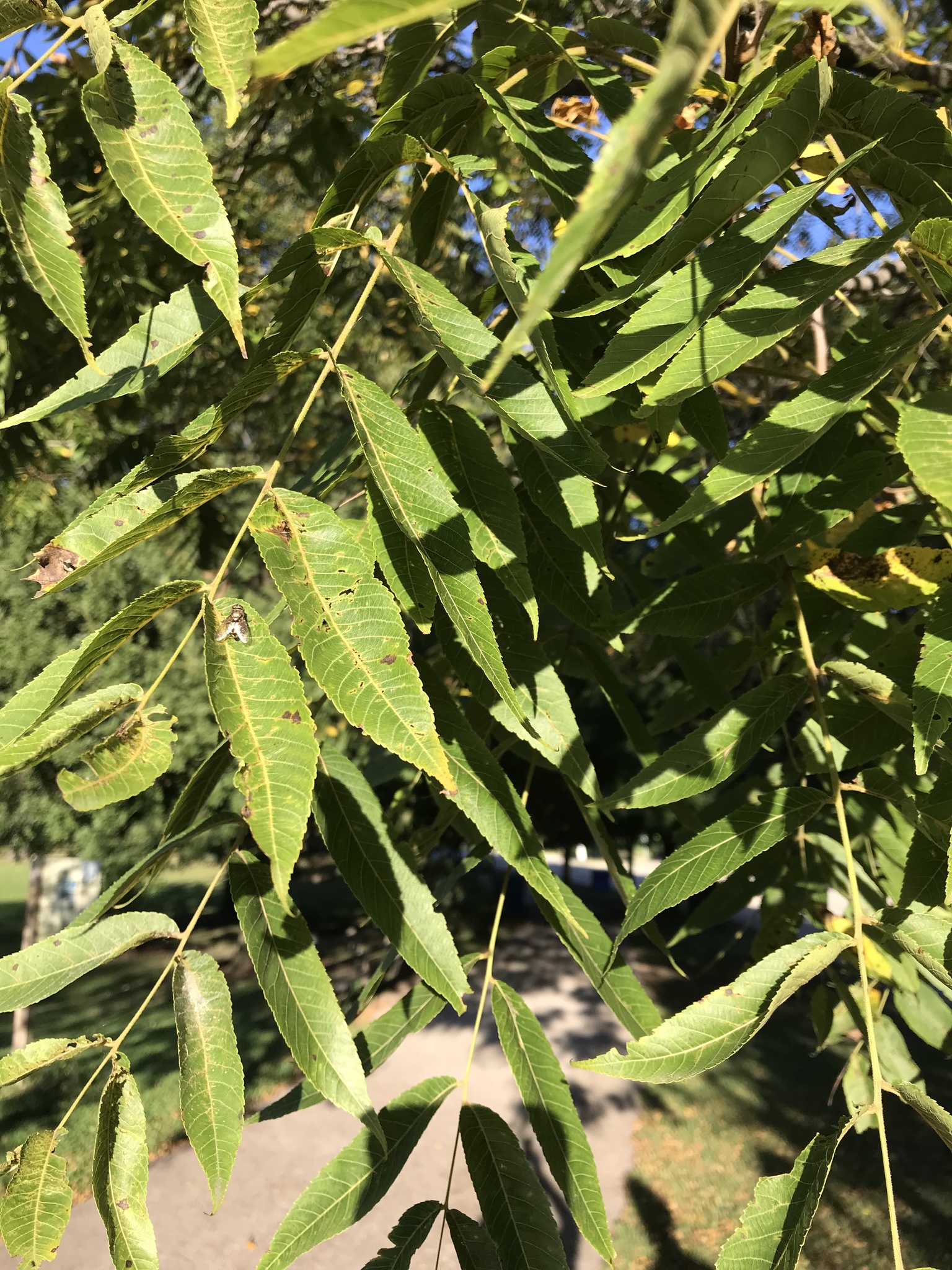
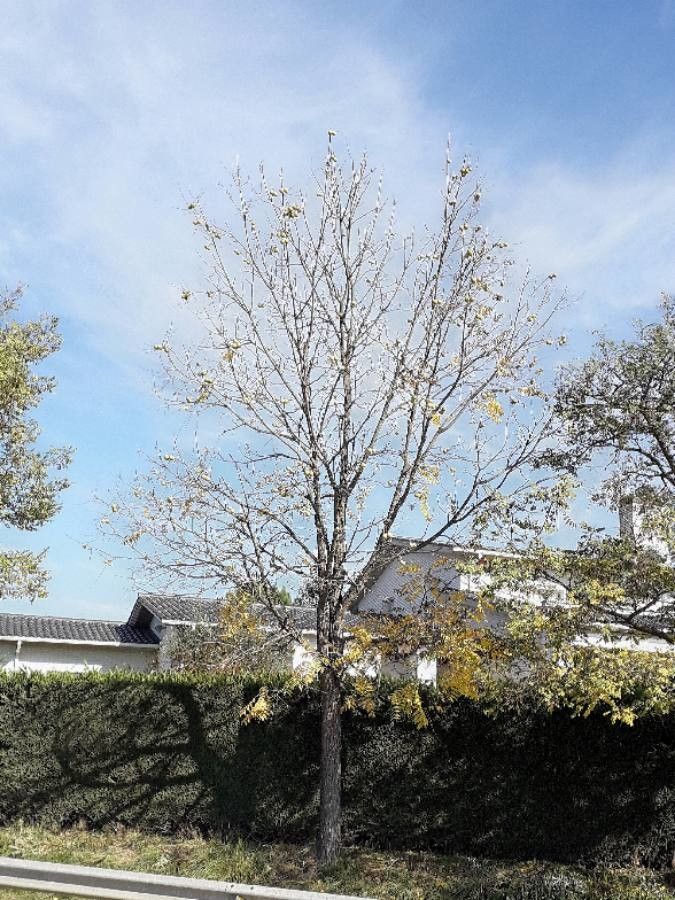
Alternate, pinnately compound leaves measure 30–60 cm (12–24 in) and carry 15–23 finely toothed, oval-lance-shaped leaflets. Crushing them releases a sharp aromatic smell. A three-lobed, monkey-face-shaped leaf scar and the conspicuously chambered pith of a cut stem remain useful winter characters when neither leaves nor fruit are present. 3
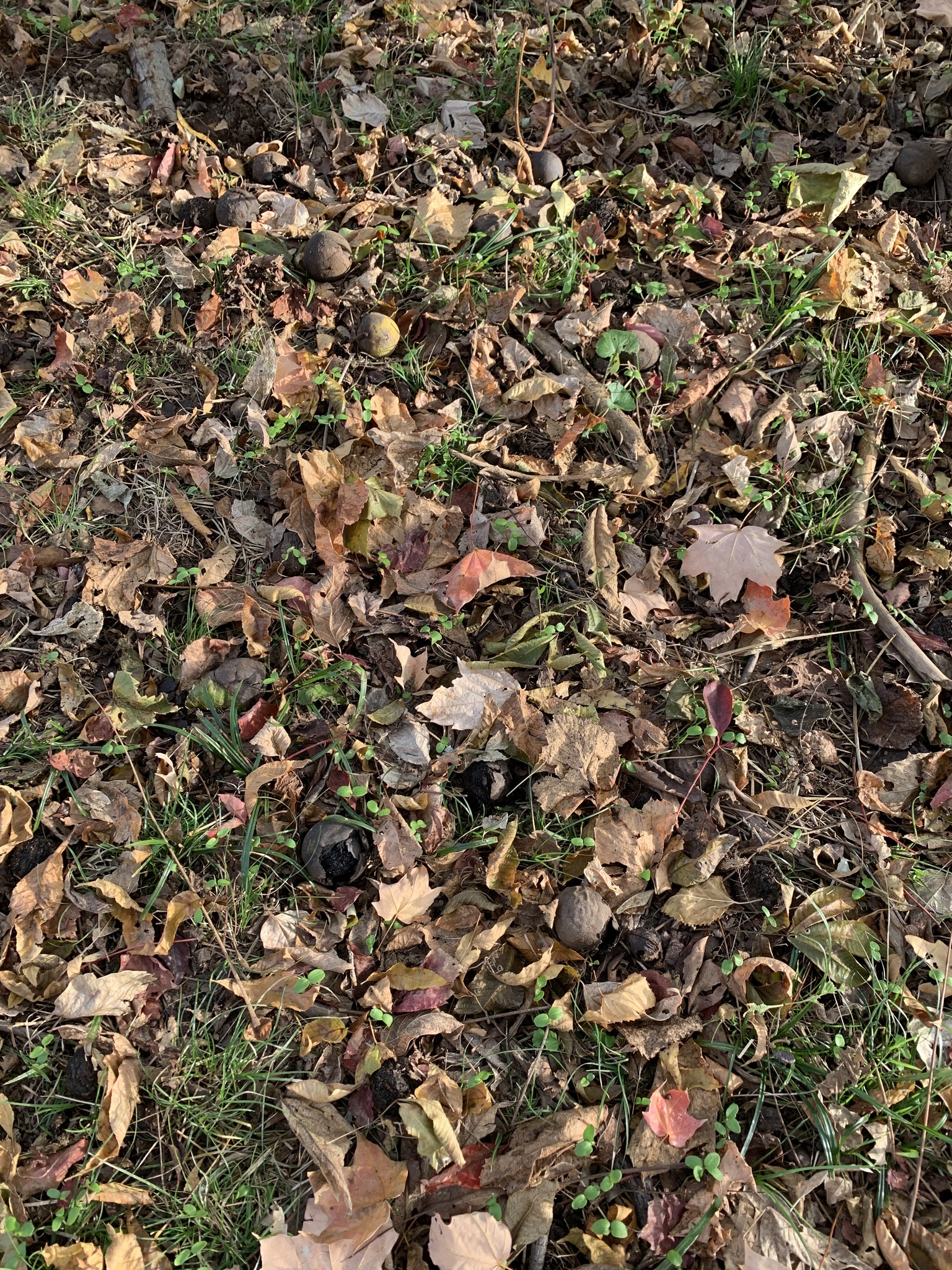
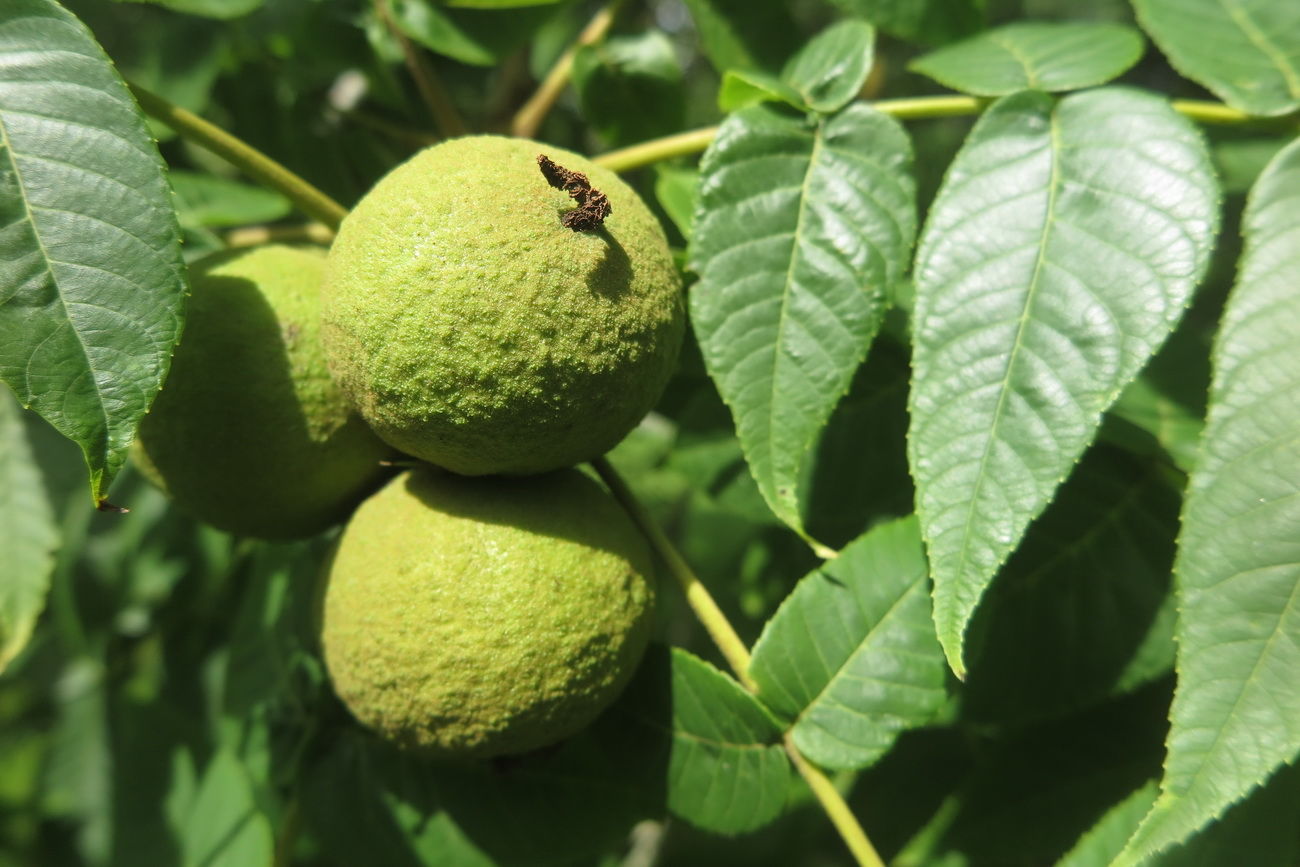
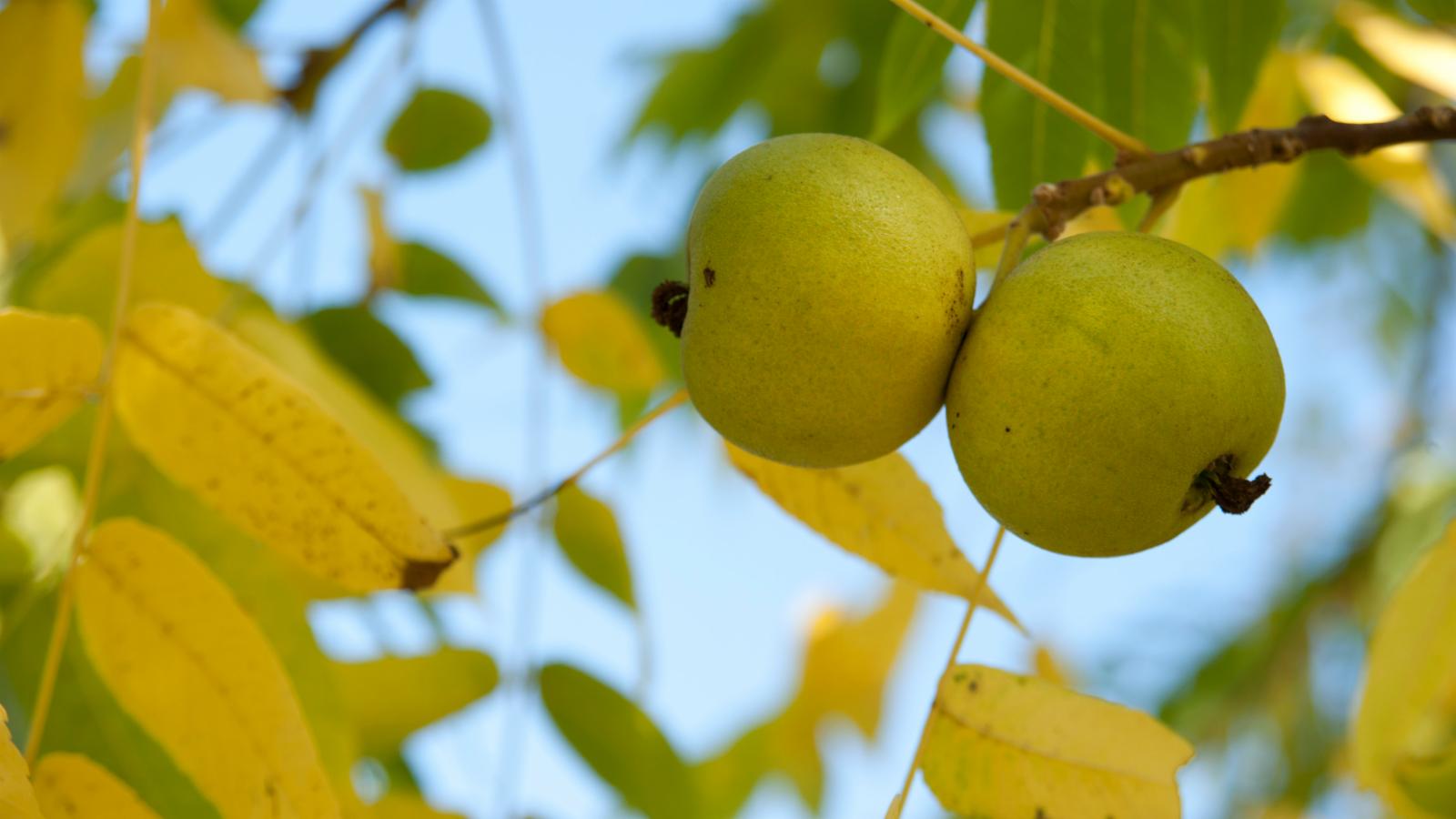
A monoecious tree, black walnut bears hanging male catkins 6–14 cm (2.4–5.5 in) long and inconspicuous female flowers in terminal spikes of two to five. Flowering falls in April–May, before or during leaf emergence in its North American spring. Rounded nuts, 3–7 cm (1.2–2.8 in) across, have fleshy yellow-green husks that remain unsplit and blacken as they ripen in September–October, the local fall. 3 2
Useful taxonomy
POWO/WCVP accepts Juglans nigra L., described by Linnaeus in 1753. Botanical literature has named several historical forms and varieties, now treated as synonyms of the typical species:
- Juglans nigra f. oblonga (Marshall) Fernald
- Juglans nigra var. boliviana C.DC.
- Juglans nigra f. laciniata Rehder
The accepted scientific name is more consistent than changing commercial names. American black walnut and eastern black walnut refer to this same species, rather than to separate botanical taxa. 1 7
Habitat and range
Its native range covers central and eastern North America, from southeastern Canada to northern Florida and west to Texas and North Dakota. Riparian woodland, alluvial valleys and lower slopes provide its main sites, on deep, fertile, well-drained soils. 1 3
The International Union for Conservation of Nature lists Juglans nigra as Least Concern, reflecting its broad range and generally stable population despite local pressure from thousand cankers disease. 6
Widely planted beyond its native range for wood and nuts, black walnut now grows in western Europe, including France, and as far away as New Zealand. It is not listed among plants considered invasive in those introduced regions. 4
Life cycle and reproduction
Flowering takes place in April–May, before or alongside leaf emergence in the local spring. Separate male and female flowers occur on the same tree but mature a few days apart. This favors fertilization by a neighboring tree rather than self-fertilization. Pollen travels by wind. 3
Nuts ripen in September–October, the local fall. Bearing begins as early as 6 years, but substantial crops come after 20 years. Outdoor propagation chiefly uses seed, with nuts cold-stratified for several months. For a named cultivar, grafting alone guarantees faithful reproduction of the selection; seedlings do not preserve the parent’s characteristics. 3 4
The taproot grows deeply in the first years, explaining the seedling’s initially modest aboveground growth. Without that underground anchorage, a wide crown cannot be supported. The same root makes later transplanting risky, hence the practice of placing a seedling in its final position as soon as it emerges. 3
Uses and risks
Dark brown to almost black heartwood is among North America’s most sought-after timbers. Dense and resistant to warping while drying, it serves in cabinetmaking, fine joinery, gunstocks and veneer. Sweet nuts, difficult to extract from their tenacious husks, go into candy and baking. Husks once supplied brown dye and yellow coloring widely used by North American settlers when other stable local pigments were unavailable. 3 4
Roots, leaves and husks release juglone, an allelopathic compound that inhibits many neighboring plants, particularly tomatoes, apple trees, azaleas and some white pines. Keep vegetable beds and sensitive plantings away from a mature tree’s canopy to avoid progressive decline without an obvious cause. 4 3
The ASPCA identifies moldy nuts and bedding material as toxic to dogs, potentially causing tremors and seizures after ingestion. Black walnut shavings in bedding can also cause horses to develop laminitis or colic simply through contact. Cats are not listed as sensitive. 5
Cultivars and look-alikes
Horticultural selections chiefly serve nut production or particular growth habits. Thomas, one of the oldest, was selected as early as 1881 for consistent, high-quality crops. Kwik-Krop is valued for early bearing. These are grafted selections of one taxon, so the scientific name remains the most dependable identity reference. 3
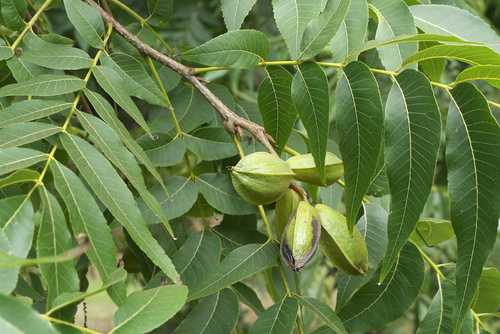
Likely look-alikes include Juglans regia, with smooth-shelled nuts and fewer leaflets, 5–9 rather than 15–23; and Juglans cinerea, with sticky husks and oblong nuts. Hickories, Carya, differ in having husks that split into four valves at maturity, whereas black walnut husks remain intact. 3
Thousand cankers disease is another threat. The fungus Geosmithia morbida, carried by the small bark beetle Pityophthorus juglandis, produces hundreds of tiny cankers beneath the bark and often kills trees within a few years. This is a risk to consider before moving untreated wood. 8
Main sources
- Plants of the World Online / Kew, Juglans nigra L.
- Royal Horticultural Society, Juglans nigra (black walnut)
- NC State Extension, Juglans nigra (Black Walnut)
- Plants For A Future, Juglans nigra
- ASPCA, Black Walnut toxicity entry
- IUCN Red List of Threatened Species, Juglans nigra assessment
- GBIF, Juglans nigra L. species page
- Wikipedia, Thousand cankers disease
Frequently asked questions
Is black walnut the same species as Persian walnut?
No. Juglans nigra and Juglans regia are distinct species in the same genus. Black walnut has an unsplit husk and almost black bark, whereas Persian walnut produces the smooth-shelled walnuts sold in stores.
Is black walnut toxic to cats and dogs?
According to the ASPCA, moldy nuts and black walnut bedding are toxic to dogs, potentially causing tremors and seizures, and to horses, in which contact with wood shavings can cause laminitis. Cats are not listed as sensitive.
Why does little grow beneath a black walnut?
Roots, leaves and husks release juglone, an allelopathic compound that inhibits many neighboring plants, especially tomatoes, apple trees and azaleas. Keep vegetable beds away from a mature tree’s canopy.
Can black walnuts be eaten?
Yes. The kernels are sweet and aromatic, but their tenacious, sticky husks make extraction difficult. Shelled nuts are chiefly used in candy and baking.
Is black walnut timber really so valuable?
Yes. Dark brown to almost black heartwood is dense and resists warping as it dries. It is among North America’s most valuable woods for cabinetmaking and veneer.
How can a young black walnut be recognized before it bears nuts?
Aromatic crushed leaves, chambered pith visible in a cut twig and a monkey-face-shaped leaf scar beneath each bud provide reliable identification even without fruit.
Is black walnut threatened by a particular disease?
Yes. Thousand cankers disease, caused by the fungus Geosmithia morbida carried by a bark beetle, forms hundreds of small cankers beneath the bark and often kills the tree within a few years.
Similar plants
If you are unsure about a plant’s toxicity, ask a botanist or veterinarian for advice.