
White deadnettle (Lamium album, )
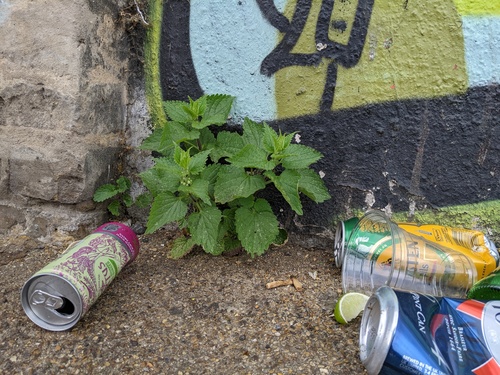
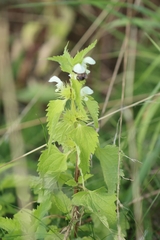
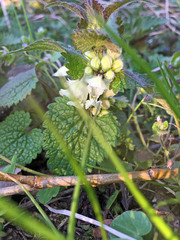
White deadnettle (Lamium album) is a herbaceous perennial in the Lamiaceae, found in hedges, waste ground and roadsides from temperate Europe to China. Its upright habit and toothed leaves closely resemble stinging nettle, but its soft hairs and white, hooded flowers distinguish it.
Read moreWhite deadnettle, White dead-nettle and White henbit
Give plenty of ambient light without direct sun on the leaves.
Full sun to light partial shade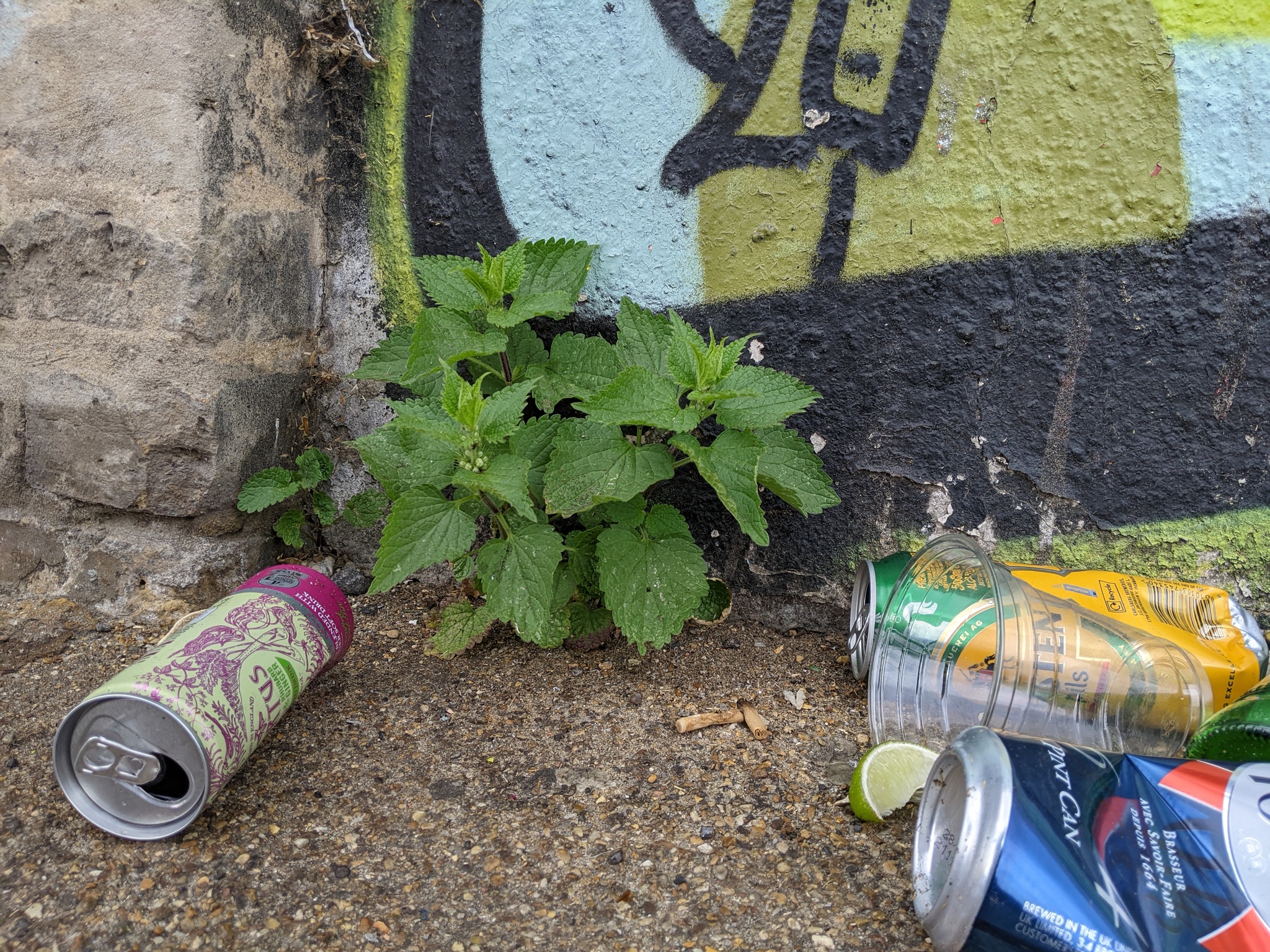
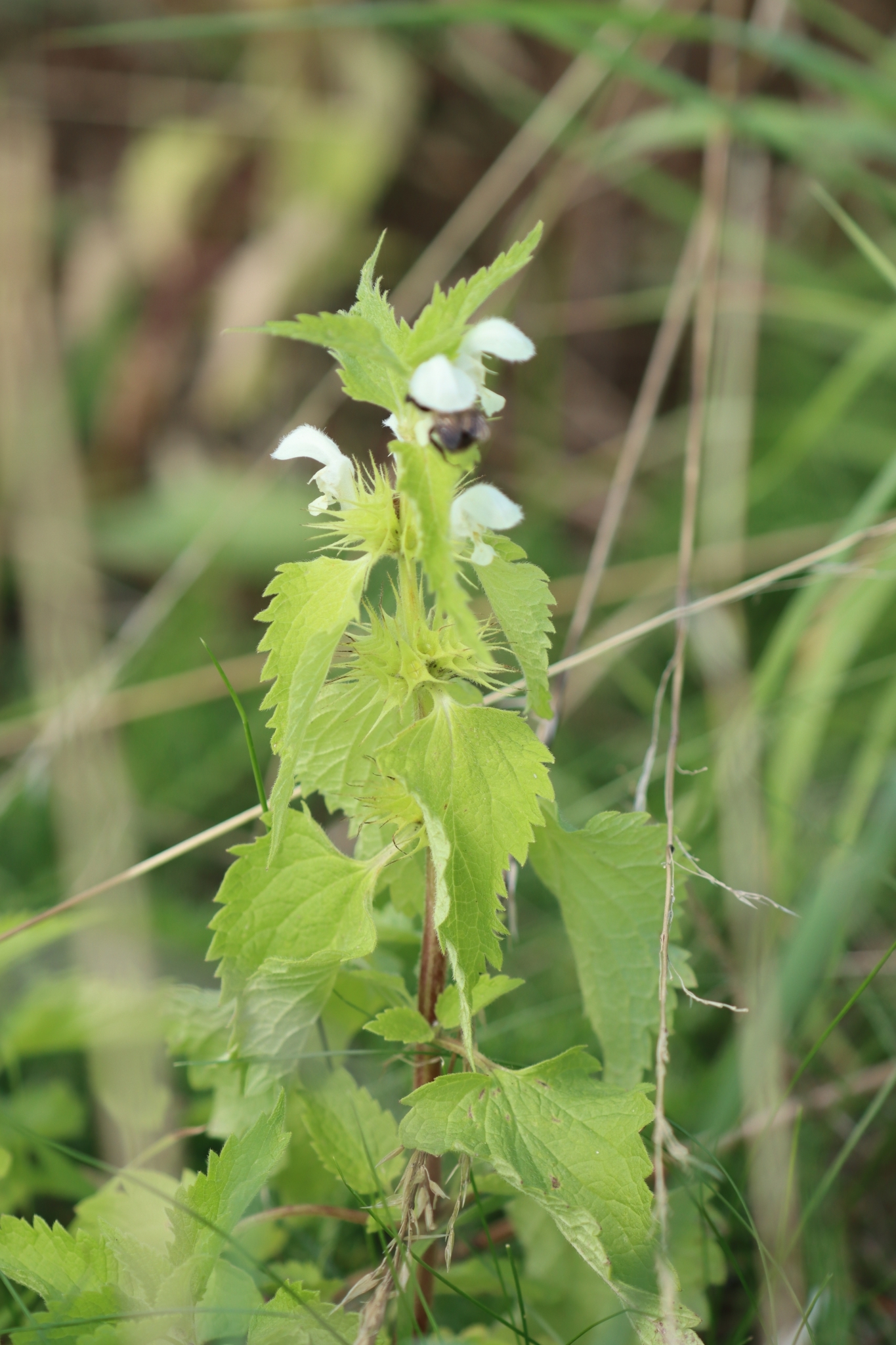
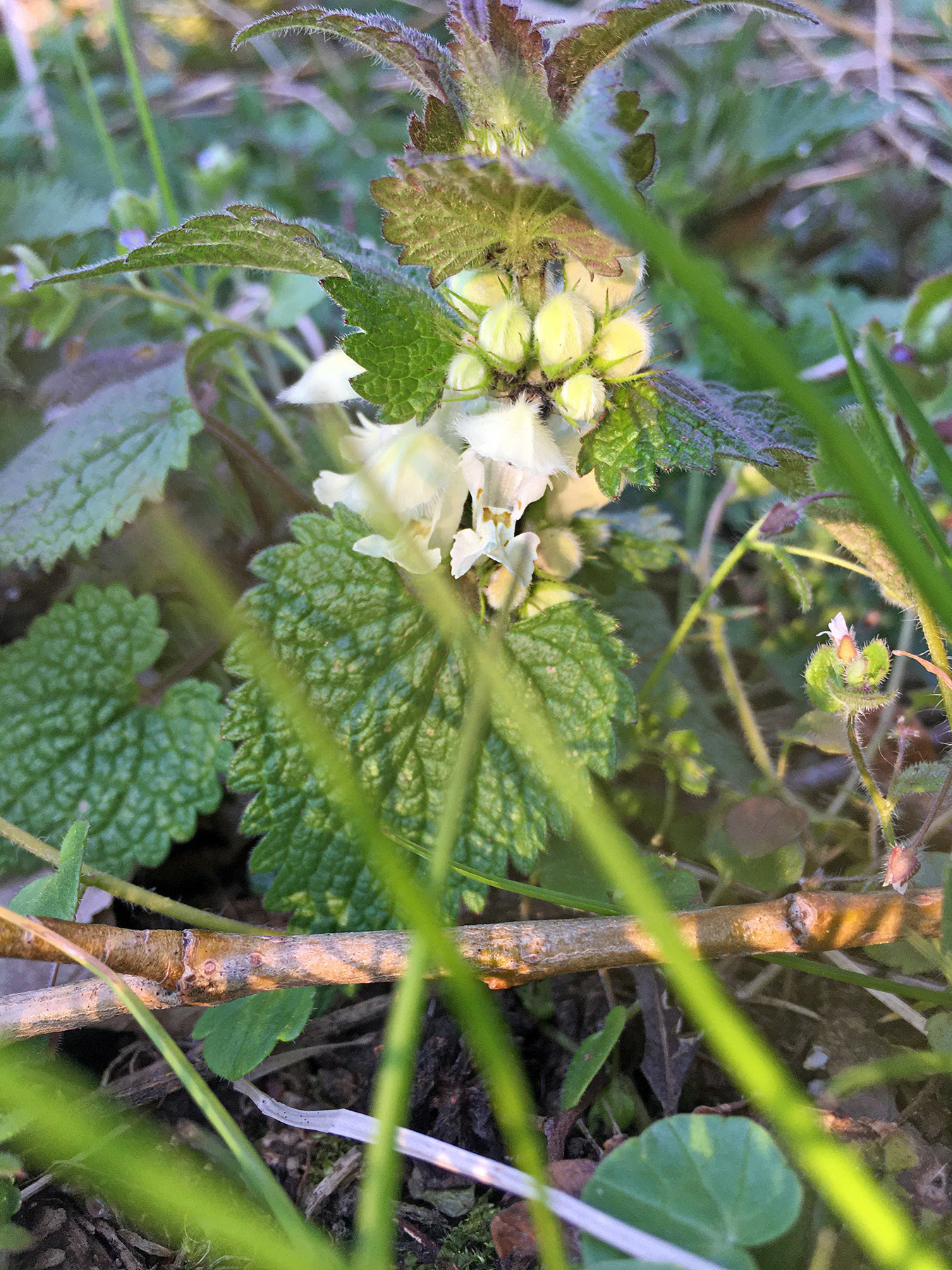


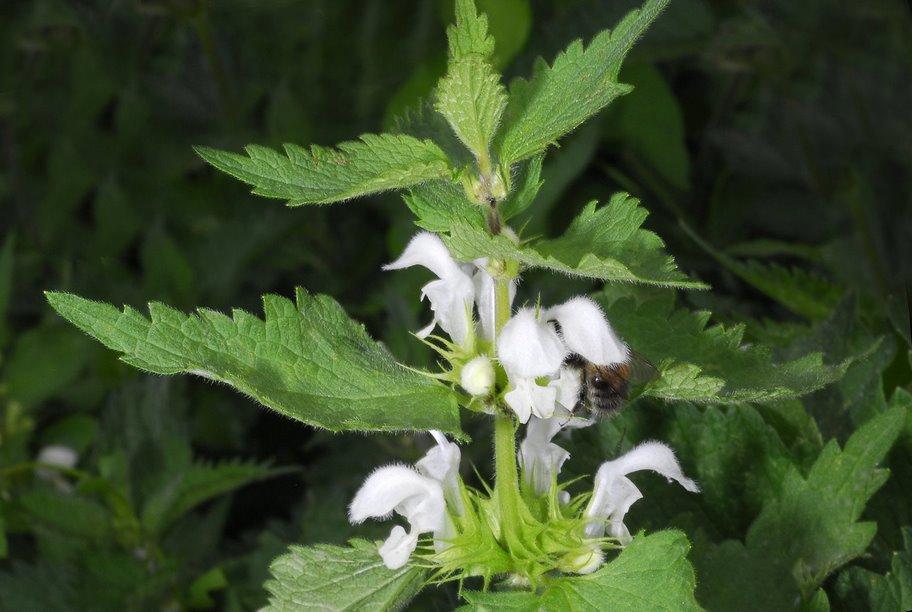

© photo
Victor Heng · cc0
John Ashburner · cc0
Kai Löhr · cc-by
Taken Sep 4, 2019 by Sébastien Ansel (cc-by-sa)
Taken Jun 23, 2019 by Renaud Brochiero (cc-by-sa)
Taken May 10, 2022 by Andrzej Konstantynowicz (cc-by-sa)
Taken May 2, 2021 by Moshira Hassan (cc-by-sa)
Taken Apr 15, 2021 by Ricardo Cano Mateo (cc-by-sa)
© copyright of the Board of Trustees of the Royal Botanic Gardens, Kew.


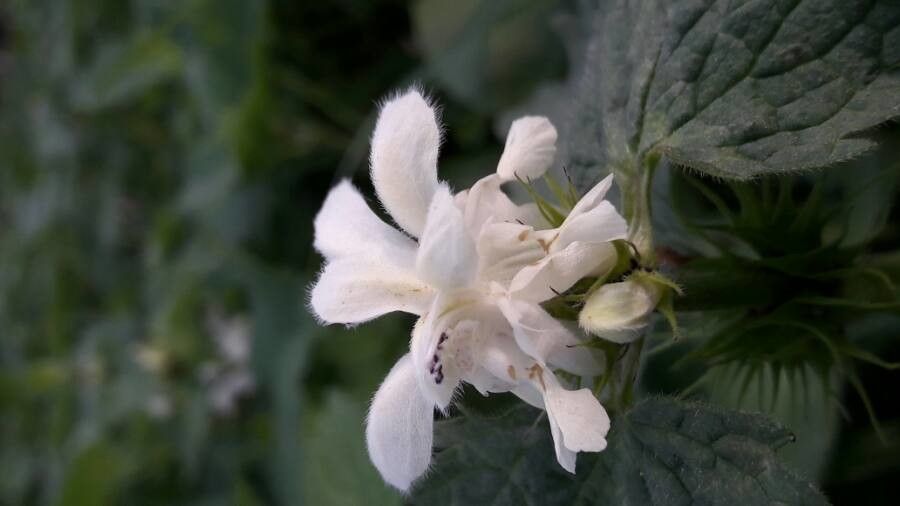


Global distribution
POWO places the native range of Lamium album in temperate Eurasia, from Europe to China, with populations reaching the Himalayas and Japan. In France, Tela Botanica and INPN describe it as common in hedges and waste ground across most of the country, rarer in the Mediterranean south. The Native Plant Trust records localized naturalization in North America, especially the northeast, without regulatory invasive status.
- Native6
- Introduced1
- Mainland France
- Great Britain
- Germany
- Himalayas
- Japan
- China
- Northeastern North America
Hexagons: regions where the plant occurs. Green dots: native range.1
Identity
White deadnettle (Lamium album L., 1753), also known as white dead-nettle, is a herbaceous perennial in the Lamiaceae. Its dense clumps reach 15–60 cm (6–24 in) high. POWO and GBIF accept it as a species of Lamium, published by Linnaeus in 1753. 1 2
The name dead-nettle reflects a striking resemblance to stinging nettle (Urtica dioica): opposite, toothed leaves with heart-shaped bases and the same upright, clumping habit. The resemblance ends at the hairs: white deadnettle has no stinging hairs, unlike the nettle it resembles. 7 5
Latin album means white and refers to the flowers rather than the foliage. Their color is a useful distinction: no other common Lamium species in France bears such clearly white flowers. 7
Recognition
Square stems, typical of the Lamiaceae, form a compact clump with leaves 3–10 cm (1–4 in) long according to the Native Plant Trust. 8 3
Opposite leaves are oval to triangular, heart-shaped at the base, strongly toothed at the edges and finely downy. They have no stinging hairs, unlike the nettle leaves they resemble. 8 7
White flowers, sometimes tinged pink, measure 1.8–3 cm (0.7–1.2 in) long and gather in tight whorls at the upper leaf axils. Each has a hairy hooded upper lip and a lower lip with two pointed lateral teeth, forming an open mouth. In its temperate Northern Hemisphere range, flowering extends from March to November, sometimes into December in mild winters. 7 3
Useful taxonomy
Three subspecies of Lamium album are accepted by POWO:
- Lamium album subsp. album occupies the typical range from Europe to China;
- Lamium album subsp. barbatum (Siebold & Zucc.) Mennema grows from Siberia to Japan and in China;
- Lamium album subsp. crinitum (Montbret & Aucher ex Benth.) Mennema extends from Turkey to the central Himalayas.
Older floras may still use Lamium vulgatum Benth. and its variety Lamium vulgatum var. album (L.) Benth., names recorded as homotypic synonyms. 2 1
Habitat and range
Temperate Eurasia, from Europe to China, forms the native range recorded by POWO. PFAF also reports populations in the Himalayas and Japan. 1 4
Across most of France, Tela Botanica and INPN describe white deadnettle as common in hedges and disturbed ground, becoming rarer in the Mediterranean south. Its national conservation status remains Least Concern. 5 6
Outside Eurasia, white deadnettle has naturalized locally in North America, especially in the northeast. It occupies disturbed habitats such as roadsides, waste ground and gardens. The Native Plant Trust assigns it no regulatory invasive status. 8
Full sun and partial shade both suit white deadnettle. It grows in light sandy, loamy or clay soils provided they remain moist, tolerates acid to alkaline pH and withstands frost down to about −25 °C (−13 °F). 3 4
Life cycle and reproduction
Dense colonies spread through rhizomatous runners creeping just below the soil surface, supplemented by abundant self-seeding. 3 4
Long-tongued bumblebees are the main pollinators, able to reach nectar at the base of the deep flower tube. After fertilization, each flower produces tiny dry nutlets about 3–3.5 mm (0.12–0.14 in) long. 8
Garden propagation uses clump division in spring or direct sowing as soon as the seeds ripen. A dense colony generally establishes within 2–5 years, depending on conditions. 4
Uses and risks
Among edible wild plants, white deadnettle provides young leaves eaten raw or cooked, in salads or as a vegetable. PFAF also records flowers brewed as an herbal tea and their provitamin A content. 4
Traditional uses describe the flowering tops as astringent and diuretic, with reputed sedative properties, particularly for minor gynecological complaints. These belong to folk practice rather than a validated medical protocol; no recent European monograph covers Lamium album. 4
No toxicity is documented for humans or domestic animals in the selected references. As with any wild gathering, certain identification before harvest is the essential precaution, especially to rule out another plant growing in the same place. 4 7
Varieties, look-alikes and related plants
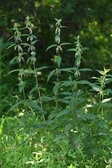
Stinging nettle, Urtica dioica, is the most common look-alike, sharing toothed, heart-based leaves and an upright outline. White deadnettle never stings. Its conspicuous white flowers at the leaf axils contrast with the true nettle’s inconspicuous greenish flower clusters. 7
Two other species in the same genus can also be confused with it:
- Lamium purpureum, purple deadnettle, is smaller, with purple-tinted upper leaves and pink to violet flowers;
- Lamium galeobdolon, yellow archangel, has yellow flowers and is sometimes placed in Galeobdolon, depending on the reference.
Flower color, combined with the complete absence of stinging hairs, provides the most reliable distinction. White deadnettle itself can be touched without a sting, whereas contact with a true stinging nettle can be painful. 7 8
Main sources
- Plants of the World Online / Kew, Lamium album L.
- GBIF Backbone Taxonomy, Lamium album L.
- Royal Horticultural Society, Lamium album - white deadnettle
- Plants For A Future, Lamium album
- Tela Botanica eFlore, Lamium album L.
- INPN / MNHN, Lamium album L., 1753
- First Nature, White Dead-nettle - Lamium album
- Go Botany / Native Plant Trust, Lamium album
Frequently asked questions
Does white deadnettle sting like a nettle?
No. Although the leaves closely resemble those of stinging nettle, Lamium album has no stinging hairs. Together with the white flowers, this is the most reliable distinction.
Is white deadnettle edible?
Young leaves and flowers are used in wild foods, raw in salads, cooked as vegetables or brewed as tea, provided identification is certain before harvest. No toxicity is documented in the selected references.
Where does white deadnettle grow in France?
According to Tela Botanica and INPN, it is common in hedges, waste ground and roadsides across most of France, but rarer in the Mediterranean south.
How does it differ from Lamium purpureum and Lamium galeobdolon?
Lamium purpureum, purple deadnettle, is smaller, with purple-tinted upper leaves and pink to violet flowers. Lamium galeobdolon, yellow archangel, is identified by yellow flowers.
Is white deadnettle invasive?
It is native in France and is not listed there as an invasive alien species. In a garden, however, it can form dense colonies through rhizomatous runners in rich, moist soil.
Does white deadnettle grow in North America?
It is introduced and locally naturalized there, especially in the northeast, in disturbed habitats such as roadsides and gardens. The Native Plant Trust records no regulatory invasive status.
Similar plants
If you are unsure about a plant’s toxicity, ask a botanist or veterinarian for advice.