
double coconut (Lodoicea maldivica, )
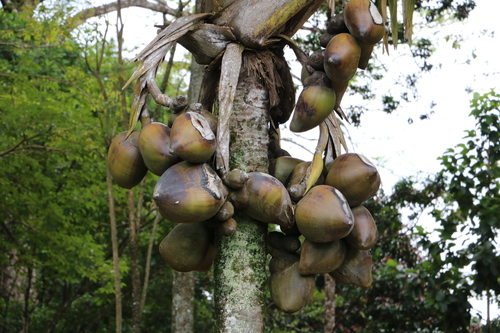


Double coconut (Lodoicea maldivica) is the only living species of Lodoicea in the Arecaceae. Strictly endemic to Praslin and Curieuse in the Seychelles, it bears the largest and heaviest seed in the plant kingdom. It was long mistakenly attributed to the Maldives, where washed-up nuts were known before its true origin was discovered.
Read moredouble coconut, coco de mer, sea coconut and cocofesse
Place in full sun, with intense direct light all day long.
Full sun as an adult; partial shade tolerated when young


© photo
(c) Hua Wan, some rights reserved (CC BY-NC), uploaded by Hua Wan · cc-by-nc
Wikimedia Commons · CC BY-SA or Public Domain
© copyright of the Board of Trustees of the Royal Botanic Gardens, Kew.


Global distribution
Lodoicea maldivica is strictly endemic to Praslin and Curieuse in the Seychelles. It formerly occurred on neighboring St Pierre, Chauve-Souris and Île Ronde, disappearing before recent reintroductions. Outside the Seychelles it occurs only as a planted tree in tropical botanical gardens, with no documented naturalized populations.
Identity
The double coconut (Lodoicea maldivica (J.F.Gmel.) Pers., 1807), also called coco de mer or sea coconut, is the only living species of Lodoicea, a genus in the Arecaceae. Its name is misleading: the palm does not grow in the Maldives. Washed-up nuts were known there long before botanists located the trees in the Seychelles. Fresh, heavy fruits sink; only a few already partly decomposed seeds may perhaps float. 1 7
The French nickname cocofesse describes the ripe fruit's two joined lobes, which suggest a human silhouette. It is a nickname rather than a reliable identification character. The scientific name Lodoicea maldivica distinguishes this seed unambiguously from an ordinary coconut washed onto a beach. 7
Recognition
Double coconut develops a single upright trunk. Its bulbous base fits into a natural rock cavity about 75 cm (30 in) across, stabilizing the tree over decades. Mature trees commonly reach 20–30 m (66–98 ft), with the tallest measured specimens reaching 34 m (112 ft). 2 3
Its costapalmate fan leaves are among the largest in the plant kingdom, measuring 7–10 m (23–33 ft) long and about 4.5 m (15 ft) wide on massive stalks. The seed is unmistakable when visible: bilobed, 40–50 cm (16–20 in) across and commonly 15–25 kg (33–55 lb) in weight, a record unmatched by another plant. No other large fan palm produces a comparable bilobed seed, making a visible fruit decisive for identification. 2 4
Useful taxonomy
Commerson described the genus Lodoicea, whose name was subsequently validated in 1800. Only one species is accepted today, although several names circulated before usage settled:
- Lodoicea sechellarum Labill.
- Lodoicea callypige Comm. ex J.St.Hil.
- Lodoicea sonneratii (Giseke) Baill.
The epithet maldivica reflects the former belief that the palm came from the Maldives. Publication priority preserved the name even after its true origin became known: botanical nomenclature can retain an earlier valid name despite a geographical error in its meaning. The accepted name remains Lodoicea maldivica. 1 4
Habitat and distribution
This palm is strictly endemic to Praslin and Curieuse in the Seychelles. It grows on ancient granite slopes, among some of the world's oldest exposed rocks, up to about 500 m (1,640 ft) above sea level. It also formerly occurred on the neighboring islets of St Pierre, Chauve-Souris and Île Ronde, where it disappeared before recent reintroductions. 4 3
The heart of the wild population lies in Praslin's Vallée de Mai, inscribed on the UNESCO World Heritage List in 1983. Annual rainfall is about 1,600 mm (63 in) and mean temperatures are 24–26°C (75–79°F): a consistently humid tropical climate without a pronounced dry season. 8 4
The reserve also contains the Seychelles' five other endemic palms. It is the only place where all six grow together. Their coexistence contributes to the site's heritage value alongside the forest's natural beauty, evolutionary history, ecological processes and endemic fauna. 8
Life cycle and reproduction
Double coconut is dioecious, with male and female flowers on separate trees. Long male catkins can exceed 2 m (6.6 ft) and carry small flowers rich in pollen and nectar; Monaco Nature Encyclopedia describes them becoming pendulous with age after about six months. The large female flowers, among the largest of any palm, occur in small groups on an inflorescence rather than invariably alone. Animals, including endemic Phelsuma geckos, take part in pollination; wind may also contribute. 2 7
Germination takes 1–2 years. A cotyledonary stalk penetrates the soil and then travels horizontally for several meters (for scale, 1 m is about 3.3 ft) before the young root establishes, sometimes far from the original fruit. Once formed, a fruit needs another 6–7 years to ripen fully. 4 2
Sexual maturity comes only after several decades. Some trees are thought to live for several centuries, retaining the ability to fruit through much of that time. Such slow growth makes container cultivation almost impractical: without the deep soil volume needed to anchor the cotyledonary stalk, a young palm remains juvenile and never begins to form a trunk. 4
Uses and risks
Woven leaves provide roofing, mats and hats; emptied fruit shells serve as vessels and cups. The gelatinous kernel of young fruit is sometimes eaten in soup. An unproven reputation as an aphrodisiac helped sustain a historical trade in jewel-mounted shells for royal courts. 4 2
No data classify double coconut as toxic to humans or animals. The principal threat concerns the plant itself: listed as Endangered by the IUCN, it has only about 8,000 mature wild individuals, threatened by fire and illegal seed harvesting. A Seychelles management decree adopted in 1995 strictly regulates the nut trade. 6 2
Tourist demand far exceeds the authorized supply. Tens of thousands of visitors see the Vallée de Mai each year, while licensed nut harvests amount to only a fraction of that number. The gap sustains an illicit market that the Seychelles authorities seek to control. 7
Forms, lookalikes and related plants
The fruit almost always has two lobes. Rare three-lobed forms are sought by collectors, but neither form represents a separate species or botanical variety: both belong to Lodoicea maldivica. 5
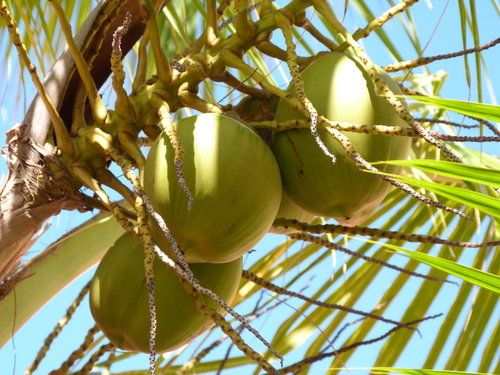
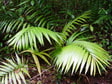
The commonest confusion is with coconut, Cocos nucifera, whose similar common name obscures its placement in a different genus. In the Vallée de Mai, double coconut grows alongside endemic palms such as Phoenicophorium borsigianum, which has a comparable tropical understory silhouette without being a close relative. 7
Main sources
- Plants of the World Online / Kew, Lodoicea maldivica (J.F.Gmel.) Pers.
- Royal Botanic Gardens Kew, Double coconut - the largest seed in the world
- Missouri Botanical Garden Plant Finder, Lodoicea maldivica
- Pl@ntUse / PROTA, Lodoicea maldivica
- Encyclopaedia Britannica, coco de mer
- IUCN Red List, Lodoicea maldivica assessment
- Monaco Nature Encyclopedia, The incredible Lodoicea maldivica and the Vallée de Mai
- UNESCO World Heritage Centre, Vallée de Mai Nature Reserve
Frequently asked questions
Does double coconut grow in the Maldives?
No. It is strictly endemic to Praslin and Curieuse in the Seychelles. Nuts washed onto beaches in the Maldives gave it a misleading name long before the trees themselves were located. Fresh fruits sink; only a few partly decomposed seeds may perhaps float.
Is double coconut toxic?
No toxicity is documented in humans or animals. The gelatinous endosperm of young fruit is traditionally eaten in soup.
Why is double coconut protected?
It is listed as Endangered, with about 8,000 mature wild individuals. A Seychelles decree adopted in 1995 strictly regulates nut harvesting and trade.
How long does double coconut take to fruit?
Sexual maturity takes several decades, then each fruit needs 6–7 years to ripen fully.
Can I grow double coconut at home?
In practice, almost never. Growth is extremely slow, the young root system needs deep soil, and the mature palm becomes enormous. Cultivation is largely restricted to major tropical botanical gardens.
How does it differ from coconut?
Its seed has two fused lobes and is much larger and heavier than that of Cocos nucifera, which belongs to a different genus.
Is it cultivated outside the Seychelles?
Yes, in tropical botanical gardens, notably in Sri Lanka, Thailand and Singapore. No naturalized populations outside the Seychelles are documented.
Similar plants
If you are unsure about a plant’s toxicity, ask a botanist or veterinarian for advice.