
Kentia palm (Howea forsteriana, )
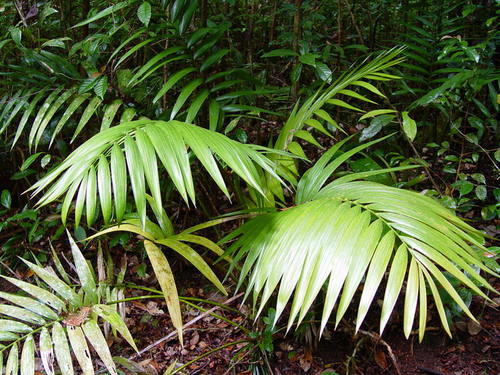
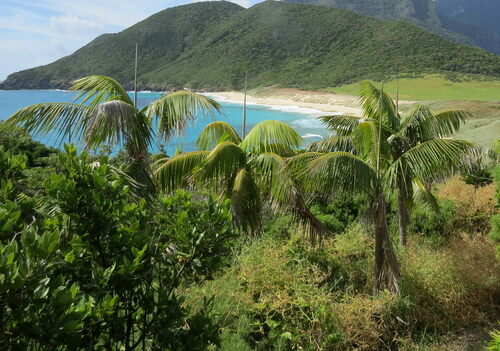
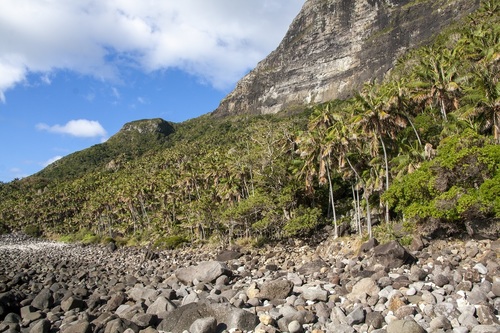
The Kentia palm (Howea forsteriana) is a palm in the family Arecaceae, endemic to Lord Howe Island, Australia. Slow-growing, it carries long pinnate fronds above a ringed trunk. Its tolerance of moderate light has made it one of the most widely grown indoor palms since the nineteenth century.
Read moreKentia, Sentry palm, Paradise palm and Thatch palm
Global distribution
The native range of Howea forsteriana is confined to Lord Howe Island in the Tasman Sea, where the species is strictly endemic. It is also grown on nearby Norfolk Island and, as an ornamental palm, in many warm temperate regions; these areas of cultivation remain distinct from the island range of origin.
- Native1
- Introduced1
- Lord Howe Island (Australia)
- Norfolk Island
Hexagons: sourced regions. Green dots: native range. Statuses according to POWO (Kew).
Identity
The Kentia palm (Howea forsteriana (F.Muell.) Becc., 1877), often just called kentia, is a palm in the genus Howea, family Arecaceae. It is strictly endemic to Lord Howe Island, a small Australian territory in the Tasman Sea, and both of its names come from there: Howea is taken from the island itself, while the trade name kentia comes from Kentia, the island's former main settlement. 1 2
Across Europe and North America, the kentia is best known as an elegant indoor palm, also sold as sentry palm or paradise palm. Its tolerance of moderate light and its soft, relaxed habit made it the parlor palm of choice as early as the Victorian era. 3 4
Recognition
Look first at the arching pinnate fronds, up to about 3 m (10 ft) long on old plants, held at the top of a single trunk. Each frond carries many narrow leaflets, dark green above and paler beneath, that droop slightly and give the palm its graceful outline. 4 2
The trunk is upright, green at first and later brown, marked with regular rings left by fallen fronds. Leaf-stalk bases are pale, smooth and spineless, which sets the kentia apart from more aggressive palms. Growth is distinctly slow: the plant puts out only a few new fronds each year. 3 4
Grown in a container, a Kentia palm rarely tops 2–3 m (6.5–10 ft). On its home island it can reach about 10 m (33 ft) tall, spreading several meters across once mature. 3 1
Useful taxonomy
Described as Howea forsteriana (F.Muell.) Becc. in the late nineteenth century, the species carries an epithet honoring the naturalists Johann Reinhold Forster and Georg Forster, who sailed with Cook in the Pacific. The genus Howea has just two species, both endemic to Lord Howe; the names worth knowing around the kentia are:
- Howea forsteriana (F.Muell.) Becc., the accepted name
- Kentia forsteriana F.Muell., the basionym behind the trade name
- Grisebachia forsteriana (F.Muell.) H.Wendl. & Drude
- Howea belmoreana (C.Moore & F.Muell.) Becc., the island's other palm
The stable reference remains the accepted scientific name, Howea forsteriana, since kentia is a trade name derived from an old genus name. Howea belmoreana, long sold under similar labels, is a distinct species, not a mere variety. 1 2
Habitat and range
This palm is endemic to Lord Howe Island, an isolated volcanic island in the Tasman Sea between Australia and New Zealand. It grows in low forest and on cool slopes, on well-drained volcanic soils, under a mild, humid oceanic climate. 1 5
That island origin accounts both for the tiny native range and for the plant's wide tolerance of moderate light: beneath the canopy, the kentia puts up with dim conditions that few palms accept. It is also widely grown on nearby Norfolk Island, which supplies part of the seed crop. 3 4
Beyond that range, the Kentia palm exists only in cultivation: a patio or conservatory palm where winters stay mild, a large green houseplant elsewhere. Those growing areas, in California, Spain or temperate Europe, should be kept separate from its single range of origin. 2 1
Life cycle and reproduction
Mature plants bear inflorescences as hanging spikes that emerge at the base of the fronds. The flowers are small and inconspicuous; fruiting begins only after a long maturation, at around 15 years of age in the wild. 4 2
The fruits are oval drupes that turn reddish brown when ripe. Their most cited peculiarity is how slowly the seeds mature: about six years on the tree. That slow pace, combined with the species' strict endemism, has turned seed harvesting into a regulated economic resource on Lord Howe Island. 1 5
Propagation in cultivation is by seed only: seeds germinate slowly, over several months, with bottom heat and good humidity. The Kentia palm has a single trunk and forms no offsets, so unlike clustering palms it cannot be grown from cuttings or divided. That is why pots on sale often hold several seedlings sown together to give a fuller, clumping look. 3 4
Uses and risks
The Kentia palm is grown essentially as an ornamental. In mild, frost-free climates it serves as a sheltered garden, patio or conservatory palm; where winters bring frost, it has become one of the best-loved indoor palms, precisely because it copes with moderate light and the dry air of a heated home. Its historic role as a parlor palm, from the 1870s onward, rests on that toughness. 2 3
On safety, the Kentia palm is one of the few indoor palms that is non-toxic. The ASPCA lists it as safe for cats and dogs, with no known toxic principle, and no signs of poisoning are described after chewing. That makes it a safe choice in a home with pets or young children, even though swallowing plant fiber is always best avoided. 6 5
Varieties, look-alikes and related plants
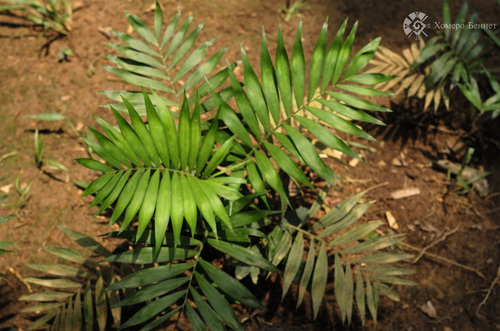
No widely distributed named cultivar exists: the Kentia palm is grown in its botanical form, and plants on sale are the species raised from seed. The main source of confusion is the other Lord Howe palm, Howea belmoreana, with more upright fronds that curve strongly like a shepherd's crook and a more compact habit.
Other indoor palms with pinnate fronds are also mistaken for it:
- Howea belmoreana, the curly palm, stockier and with recurved fronds
- Chamaedorea elegans, the parlor palm, much smaller with several slender stems
- Dypsis lutescens, the areca palm, clump-forming with yellow leaf stalks
A single ringed trunk, long soft fronds with drooping leaflets and slow growth remain the most reliable clues that a palm sold as a kentia really is Howea forsteriana. 4 1
Main sources
- Plants of the World Online / Kew, Howea forsteriana (F.Muell.) Becc.
- Royal Horticultural Society, Howea forsteriana, kentia palm
- North Carolina Extension Gardener Plant Toolbox, Howea forsteriana
- Encyclopaedia Britannica, paradise palm (Howea)
- Plants For A Future, Howea forsteriana
- ASPCA, Kentia palm (Howea forsteriana) non-toxic entry
Frequently asked questions
Is the Kentia palm toxic to cats and dogs?
No. The ASPCA lists the Kentia palm (Howea forsteriana) as non-toxic to cats and dogs. It is one of the safest indoor palms to keep around pets.
Why is my Kentia palm growing so slowly?
That is normal. Howea forsteriana is a slow-growing palm that produces only a few fronds a year. Good indirect light and regular feeding in summer support that natural pace as well as anything can.
Why are the frond tips turning brown?
Brown tips mostly come from air that is too dry, hard water or a potassium deficiency. Raising humidity, wiping the fronds and using a palm fertilizer keep the problem in check.
How much light does a Kentia palm need?
Bright but indirect light produces the best fronds. The Kentia palm copes well with partial shade, which explains its success as a living-room palm, but harsh direct sun scorches it.
Where does the Kentia palm come from?
It is strictly endemic to Lord Howe Island, Australia, in the Tasman Sea. It is also grown on nearby Norfolk Island and has been exported as seed since the 1870s.
How do you propagate a Kentia palm?
Only from seed. The seeds germinate slowly, over several months, with warmth and humidity. This single-trunked palm cannot be grown from cuttings or divided.
How tall does a Kentia palm get?
In a pot it rarely exceeds 2–3 m (6.5–10 ft). On Lord Howe Island it can reach about 10 m (33 ft) tall, with fronds around 3 m (10 ft) long.
Similar plants
Botanical data compiled from reference sources (RHS, Kew Gardens, POWO). This profile is for guidance only and is not a substitute for advice from a botanist or veterinarian if you have concerns about toxicity.