
Chinese wolfberry (Lycium chinense, )
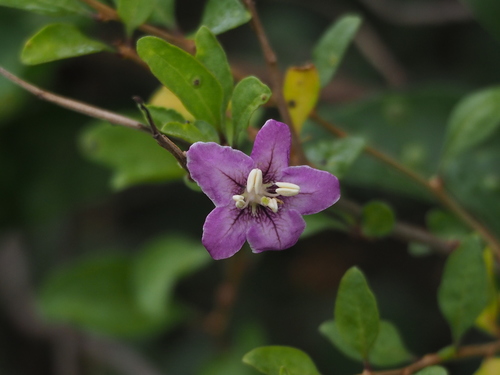

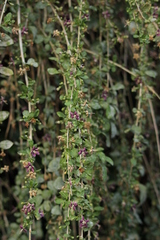
Chinese wolfberry (Lycium chinense Mill., 1768) is a bushy shrub in the Solanaceae family with flexible, sparsely thorny branches. Cultivated and sometimes naturalized from the Mediterranean region to East Asia, it produces red berries sold as goji and edible leaves. It is often confused with its close relative Lycium barbarum.
Read moreChinese wolfberry, Chinese matrimony vine, Chinese boxthorn, Chinese desert-thorn and Gouqi
Allow a few hours of direct sun per day, preferably morning or evening.
Full sun; tolerates light partial shade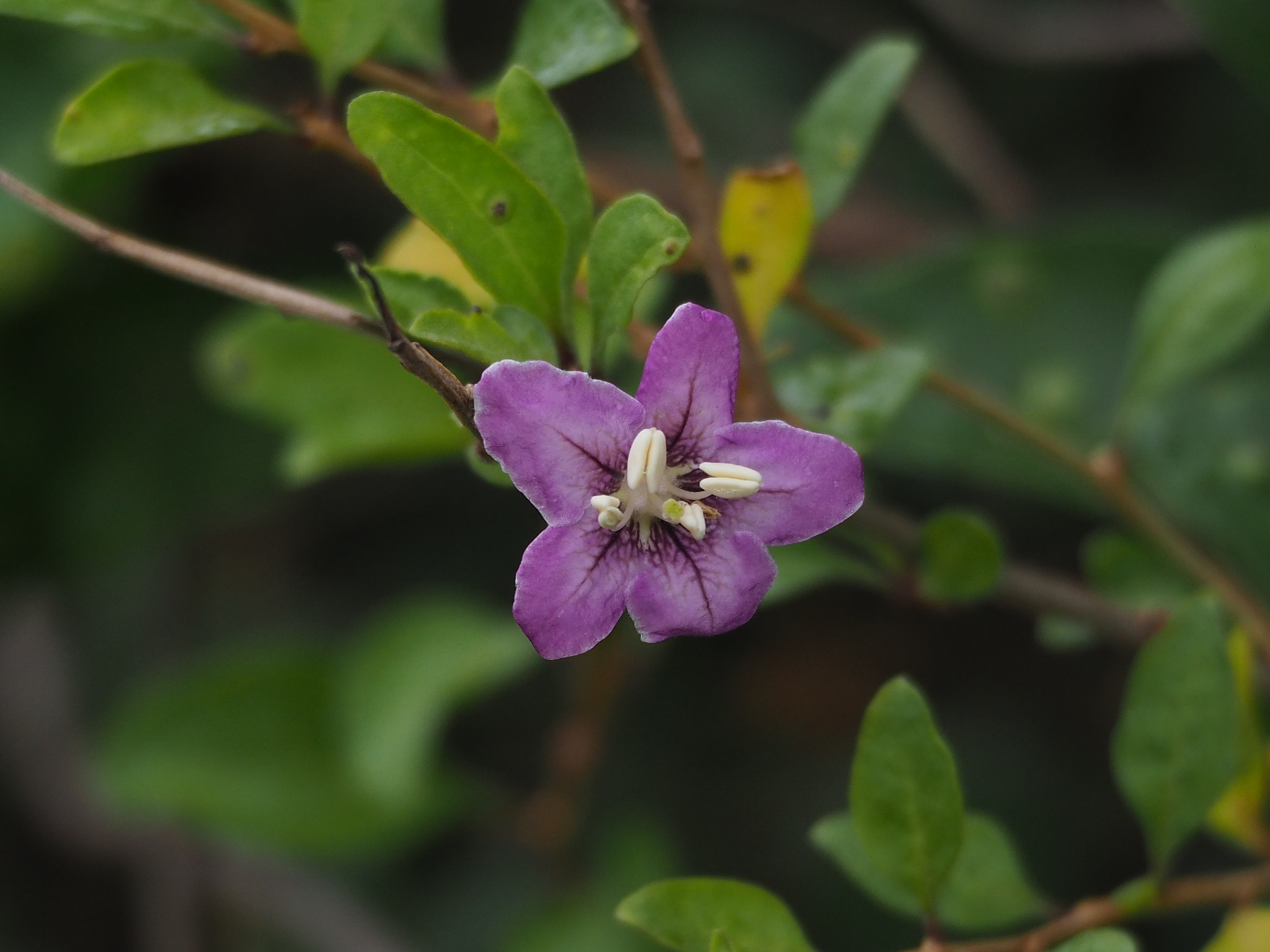


© photo
no rights reserved, uploaded by 葉子 · cc0
Hibiki Katayama · cc0
Björn Sothmann · cc-by
Taken Sep 15, 2005 by Photoflora - Benoit BOCK (©)
Taken Aug 15, 2012 by Photoflora - Benoit BOCK (©)
Taken Jan 1, 1970 by Photoflora - L'Abbé COSTE (©)
Taken Jul 31, 1854 by Tela Botanica − Herbier PONTARLIER-MARICHAL (cc-by-sa)
Taken Jul 14, 2013 by Tela Botanica − George FOWLER (cc-by-sa)




Global distribution
The native range of Lycium chinense covers China, Mongolia and eastern temperate Asia, including Korea and Japan. It is also widely naturalized outside this range, from the Mediterranean region across Europe, particularly where it escaped from old gardens or planted hedges.
- Native4
- Introduced3
- China
- Mongolia
- Korea
- Japan
- Southern Europe
- United Kingdom
- North America
Hexagons: regions where the plant occurs. Green dots: native range.1
Identity
Chinese wolfberry (Lycium chinense Mill., 1768) is a shrub in the Solanaceae family. British botanist Philip Miller described it in the eighth edition of his Gardeners Dictionary. POWO still accepts the same name for this member of the genus Lycium, giving it a stable botanical identity despite the overlapping names used for goji-producing plants. 1 2
The Chinese name gouqi (枸杞) applies both to Lycium chinense and its close relative Lycium barbarum. Both supply the red berries sold as goji. The trade name “Lycium tibeticum,” sometimes printed on packaging, has no recognized botanical standing: it was coined to promote the product in Western markets, rather than to identify a separate Tibetan species. Chinese matrimony vine, Chinese boxthorn and Chinese desert-thorn are other English names for Chinese wolfberry. 6
Recognition
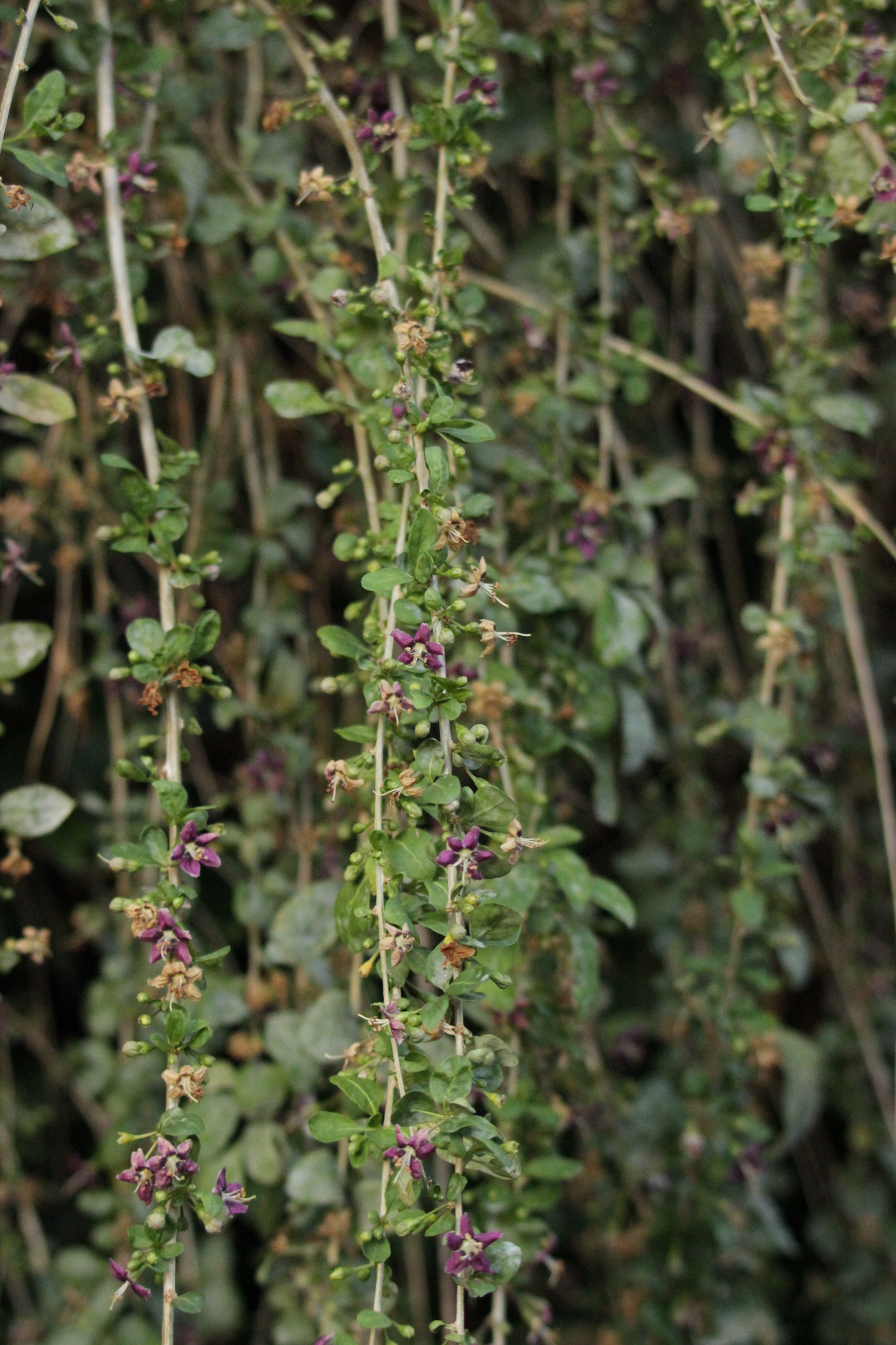
Flexible, arching branches give Lycium chinense its bushy, often drooping shape. The shrub generally reaches 1–3 m (3–10 ft) tall with a similar spread. Short thorns, 0.5–2 cm (0.2–0.8 in) long, are relatively sparse and occur mainly on older branches. A smooth young shoot therefore does not rule out thorns developing elsewhere as the plant matures. 4 6
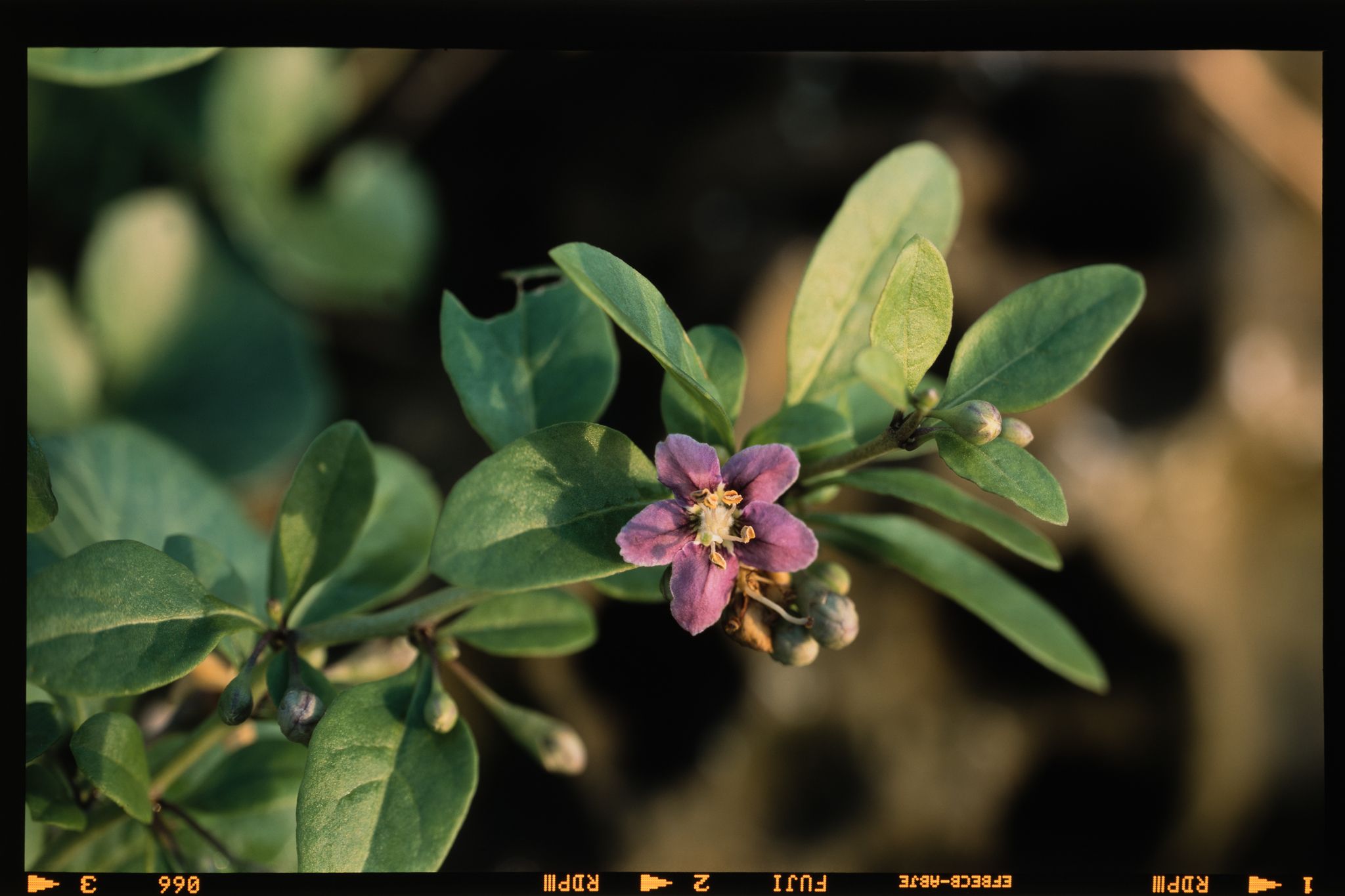
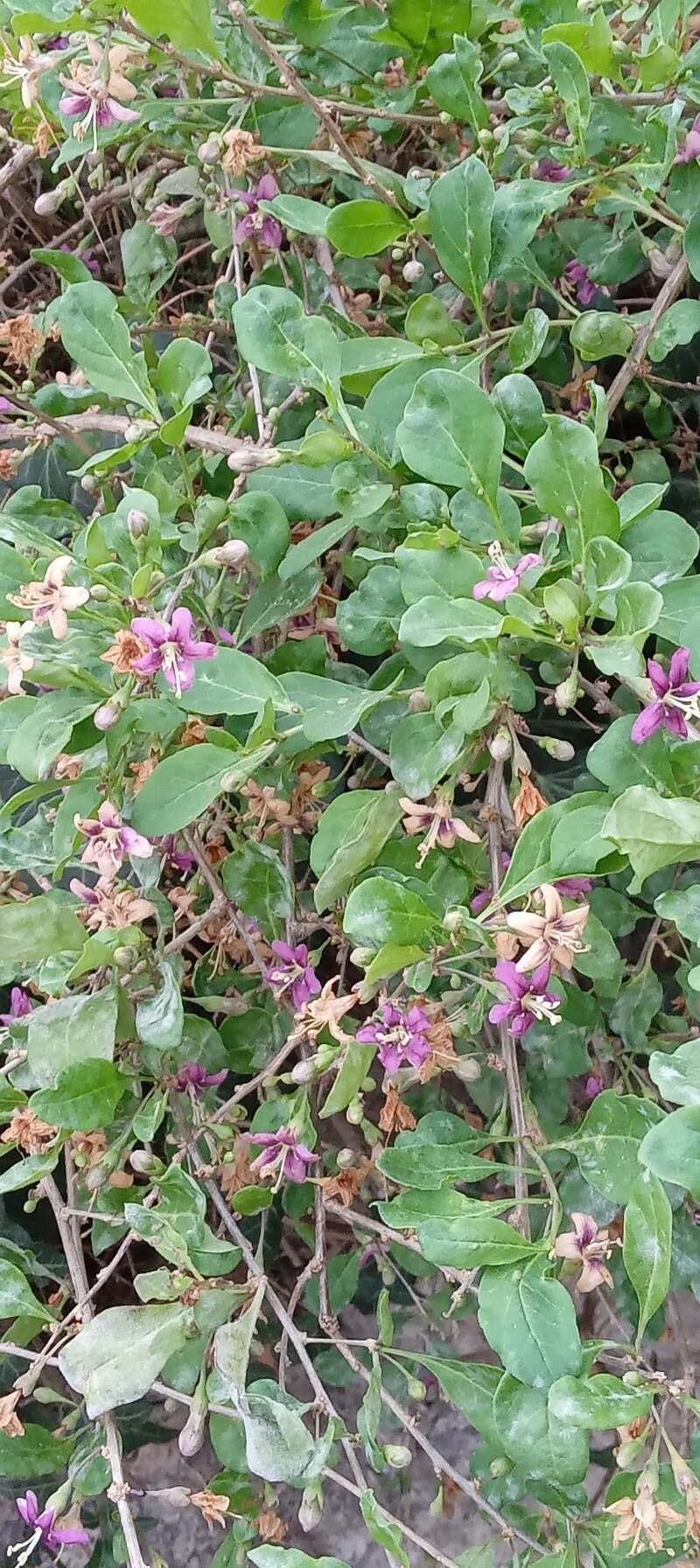
Pale green leaves measure 1.5–5 cm (0.6–2 in) long, range from oval to lance-shaped and grow singly or in groups of two to four at a node. Flowers appear alone or in small groups, with purplish lobes and a ring of hairs at the base of the tube. The calyx has more than two lobes, compared with two in Lycium barbarum, already providing a useful field distinction. 7 6
The following berries are egg-shaped and orange-red, usually 7–15 mm (0.3–0.6 in) long, reaching 22 mm (0.9 in) in some cultivated forms. They ripen from summer into fall. Before a young plant bears fruit, its arching habit and sparsely thorny stems remain the first visible clues, although flowers are more useful for separating it from its closest relative. 7 3
Useful taxonomy
Within Lycium chinense, POWO recognizes Lycium chinense var. potaninii (Pojark.) A.M.Lu, described in 1978. It has narrower branches and leaves and is sometimes grown in China as a substitute for Lycium barbarum. Several other names are treated as synonyms, including Lycium chinense var. rhombifolium (Moench) Bean and Lycium barbarum var. chinense (Mill.) Aiton. The latter is a homotypic name, illustrating the long history of confusion between the two species in horticultural literature. 1
Flower structure offers a more reliable distinction than berry color or size. The calyx has more than two lobes in Lycium chinense, against two clearly defined lobes in Lycium barbarum. The corolla tube is also relatively shorter in Lycium chinense. These features carry more taxonomic weight than the very similar fruits of the two species. 7
Habitat and range
China, Mongolia and eastern temperate Asia, including Korea and Japan, form the native range of Lycium chinense. It grows in lowland scrub and on riverbanks. Beyond that range, it is widely naturalized from the Mediterranean region to the United Kingdom, especially in coastal areas and hedges near houses. Native occurrence and escape from cultivation should therefore be distinguished when describing an individual population. 1 4
France provides one documented example of introduction: the species is not native there but has established locally in southern, western and central regions. It occurs along hedges and paths, often after escaping from old gardens. Spread through suckers as well as seed helps explain why it persists around formerly inhabited sites long after the original planting. 6 5
In North America it is introduced. The USDA records it under the symbol LYCH, and the U.S. Fish and Wildlife Service profile uses the English name Chinese desert-thorn for the same taxon. 9 8
Life cycle and reproduction
Self-fertile, hermaphroditic flowers open from late spring through summer, with bees providing pollination. Fruits develop through summer and ripen from midsummer into fall, spreading the harvest over several months. These seasonal descriptions should be read against local conditions rather than transferred as Northern Hemisphere dates to gardens in the Southern Hemisphere. 4 7
Three methods are used to raise new plants: spring sowing, with rapid germination; semi-ripe cuttings taken in summer; and division of suckers in late winter. Seed-grown plants often flower and fruit from their second year, a noticeably shorter wait than for many comparable woody shrubs. The different methods let growers work with seed or with vegetative growth already present on an established plant. 4 3
Uses and risks
Ripe berries lead the culinary uses. They are eaten raw or dried, or steeped in hot water as tea, with a sweet flavor reminiscent of anise. Young leaves and shoots have a peppermint-like flavor and are eaten raw in salads or cooked as vegetables. They are rich in vitamin A and protein, giving the plant a role as a leafy vegetable as well as a fruit crop. 4 5
Traditional Chinese medical use has a long written history. The Shennong bencao jing, compiled around the beginning of the Common Era, describes gouqi as a tonic for tendons and bones. Li Shizhen repeated its uses for the kidneys, lungs and general vitality in his 16th-century Bencao Gangmu. These are historical uses. Only Lycium barbarum is included in the official Chinese pharmacopoeia today; Lycium chinense is mainly a substitute or supplementary vegetable crop. 6
No toxicity is documented for cats or dogs. Nevertheless, large quantities of raw leaves are best avoided. Like many members of the Solanaceae, Lycium contains alkaloids that can cause headaches, digestive upset and dilated pupils when consumed in excess. The absence of documented pet toxicity should not be read as an invitation to feed animals unrestricted amounts. 5 4
Varieties, look-alikes and related plants
The narrow-leaved variety potaninii remains mainly a Chinese botanical curiosity, seldom encountered outside its native range. “Lycium tibeticum,” by contrast, appears widely on goji packaging despite having no scientific validity. The full botanical name is a better basis for identifying the plant actually being grown than a commercial name suggesting an origin in Tibet. 1
Common sources of confusion include:
- Lycium barbarum, with almost identical flowers and fruits, distinguished mainly by its two-lobed calyx;
- Solanum dulcamara, another hedgerow member of the Solanaceae with red berries, but without thorns and with leaves often lobed at the base;
- Rosa canina, whose red hips resemble wolfberry fruits but grow on thorny stems with compound leaves, a clearly different foliage structure.
The calyx, the shape of the branches and the arrangement of the leaves are the most dependable features for separating these plants in the field. Red fruit alone is a poor identification character when unrelated hedgerow plants can bear superficially similar crops. 7
Main sources
- Plants of the World Online / Kew, Lycium chinense Mill.
- International Plant Names Index, Lycium chinense Mill.
- Missouri Botanical Garden Plant Finder, Lycium chinense
- Plants For A Future, Lycium chinense database entry
- NC State Extension, Lycium (Box Thorn, Matrimony Vine, Goji Berry)
- Wikipédia (FR), Lycium chinense
- Wikipedia (EN), Lycium chinense
- U.S. Fish and Wildlife Service, Chinese Desert-thorn (Lycium chinense) species profile
- USDA PLANTS Database, Lycium chinense Mill. (symbol LYCH)
Frequently asked questions
Is Chinese wolfberry poisonous to cats or dogs?
No toxicity is documented for cats or dogs; humans eat the ripe fruit and young leaves. As a precaution, avoid large amounts of raw leaves, as with many other nightshade-family plants.
Does Chinese wolfberry produce the same goji berries as Lycium barbarum?
Both species produce red berries sold interchangeably as goji in China. Only Lycium barbarum is included in the official Chinese pharmacopoeia; Lycium chinense is mainly a substitute or supplementary vegetable crop.
How can I distinguish Lycium chinense from Lycium barbarum?
The most reliable feature is the calyx, which has more than two lobes in Lycium chinense and two distinct lobes in Lycium barbarum. The corolla tube is also relatively shorter in Lycium chinense.
Why do some goji packages say Lycium tibeticum?
This trade name has no recognized botanical standing. It was coined to promote goji berries in Western markets and does not represent a separate species from Tibet.
Can you eat Chinese wolfberry leaves?
Yes. Young leaves are eaten raw in salads or cooked as vegetables, with a flavor resembling peppermint. They are rich in vitamin A and protein, but moderate portions are advisable.
Does Chinese wolfberry grow wild in France?
It is not native there, but has locally naturalized in southern, western and central France, often along hedges and paths after escaping from old gardens.
How long has Chinese wolfberry been used in traditional medicine?
The Shennong bencao jing, compiled around the beginning of the Common Era, already describes gouqi as a tonic for tendons and bones. Li Shizhen repeated its uses in his 16th-century Bencao Gangmu.
Similar plants
If you are unsure about a plant’s toxicity, ask a botanist or veterinarian for advice.