
Creeping jenny (Lysimachia nummularia, )
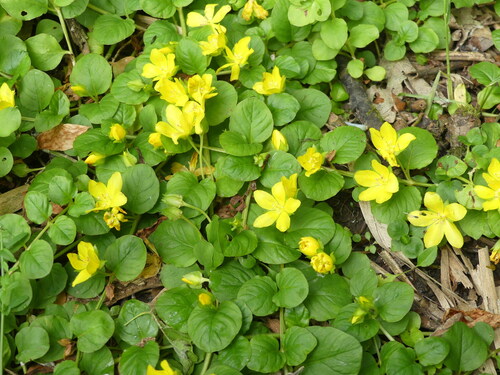
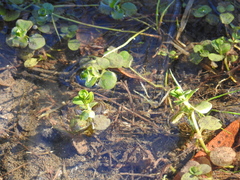
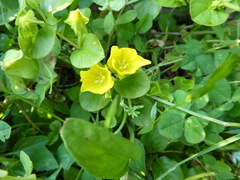
Creeping Jenny (Lysimachia nummularia L., 1753), also called moneywort, is a creeping perennial in the Primulaceae family, native from Europe to southwestern Siberia. Its prostrate stems root at every node and bear opposite, rounded leaves, giving rise to the Latin name nummularia, meaning like a coin. In summer, solitary yellow, cup-shaped flowers appear in the leaf axils. Introduced beyond Europe as an ornamental, it has become invasive in some North American wetlands.
Read moreCreeping jenny, moneywort and herb twopence




© photo
(c) miroslavamalovcova, some rights reserved (CC BY-NC) · cc-by-nc
Yann Kemper · cc0
Bruce Cook · cc0
Taken Jun 17, 2015 by Tela Botanica − Dominique REMAUD (cc-by-sa)
Taken Jan 1, 1970 by Photoflora - L'Abbé COSTE (©)
Taken Dec 31, 1847 by Tela Botanica − Herbier PONTARLIER-MARICHAL (cc-by-sa)
Taken Jun 26, 2022 by David Laloi (cc-by-sa)
Taken Oct 20, 2020 by Mendoza morelia (cc-by-sa)
© copyright of the Board of Trustees of the Royal Botanic Gardens, Kew.




Global distribution
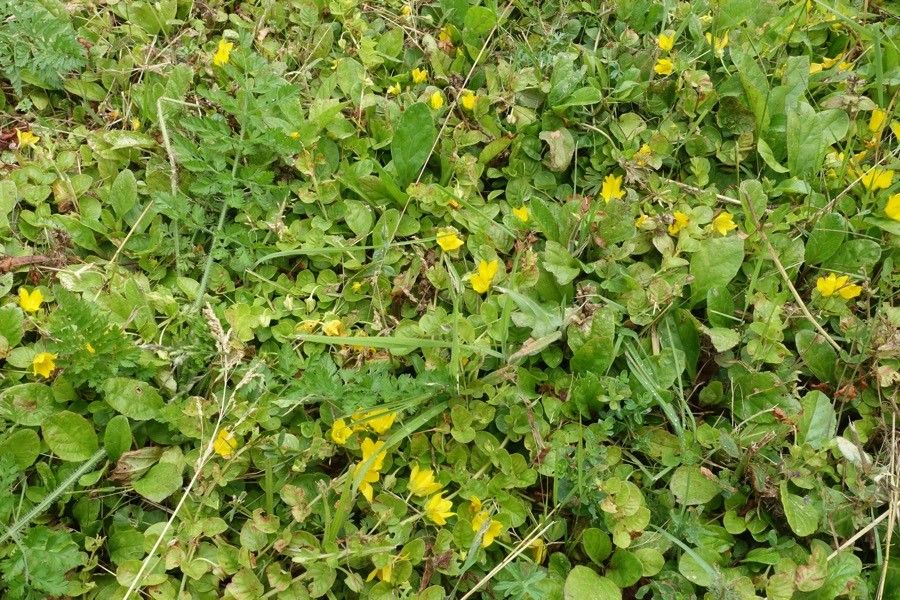
The native range of Lysimachia nummularia covers temperate Europe to southwestern Siberia and northwestern Türkiye. Now widely introduced beyond this range and grown almost everywhere as an ornamental, it is locally invasive in North American wetlands.
- Native4
- Introduced3
- Invasive1
- France
- Germany
- United Kingdom
- Western Russia
- Canada
- New Zealand
- Australia (Victoria)
- United States
Hexagons: regions where the plant occurs. Green dots: native range.1
Identity
Creeping Jenny (Lysimachia nummularia L., 1753), also known as moneywort, is a perennial in the genus Lysimachia, family Primulaceae. In France, the names herbe aux écus and Monnoyère describe its round leaves, arranged in pairs along the stems like small coins. 3 1
The Latin epithet nummularia literally means “like a coin.” The English names moneywort and herb twopence share that reference. Creeping Jenny can itself cause confusion: an inexperienced gardener may use it for two unrelated creeping plants, Convolvulus arvensis and Glechoma hederacea. 4
Recognition
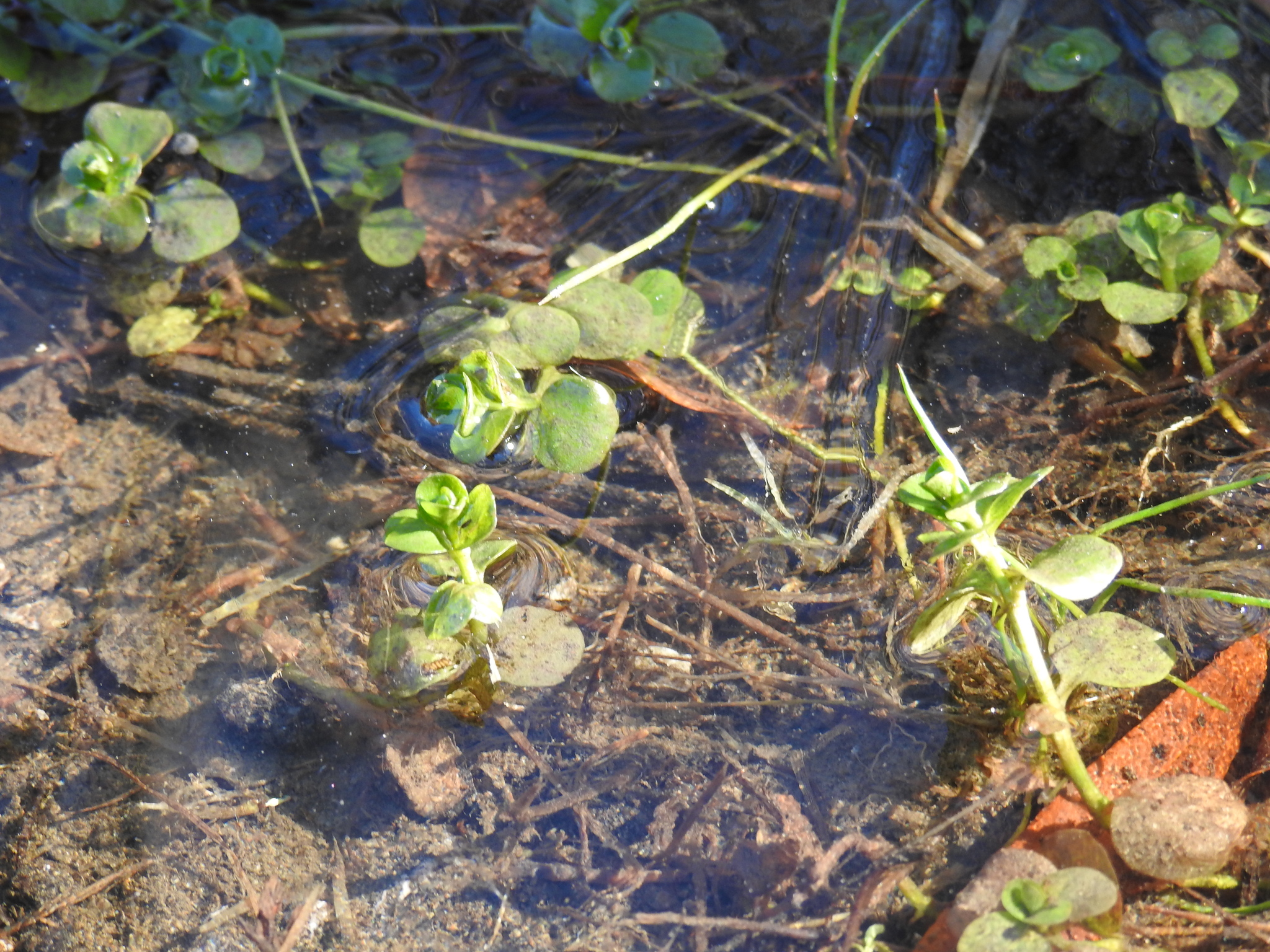
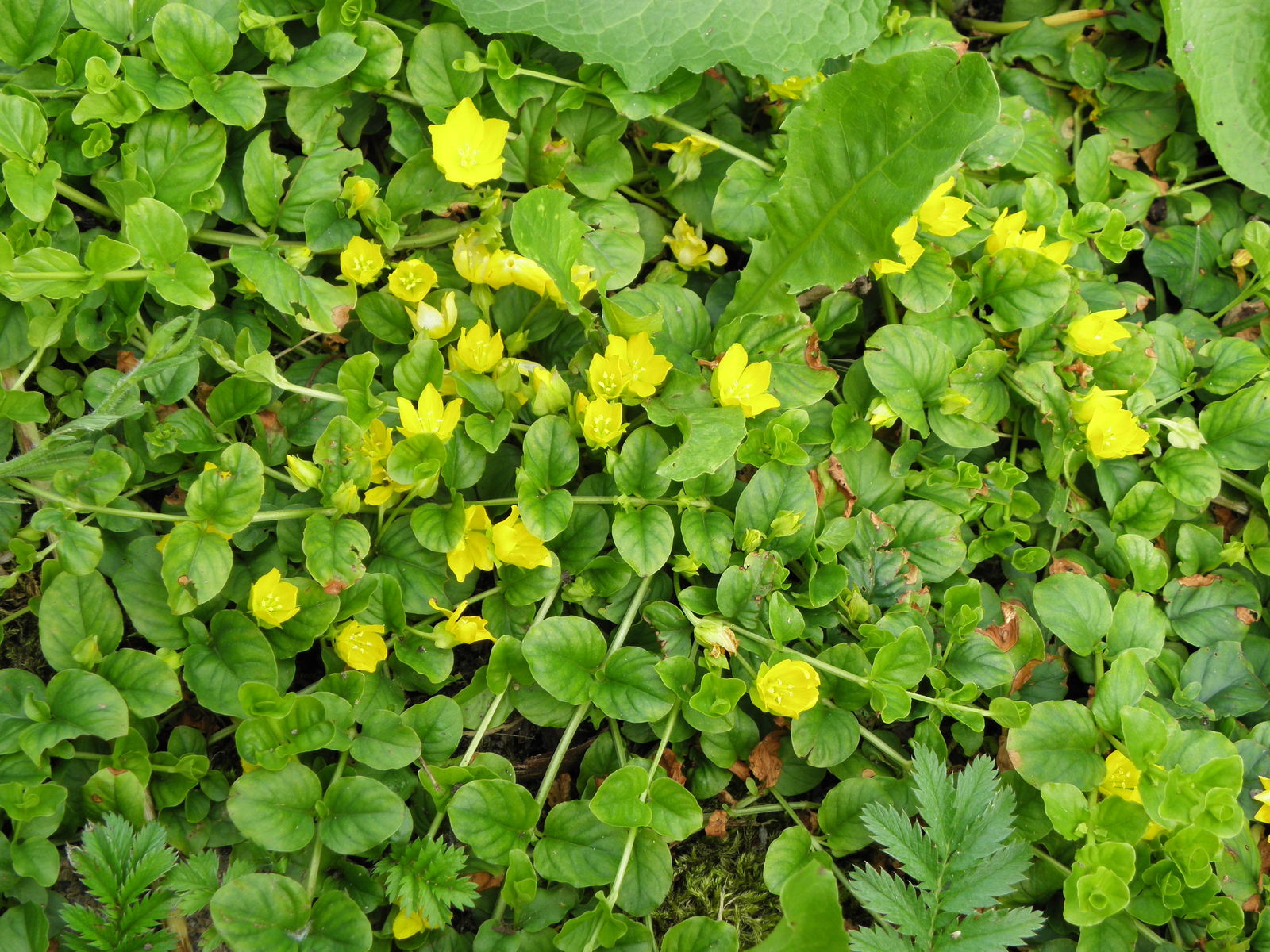
Vigorous, prostrate stems give Lysimachia nummularia its carpet-forming habit. The foliage is evergreen or semi-evergreen depending on winter severity. Square in cross-section, the stems root at every node and can spread 60–150 cm (2–5 ft) in a favorable season, without a clear natural limit. 3 4
Opposite leaves range from circular to rounded-oval, measure only a few centimeters (roughly an inch or so) across and sometimes carry tiny black glandular dots. The leafy carpet stays low, around 5–10 cm (2–4 in) tall, even while the stems travel far beyond it. 4 2
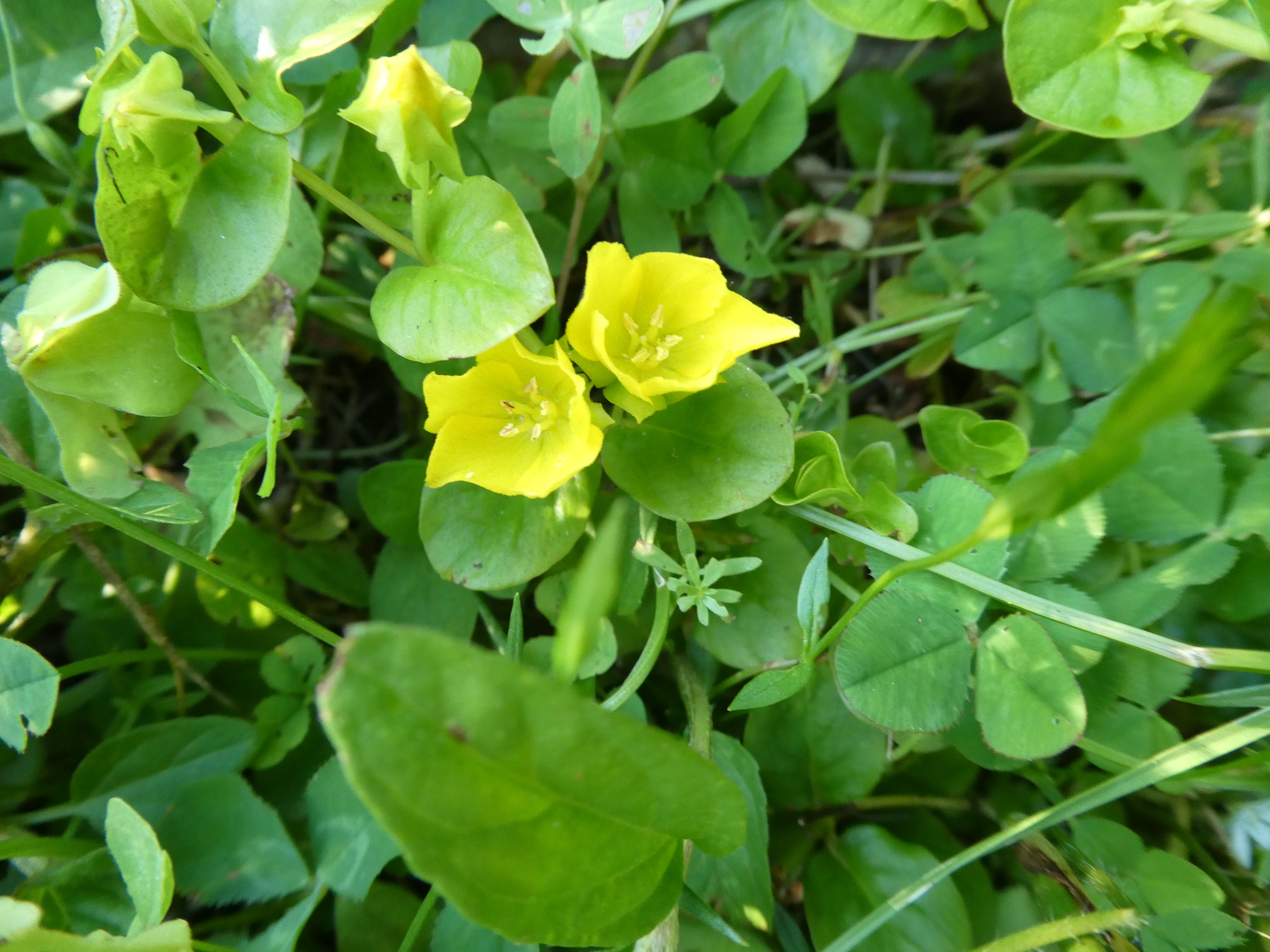
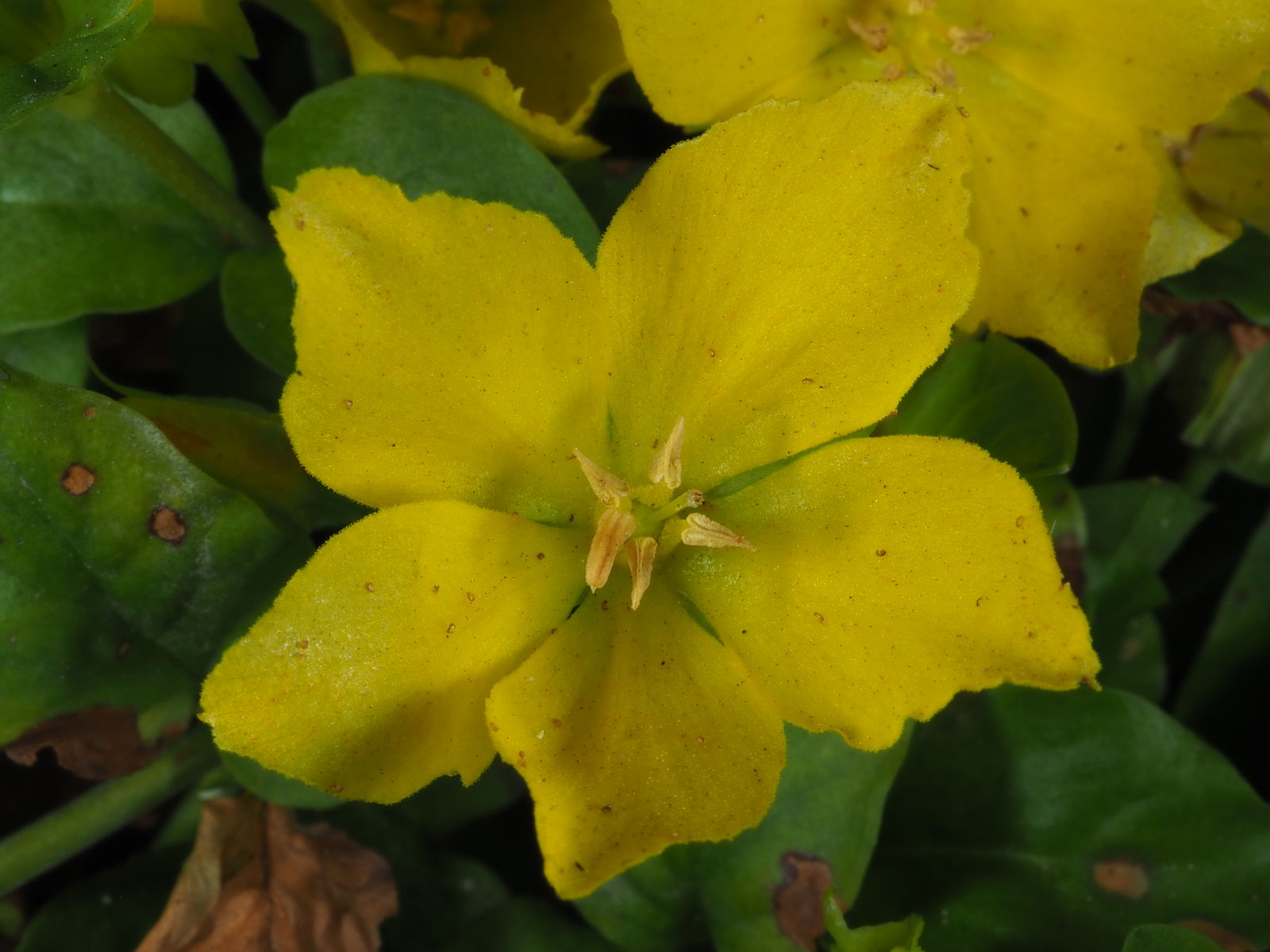
Yellow, cup-shaped flowers measure about 2 cm (0.8 in) across and appear singly in the leaf axils, never in spikes or clusters. The calyx has broad lobes and the five-lobed corolla is finely glandular. Flowering runs from June to September in the Northern Hemisphere, across the local summer. 5 3
Useful taxonomy
The family placement of Lysimachia nummularia has changed with classification systems. It has belonged to Primulaceae since APG III (2009), after placement in Myrsinaceae under the earlier APG and APG II systems. The scientific name Lysimachia nummularia remains a stable identification reference regardless of the family name adopted. 5 1
Recorded botanical synonyms include:
- Ephemerum nummularia (L.) Schur (historical synonym)
- Lysimachia nummularia var. festiva E.Fourn. ex Bélézé (name at variety rank)
- Lysimachia repens Stokes (historical synonym)
The accepted scientific name, Lysimachia nummularia L., provides the stable reference. It separates the species from its historical synonyms and from similar horticultural labels encountered in cultivation. 3 1
Habitat and range
Temperate Europe, southwestern Siberia and northwestern Türkiye make up its native range. There it colonizes ditches, wet meadows and banks, with a marked preference for calcareous soils. In France it occurs almost throughout the country but becomes scarce in the south. 1 3
Ornamental planting beyond its native range has led to naturalization in North America, where Lysimachia nummularia is now invasive in some areas, especially wetlands and pond margins. Even a fragment of stem left behind after weeding can start colonization again, making eradication difficult. 4
Its invasive status in North America contrasts with its position in France, where Lysimachia nummularia has regional protection in Limousin. The same plant can therefore be native and protected in one part of its range yet introduced and invasive elsewhere. The French example is regional, rather than a statement of rules for every reader. 5
Life cycle and reproduction
Stem rooting accounts for almost all reproduction in Lysimachia nummularia. A single fragment rooted at a node can establish a new carpet. This ability explains the speed at which a planting extends sideways across suitable ground. 3
Sexual reproduction occurs but plays a secondary role. Insect pollination or self-pollination produces capsules described as rare and shorter than the calyx. Unlike many other Primulaceae, this species does not normally produce abundant fruit. 5 3
Several phenolic acids occur in the plant, a chemical trait shared with its close relative Lysimachia vulgaris. No toxic consequence is documented for the phenolic acids in Lysimachia nummularia, although they help account for occasional traditional use in folk herbal medicine. 4
Uses and risks
Tolerance of frost down to −15 °C (5 °F) helps explain the frequent use of creeping Jenny in temperate gardens, both in beds and beside ponds. Local winter conditions still determine how much foliage persists. 2
Gardeners chiefly grow it as an ornamental ground cover for moist beds, a pond edging plant or an aquatic marginal. The golden-leaved cultivar Aurea is less aggressive than the typical species and has received the Royal Horticultural Society's Award of Garden Merit, a distinction for plants judged reliable in gardens. It also suits hanging baskets. 4
No toxic constituent is documented in Lysimachia nummularia. The species is absent from the ASPCA lists of toxic and nontoxic plants for cats; it is therefore placed by default among garden perennials with no known risk to cats, dogs or people. Its status for horses remains undocumented. 7
The main risk associated with the species is thus ecological rather than a health concern. Its invasive behavior in some wetlands outside Europe calls for containing cultivated plants near ponds or natural watercourses. 4
Varieties, look-alikes and related plants
Ground ivy, Glechoma hederacea, is a creeping member of the Lamiaceae with rounded leaves, often mistaken for creeping Jenny. Flowers separate them clearly: blue-violet flowers in spikes in Glechoma hederacea, versus yellow flowers in solitary cups in Lysimachia nummularia. Leaf margins also help: scalloped in ground ivy, smooth in creeping Jenny. 6
The name creeping Jenny creates another possible confusion because it sometimes refers to Convolvulus arvensis, a climbing bindweed unrelated to Lysimachia nummularia. Checking the binomial before buying a plant or identifying it outdoors avoids confusing creeping Jenny with field bindweed. 4
Aurea is a cultivar rather than a separate species. This golden-leaved horticultural selection is more compact and less spreading, making it useful where the ordinary ground cover would be too vigorous for a small bed. 4
Main sources
- Plants of the World Online / Kew, Lysimachia nummularia L.
- Royal Horticultural Society, Lysimachia nummularia - creeping Jenny
- Tela Botanica / eFlore, Lysimachia nummularia, summary BDTFX
- Wikipedia (EN), Lysimachia nummularia
- Wikipedia (FR), Lysimaque nummulaire
- NC State Extension Gardener Plant Toolbox, Lysimachia nummularia
- ASPCA, list of toxic and nontoxic plants for cats
Frequently asked questions
Is creeping Jenny invasive?
Outside its native European range, it is considered invasive in some parts of North America, particularly wetlands and pond margins. In France, by contrast, it is native and protected in Limousin.
Is creeping Jenny poisonous to animals?
No toxic constituent is documented for this species. It does not appear on the ASPCA lists of toxic or nontoxic plants for cats, placing it by default among perennials with no known risk to cats, dogs or people; its status for horses remains undocumented.
Can creeping Jenny grow in a pond or aquarium?
Yes. It suits pond edges or use as an aquatic marginal, particularly the cultivar Aurea, which is less vigorous than the typical species.
How can I tell Lysimachia nummularia from Glechoma hederacea?
The two creeping plants look similar from a distance, but Glechoma hederacea has scalloped leaves and blue-violet flowers in spikes. Lysimachia nummularia has smooth leaf edges and solitary, yellow, cup-shaped flowers.
Does creeping Jenny need a lot of light?
No. It tolerates both full sun and partial shade, flowering more abundantly in bright positions and developing more spreading foliage in shade.
Why is creeping Jenny called moneywort?
The name refers to the round leaves, which resemble small coins arranged in pairs along the prostrate stems.
How can I limit creeping Jenny in the garden?
A buried edging barrier or cultivation in a container slows spontaneous stem rooting. Regularly removing fragments that extend beyond the intended area remains the most reliable method.
Similar plants
If you are unsure about a plant’s toxicity, ask a botanist or veterinarian for advice.