
Noni (Morinda citrifolia, )
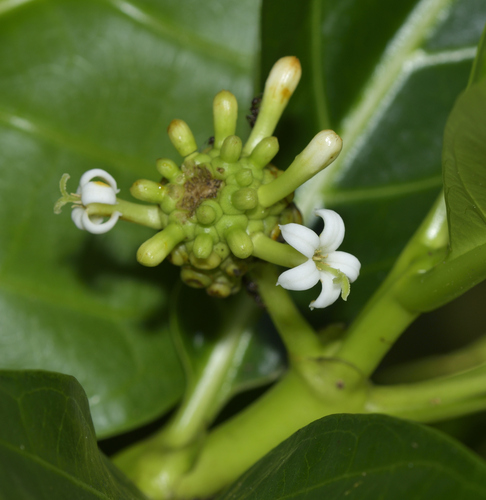
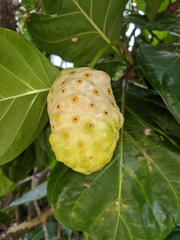
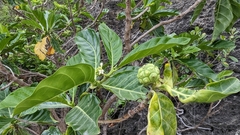
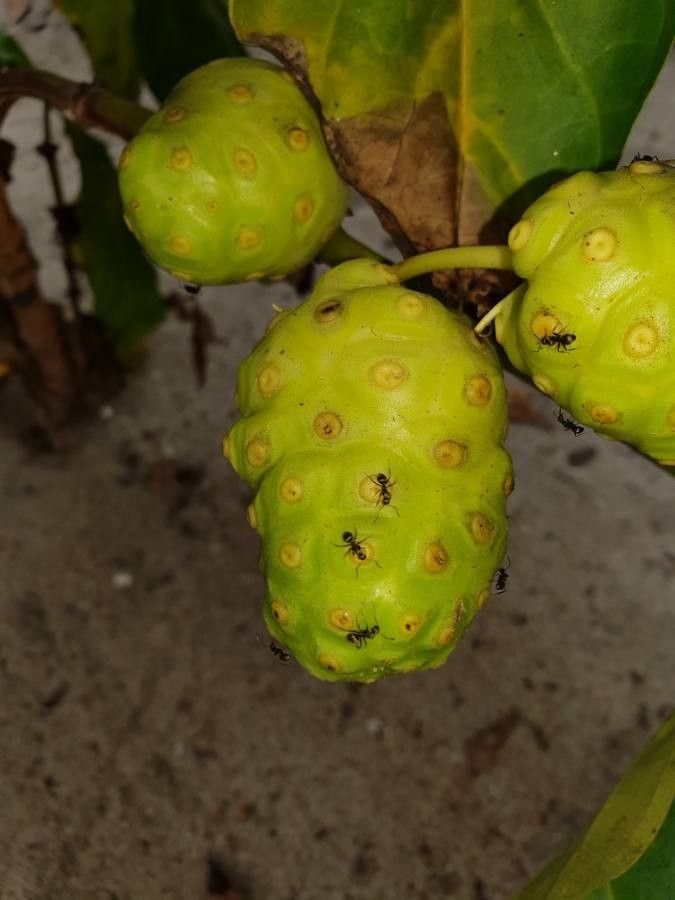
Noni (Morinda citrifolia) is a shrub or small tree in the Rubiaceae, native to Southeast Asia and northern Australia and now widespread across the tropical Pacific. Its glossy leaves have tufts of hairs where the veins meet, and its egg-shaped fruit ripens yellow-white with a rancid-cheese smell that gives it the name cheese fruit.
Read moreNoni, Mûrier indien, Nono, Morindier, Indian mulberry and Cheese fruit



© photo
(c) ytw, some rights reserved (CC BY-NC), uploaded by ytw · cc-by-nc
Zinnia Xu · cc0
潘立傑 LICHIEH_PAN · cc-by
Taken Apr 17, 2019 by OTS - O. Vargas (cc-by-nc-sa)
Taken Nov 4, 2022 by Ibnu yusan (cc-by-sa)
Taken Aug 9, 2017 by Tela Botanica − Sylvain PIRY (cc-by-sa)
© copyright of the Board of Trustees of the Royal Botanic Gardens, Kew.




Global distribution
Morinda citrifolia is native from tropical and subtropical Asia to northern Australia. Polynesian sailors carried it across the Pacific as a canoe plant. Its status varies greatly among islands, from native to an ancient introduction or a recent commercial crop.
- Native5
- Introduced2
- Indonesia
- Malaysia
- Philippines
- India
- Australia (Queensland and Northern Territory)
- French Polynesia
- Hawaii
Hexagons: regions where the plant occurs. Green dots: native range.1
Identity
Noni (Morinda citrifolia L., 1753), also known as Indian mulberry, is a shrub or small tree in the genus Morinda and the coffee family, Rubiaceae. Carl Linnaeus described the species in Species Plantarum in 1753. Plants of the World Online continues to accept that name. 1 2
The trade name noni is relatively recent. It replaced nono, the original Tahitian name, when fruit juice was introduced to Western markets in the 1990s. Indian mulberry can mislead readers about its botanical relationships: only the surface of the fruit resembles a mulberry. Noni belongs to the Rubiaceae, while true mulberries (Morus) belong to the separate Moraceae family. 11
Recognition
A conical crown and gray-brown bark characterize this tree, which reaches 3–8 m (10–26 ft) tall and sometimes 10 m (33 ft). Its taproot extends deep into the soil, explaining its resistance to drought once established. 5
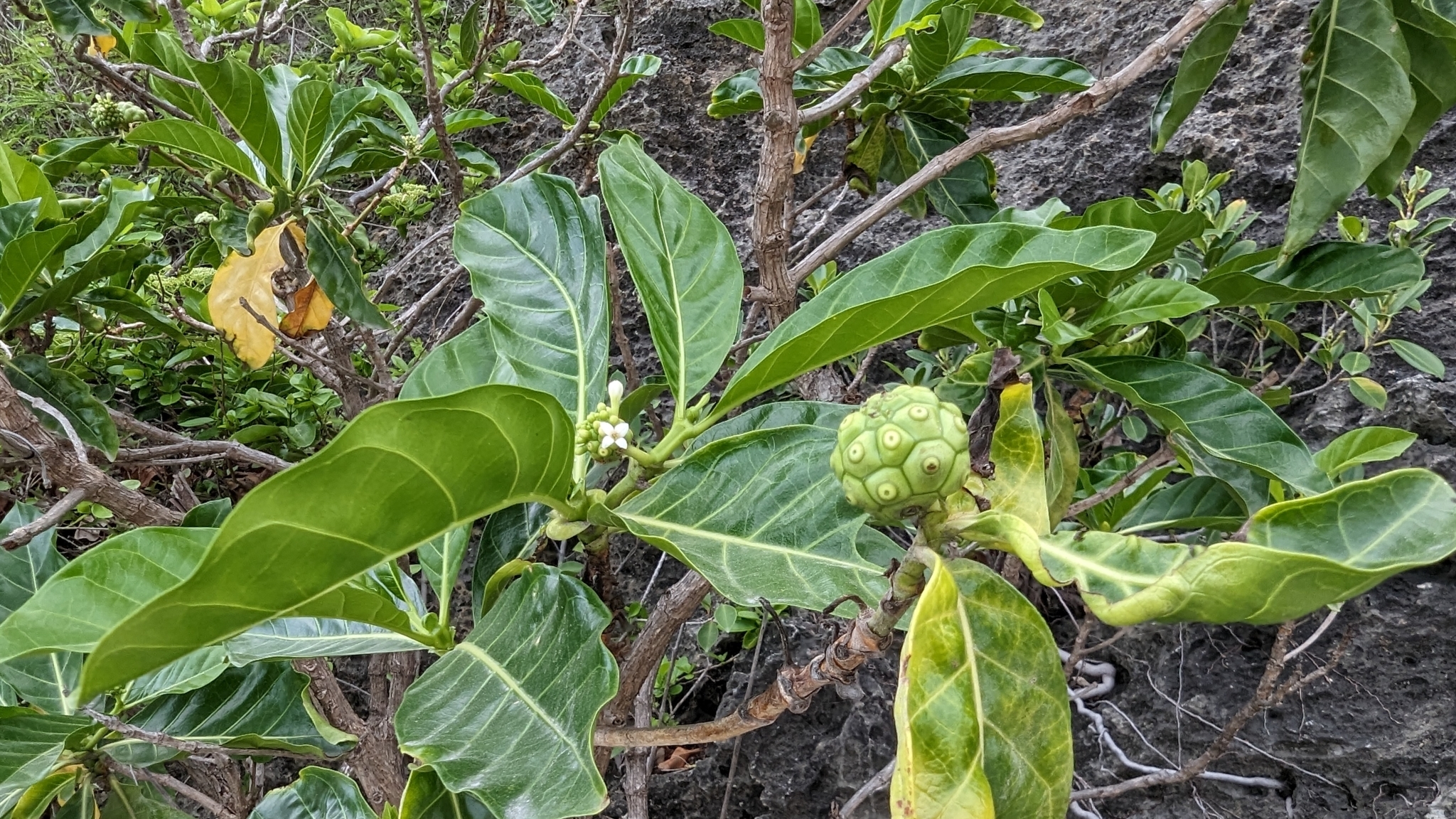
Opposite, glossy leaves are elliptical to lance-shaped, measuring 15–50 cm (6–20 in) long and 5–17 cm (2–7 in) wide. Small tufts of hairs, called domatia, provide a useful identification feature. They occupy the junctions between the midrib and secondary veins on the underside of the leaf blade. 5
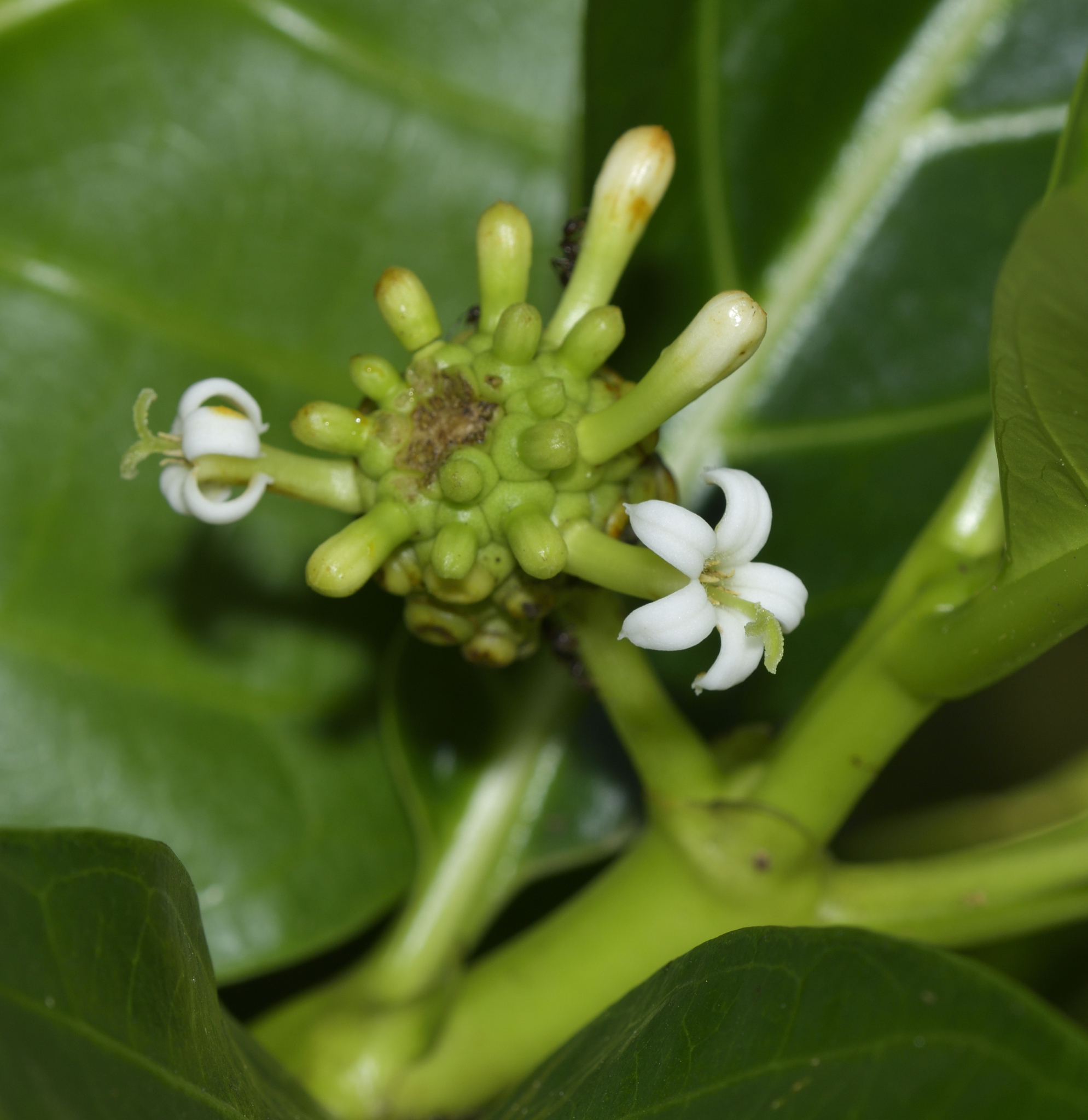
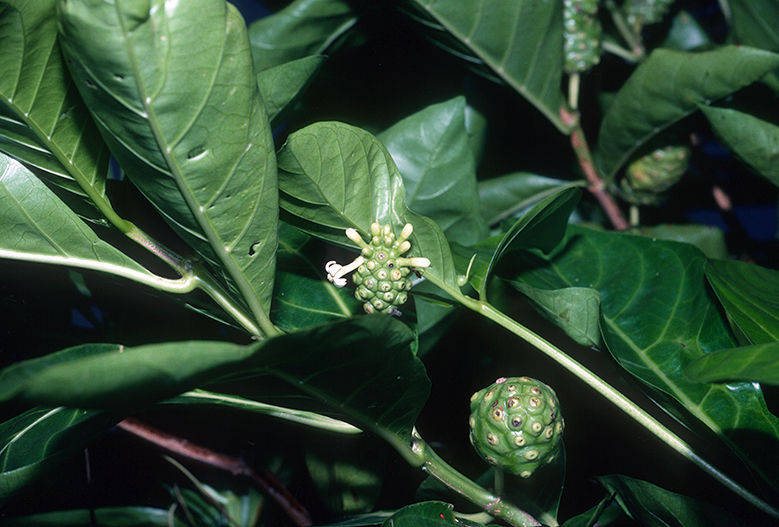
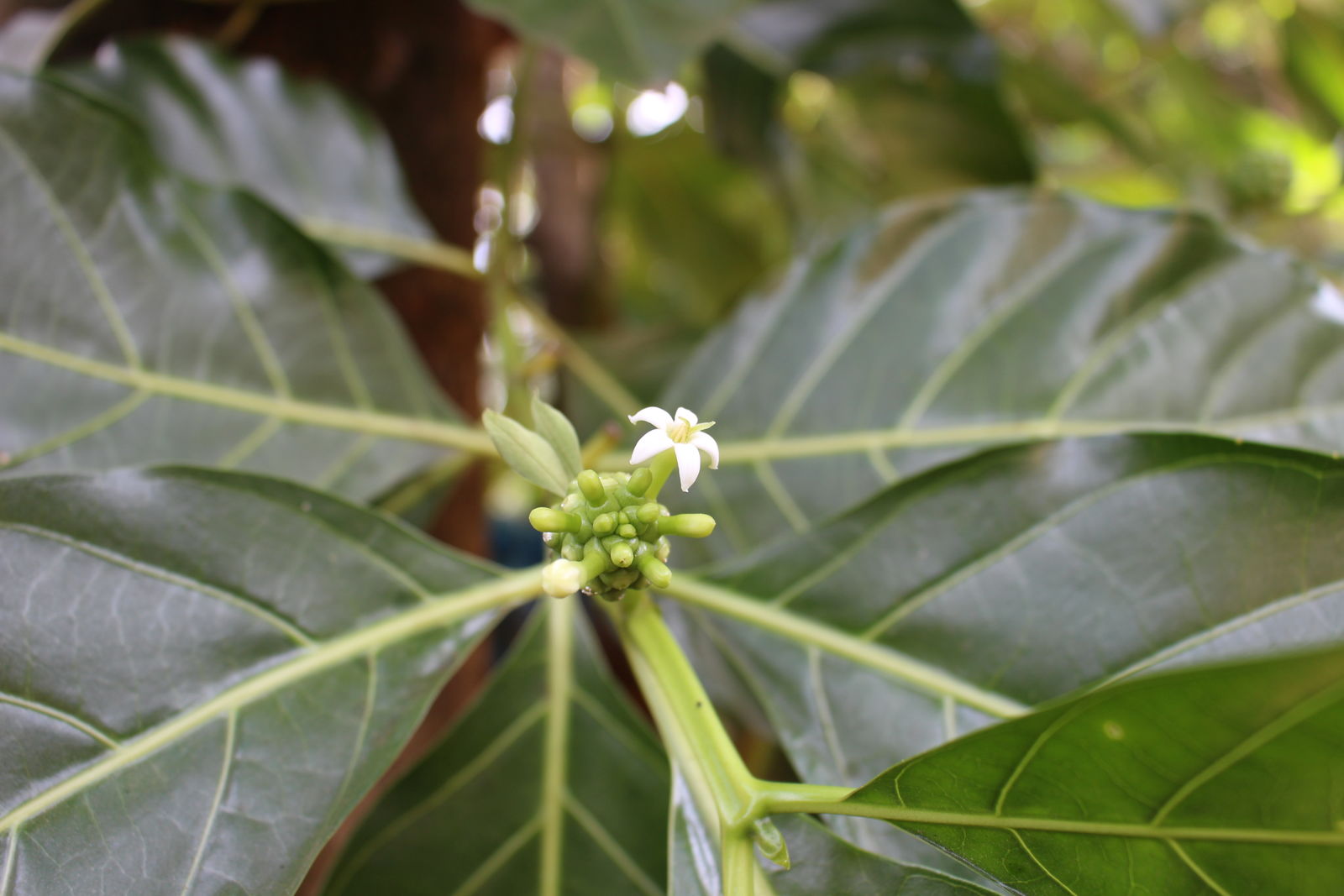
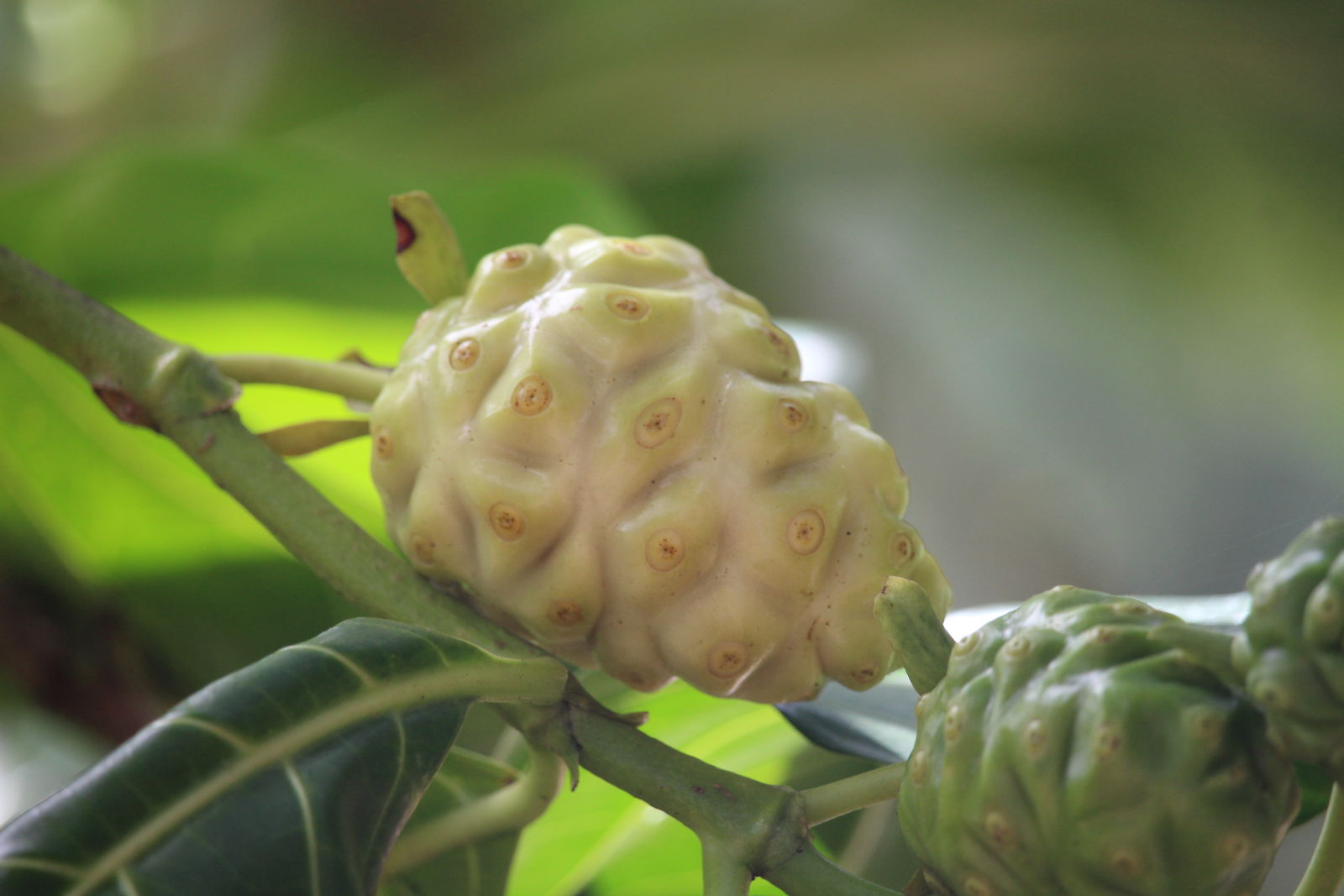
White, fragrant flowers form rounded heads on stalks 1–4 cm (0.4–1.6 in) long in the leaf axils. The resulting fruit is a syncarp, a fleshy mass formed by the fusion of dozens of small flowers from one head. This explains its surface of polygonal facets. Initially green, the fruit becomes translucent yellow-white at maturity and develops a rancid-cheese smell, earning the English name cheese fruit. 5 4
Useful taxonomy
Several names have been used for this species before Morinda citrifolia became established as its accepted name. The principal synonyms to recognize are:
- Morinda tinctoria Noronha (historical name)
- Morinda citrifolia var. bracteata (Roxb.) Kurz
- Morinda citrifolia var. potteri O.Deg.
- Samama citrifolia (L.) Kuntze
Older botanical and horticultural literature sometimes uses Morinda tinctoria, a name referring to the root's use as a dye. The accepted scientific name remains Morinda citrifolia. 1 3
Habitat and range
Tropical and subtropical Asia through northern Australia form the native range of Morinda citrifolia. Polynesian sailors later carried it across the Pacific as a canoe plant, alongside coconut and pandanus. Its status consequently varies among islands, from native to an ancient introduction or a recently cultivated crop for the juice trade. 6 11
Coastal vegetation and secondary woodland following disturbance are typical habitats. Noni is among the first plants to establish on volcanic ground and poor or saline soils. Its tolerance of these soils explains why some risk assessments rate it as a strong colonizer of degraded ground, despite its native status across most of its range. 4 6
The IUCN conservation assessment places the species in the Least Concern category, with no threat identified across its overall range. 7
Life cycle and reproduction
Winter brings no marked dormancy to noni, unlike a temperate tree. In favorable tropical conditions, flowering and fruiting continue almost year-round, without a clear seasonal peak. A plant growing in good conditions may flower and fruit in its first year. 4 11
Seeds are the most common means of propagation. They germinate in 3–9 weeks and remain viable for at least six months in storage. Stem cuttings bring plants into fruit sooner than growing them from seed. 4
Uses and risks
Ripe fruit, young leaves and some roasted seeds are eaten. The leaves are rich in protein and vitamin A. More astringent, unripe fruit goes into curries and sambals in South Asia. Ripe fruit is mainly processed into juice because its powerful smell discourages eating it as it is. 4 5
Traditional medicine uses the root for urinary disorders, the bark during childbirth and the fruit for respiratory complaints. These are documented traditional uses and do not amount to clinical validation. 4
No toxicity from contact with the plant is documented in cats, dogs or humans. The debate concerns concentrated juice instead. Two hepatitis cases were reported in Austria after prolonged, heavy consumption, while a broader clinical and toxicological study found no evidence of liver toxicity at usual doses. Both interpretations appear in the medical literature, calling for caution with concentrated courses rather than a general warning about the plant. 10 9
Varieties, look-alikes and related plants
Noni has no established horticultural cultivars comparable to the variegated forms of other ornamental plants. Trade descriptions mainly distinguish round-fruited and elongated-fruited plants. These reflect natural differences in shape, without a separate botanical status. 1
Potential sources of confusion include:
- Morinda tinctoria Noronha, a historical synonym of the same taxon rather than a separate species;
- Morinda royoc, a separate Caribbean species with much smaller fruit;
- true mulberries in the genus Morus, botanically unrelated despite the shared common name.
A rancid-cheese smell at full ripeness, polygonal facets on the syncarp and domatia on the leaf undersides remain the most reliable features for distinguishing Morinda citrifolia from these other plants. 5
Main sources
- Plants of the World Online / Kew, Morinda citrifolia L.
- International Plant Names Index (IPNI), Morinda citrifolia L.
- GBIF Backbone Taxonomy, Morinda citrifolia L.
- Plants For A Future (PFAF), Morinda citrifolia
- World Agroforestry Database, Morinda citrifolia species profile
- Pacific Island Ecosystems at Risk (PIER), Morinda citrifolia risk assessment
- IUCN Red List, Morinda citrifolia assessment (de Kok 2024)
- INPN, Morinda citrifolia L. 1753, noni
- West et al., World Journal of Gastroenterology, noni juice is not hepatotoxic
- Hepatotoxicity of NONI juice, report of two cases
- CTAHR / University of Hawaii, Noni resources
Frequently asked questions
Is noni poisonous to cats and dogs?
No toxicity is documented in cats, dogs or humans from contact with the plant or its fruit. Prolonged consumption of very high doses of concentrated juice has, however, been associated with rare hepatitis cases in humans.
Why does noni fruit smell like cheese?
The rancid-cheese smell develops only when the fruit is fully ripe, as it changes from green to translucent yellow-white. The same smell indicates when it is ready to harvest.
Is noni a true mulberry?
No. The name Indian mulberry refers to the surface resemblance of the fruit to a mulberry. Morinda citrifolia belongs to the coffee family, Rubiaceae, while true mulberries (Morus) belong to the Moraceae.
Where does the name noni come from?
The original Tahitian name, nono, was changed to noni when the juice was marketed in the 1990s. This marketing choice eventually became established in Western trade.
Is noni invasive?
Some risk assessments rate it as a strong colonizer of disturbed ground, although the species is native to most Pacific islands. Hawaii, where it was introduced, is a documented exception.
Can noni be grown in metropolitan France?
It cannot grow outdoors in the ground there: the shrub tolerates no frost and already suffers damage below 12 °C (54 °F). In metropolitan France, it is limited to a large container in a greenhouse heated year-round.
Which parts of noni are edible?
The ripe fruit, young leaves and some roasted seeds are eaten. Unripe fruit also goes into curries and sambals in South Asia, while ripe fruit is mainly used for juice.
Similar plants

If you are unsure about a plant’s toxicity, ask a botanist or veterinarian for advice.