
Coffee (Coffea arabica, )
Coffee (Coffea arabica), also called Arabica coffee or Arabian coffee, is an evergreen shrub in the madder family, Rubiaceae, native to the highland forests of Ethiopia, South Sudan and northern Kenya. Grown throughout the tropics for its seeds, it supplies about 60% of the world's coffee and, outside the tropics, is also kept as a houseplant.
Read moreArabica coffee, Arabian coffee and Coffee plant
Place in indirect light or in a shaded room.
Global distribution
According to Plants of the World Online, the native range of Coffea arabica is limited to the highland forests of southwestern Ethiopia, eastern South Sudan and northern Kenya (Mount Marsabit). Carried early to Yemen and then across the tropics, the plant is now mostly cultivated; Brazil, Colombia and many other tropical countries grow it, although it is not native there.
- Native3
- Introduced1
- Ethiopia
- South Sudan
- Kenya
- Yemen
Hexagons: sourced regions. Green dots: native range. Statuses according to POWO (Kew).
Identity
Coffee (Coffea arabica L., 1753), also known as Arabica coffee, is an evergreen shrub in the genus Coffea, part of the madder family, Rubiaceae. Most of the coffee drunk worldwide comes from this one plant: the species alone accounts for about 60% of global production. 1 2
The name misleads. Linnaeus coined the epithet arabica in 1753, yet the species is not native to Arabia; it comes from the highland forests of East Africa. Yemen and the Arabian Peninsula mainly served as an early trade hub, hence the label "Arabian coffee." 1 3
The drink's vocabulary points the same way. In Arabic the plant is called bunn (بُنّ), a word borrowed from Oromo buna, a language spoken across part of the Ethiopian highlands where the species originates. Before Linnaeus, the botanist Antoine de Jussieu had described the plant in 1715 as Jasminum arabicum, working from a specimen sent by the Amsterdam botanical garden; Linnaeus built on that description when he fixed the current binomial. 2 3
Recognition
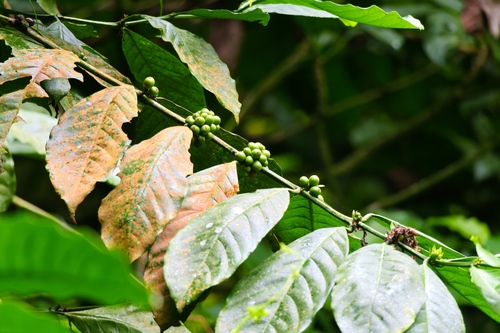
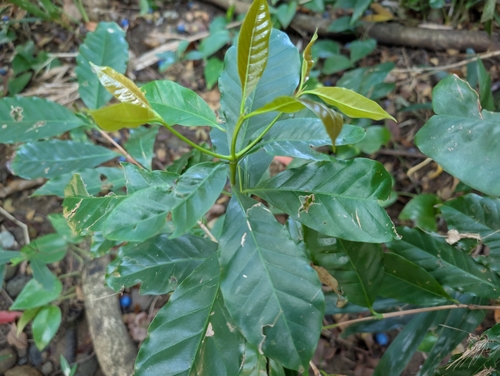
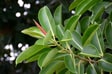
A shrub or small tree with glossy, evergreen foliage, Coffea arabica can reach 9–12 m (30–40 ft) in the wild. Plantations usually keep it near 5 m (16 ft), and potted plants stay under 2 m (6.5 ft). The leaves are opposite, simple and elliptic, a shiny dark green with pronounced veins and often slightly wavy margins. 4 2
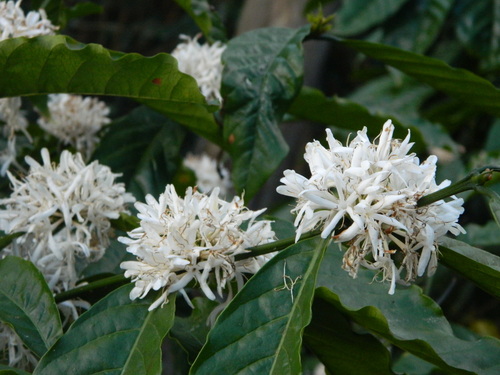
Its white, star-shaped, fragrant flowers smell of jasmine. They form in clusters in the leaf axils and measure a little over 1 cm (0.4 in) across. Flowering is seasonal: in the native habitat, a dry season followed by rain sets it off. 4 3
Drupes, the "coffee cherries," follow the flowers and ripen from green to yellow and finally deep red. Each cherry usually holds two seeds; processed and roasted, these become coffee beans. 4 5
Useful taxonomy
Linnaeus described the species in 1753, and Coffea arabica L. remains the accepted name. The genus Coffea belongs to the large Rubiaceae family, which also includes gardenia and cinchona. 1
Genetics set this coffee apart from its relatives: it is an allotetraploid with 44 chromosomes (4 × 11), whereas most other species in the genus are diploid, with 22 chromosomes (2 × 11). Molecular analysis of its genome shows it arose from the natural hybridization of two diploid species, Coffea canephora and Coffea eugenioides. 6 3
That origin weighs heavily on cultivation. The genome sequence points to a single polyploidization event at the base of the species, which explains its very low genetic diversity in both wild and cultivated populations. It is one reason Arabica is so vulnerable to disease and why breeding programs matter so much. 7
Mix-ups mostly involve the other cultivated species in the genus:
- Coffea canephora Pierre ex A.Froehner, robusta, higher in caffeine;
- Coffea liberica W.Bull ex Hiern, with larger leaves and fruit;
- Coffea eugenioides S.Moore, one of Arabica's genetic parents.
The accepted scientific name, Coffea arabica, is the one reliable anchor. 1
Habitat and range
Strictly, the native range covers only the highland forests of southwestern Ethiopia and eastern South Sudan (the Boma Plateau), a tropical biome with a pronounced dry season. There the plant grows in shaded understory, usually between 1,200 and 2,000 m (3,900–6,600 ft). It also occurs on Mount Marsabit in northern Kenya, though recent work leans toward a naturalized rather than truly native presence. 1 2
Carried early to Yemen, where its cultivation is documented from the 12th century, the species spread to Asia and then the Americas, and is now grown throughout the tropics. Brazil and Colombia are the leading producers, but coffee is not native to either, so its native range has to be kept apart from its vast area of cultivation. 3 5
The distinction has real consequences. Although its wild population is estimated in the billions of individuals, Arabica is listed as Endangered on the IUCN Red List once climate change is taken into account. Modeling of the indigenous Ethiopian populations predicts a severe decline: depending on the scenario, numbers could drop by 50–80% and the suitable range shrink by roughly 40–50% by the end of the century, a direct threat to the species' gene pool. 8 9
Life cycle and reproduction
Propagation is by fresh seed, which germinates in one to three months in a warm, moist mix. Seed loses viability quickly, so sow it soon after harvest. 10 11
Cultivated plants bear their first flowers at about 3–4 years and reach full seed production at about 6–8 years. A plant can then stay commercially productive for several decades. Flowering, and fruit set after it, depend heavily on warmth, light and good humidity. 5 11
Its ideal temperature range is about 15–24 °C (59–75 °F). Coffee is frost-tender and drops its leaves once temperatures fall too low. Outdoors it suits only frost-free climates, roughly USDA zones 10 and 11; where winters bring frost, it is grown as a houseplant or in a heated conservatory. 10 5
Uses and risks
The species' economic importance is unmatched: its roasted seeds give Arabica coffee. The leaves can also be brewed and contain caffeine, and the species has traditional uses as a central nervous system stimulant. 11 2
Coffee drinkers generally rate Arabica above its rival robusta (Coffea canephora), which is easier to grow and higher yielding. The gap shows in the cup too: about 100 mg of caffeine per cup of Arabica against nearly 250 mg for robusta, which now makes up a large share of world production and often goes into blends. 3
As an ornamental, the plant earns its place with glossy foliage and scented flowers in a bright room or conservatory. In its homeland, its understory ecology inspired shade-grown coffee, where taller trees shelter the shrubs. 5 4
On the risk side, the plant itself has low toxicity, but its seeds and used coffee grounds contain caffeine and other methylxanthines. The ASPCA warns that in animals these can cause vomiting, restlessness, excessive thirst, abnormal heart rhythm, tremors and even seizures. Take care with dogs, cats and horses, especially around the seeds and grounds. 12
Varieties, look-alikes and related plants
Arabica has given rise to many cultivated lines. Typica is the historic reference line; Bourbon, a widely grown mutation of it, is prized for cup quality. Houseplant growers will also meet a dwarf form labeled Nana, whose exact cultivar status is worth checking with the seller. 10
Confusion rarely comes from another family; it happens within Coffea itself, with robusta (Coffea canephora), higher in caffeine, and liberica (Coffea liberica), with larger leaves and fruit. When buying an ornamental plant, the scientific name and the opposite, glossy leaves are the most dependable clues. 1 4
Main sources
- Plants of the World Online / Kew, Coffea arabica L.
- Royal Horticultural Society, Coffea arabica, Arabian coffee
- Missouri Botanical Garden Plant Finder, Coffea arabica
- NC State Extension Gardener Plant Toolbox, Coffea arabica
- Plants For A Future, Coffea arabica
- Wikipedia (EN), Coffea arabica
- Wikipedia (FR), Caféier d'Arabie
- ASPCA, People Foods to Avoid Feeding Your Pets (caffeine and methylxanthines)
- Royal Botanic Gardens Kew, wild coffee species threatened with extinction
- Lashermes et al. 1999, Molecular characterisation and origin of the Coffea arabica L. genome (Molecular and General Genetics)
- Scalabrin et al. 2020, A single polyploidization event at the origin of the tetraploid genome of Coffea arabica (Scientific Reports)
- Davis et al. 2012, The Impact of Climate Change on Indigenous Arabica Coffee (PLoS ONE)
Frequently asked questions
Does Coffea arabica really produce the coffee we drink?
Yes. Coffea arabica supplies about 60% of the world's coffee. Each red cherry holds two seeds, which become coffee beans after processing, roasting and grinding.
Is Coffea arabica toxic to pets?
The plant itself has low toxicity, but its seeds and used grounds contain caffeine and other methylxanthines. The ASPCA notes that these substances can cause vomiting, restlessness and heart problems in dogs and cats.
How long does a coffee plant take to flower?
In cultivation, the first flowers usually appear at about 3 to 4 years. Full seed production tends to arrive around 6 to 8 years, given good light and warmth.
What is the difference between Arabica and Robusta?
Robusta is Coffea canephora, a separate species. Arabica is allotetraploid and contains roughly half as much caffeine, which often makes it milder in the cup.
Can you grow a coffee plant in an apartment?
Yes, in a bright, warm room out of direct sun. It needs at least 13 °C (55 °F), humidity of at least 50% and a free-draining mix. It can flower indoors, though less reliably than in a tropical climate.
Where does Arabian coffee actually come from?
Despite its name, it is native to the highland forests of Ethiopia, South Sudan and northern Kenya. Yemen and Arabia spread the plant; they are not its botanical origin.
Is wild coffee threatened?
Yes. Kew assessed wild Arabica as Endangered on the IUCN Red List once climate change is factored in, as its natural population could fall sharply by the end of the century.
Similar plants
Botanical data compiled from reference sources (RHS, Kew Gardens, POWO). This profile is for guidance only and is not a substitute for advice from a botanist or veterinarian if you have concerns about toxicity.