
Sweet olive (Osmanthus fragrans, )
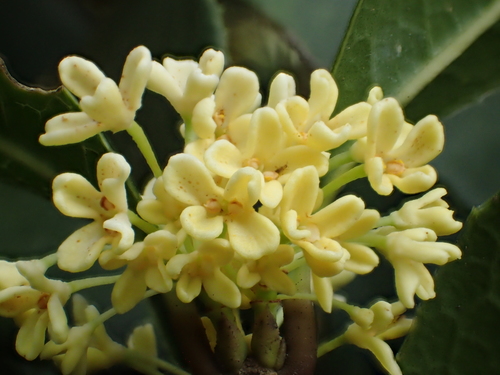
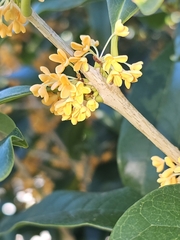
Sweet olive (Osmanthus fragrans Lour., 1790) is an evergreen shrub or small tree in the Oleaceae family, native to subtropical East Asian forests from the southern Himalayas to southern Japan. Its brief fall flowering carries a powerful ripe-apricot fragrance. It is widely cultivated in China and Japan, particularly for flavoring tea.
Read moreSweet olive, Sweet osmanthus, Fragrant olive, Tea olive and Guihua
Allow a few hours of direct sun per day, preferably morning or evening.
Full sun to light partial shade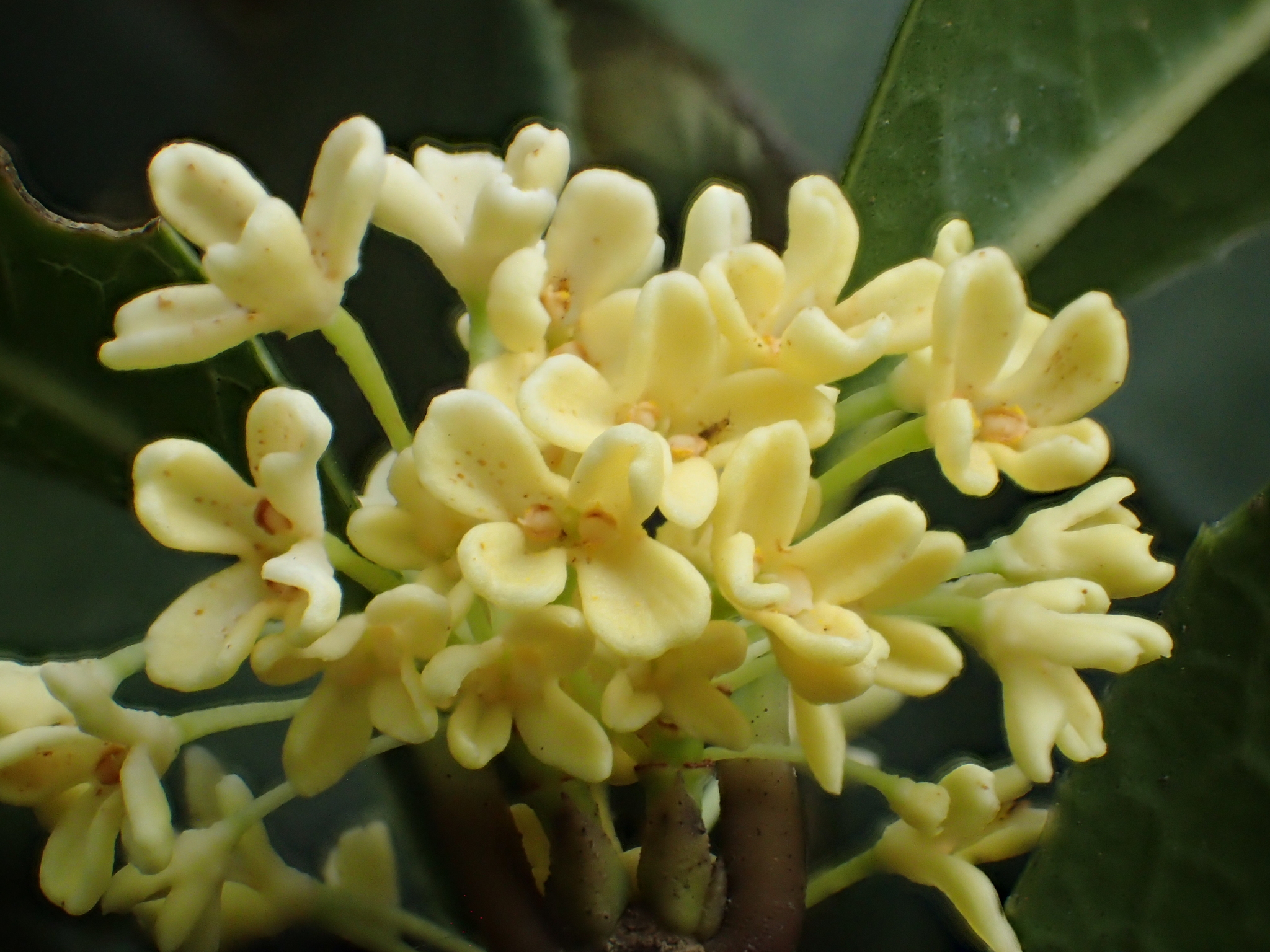
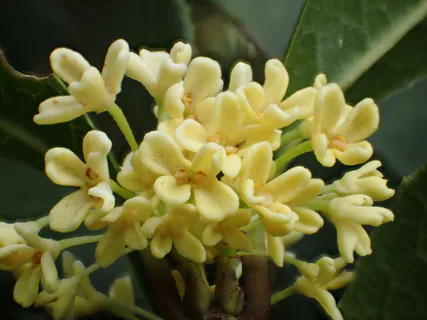


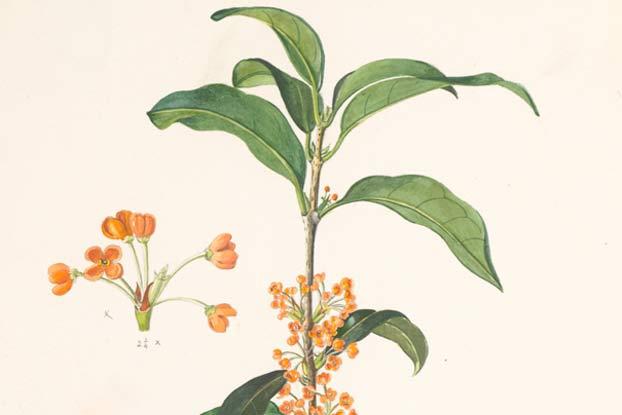

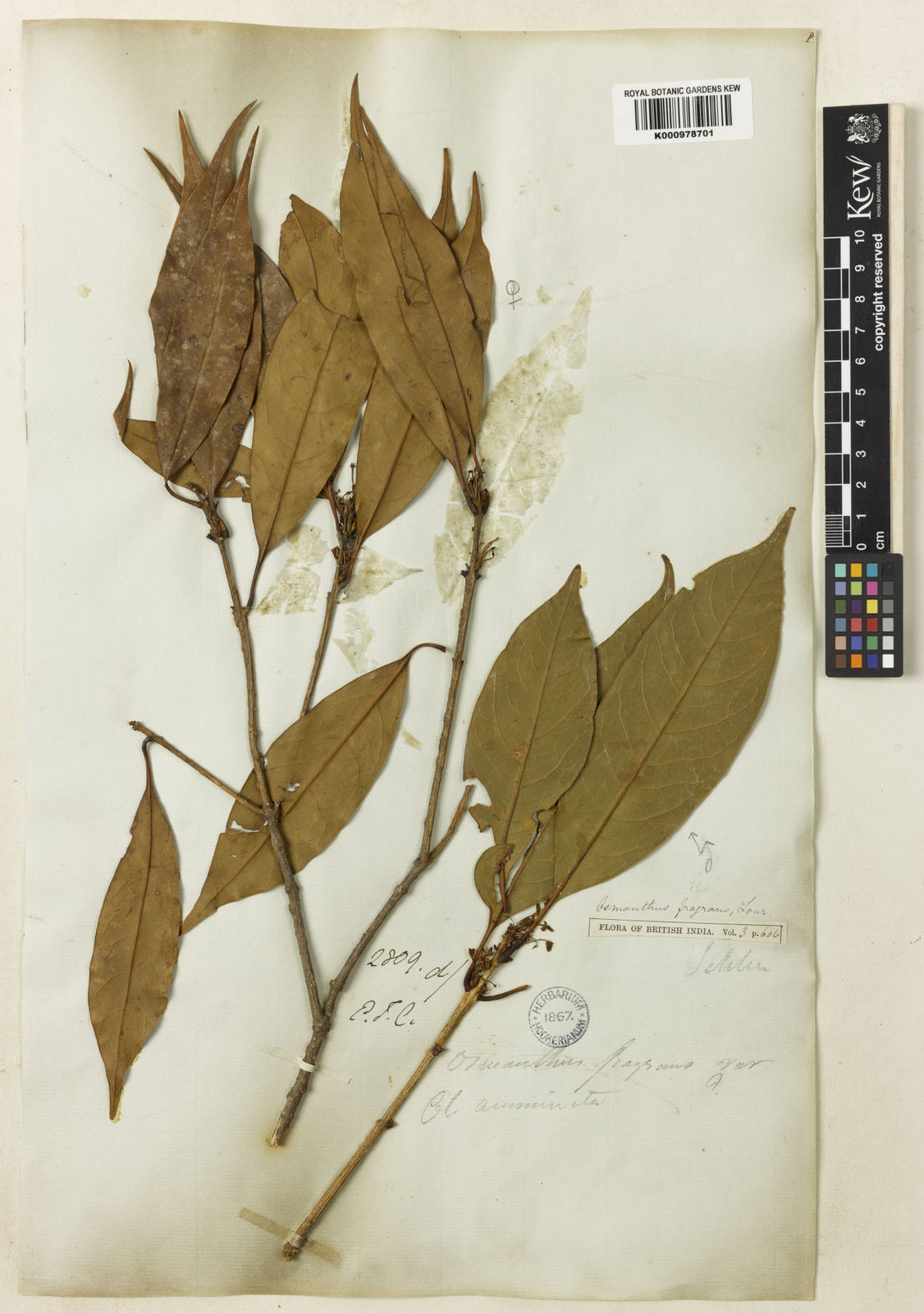
© photo
no rights reserved, uploaded by 葉子 · cc0
iNaturalist User · cc-by
Taken Sep 10, 1966 by Royal Botanic Garden Edinburgh - Anonymous (cc-by-nc)
Taken Sep 16, 1966 by Royal Botanic Garden Edinburgh - Anonymous (cc-by-nc)
Taken Sep 8, 1988 by Royal Botanic Garden Edinburgh - Anonymous (cc-by-nc)
Taken Oct 26, 1967 by Royal Botanic Garden Edinburgh - Anonymous (cc-by-nc)
Taken Feb 5, 2022 by Giacomo Sellan (cc-by-sa)
© copyright of the Board of Trustees of the Royal Botanic Gardens, Kew.


Global distribution
Osmanthus fragrans is native to subtropical East Asian forests from the Himalayas to southern Japan, through southern China, Taiwan and mainland Southeast Asia. Natural populations are concentrated mainly south of the Yangtze basin. Beyond this range, it is chiefly cultivated as an ornamental.
- Native8
- China
- Nepal and the Himalayas
- Southern Japan
- Taiwan
- Vietnam
- Myanmar
- Thailand
- Cambodia
Hexagons: regions where the plant occurs. Green dots: native range.1
Identity
Sweet olive (Osmanthus fragrans Lour., 1790), also called sweet osmanthus, is an evergreen shrub or small tree in the Oleaceae family and the genus Osmanthus. The name joins the Greek osmê, meaning smell, and anthos, flower: literally “fragrant flower.” The Latin epithet fragrans also means fragrant. Its ripe-apricot scent can identify it from several meters away during fall flowering. 5 6
The common name recalls a family relationship rather than membership in the true olive genus. Sweet olive shares Oleaceae with the true olive (Olea europaea) but belongs to a different genus and produces no equivalent edible fruit. João de Loureiro first described it in 1790 in Flora Cochinchinensis, using plants already cultivated in Southeast Asia. 1 8
Recognition
Opposite, elliptical leaves 7–15 cm (3–6 in) long give the plant its evergreen, leathery and glossy foliage. Margins are smooth or finely toothed, without spines. Leaf edges distinguish Osmanthus fragrans more reliably than flower color from Osmanthus heterophyllus: false holly has regularly spaced, sharp teeth along its leaves, while sweet olive never has these spines. 5 4
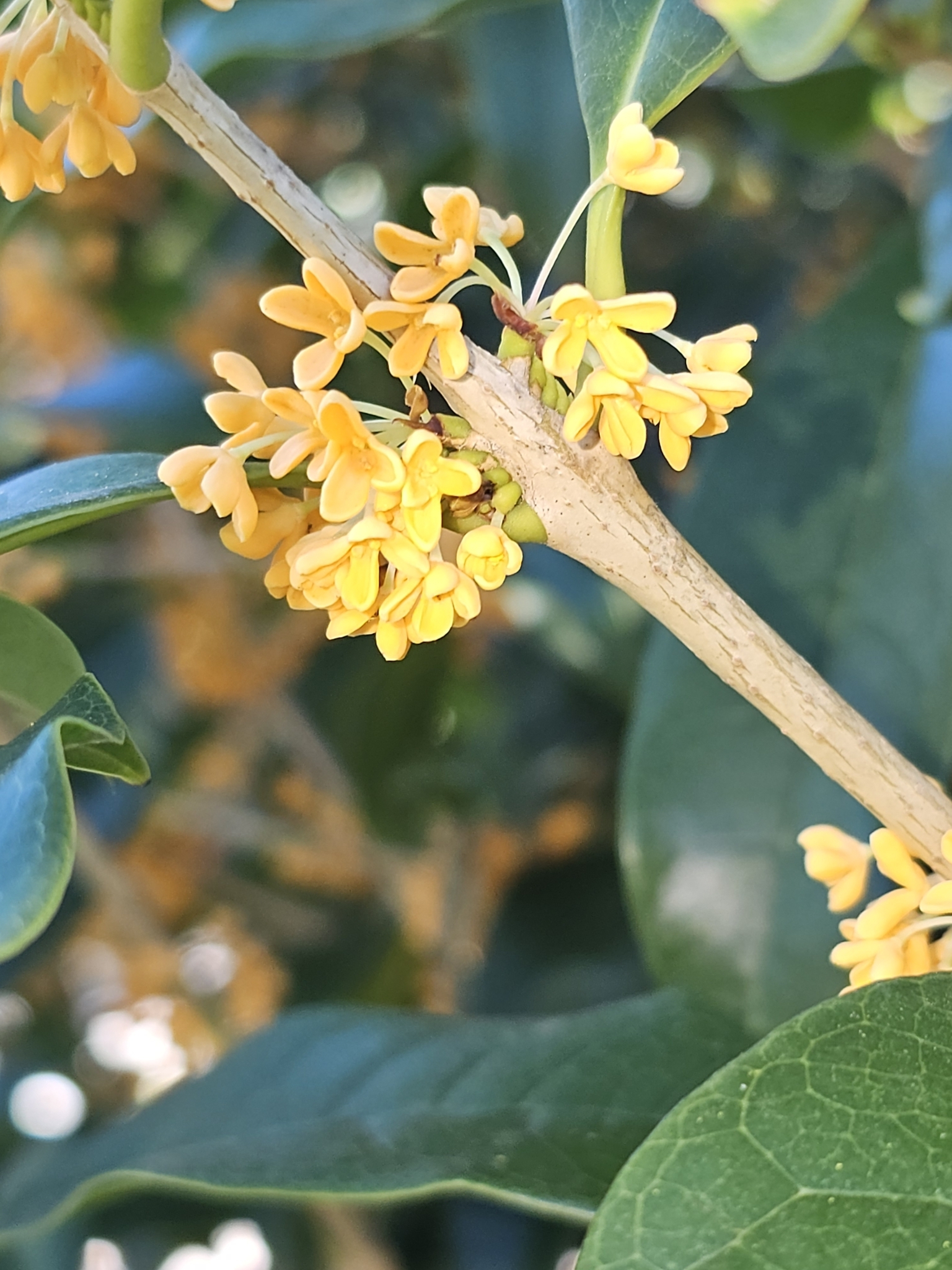
Small clusters tucked into leaf axils carry tiny flowers barely 1 cm (0.4 in) across. Colors vary from creamy white to yellow or orange with the variety. At a distance, the ripe-apricot or peach fragrance is more useful for recognition than the flowers themselves, carrying several meters during full bloom. 2 5
The main flower display lasts only a few days in late summer or fall, sometimes followed by a quieter spring flush. Small purple-black drupes 1–1.5 cm (0.4–0.6 in) long resemble miniature olives. They are rarely seen on garden-center plants, since most are male clones that do not fruit. 2 6
Useful taxonomy
Botanically, the accepted species is Osmanthus fragrans Lour., in Oleaceae and the order Lamiales. Several varieties and forms have been described; some are now treated as synonyms of the typical variety:
- Osmanthus fragrans var. aurantiacus Makino, the orange-flowered variety
- Osmanthus fragrans f. leucanthus T.Yamaz., the white-flowered form
- Osmanthus fragrans var. thunbergii Makino, a synonym of the typical variety
- Osmanthus fragrans var. latifolius Makino, a broad-leaved synonym
- Tornelia fragrans Gut. ex Schott, an old historical generic name
Before buying, aurantiacus is a particularly useful name to recognize. This orange-flowered variety is the most fragrant and the most sought after in China for tea and guihua wine. The white leucanthus form has a quieter scent. 1 6
Habitat and range
From the Himalayas to southern Japan, sweet olive occurs through southern China (Guizhou, Sichuan, Hainan and Yunnan), Taiwan, Myanmar, Thailand, Cambodia and Vietnam. Natural populations are concentrated mainly south of the Yangtze basin in subtropical evergreen forests. 1 5
Five historic cultivation centers stand out in China: Hangzhou, Suzhou, Xianning, Guilin and Chengdu. Guilin itself literally means “forest of osmanthus.” The species also lines many urban avenues in southern China, providing summer shade and fall fragrance. 6
Outside its native area, sweet olive is chiefly ornamental. In France it grows outdoors in mild regions and in containers elsewhere; it is also cultivated in the southern United States, where it is rated hardy in USDA zones 8b–11. The International Union for Conservation of Nature lists the species as Least Concern, with no identified threat to its natural populations. 8 3 9
Life cycle and reproduction
Nurseries chiefly propagate sweet olive from semi-ripe cuttings taken in summer. Rooting is slow and may take several months in a shaded frame. Seed propagation is possible but seldom chosen for named varieties, since it cannot guarantee flower color or fragrance intensity. Cuttings reproduce the parent faithfully. 4 6
Young shrubs grow slowly for the first few years, then accelerate once well rooted. Mature size takes 10–20 years in cultivation. Flowers form on the previous year's wood, so late-summer pruning removes much of the following flower display. 2 3
Taiwan's commercial orchards consist of more than 95% male clones. These are selected for abundant flowers and the absence of fruit that would complicate harvesting flowers for tea and perfumery. 6
Uses and risks
Dried flowers flavor green or black tea as guìhuā chá. They also go into jams, cakes, rice dumplings and liqueurs, and form the basis of chátāng, a traditional Tianjin dessert. For perfumery, extraction must take place within 24 hours of harvest to capture the fragrance before the flowers wilt. Several luxury perfume houses use it for single-flower fragrances. 5 6
For household pets, the ASPCA lists Osmanthus fragrans as non-toxic to cats and dogs. That source does not document horse toxicity. Some sensitive cats may simply dislike the strong fragrance, which is distinct from actual toxicity. 7
Traditional Chinese medicine uses the flowers, fruit and roots for toothache, coughs or abdominal pain, describing them as pungent and warming. These are traditional pharmacopoeial uses and do not replace medical advice. 6
Varieties, look-alikes and related plants
Flower color and scent intensity chiefly distinguish the horticultural varieties. Orange-flowered Aurantiacus is especially prized for culinary use; Fudingzhu is an early-flowering Chinese cultivar with silvery-white flowers, grown in orchards; Yanhua has variegated foliage and is chosen more for ornament than scent. Latifolius, present in botanical synonymy, also circulates in nurseries for broad-leaved plants without a stable taxonomic status. 1 5
Plants most often confused with sweet olive include:
- Osmanthus heterophyllus, false holly, whose spiny leaves resemble true holly (Ilex aquifolium) despite its broadly similar outline;
- Osmanthus × fortunei, the hybrid between the two preceding Osmanthus species, with regularly spaced leaf spines inherited from false holly;
- Olea europaea, the true olive, which shares Oleaceae but belongs to a separate genus and lacks both the characteristic fragrance and the same leaf outline.
Look closely at the leaf edge: it provides a clearer distinction than flower color, which varies between plants. Margins are smooth or finely toothed in Osmanthus fragrans, distinctly spiny in false holly. A full scientific name avoids confusion with the many other Osmanthus species that often share a scent but have different growing requirements. 4 5
Main sources
- Plants of the World Online / Kew, Osmanthus fragrans Lour.
- Royal Horticultural Society, Osmanthus fragrans
- Missouri Botanical Garden Plant Finder, Osmanthus fragrans
- NC State Extension, Osmanthus fragrans (fragrant tea olive)
- Wikipedia, Osmanthus fragrans
- Wikipedia FR, Sweet olive
- ASPCA, Osmanthus fragrans toxicity entry
- Tela Botanica / BDTFX, Osmanthus fragrans Lour.
- IUCN Red List, Osmanthus fragrans assessment
Frequently asked questions
Is sweet olive toxic to cats and dogs?
No. The ASPCA lists Osmanthus fragrans as non-toxic to cats and dogs. That source does not document toxicity in horses, so caution remains appropriate.
Why has my sweet olive not flowered yet?
The most common cause is the age of a young plant: full flowering often takes several years. Another frequent cause is late-summer pruning that removes the wood bearing buds.
How do Osmanthus fragrans and Osmanthus heterophyllus differ?
Leaf margins are the most reliable guide: smooth or finely toothed in Osmanthus fragrans, distinctly spiny and holly-like in Osmanthus heterophyllus. They share a genus but have different garden uses.
Can you eat sweet olive flowers?
Yes. Dried flowers traditionally flavor tea, jams and some liqueurs in China. The orange-flowered aurantiacus variety is particularly sought after for these culinary uses.
What is the lowest temperature sweet olive tolerates?
According to the sources, an established plant tolerates brief frosts down to about −10 °C (14 °F). Young plants and those in containers are more sensitive and need winter protection.
Why is it called sweet olive?
The name recalls its family relationship with the true olive, Olea europaea: both belong to Oleaceae. Osmanthus fragrans belongs to a separate genus, however, and has no equivalent edible olive fruit.
When can I prune sweet olive without losing the flowers?
Just after fall flowering. The following year’s buds form on existing wood, so late-summer pruning removes many of the future flowers.
Similar plants
If you are unsure about a plant’s toxicity, ask a botanist or veterinarian for advice.