
Pandan (Pandanus amaryllifolius, )


Pandan (Pandanus amaryllifolius) is a tropical plant in the Pandanaceae with aromatic, strap-shaped leaves. Cultivated throughout Southeast Asia, it has never been confirmed in the wild and is propagated only from offsets or cuttings. Its nearly spineless foliage releases a distinctive fragrant-rice aroma when crushed.
Read morePandan, Fragrant screwpine, Scented pandan, Pandan wangi and Screwpine
Give plenty of ambient light without direct sun on the leaves.
Bright indirect light; tolerates partial shade


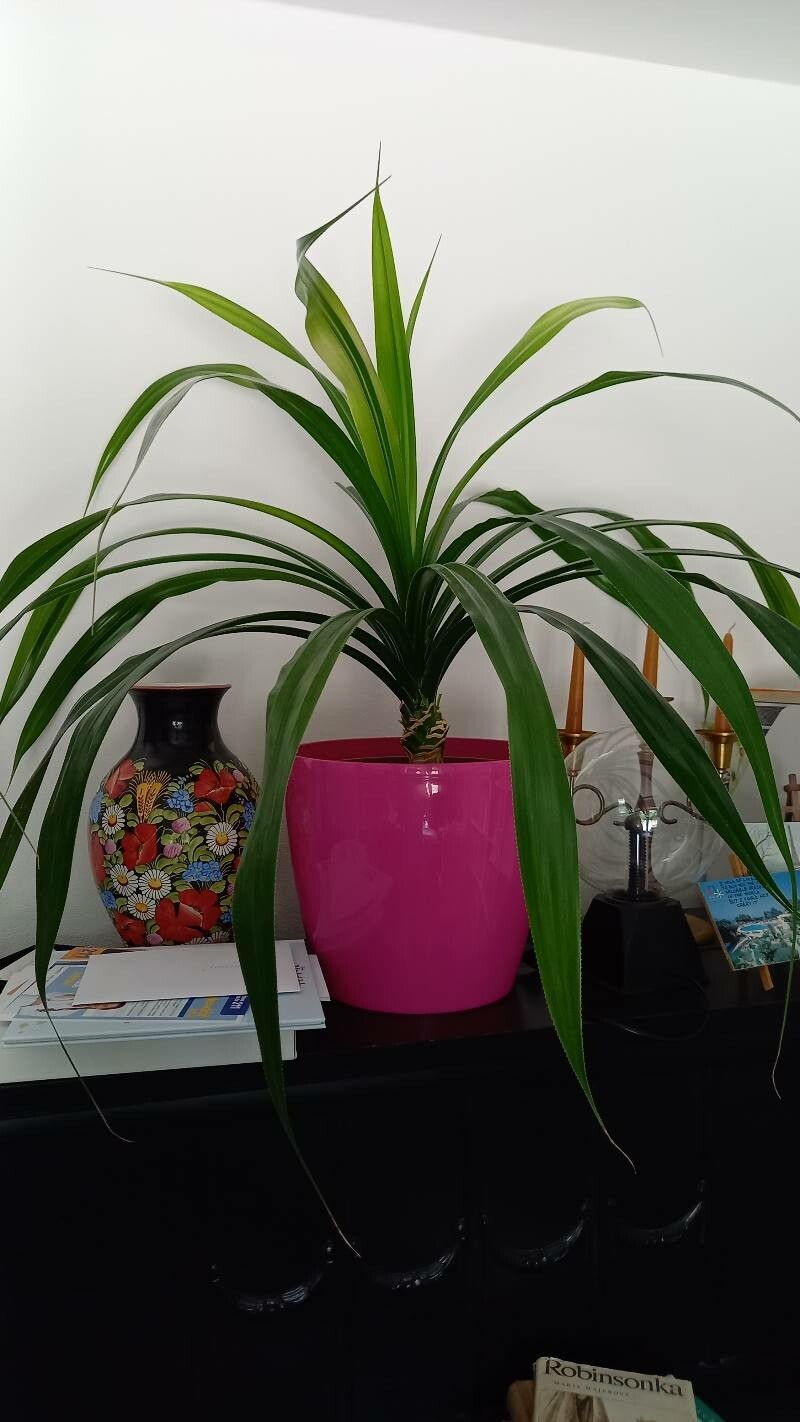
© photo
Wikimedia Commons · CC BY-SA or Public Domain
Taken Nov 22, 2022 by Prasanta Hembram (cc-by-sa)
© copyright of the Board of Trustees of the Royal Botanic Gardens, Kew.




Global distribution
The exact origin of Pandanus amaryllifolius remains uncertain. The Moluccas in Indonesia are the most often suggested location, based on rare male-flowering specimens. It is now cultivated across Southeast Asia and parts of South Asia, but no confirmed wild population has been documented.
- Native1
- Introduced2
- Indonesia (Moluccas)
- Southern India
- Réunion
Hexagons: regions where the plant occurs. Green dots: native range.1
Identity
Pandan (Pandanus amaryllifolius Roxb., 1832), or fragrant screwpine, belongs to Pandanus in the Pandanaceae. Unlike most cultivated species, it has never been confirmed in the wild. This ancient cultigen has passed from cutting to cutting for generations. Almost complete sterility prevents sexual reproduction in cultivation. A cutting set at an angle in moist growing medium develops its first roots in 3–6 weeks; plants are not raised from seed. 1 3
Rare male-flowering specimens from the Moluccas, Indonesia, underpin the most frequently proposed origin. Today the plant is cultivated across Southeast Asia, from Sri Lanka to the Philippines. Regional names include pandan wangi in Indonesia and Malaysia and dứa thơm in Vietnam. 3 5
Recognition
Fanlike sprays of strap-shaped leaves form a rosette, spiraling around a stem that becomes woody with age. Two growth forms are described: a slender-stemmed small form reaching 1–1.6 m (3–5 ft), and a thick-stemmed large form reaching 2–4.5 m (6.5–15 ft) with leaves up to 220 cm (7 ft) long. This difference helps distinguish a compact juvenile from a mature small-form plant. 3
Nearly spineless leaf edges distinguish Pandanus amaryllifolius from prickly ornamental screwpines. Only tiny rough projections less than 1 mm (0.04 in) long remain near the leaf tips, a feature that can be checked directly. 3
Crushing a leaf releases a clear fragrant-rice or vanilla-like scent from 2-acetyl-1-pyrroline, the same compound that scents basmati and jasmine rice. Among screwpines, this distinctive leaf aroma identifies the species: other members do not release a comparable smell when crushed. 3 5
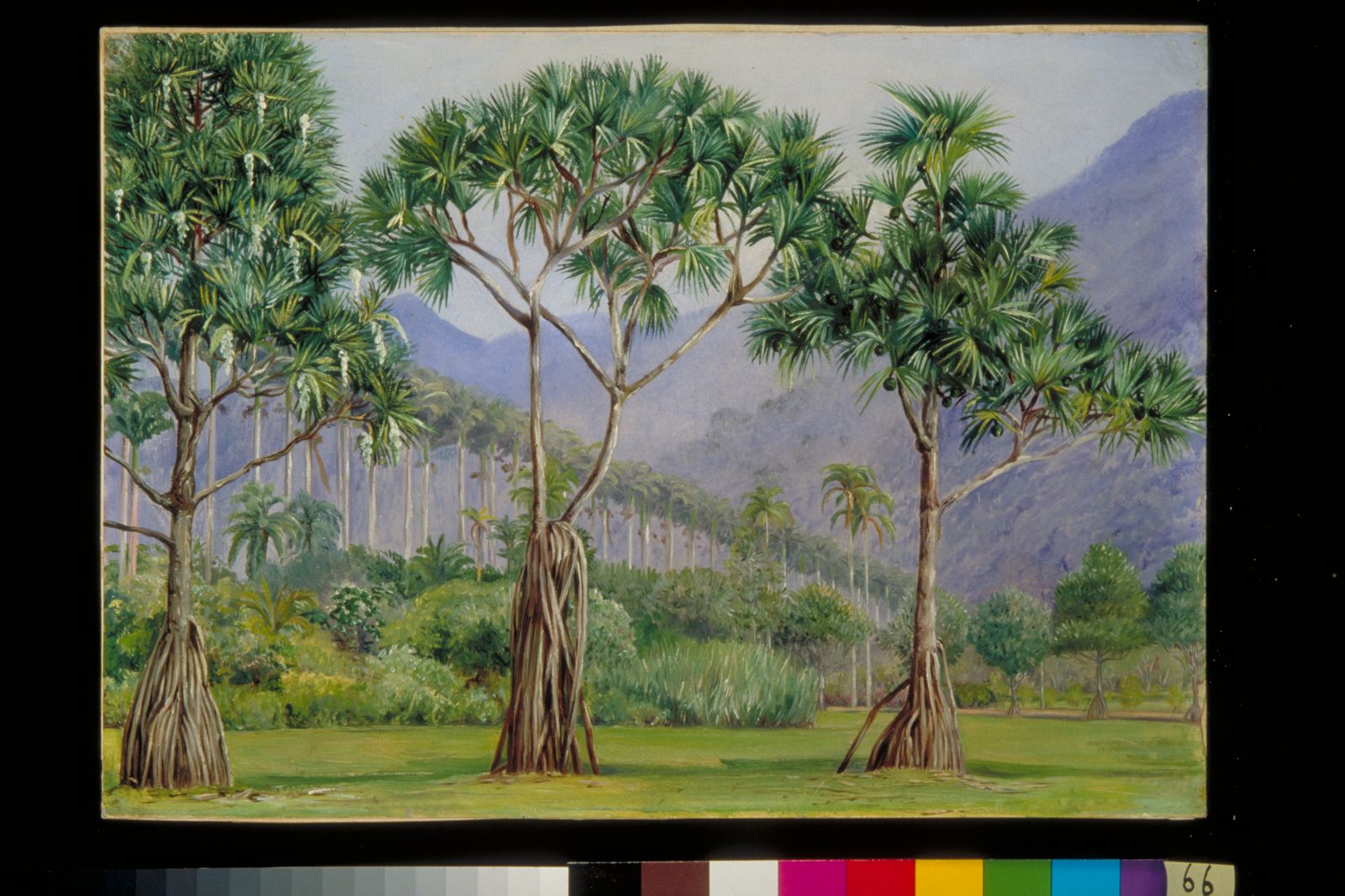
Established older plants develop woody prop roots at their base, anchoring them in a way reminiscent of mangroves. These roots appear mainly on aging specimens and are uncommon on young potted plants. 7
Useful taxonomy
Roxburgh’s name Pandanus amaryllifolius, published in 1832, is accepted for this aromatic plant. Several names were used before the synonymy was settled:
- Pandanus latifolius hort. ex Zipp. (botanical synonym)
- Pandanus hasskarlii Merr. (botanical synonym)
- Pandanus odorus Ridl. (botanical synonym)
Older horticultural and scientific works still use some of these synonyms. One species can consequently appear under different Latin names from one reference to another. 6 3
International taxonomic references recognize Pandanus amaryllifolius as the accepted name, with no currently recognized variety or subspecies. This binomial is the most reliable way to connect older names with the plant now cultivated as pandan. 1 2
Habitat and range
No identifiable natural stands are known. The plant occurs in mixed tropical gardens, light woodland understories and along rice fields or watercourses, always associated with other food or aromatic crops. 3
Cultivation centers on six countries: Sri Lanka, Thailand, Vietnam, Malaysia, Indonesia and the Philippines, each with its own vernacular name. Human migration later carried it to other tropical regions, including southern India and the Indian Ocean. There, vacoa is a broader name applied to several screwpine species. 3 7
Good shade tolerance suits pandan to woodland understories and field edges rather than constant full sun. It can therefore fit into home gardens already occupied by other crops. 4
Life cycle and reproduction
Almost total sterility shapes the life cycle of Pandanus amaryllifolius. Only rare male-flowering specimens have been reported, with no reliable fruiting documented in cultivation. In ordinary horticultural practice it yields neither viable seed nor a usable fruit crop. 5 3
Propagation is exclusively vegetative. A rooted basal offset can be separated, or a stem section inserted at an angle into moist growing medium. Rooting takes 3–6 weeks in either case. 4
Old wood needs care when pruning: pandan branches lack dormant buds and do not regrow when cut back into old stems. Regular harvesting of mature leaves is the way to maintain the plant without compromising its recovery. 4
Leaf harvesting can begin 6 months after planting and continue for years. Repeated harvesting maintains a low, clumping habit and prevents development of the small-palm silhouette an unharvested plant can acquire. 4 3
Uses and risks
Cooking is the principal use of pandan leaves. Fresh or dried leaves flavor and color rice, desserts, jellies and savory dishes such as leaf-wrapped chicken, kai ho bai toei. Green juice extracted from the foliage supplies a natural coloring for cakes and pastries. 5 7
Traditional preparations include calming leaf infusions, diabetes remedies in Thailand, and external applications for rheumatism and skin complaints. 4-hydroxybenzoate, identified in the leaves, lowers blood glucose in laboratory testing. This isolated finding does not replace medical advice for people. 4 3
Fragrance also supports use as a natural room or vehicle freshener and a reported repellent against American cockroaches. Leaves are woven into baskets or wrappers for desserts. No known toxicity risk is reported for people or domestic animals. 5 4
Varieties, look-alikes and related plants
Indoor horticulture mainly offers the green culinary form and Variegatus, with creamy-white stripes and an ornamental role; its scent is often weaker. Plants sold under the French horticultural label Petite forme, meaning small form, have stems no taller than 1.6 m (5 ft), compared with 4.5 m (15 ft) for the large form in tropical ground. 7
Ornamental screwpines, especially Pandanus veitchii and Pandanus utilis, cause the most confusion. They carry conspicuous spines on the leaf edges and lack a distinctive smell when crushed. Pandan has almost smooth edges and a recognizable fragrant-rice aroma. 3
In Réunion and elsewhere, the generic name vacoa includes several Pandanus species used for weaving or flavoring. It therefore does not refer exclusively to Pandanus amaryllifolius, explaining some naming confusion between French-speaking regions. 7 6
Main sources
- Plants of the World Online / Kew, Pandanus amaryllifolius Roxb.
- International Plant Names Index, Pandanus amaryllifolius Roxb.
- PROSEA via Pl@ntUse, Pandanus amaryllifolius
- Plants For A Future, Pandanus amaryllifolius
- Wikipedia (EN), Pandanus amaryllifolius
- Wikipedia (FR), Pandanus amaryllifolius
- Gerbeaud.com, Pandanus amaryllifolius, edible pandan
- USDA NPGS GRIN Taxonomy, Pandanus amaryllifolius
Frequently asked questions
Does pandan grow wild?
No confirmed wild population has been documented. Pandanus amaryllifolius is regarded as an ancient cultigen, probably from the Moluccas, maintained for centuries through cuttings and division of offsets.
Why does pandan never produce fruit?
It is essentially sterile. Only rare male-flowering specimens have been observed, and no reliable fruiting is reported in cultivation. Propagation is therefore exclusively vegetative.
Is pandan poisonous to pets?
No toxicity risk is documented for people or domestic animals. The leaves are widely used in Southeast Asia as a flavoring and natural coloring.
How can I tell pandan from ornamental screwpines?
Common ornamentals such as Pandanus veitchii and Pandanus utilis have conspicuous spines along the leaf edges and no distinctive scent. Pandanus amaryllifolius has almost smooth edges and a clear fragrant-rice smell when a leaf is crushed.
What gives pandan its scent?
The aroma comes mainly from 2-acetyl-1-pyrroline, also responsible for the fragrance of basmati and jasmine rice, present in notable concentrations in the leaves.
How do I grow pandan in a temperate climate?
Outside the tropics, grow it indoors in a pot near a bright window without direct sunlight. Keep the temperature above 15 °C (59 °F) and the growing medium constantly moist.
Similar plants

If you are unsure about a plant’s toxicity, ask a botanist or veterinarian for advice.