
Long pepper (Piper longum, )
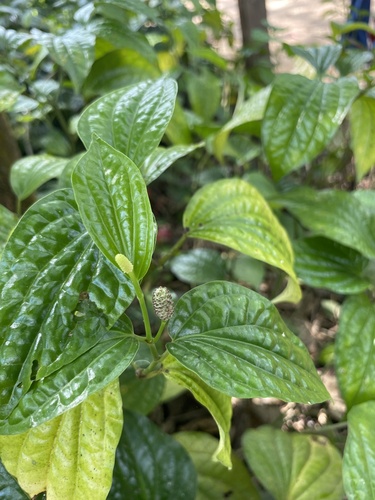


Long pepper (Piper longum) is a climbing vine or subshrub in the Piperaceae family, native to the eastern Himalayas, southern China and Indochina. Its dried fruit spike, more pungent than black pepper, and its fleshy root have been used since antiquity as a spice and in Ayurvedic medicine.
Read moreLong pepper, Indian long pepper and Pippali
Place in indirect light or in a shaded room.
Partial shade to filtered light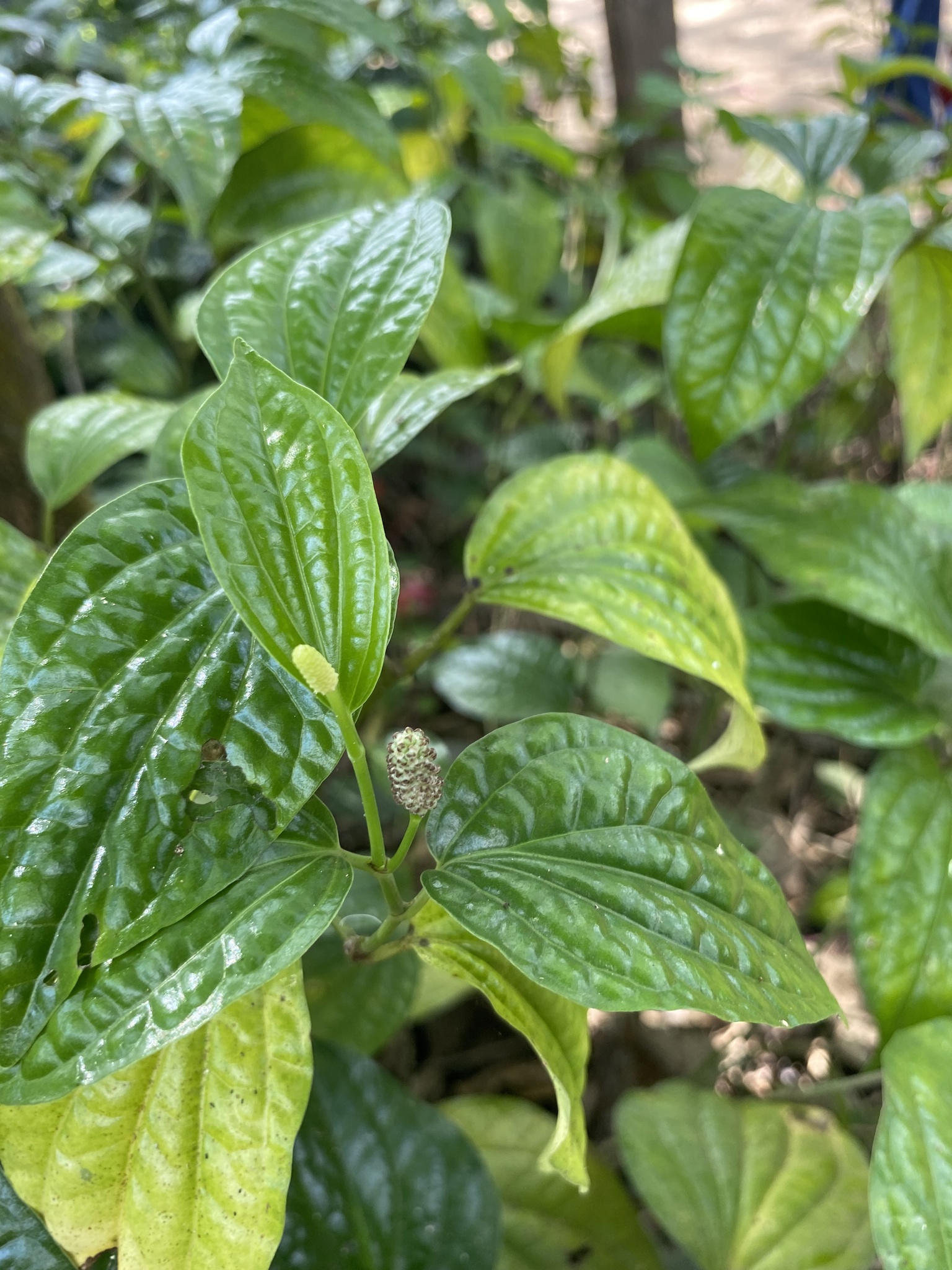


© photo
(c) kosala-abeykoon, some rights reserved (CC BY-NC) · cc-by-nc
Wikimedia Commons · CC BY-SA or Public Domain
Taken Sep 4, 1977 by Royal Botanic Garden Edinburgh - Bhaskar Adhikari (cc-by-nc)
Taken May 7, 1957 by Royal Botanic Garden Edinburgh - Ganga Datt Bhatt (cc-by-nc)
Taken Dec 4, 1966 by Royal Botanic Garden Edinburgh - Bhaskar Adhikari (cc-by-nc)
Taken Nov 24, 2022 by IMMORTAL_2209 (cc-by-sa)
© copyright of the Board of Trustees of the Royal Botanic Gardens, Kew.


Global distribution
POWO places the native range of Piper longum from the eastern Himalayas to southern China (southern Yunnan) and Indochina. It was later widely domesticated and cultivated in the Deccan peninsula of India, which remains the main center of commercial long pepper production.
- Native3
- Nepal
- China (Yunnan)
- Vietnam
Hexagons: regions where the plant occurs. Green dots: native range.1
Identity
An ancient spice with two harvested organs, Long pepper (Piper longum L., 1753) is a climbing vine or subshrub in the pepper family, Piperaceae. Its Sanskrit name, pippali, gave rise to the word for pepper through ancient Greek and then Latin piper. In most European languages, that inherited word eventually came to refer mainly to its relative Piper nigrum. 1 3
The dried fruit spike, called pippali, and the fleshy main root, called piplamul, are traded separately. Both have been used since antiquity as spice or traditional remedy, but their commercial grades follow separate systems. The distinction between root and fruit is therefore essential when interpreting product names. 7
Dozens of vernacular names in different languages refer to this same species. Despite their varied spellings, these names describe a single taxon, Piper longum, rather than a collection of different peppers. 8
Recognition
Knotted creeping stems, thickened at every node, rise from large, woody perennial roots. With suitable support, Piper longum climbs to 5 m (16 ft); alternatively, it spreads as a subshrub 50 cm–2 m (1.5–6.5 ft) tall. Its form thus depends on training and available support, unlike the consistently supported cultivated vines of Piper nigrum and Piper betle. 1 4
Alternate leaves lack stipules and have an elongated heart shape, reaching 15 cm (6 in) long. Tiny flowers without visible petals are unisexual and borne on separate plants. They form upright spikes measuring 2–3.5 cm (0.8–1.4 in) long. 4 5
A dense fruit spike resembles a hazel catkin rather than a cluster of separate peppercorns. Minute berries, each about the size of a poppy seed, are fused onto the surface of the spadix. Green when immature, they turn black as they dry. This whole spike differs clearly from the round, separate grains of black pepper. 3 6
Useful taxonomy
For this species, POWO accepts Piper longum L. in Piperaceae and the order Piperales. Several historical synonyms refer to the same plant rather than to distinct long peppers: 1
- Chavica longa (L.) H.Karst., a historical synonym
- Chavica roxburghii Miq., another synonym
- Piper roxburghii (Miq.) J.Presl, a synonymous name
The name Piper longum Blume, published in 1826, is considered misapplied and actually refers to another species in the genus. Older references therefore require attention to the author as well as the binomial. The reliable reference for Indian long pepper is Piper longum L., 1753, with its complete authority. 1 2
Habitat and distribution
From the eastern Himalayas through southern China, including southern Yunnan, to Indochina, the native range recorded by POWO covers humid tropical forest understory in lowlands and foothills. These habitats explain the plant's association with warmth, moisture and some shelter from direct light. 1 5
India's Deccan peninsula became an early center of domestication and remains the main commercial production region. Cultivation also occurs in Nepal, Sri Lanka, Malaysia and other parts of Southeast Asia, extending the crop beyond its native forest distribution. 3 4
Wild plants anchor themselves to tree trunks or grow in clearings according to available light. In cultivated plots in India and Nepal, the vine grows in rich, calcareous soil under partial shade. Support and light availability together influence whether its growth is climbing or spreading. 7
Life cycle and reproduction
Unisexual long pepper flowers grow on separate male and female plants, so natural pollination is needed for fruit spikes to form. The presence of vigorous foliage alone does not establish that a plant can produce a fruit harvest. 4
Following pollination, fruit spikes develop over several months, from summer flowering to an autumn or winter harvest in the Northern Hemisphere. Picked while still green, the spikes are sun-dried until they darken and harden. This resembles black pepper processing, but the entire spike is dried together instead of separate individual berries. 6 3
Cultivated plants are propagated by nodal stem cuttings or division of a root piece. Both methods establish roots within 3–4 weeks in a warm, moist medium. A cutting-grown plant generally produces its first fruit spikes after 2–3 years, so vegetative growth precedes the first spice harvest by a substantial interval. 7
Uses and risks
Medicine and cooking account for the principal uses of long pepper. In Ayurveda, Piper longum is an ingredient of Trikatu, a traditional preparation combining long pepper, black pepper and ginger. It appears in ancient texts such as the Caraka Samhita. The dried fruit contains piperine and piperlongumine, alkaloids associated with pungency and studied for pharmacological properties. 7
Long pepper reached Rome before black pepper and sold for as much as three times its price. Easier to cultivate on a large scale, black pepper gradually displaced it in Europe from the Middle Ages onward. This change left an ancient, once highly valued spice comparatively rare in modern commerce. 6 3
The cited sources do not classify this species as toxic to domestic animals, but contraceptive activity has been reported in animals for the fruit. Particular caution is therefore warranted during pregnancy and breastfeeding. Piperine can also alter the action of some medicines through effects on liver enzymes; traditional use does not remove the possibility of drug interactions. 7
Varieties and similar plants
Shared trade names can obscure the distinction between Indian and Javanese long pepper. Piper longum, associated with India and the eastern Himalayas, and Piper retrofractum, native to Java in Indonesia, are both sold as long pepper. They nevertheless remain separate botanical species. 6
Black pepper (Piper nigrum) has round, separate fruit rather than the dense spike of Piper longum, although both share piperine as a pungent compound. Sichuan pepper (Zanthoxylum, Rutaceae) and pink pepper (Schinus, Anacardiaceae) carry the same everyday word without belonging to Piper or sharing its chemistry. 1
Within Piper longum itself, the harvested pippali fruit spikes and piplamul roots are graded separately by thickness and regional origin. These commercial grades do not represent registered botanical varieties, even when their names resemble those of horticultural selections.
Main sources
- Plants of the World Online / Kew, Piper longum L.
- International Plant Names Index, Piper longum L.
- Wikipedia (EN), Piper longum (long pepper)
- Wikipedia (UK), Перець довгий
- GBIF, Piper longum L.
- Gernot Katzer's Spice Pages, Long Pepper (Piper longum/retrofractum)
- PMC, A census of P. longum's phytochemicals and their network pharmacological evaluation
- Wikidata, Piper longum (Q685336)
Frequently asked questions
Is long pepper stronger than black pepper?
Yes. Long pepper tastes more pungent and sweeter than black pepper, with a pronounced earthy note. This flavor profile favors using smaller quantities in cooking.
Are Indian long pepper and Java long pepper the same plant?
No. The trade often groups Piper longum, from India and the eastern Himalayas, and Piper retrofractum, from Java in Indonesia, under the same name, long pepper. They are distinct Piper species.
Which part of the plant is used?
The dried fruit spike, called pippali, is the main form sold as a spice and traditional remedy. The main root, called piplamul, is harvested and graded separately in Ayurvedic medicine according to its thickness.
Should long pepper be avoided during pregnancy?
Contraceptive activity has been reported in animals for Piper longum fruit. This calls for particular caution during pregnancy and breastfeeding because adequate human safety data are lacking.
Why did black pepper replace long pepper in Europe?
Long pepper reached Europe before black pepper and sold for more in Rome. Black pepper, easier to grow on a large scale and transport, gradually displaced it from the Middle Ages onward, leaving long pepper uncommon in modern trade.
Can long pepper be grown indoors?
In temperate climates it is best suited to a warm greenhouse or humid conservatory with temperatures consistently above 18 °C (64 °F). Fruiting in an ordinary indoor pot is rare because sufficient warmth is usually lacking.
Similar plants
If you are unsure about a plant’s toxicity, ask a botanist or veterinarian for advice.