
Kava (Piper methysticum, )


Kava (Piper methysticum G.Forst.) is a branching shrub in the Piperaceae family, cultivated throughout the western Pacific for roots used to make a traditional relaxing drink. It is a sterile cultivated plant propagated only from cuttings, and regular consumption is associated with a documented risk of liver injury in humans.
Read moreKava, Kava-kava, 'Awa, Yaqona and Sakau
Place in indirect light or in a shaded room.
Partial shade when young; established plants tolerate more sun


© photo
Wikimedia Commons · CC BY-SA or Public Domain




Global distribution
POWO places the native range of Piper methysticum from the Santa Cruz Islands in the Solomon Islands to Vanuatu. The plant was later domesticated and carried by early seafarers throughout the western Pacific, where it is now cultivated far beyond its strictly native range.
- Native2
- Introduced1
- Vanuatu
- Santa Cruz Islands (Solomon Islands)
- Hawaii
Hexagons: regions where the plant occurs. Green dots: native range.1
Identity
A root crop of the Pacific, Kava (Piper methysticum G.Forst., 1786) is a branching shrub in the pepper family, Piperaceae. Its root system can weigh up to 7 kg (15 lb) at maturity. Unlike the closely related wild Piper wichmannii, cultivated kava almost never produces viable seed. It is a sterile cultigen, multiplied exclusively by stem cuttings rather than seed. 1 5
The name comes from Tongan and Marquesan words meaning “bitter,” a reference to the taste of the root when prepared as a drink. Kava names both the living plant and the traditional root beverage, consumed throughout the western Pacific for its relaxing effects. This shared name reflects how closely the crop and its preparation are connected. 1 7
Recognition
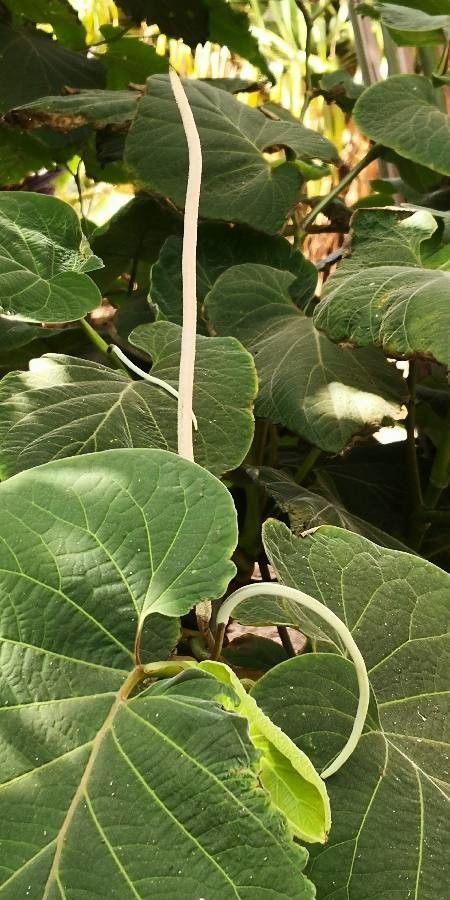
Several stems emerge from a thick, woody rhizome to form a branching shrub, commonly 2 m (6.5 ft) tall and sometimes reaching 4 m (13 ft) in vigorous plants. Each stem measures 1–3 cm (0.4–1.2 in) in diameter. Knotted aerial roots appear at the nodes, a feature shared with many other Piper species rather than one unique to kava. 5 7
Large, alternate, heart-shaped leaves resemble those of many other members of the genus. The harvested root system has two recognizable parts: broad crown roots, cut into pieces likened to wooden counters, and finer lateral roots. Although narrower than the crown roots, the lateral roots contain more kavalactones. 7
Flowers and fruit rarely appear on cultivated kava, unlike many other cultivated peppers. Their almost consistent absence can help confirm the identity of an already developed shrub, alongside its branching form and leaf shape. A large leafy plant may therefore be mature without carrying the flowers or berries expected on other peppers. 5
Useful taxonomy
Forster's name Piper methysticum G.Forst., published in 1786, is the accepted name in Piperaceae. WCVP also records Piper methysticum L.f., 1782, as an invalid name, distinct from Forster's valid publication. The author and publication date distinguish these otherwise identical-looking names. 1
Its close relative Piper wichmannii C.DC. is regarded as the wild ancestor and retained by POWO as a separately accepted species. Analytical chemistry studies have described the two taxa as conspecific. This relationship explains why Piper methysticum var. wichmannii appears among the synonyms of Piper wichmannii, rather than under cultivated kava. 2 6
That close relationship can complicate field identification. A similar-looking wild plant may be fertile, chemically different Piper wichmannii, rather than cultivated kava itself. Appearance alone should not erase the distinction between the domesticated crop and its wild relative. 2
Habitat and distribution
The Santa Cruz Islands in the Solomon Islands and Vanuatu mark the native range described by POWO. This is a relatively restricted area for a plant now cultivated across the western Pacific, and its present crop distribution should be distinguished from that original range. 1
Following domestication, early seafarers spread kava throughout the western Pacific. Cultivation became established in Hawaii, the Federated States of Micronesia, Fiji, Samoa and Tonga, among other islands. The crop's broad cultural geography thus reflects human movement as well as suitable tropical growing conditions. 7
Moist places, often near streams, support Piper methysticum from sea level to 800 m (2,600 ft) on stony, well-drained soil. Young plants favor shade. Established shrubs tolerate more sunshine without requiring it, so the amount of sun a plant accepts changes as it develops. 5
Life cycle and reproduction
Nodal stem cuttings maintain cultivated kava from one generation to the next. As a sterile cultigen, it depends exclusively on this vegetative propagation in cultivation. Sexual reproduction through seed remains exceptional, in contrast with its still-fertile wild ancestor Piper wichmannii. 7 6
Harvest maturity varies greatly by cultivar. Noble varieties require up to 5 years before the roots are fully usable, compared with around 1 year for non-noble or tudei varieties. At maturity, the roots of the oldest plants can weigh as much as 7 kg (15 lb). Faster harvest therefore does not imply that the cultivars have equivalent chemical profiles. 7 5
Uses and risks
Traditional preparation begins by pounding or grating fresh or dried roots. The material is mixed with water or coconut milk and strained through cloth to produce the beverage. Both root preparation and filtration belong to this customary method; the harvested root is not simply used as a pepper-like seasoning. 5 4
Kavalactones are the principal active compounds. Of 18 identified molecules, six account for about 96% of the pharmacological activity: kavain, dihydrokavain, methysticin, dihydromethysticin, yangonin and desmethoxyyangonin. These compounds are associated with relaxation and numbness in the mouth. Clinical trials have studied daily doses of 105–210 mg over several weeks; these are research quantities, not a general consumption recommendation. 7 4
Liver injury is the best-documented serious risk. Medical literature records 50–100 clinically confirmed cases, with fatigue, nausea and jaundice developing 2–24 weeks after consumption began; some were severe or fatal. This risk led Germany, Switzerland and Canada to restrict or prohibit kava sales before some measures were partly relaxed. Regulations depend on jurisdiction, so this history does not establish its current legal status everywhere. 4 3
Prolonged heavy consumption is also associated with a reversible skin disorder affecting the legs. This dermatosis improves when consumption is reduced, adding a distinct long-term effect to the better-known concern about the liver. 3
Varieties and similar plants
Hundreds of traditional kava cultivars fall into two broad chemical categories. Noble cultivars, including Melomelo in Vanuatu and Isa and Mahakea in Hawaii, have a kavalactone profile considered more favorable than that of tudei types, with fewer reported side effects. Cultivar identity therefore matters beyond differences in plant appearance. 7 6
Tudei, or non-noble, cultivars mature in around 1 year, compared with up to 5 years for noble cultivars. They contain higher concentrations of flavokavains, compounds associated with the documented liver risk in humans. The shorter production cycle is thus accompanied by an important chemical distinction. 7 4
Two close plants cause particular confusion: Piper wichmannii, kava's fertile wild ancestor, and Piper excelsum, New Zealand kawakawa, which lacks psychoactive properties despite its similar common name. The large genus Piper also includes Piper nigrum, black pepper, cultivated for a culinary use quite different from that of kava. 7
Main sources
- Plants of the World Online / Kew, Piper methysticum G.Forst.
- Plants of the World Online / Kew, Piper wichmannii C.DC.
- National Center for Complementary and Integrative Health, Kava
- NCBI Bookshelf, Kava Kava (LiverTox clinical overview)
- Useful Tropical Plants Database, Piper methysticum
- Wang et al. 2013, Journal of Food Science and Technology, kavalactone content of Isa and Mahakea kava varieties
- Wikipedia, Kava
Frequently asked questions
Is kava the same plant as black pepper?
No. Kava (Piper methysticum) and black pepper (Piper nigrum) belong to the same genus, Piper, but are different species grown for different purposes: roots for kava and dried fruit for black pepper.
Does kava produce seeds?
Almost never in cultivation. Kava is a sterile cultivated plant propagated exclusively by nodal stem cuttings over generations, unlike its fertile wild ancestor Piper wichmannii.
Is kava toxic?
Available data report it as non-toxic to cats and dogs. In humans, regular consumption of root preparations is associated with a documented risk of liver injury, sometimes severe.
What is the difference between noble and tudei kava?
Noble cultivars have a more favorable kavalactone profile and fewer reported side effects. Tudei, or non-noble, cultivars mature faster but contain more flavokavains, associated with a more documented liver risk.
Where does kava come from?
Its native range runs from the Santa Cruz Islands in the Solomon Islands to Vanuatu. Domesticated locally around 3,000 years ago, it was later carried throughout the Pacific by early seafarers.
Is kava legal?
Its status varies by country. Several countries restricted or prohibited sales because of documented liver risks, before some restrictions were partly relaxed. The applicable rules therefore depend on the local jurisdiction.
How can a growing kava plant be recognized?
A branching shrub with large heart-shaped leaves, knotted aerial roots and an almost complete absence of flowers or fruit distinguishes kava from other garden-grown Piper species.
Similar plants
If you are unsure about a plant’s toxicity, ask a botanist or veterinarian for advice.