
Tea (Camellia sinensis, )
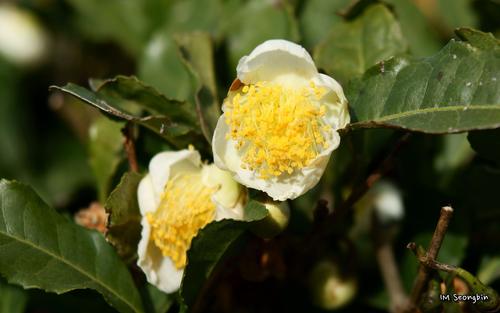
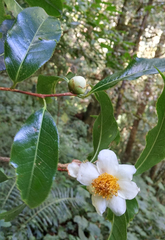

Tea (Camellia sinensis) is an evergreen shrub or small tree in the Theaceae whose young leaves and buds produce white, green, oolong and black teas. It grows in acidic to neutral soil and differs from ornamental camellias and the unrelated plants used for herbal infusions.
Read moreTea, Tea plant, Tea camellia, Tea tree camellia, Black tea and Green tea
Give plenty of ambient light without direct sun on the leaves.
Partial shade to gentle sun


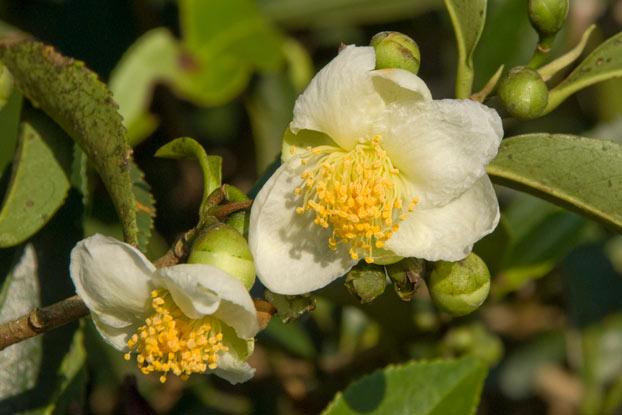
© photo
(c) Seongbin Im, some rights reserved (CC BY-NC-SA) · cc-by-nc-sa
Kristof Zyskowski · cc-by
Wikimedia Commons · CC BY-SA or Public Domain
Taken Jan 14, 2017 by Anziz AHMED ABDOU (cc-by-sa)
Taken Nov 17, 2014 by Tela Botanica − Liliane Roubaudi (cc-by-sa)
© copyright of the Board of Trustees of the Royal Botanic Gardens, Kew.


Global distribution
POWO/WCVP recognizes a native range from the eastern Himalayas to southern China and northern Indochina, including Hainan. Cultivation and introductions extend much farther; no French invasive status is reported.
- Native8
- Introduced2
- Assam
- Eastern Himalayas
- Southern China
- Hainan
- Laos
- Myanmar
- Thailand
- Vietnam
- Sri Lanka
- Réunion
Hexagons: regions where the plant occurs. Green dots: native range.1
Identity
Tea (Camellia sinensis (L.) Kuntze, 1881) is an accepted species in the Theaceae, within the order Ericales. POWO/WCVP recognizes Kuntze’s combination, published in 1881, as the accepted name. Its historical basionym, Thea sinensis L., dates to 1753 and explains why the older genus name still appears in botanical literature. 1 2
English names include Tea plant, Tea camellia and Tea tree camellia. The familiar word tea can refer to the living plant or the drink made from it. A full scientific name is especially useful on plant labels because similar commercial names may refer to unrelated plants or to herbal infusions rather than Camellia sinensis. 3 4
True white, green, oolong and black teas all come from this species. Their differences reflect the variety, climate, harvest and processing. Mint, vervain or rooibos infusions are herbal teas in everyday English, but they do not come from the tea plant. The distinction is botanical even when the drinks are prepared in similar ways. 5
Recognition
Pruning often conceals the natural stature of this slow-growing evergreen shrub or small tree. RHS describes a large upright shrub, while Missouri Botanical Garden gives a common height of approximately 3–4.5 m (10–15 ft). It can be maintained as a much lower hedge, so a short plantation bush and a taller garden specimen may belong to the same species. 4 6
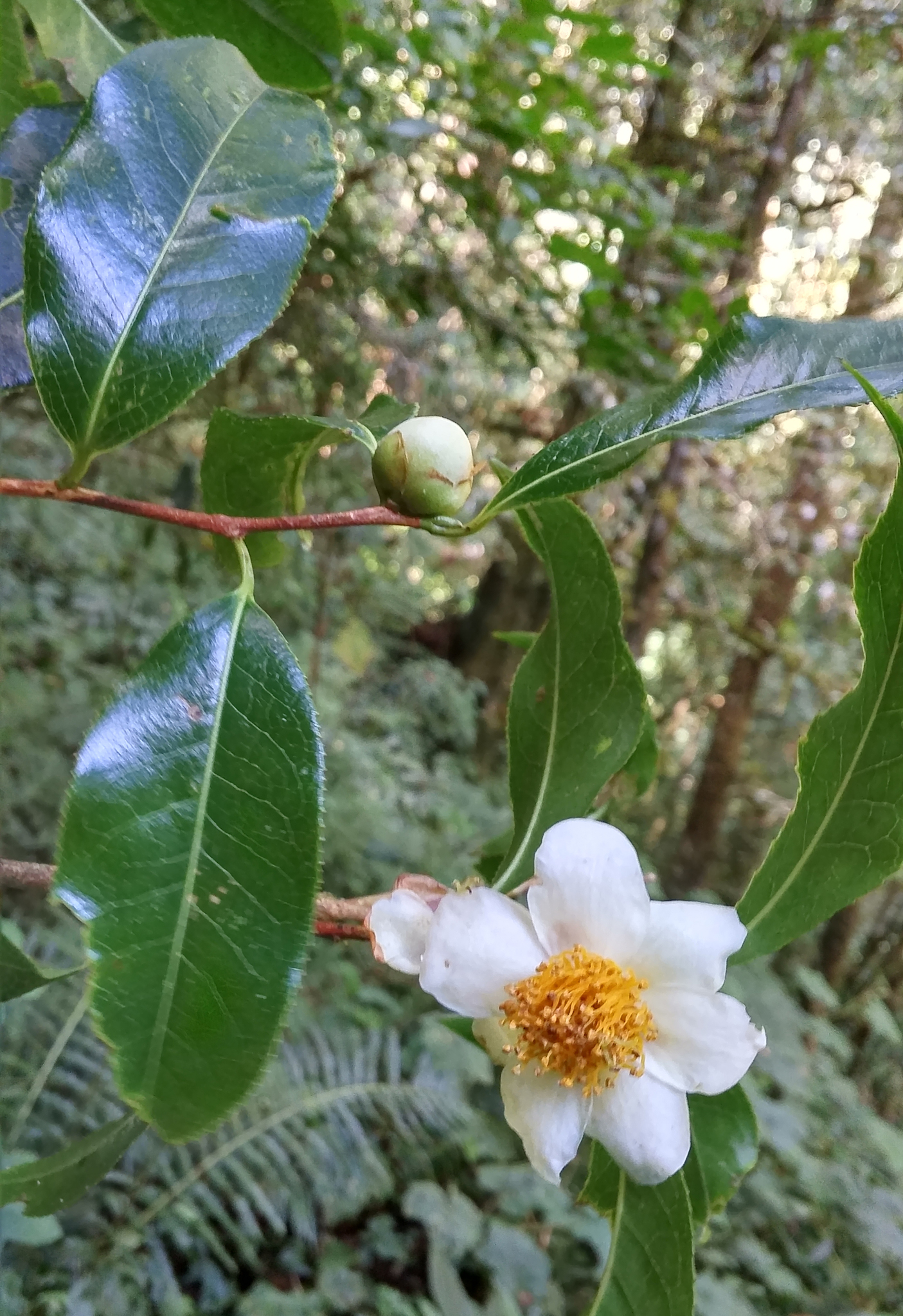
Alternate, simple leaves are dark green, glossy and elliptical to lance-shaped, with toothed margins. NC State notes that young leaves may be slightly hairy before becoming hairless. This growth-stage distinction matters because young shoots and buds provide most of the material harvested for tea, rather than the older, tougher leaves. 5 6
Small flowers make a quieter display than those of many ornamental camellias. They are white, fragrant and single, with numerous yellow stamens, appearing in autumn or early winter under the cited growing conditions. The fruit is a green capsule that turns brown, often with three lobes, and eventually opens when ripe. 4 5
Useful taxonomy
Historical names listed by POWO include two important homotypic synonyms: Thea sinensis L. and Camellia thea Link. They can appear in older publications, horticultural lists and secondary databases. The modern reference remains Camellia sinensis (L.) Kuntze, so a change of name in an old text does not automatically mean a different plant. 1 3
Infraspecific varieties require careful interpretation. POWO accepts var. sinensis, var. assamica, var. dehungensis, var. pubilimba and var. madoensis. NC State highlights the two most familiar cultivated forms: the smaller-leaved Chinese var. sinensis, with greater cold tolerance, and the larger-leaved var. assamica, associated with Assam. These names describe botanical variation within the species. 1 5
“Camellia” alone therefore provides insufficient identification. Camellia japonica and Camellia sasanqua belong to the same genus but are cultivated chiefly for their larger ornamental flowers. Tea is identified by the combined evidence of its leaves, small white flowers and use as a harvested crop, rather than by the genus name alone. 5 4
Habitat and range
From the eastern Himalayas through southern China to northern Indochina, POWO/WCVP recognizes a native range that includes Hainan. Trefle details Assam, southern China, the eastern Himalayas, Laos, Myanmar, Thailand and Vietnam, and also records many introductions associated with cultivation. These introduced populations should be distinguished from the native range. 1 3
Horticultural references agree on rich, organic soil that is acidic to neutral, moist but well drained, with shelter and filtered light to gentle sun. RHS emphasizes fertile, moist, well-drained soil. NC State also allows full sun where heat and water supply remain manageable. Advice about sun exposure therefore depends on local growing conditions. 4 5
Widespread cultivation in tea-producing countries does not create a worldwide native range. For mainland France, the consulted records support localized ornamental or agricultural cultivation rather than a published invasive status. That French assessment is a territorial example and cannot determine the plant’s regulatory position in every English-speaking country. 1 7
Life cycle, harvest and cultivation
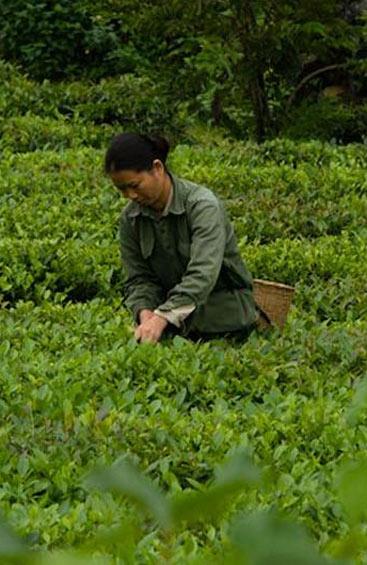
Management changes the visible life cycle. Left untrimmed, tea becomes an evergreen shrub that flowers and fruits; as a crop, it is kept low to produce accessible shoots. RHS notes that commercial plants are often pruned to about 1.2 m (4 ft) to make picking easier. Plant height in cultivation thus reflects repeated management as well as natural growth. 4
NC State describes harvesting as new leaves emerge, beginning in early spring in its Northern Hemisphere context. Different processing produces white, green, oolong or black tea. This describes the crop rather than a complete food-preparation method: correct identification, freedom from unsuitable treatments and appropriate processing remain necessary before consumption. 5
Fresh seed, semi-ripe or hardwood cuttings, and layering are propagation options in the horticultural sources. Seed-grown plants may vary, whereas cuttings and layering better retain the characteristics of a selected parent. The choice matters when the aim is to preserve a particular plant’s features rather than raise a variable group of seedlings. 4 7
Uses and risks
Leaves and buds dried for tea provide the main documented food use. NC State mentions both leaves and buds, while RHS confirms that black and green teas come from this plant. NC State also records fragrant flowers as a source of edible oil, but this does not provide a preparation recommendation for garden-harvested flowers. 5 4
Caffeine is the main reason for caution. FDA identifies coffee, tea and chocolate as common sources, emphasizes wide differences in sensitivity, and cites 400 mg a day as an adult reference amount generally not associated with negative effects. That figure does not replace individual medical advice during pregnancy, for children, when taking medicines or when caffeine sensitivity is a concern. 8
For animals, calling the plant harmless overlooks methylxanthines such as caffeine. ASPCA lists vomiting, diarrhea, thirst, agitation, abnormal heart rhythm, tremors and seizures among effects associated with chocolate, coffee and caffeine. Pet Poison Helpline also identifies tea, tea bags and caffeinated supplements as potential sources of exposure. 9 10
Tea does not share the same irritation mechanism as an oxalate-containing aroid, and it is not universally unsuitable for human consumption. Nevertheless, leaves and caffeinated drinks must not be offered to animals. Veterinary advice is needed if an animal ingests a substantial amount of leaves, tea bags or a concentrated caffeinated drink. 10 11
Varieties, look-alikes and related plants
The two most useful horticultural reference points are var. sinensis and var. assamica. The former is often described as more compact and more cold tolerant; the latter is larger and associated with Assam teas. Other POWO-accepted varieties have a botanical identity, but that alone does not support specific claims about flavor or hardiness without cultivation evidence. 1 5
Japanese camellia, Camellia japonica, is easily confused with tea because both have evergreen foliage, favor acidic soil and belong to the same genus. Their principal uses differ: large ornamental flowers for Japanese camellia and young harvested shoots for C. sinensis. Leaves of an ornamental camellia must not be treated as tea leaves simply because the plants are related. 5
Common-name confusion extends beyond camellias. “Tea tree” and similar labels may refer to different commercial products or unrelated plants, depending on the country and retail context. The complete scientific name, Camellia sinensis, identifies the plant used for true tea more reliably than an abbreviated sales name. 4 3
Main sources
- Plants of the World Online / Kew, Camellia sinensis (L.) Kuntze
- WCVP / Plants of the World Online, Camellia sinensis
- Trefle, species data, Camellia sinensis
- Royal Horticultural Society, Camellia sinensis
- NC State Extension Gardener Plant Toolbox, Camellia sinensis
- Missouri Botanical Garden Plant Finder, Camellia sinensis
- Perenual, horticultural traits, Camellia sinensis
- U.S. FDA, Spilling the Beans: How Much Caffeine is Too Much?
- ASPCA, People Foods to Avoid Feeding Your Pets: Chocolate, Coffee and Caffeine
- Pet Poison Helpline, Caffeine
- Merck Veterinary Manual, methylxanthine toxicosis context
Frequently asked questions
Does one plant produce all types of tea?
Camellia sinensis produces true white, green, oolong, black and dark teas, depending on harvest and processing. Herbal infusions made from other plants do not come from tea.
Is Camellia sinensis an ornamental camellia?
It is botanically a camellia, but it is not Japanese camellia. Camellia japonica is grown mainly for ornamental flowers; C. sinensis is the plant used for tea.
Are tea leaves edible?
Young leaves and buds provide the raw material for tea. Food harvesting requires reliable identification, untreated plants and appropriate processing.
Is tea dangerous to cats and dogs?
Its risk is not the oxalate irritation associated with some ornamental plants, but the caffeine in its leaves and infusions. Keep tea bags, quantities of leaves and caffeinated drinks away from animals.
What is the difference between var. sinensis and var. assamica?
NC State describes var. sinensis as a small-leaved Chinese form with greater cold tolerance, and var. assamica as a large-leaved form associated with Assam.
Can tea be grown in France?
Yes, in mild, sheltered conditions with acidic, moist soil, often in a container or favorable microclimate. The consulted sources do not establish a French invasive status; growing conditions vary elsewhere.
Similar plants
If you are unsure about a plant’s toxicity, ask a botanist or veterinarian for advice.