
Japanese pittosporum (Pittosporum tobira, )
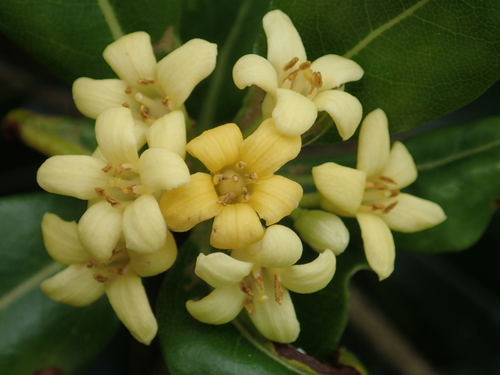
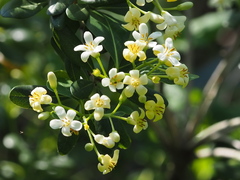
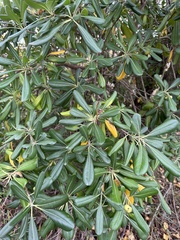
Japanese pittosporum (Pittosporum tobira) is an evergreen shrub in the Pittosporaceae family, native to southern Korea and central and southern Japan. Grown worldwide for glossy leaves clustered in rosettes and spring flowers scented like orange blossom, it tolerates coastal salt spray and drought once established.
Read moreJapanese pittosporum, Japanese mock orange, Australian laurel and Japanese cheesewood
Allow a few hours of direct sun per day, preferably morning or evening.
Full sun to light partial shade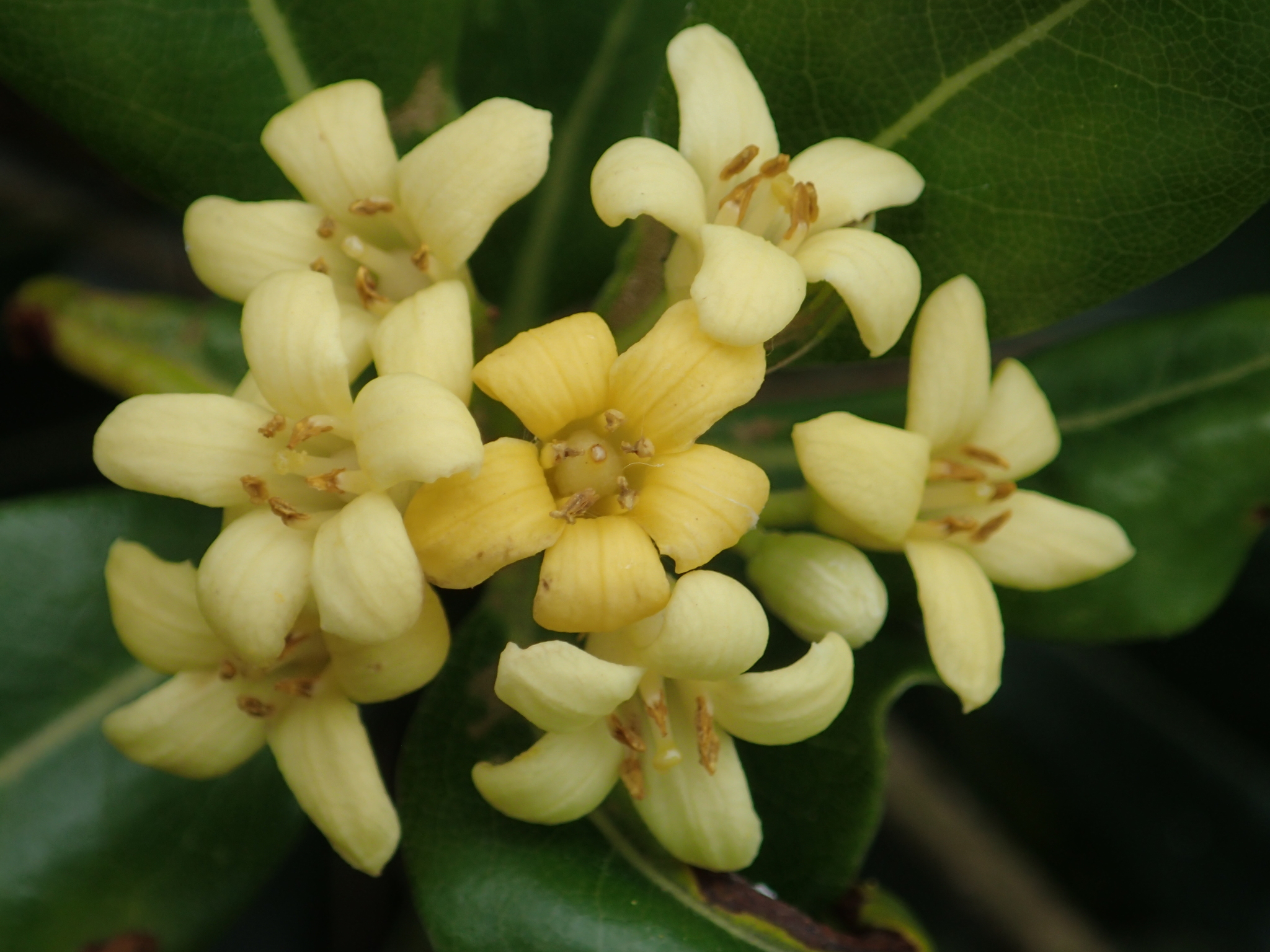


© photo
no rights reserved, uploaded by 葉子 · cc0
葉子 · cc0
Katrin Simon · cc-by
Taken Jul 17, 2019 by pierquetout (cc-by-sa)
Taken Apr 13, 2020 by Michele (cc-by-sa)
Taken Nov 8, 2019 by PNX Vanesita (cc-by-sa)
Taken May 6, 2021 by Thierry LE COM (cc-by-sa)
Taken Apr 17, 2017 by papaloux (cc-by-sa)
© copyright of the Board of Trustees of the Royal Botanic Gardens, Kew.




Global distribution
Plants of the World Online gives the strict native range of Pittosporum tobira as southern Korea and central-southern Japan, extending to the Nansei (Ryukyu) Islands. Many horticultural references and Wikipedia include southern China (Fujian) and Taiwan, where related populations are sometimes treated as separate varieties. Elsewhere it is mainly grown as an ornamental shrub and coastal hedge.
- Native4
- Introduced1
- Japan
- South Korea
- Southern China
- Taiwan
- Southeastern United States
Hexagons: regions where the plant occurs. Green dots: native range.1
Identity
Japanese pittosporum (Pittosporum tobira (Thunb.) W.T.Aiton, 1811), also called Japanese mock orange, is an evergreen shrub in the Pittosporaceae family. Tight rosettes of leaves at the branch tips identify it year-round, well before its brief spring flowering. Carl Peter Thunberg first described it as Euonymus tobira in 1780; William Townsend Aiton transferred it to Pittosporum in his Hortus Kewensis in 1811. 1 7
Mock orange refers to the sweet orange-blossom fragrance, although the plant does not belong to the citrus family, Rutaceae. Other established names include Australian laurel and Japanese cheesewood. The genus name combines Greek pitta, pitch, and sporos, seed, referring to the sticky resin surrounding the seeds; tobira derives from the Japanese tobera. 8 7
Recognition
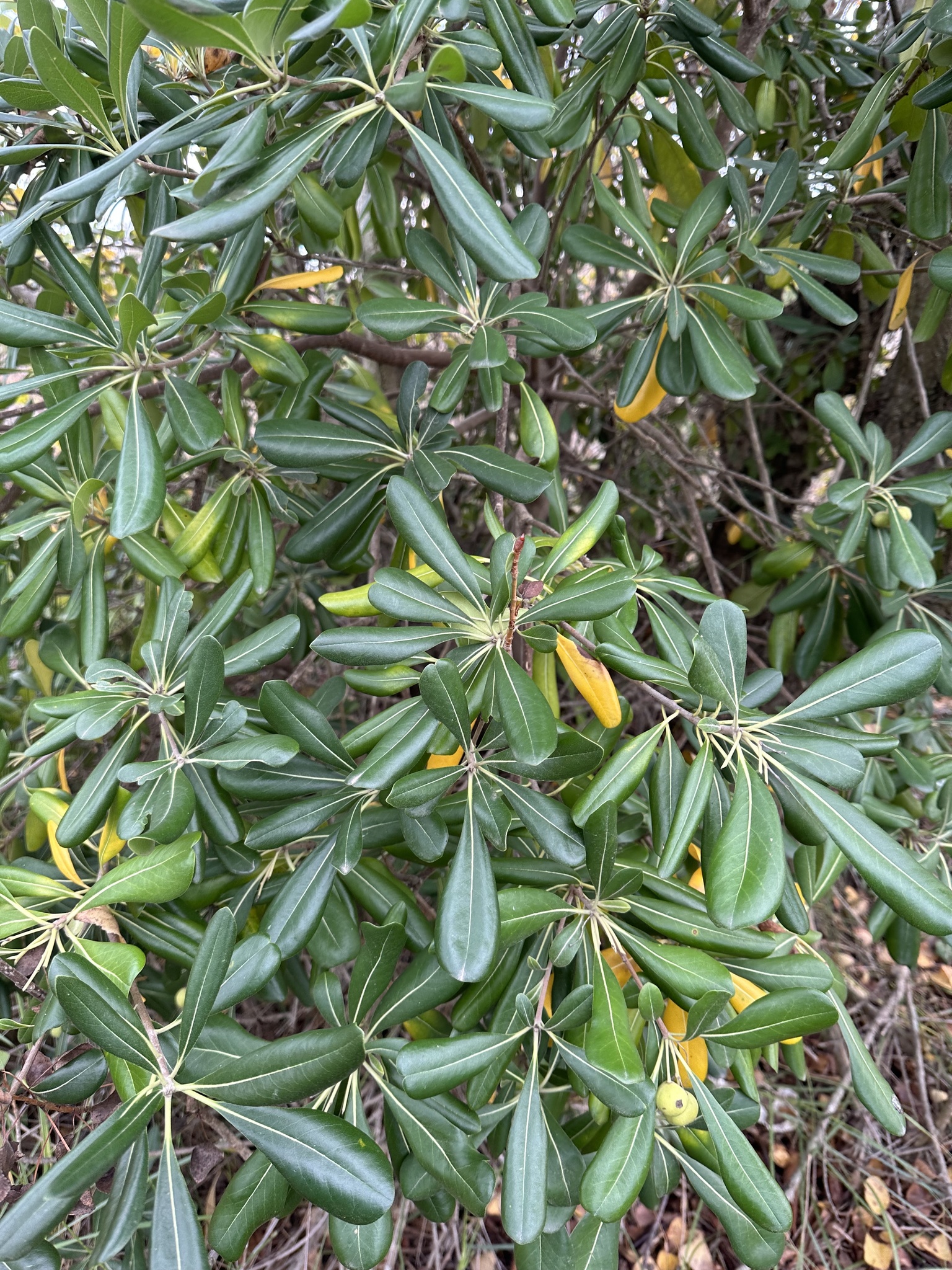
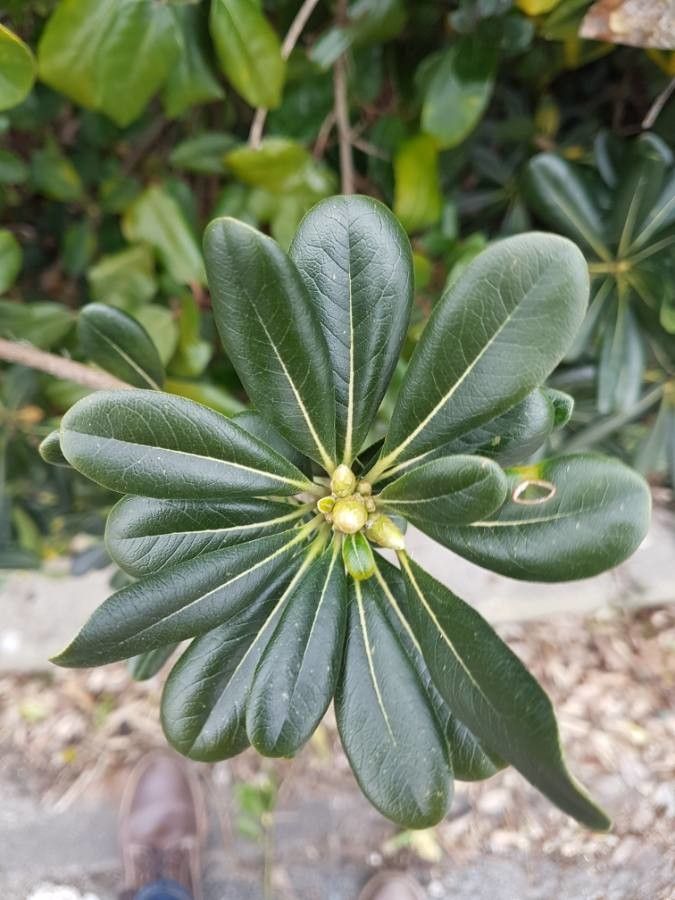
Tight clusters of evergreen, leathery, glossy leaves remain at the branch tips throughout the year, while flowers and fruits offer shorter-lived clues. Obovate to spoon-shaped leaves measure 4–10 cm (1.6–4 in) long, often with slightly rolled edges and darker, shinier upper surfaces. 3 7
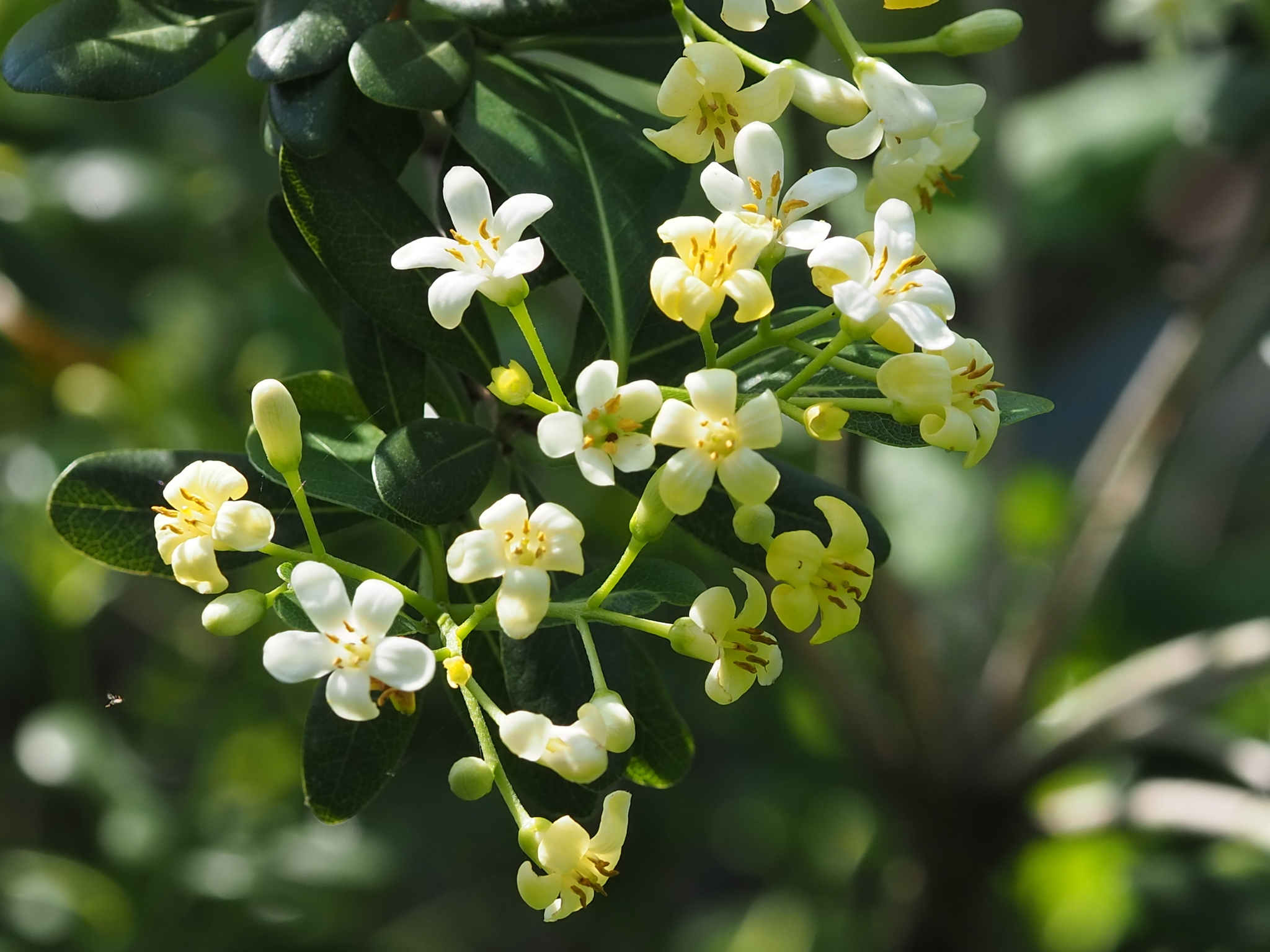
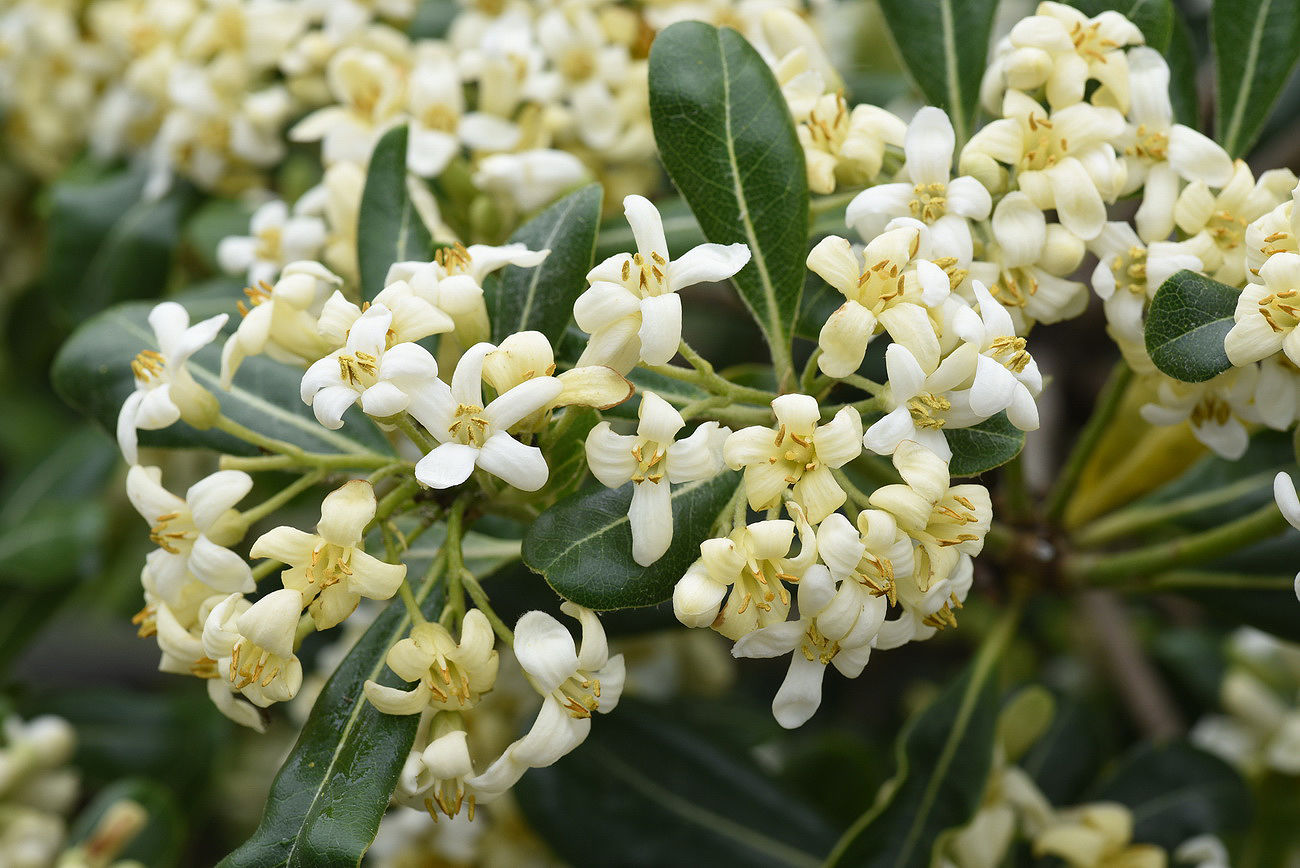
Small fragrant flower clusters open at the branch tips, turning from white to cream and yellow with age. Each flower has five petals about 1 cm (0.4 in) long. Their sweet orange-blossom scent can travel several meters during spring flowering. 2 3
A three-sided capsule turns from green to brown and splits into three valves, exposing sticky orange to red seeds. In cultivation, shrubs rarely exceed 2.5–4 m (8–13 ft), whereas plants in native forests may reach 10 m (33 ft) and develop a small-tree form. 7 4
Useful taxonomy
Within Pittosporaceae, the accepted species is Pittosporum tobira (Thunb.) W.T.Aiton. Several associated names and varieties occur in botanical literature and horticulture:
- Euonymus tobira Thunb., the basionym published by Thunberg in 1780;
- Pittosporum tobira var. calvescens Ohwi, a separately accepted variety endemic to northern Taiwan;
- Pittosporum tobira var. chinense S.Kobay., a synonym assigned to the typical variety;
- Pittosporum tobira var. sukuraii Gowda, a synonym associated with another subsidiary population.
More than 200 species belong to Pittosporum, with Pittosporum japonicum and Pittosporum glabratum among its close phylogenetic relatives. The full scientific name, Pittosporum tobira, provides the clearest buying reference and separates this shrub from taller members of the genus. 1 7
Habitat and range
Southern Korea and central-southern Japan form the strict native range given by Plants of the World Online, extending to the Nansei (Ryukyu) Islands and including southern Honshu, Kyushu and Shikoku. Many horticultural references also include southern China (Fujian) and Taiwan, where related populations may be treated as separate varieties rather than part of the typical species' range. 1 7
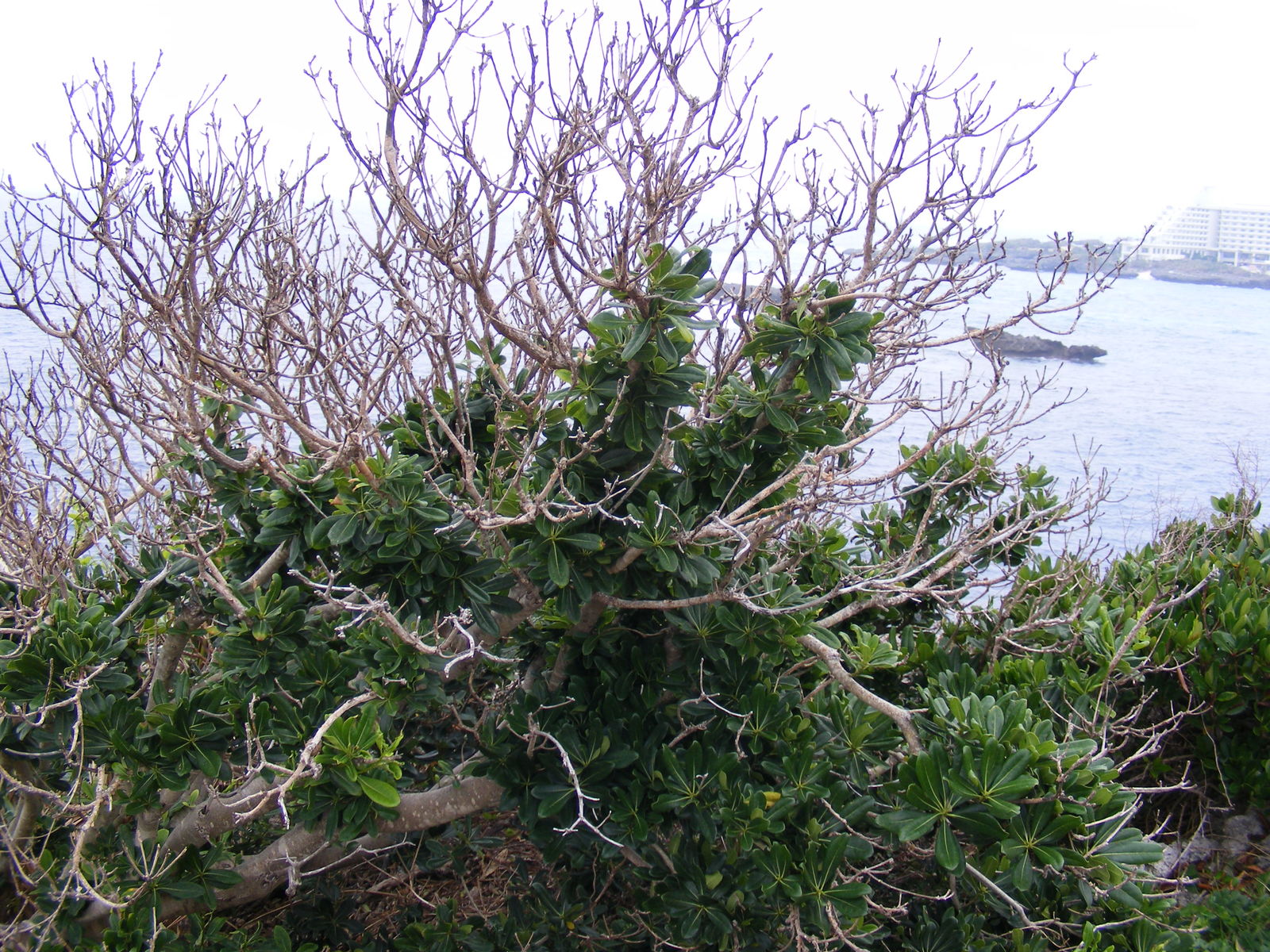
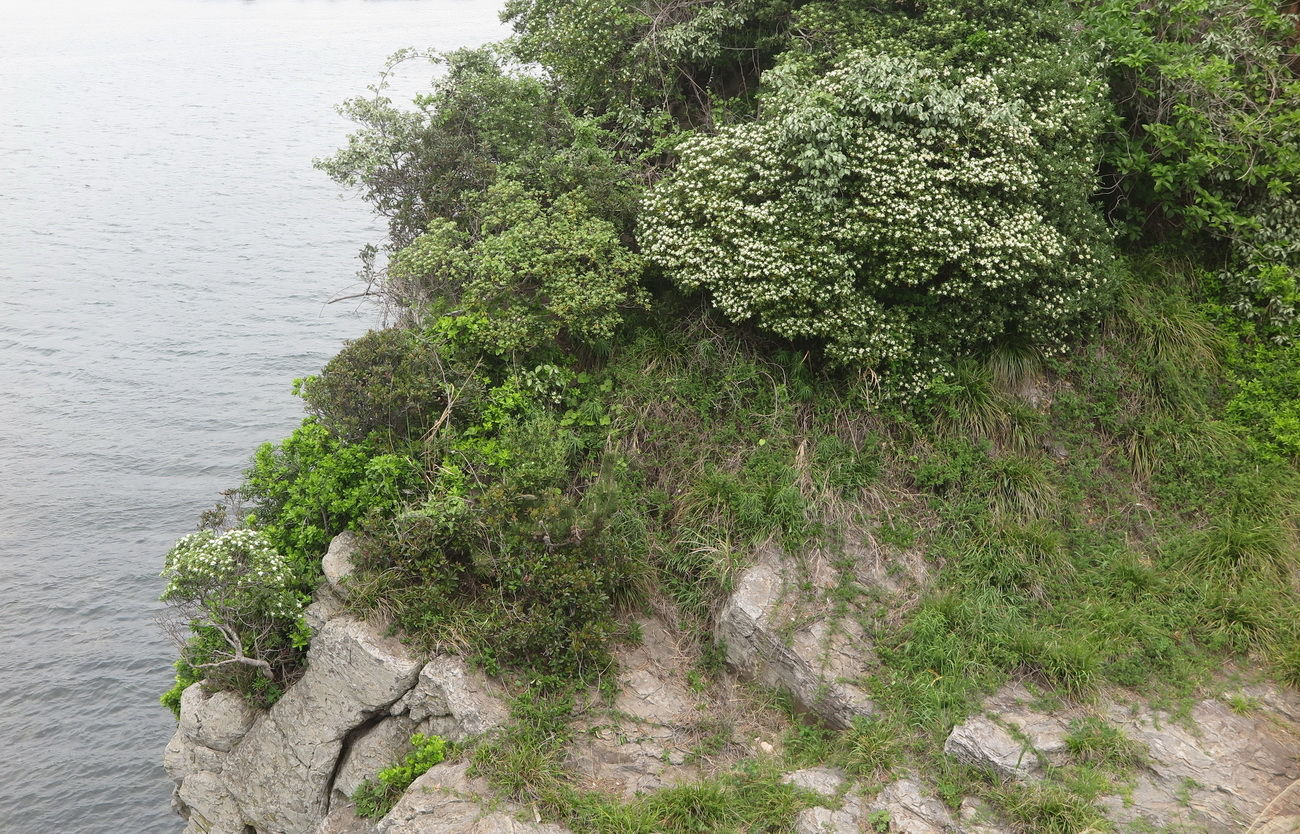
Wild populations occupy coastal forests, limestone cliffs and outcrops, slopes and sandy shores, in some cases up to 1,800 m (5,900 ft) above sea level. Constant salt exposure on spray-battered cliffs helps explain its cultivated tolerance of marine winds and poor soils. 5 7
Coastal hedges and ornamental screens carry it beyond its original range, including France, Spain and the southern United States. Horticultural references place it in USDA zones 8–11. At some maritime Florida sites it has naturalized at coastal forest edges, without being designated a regulated invasive species. 3 4
Life cycle and reproduction
Spring flowers develop on wood formed the previous year, with April–May flowering in the Northern Hemisphere reference climate. Late spring or summer pruning removes much of the following season's flower-bearing growth, particularly on young shrubs, and is the most frequent explanation for poor flowering. 2 4
Nurseries mainly propagate it from semi-ripe cuttings taken in summer from partly woody shoots; roots develop within a few weeks. Late-winter sowing under heated glass is possible, but seedlings do not reliably preserve the characteristics of named cultivars such as Variegatum. 5 3
Horticultural references generally describe growth as fast, noticeably quicker than comparable fragrant shrubs such as osmanthus. A mature outline usually develops in 5–10 years, helping explain its popularity for hedges that soon provide a dense screen. 3
Uses and risks
Salt-tolerant hedges, windbreaks, privacy screens and coastal borders are its principal ornamental roles. A specimen near a terrace also brings the flower fragrance close at hand. Its leathery foliage tolerates salt spray that causes many other evergreen shrubs to shed leaves. 2 5
The ASPCA lists Pittosporum tobira as nontoxic to cats, dogs and horses. Nevertheless, saponins in the leaves and fruit may cause digestive irritation if large quantities are eaten, a caution distinct from a formal toxic classification. 6 5
Crushed foliage and twigs release an unpleasant, almost cheesy odor unrelated to pests or disease. This characteristic lies behind the Japanese name tobera, door tree, and the English name cheesewood. 7 8
Varieties, look-alikes and related plants
Creamy white leaf margins distinguish Variegatum, which has received the Royal Horticultural Society Award of Garden Merit alongside the species. Nanum, often sold as Wheeler's Dwarf, is a dwarf, compact form for low borders; Miss Muffet is a more recent rounded selection suited to containers. 2 4
Several shrubs can be mistaken for it:
- Pittosporum undulatum is taller, with wavy leaf margins, and is considered invasive in several introduced regions;
- Pittosporum eugenioides is native to New Zealand and has narrower, wavy leaves;
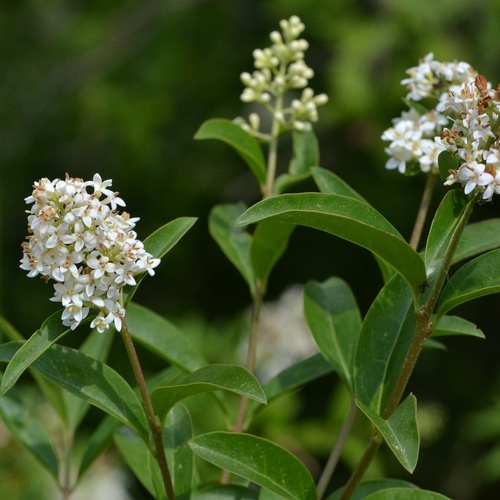
- Ligustrum vulgare, common privet, also forms hedges and clusters of white flowers, but its foliage is toxic, unlike Japanese pittosporum.
Dense leaf rosettes and the cheesy smell released when crushed distinguish Japanese pittosporum from privet, which does not form those rosettes. Privet is toxic to domestic animals, so this distinction has practical importance when planting near a dog or cat that chews foliage. 7 3
Main sources
- Plants of the World Online / Kew, Pittosporum tobira (Thunb.) W.T.Aiton
- Royal Horticultural Society, Pittosporum tobira
- NC State Extension, Pittosporum tobira (Japanese mock orange)
- Missouri Botanical Garden Plant Finder, Pittosporum tobira
- Plants For A Future, Pittosporum tobira
- ASPCA, Japanese Pittosporum toxicity entry
- Wikipedia, Pittosporum tobira
- Wikipedia FR, Pittosporum tobira
Frequently asked questions
Is Japanese pittosporum toxic to cats and dogs?
No. The ASPCA lists Pittosporum tobira as nontoxic to cats, dogs and horses. Its leaves and fruits do contain saponins that may cause digestive irritation if large amounts are eaten.
Why is my Japanese pittosporum not flowering?
Late pruning is the most common cause: it removes wood carrying buds formed the previous year. Young plants and those in dense shade also flower less reliably.
Why does Japanese pittosporum smell unpleasant when pruned?
Crushed leaves or twigs release an unpleasant, almost cheesy smell unrelated to disease. Its Japanese name, tobera, means door tree; branches were once hung at entrances to ward off evil spirits.
Does Japanese pittosporum tolerate seaside conditions?
Yes. Its leathery leaves tolerate salt spray and salty winds well, making it a classic choice for coastal hedges and borders.
Which plants resemble Japanese pittosporum?
Common look-alikes include the taller, wavy-leaved Pittosporum undulatum, the narrower-leaved Pittosporum eugenioides and common privet (Ligustrum vulgare), which also forms hedges and clusters of white flowers.
How does Variegatum differ from the species?
Variegatum has creamy white leaf margins that brighten the foliage, but it is often slightly less vigorous than the plain-leaved species. Both have received the Royal Horticultural Society Award of Garden Merit.
How much cold can Japanese pittosporum tolerate?
An established plant tolerates brief frosts down to about -10 °C according to the references. Young and container-grown plants are more sensitive and need winter protection.
Similar plants
If you are unsure about a plant’s toxicity, ask a botanist or veterinarian for advice.