
Broadleaf plantain (Plantago major, )
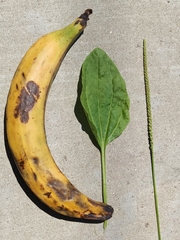
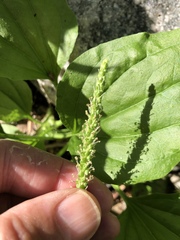
Broadleaf plantain (Plantago major) is a perennial herb in the Plantaginaceae family, native to temperate Eurasia, the Arabian Peninsula, Macaronesia and North Africa. Now naturalized across most inhabited continents, its low rosette of broad, strongly veined leaves withstands repeated trampling on lawns, paths and compacted ground.
Read moreBroadleaf plantain, Greater plantain, Common plantain and White man's foot
Allow a few hours of direct sun per day, preferably morning or evening.
Full sun to light partial shade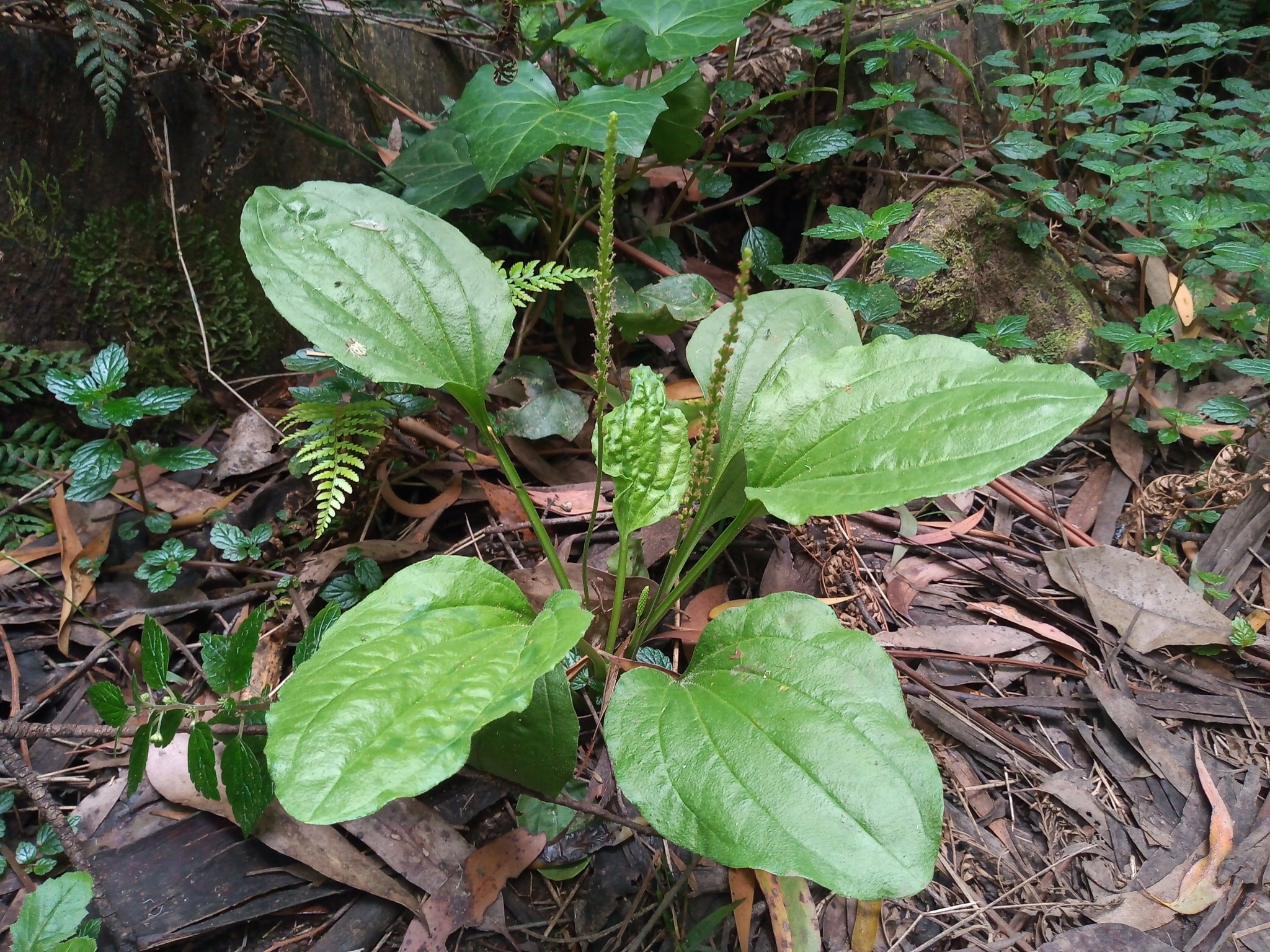

© photo
(c) Reiner Richter, some rights reserved (CC BY-NC-SA), uploaded by Reiner Richter · cc-by-nc-sa
Vasily Reinkymov · cc0
Andrew Garn · CC BY-NC
no rights reserved · cc0
(c) Юлия, some rights reserved (CC BY) · cc-by
Global distribution
Plantago major is native to temperate Eurasia, from Europe to the Arabian Peninsula, as well as Macaronesia and North Africa. Introduced beyond this range early on, it is now naturalized across almost all inhabited continents, usually on ground disturbed by people.
- Native4
- Introduced3
- Mainland France
- Europe
- Temperate Asia
- North Africa and Macaronesia
- United States
- Canada
- Australia
Hexagons: regions where the plant occurs. Green dots: native range.1
Identity
Broadleaf plantain (Plantago major L., 1753), also known as greater plantain or common plantain, is a perennial herb in the genus Plantago, within the Plantaginaceae family. Plants of the World Online accepts the name published by Linnaeus in 1753. Its native range spans temperate Eurasia, the Arabian Peninsula, Macaronesia and North Africa. 1 5
The Latin word planta, meaning the sole of the foot, gave Plantago its name: the low, flattened leaf rosette resembles a footprint. European settlers spread the plant so widely in North America that Indigenous peoples called it white man's foot. It colonized disturbed ground along routes of settlement, sometimes appearing before later settlers themselves arrived. 8 3
Recognition
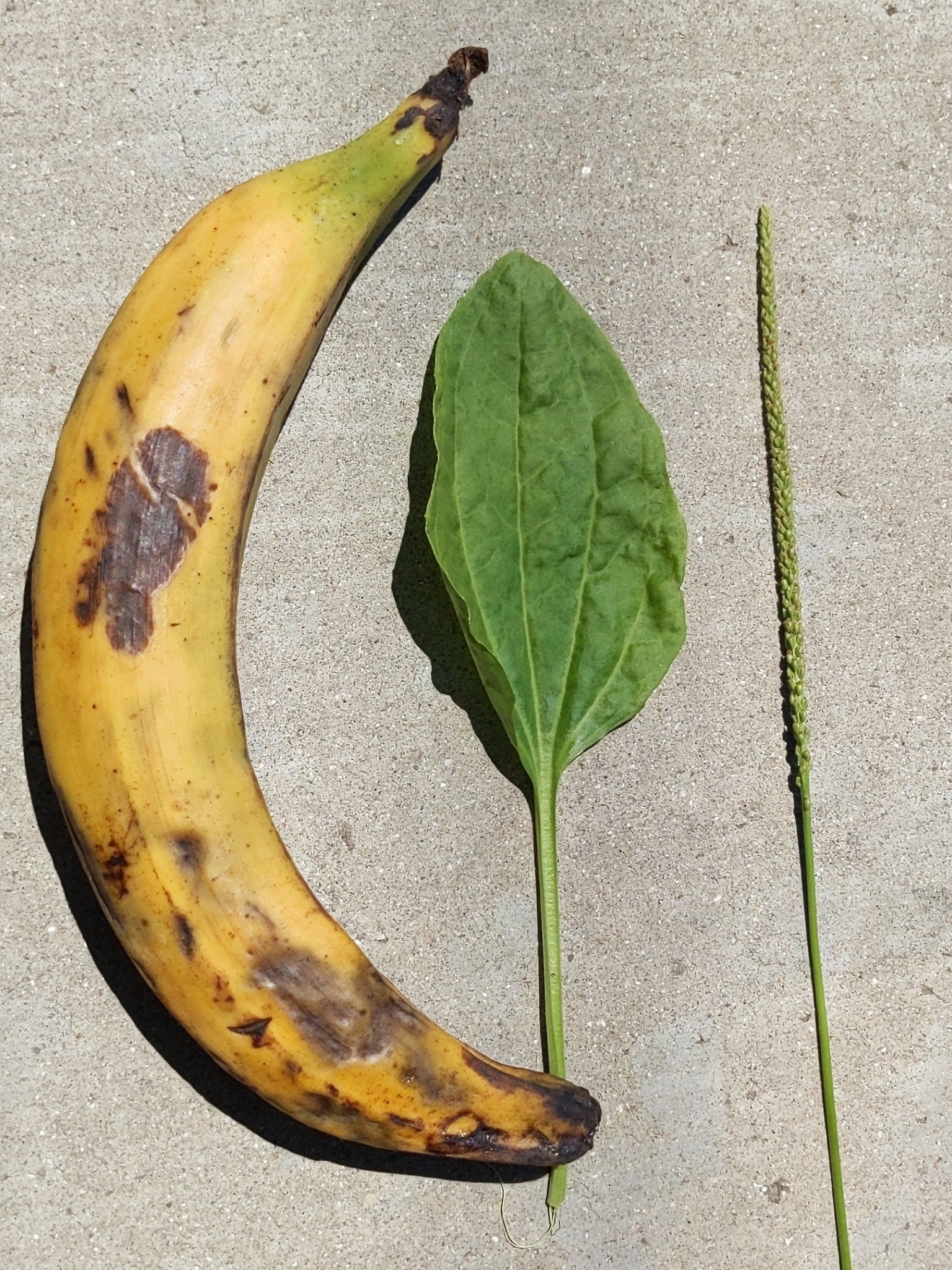
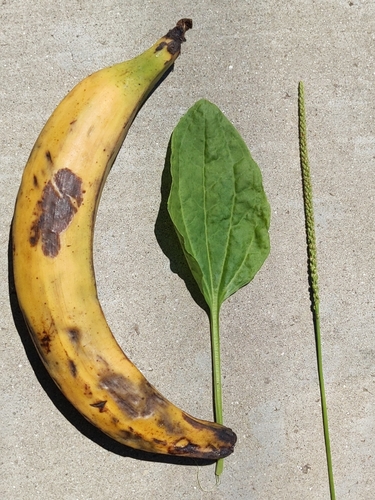
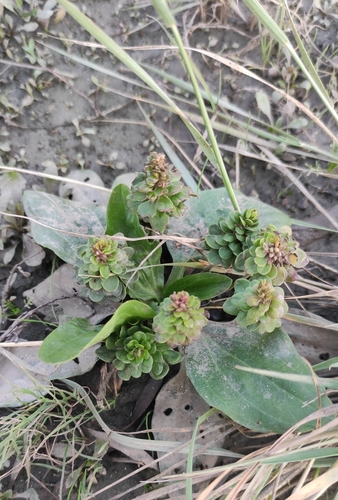
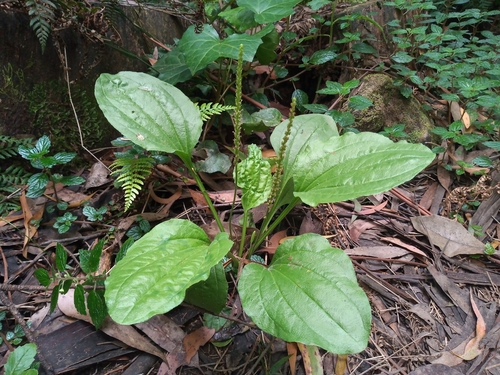
Broad oval to rounded leaves form a basal rosette in Plantago major. The blades are 5–10 cm (2–4 in) wide and sit on sturdy, often winged stalks. Five to nine conspicuous parallel veins run through each blade, separating this species from narrow-leaved plantains such as Plantago lanceolata. 3 4
One or more upright, leafless flower stalks rise from the rosette's center to 10–60 cm (4–24 in), depending on soil and exposure. Each bears a dense spike of tiny greenish to brownish flowers with protruding white or purple stamens. Wind carries the pollen, rather than insects. The low leaves and much taller flowering stalks give the plant two distinct outlines at different stages of growth. 5 3
Useful taxonomy
For broadleaf plantain, the accepted botanical name is Plantago major L., published in 1753. Several subspecies are recognized, including the following forms: 1
- Plantago major subsp. major, the most widespread form;
- Plantago major subsp. intermedia (Gilib.) Lange, found in damp and sometimes saline habitats, with narrower, hairy leaves;
- Plantago major subsp. pleiosperma Pilg., with more seeds in each capsule.
More than 250 species belong to Plantago. The genus shares the Plantaginaceae family with Digitalis and Veronica. This relationship is less obvious from appearance: broadleaf plantain's ground-hugging rosette looks quite different from the tall flowering stems of foxgloves. Botanical family membership does not require a shared overall shape. 6
Habitat and range
Across its original range, broadleaf plantain grows from Europe east to Afghanistan and Yemen, with populations in Macaronesia and North Africa. It is native and common through most of mainland France. These native populations belong to the same species now familiar along paths far beyond that range. 1 5
By the 17th century, introductions had brought Plantago major to North America. It is now naturalized from coast to coast there and across most other inhabited continents. The IUCN assesses it as Least Concern. Mown lawns, path edges, gravel drives and waste ground provide the disturbed soils it readily colonizes. 7 3
Repeated trampling leaves many grasses broken or sparse, but broadleaf plantain's flexible leaves and tough veins withstand feet, wheels and hooves. This physical resilience helps explain why rosettes persist in compacted places where ordinary turf thins out. Its familiar position beside paths reflects a specific tolerance, rather than simply a preference for lawns. 3
Life cycle and reproduction
Spring through early fall is the flowering period described for temperate northern populations. The flowers are bisexual, self-fertile and wind-pollinated. A well-established plant can produce as many as 20,000 seeds in a season, allowing a small rosette to contribute a substantial seed supply. 4 3
A ripe fruit is a pyxis, a capsule that opens with a circular lid and releases 4–13 seeds. These tiny brown seeds have a netlike surface. When wet, they develop sticky mucilage that attaches them to shoe soles, tires and animal coats. Contact transport, more than wind, accounts for the plant's worldwide spread along busy routes. 4 2
Uses and risks
Tender leaves gathered before flowering can be eaten raw in salads or cooked as greens once their tough fibers have been removed. The seeds contain mucilage and vitamin B1 and are edible too. Their small size makes gathering a useful amount slow work, which limits their convenience compared with the young leaves. 2
Traditional uses include crushed-leaf poultices as an astringent and to support healing of wounds, insect bites and irritated skin. The root formerly appeared in remedies for fever and respiratory infections. No toxicity is documented for ordinary use of Plantago major; very large quantities can cause low blood pressure and diarrhea. Traditional use should not be read as proof of a treatment's effectiveness. 2 3
Varieties, look-alikes and related plants
Purple foliage distinguishes 'Rubrifolia', also sold as 'Atropurpurea', from the green wild form. This ornamental selection offers bronze to burgundy leaves for pond margins and damp gardens, although the wild species is generally regarded as a weed rather than an ornamental plant. 2
Narrow, lance-shaped leaves with three to five veins and a short, conical flower spike indicate Plantago lanceolata. In North America, Plantago rugelii is another look-alike: its leaf stalks are often purple, and its capsules open near the base rather than halfway up the fruit. 4
Leaf venation remains a stronger guide than stalk color or flower-spike shape alone. A broad blade with five to nine parallel veins and an uncolored stalk points toward Plantago major. A narrow blade or a purple stalk suggests one of its relatives and calls for checking the other distinguishing features.
Main sources
- Plants of the World Online / Kew, Plantago major L.
- Plants For A Future, Plantago major
- North Carolina Extension Gardener Plant Toolbox, Plantago major
- Go Botany / Native Plant Trust, Plantago major
- INPN / MNHN, Plantago major L., 1753 - Broadleaf plantain
- Tela Botanica / eFlore bdtfx, Plantago major L.
- IUCN Red List, Plantago major assessment
- Oxford University Plants 400, Plantago
Frequently asked questions
Is broadleaf plantain toxic?
No toxicity is documented in ordinary use. Very large quantities may cause low blood pressure and diarrhea; this effect is associated with high doses rather than normal food or traditional medicinal use.
Why does broadleaf plantain tolerate trampling?
Flexible leaves and tough veins withstand repeated footsteps, wheels and hooves without breaking, where ordinary turf would soon thin under the same pressure.
How can I tell Plantago major from Plantago lanceolata?
Leaf shape is the quickest guide. Plantago major has broad oval leaves with five to nine veins; Plantago lanceolata has narrow lance-shaped leaves with three to five veins and a shorter, conical flower spike.
Where does the name white man's foot come from?
Indigenous peoples in North America used this name because the plant colonized ground disturbed by European settlers, following their movements like a lasting footprint.
Can you eat broadleaf plantain?
Young leaves can be eaten raw in salads or cooked as greens after removing their tough fibers. The seeds are edible but collecting useful quantities is tedious.
Is broadleaf plantain invasive?
In France, where it is native, it is a common weed rather than an invasive alien species. In North America and Australia it is widely naturalized, but is rarely ranked among the most troublesome invasive plants.
Are there ornamental forms of broadleaf plantain?
The cultivar 'Rubrifolia', also sold as 'Atropurpurea', has purple to bronze foliage used beside ponds, unlike the entirely green wild form.
Similar plants

If you are unsure about a plant’s toxicity, ask a botanist or veterinarian for advice.