
Buddhist pine (Podocarpus macrophyllus, )
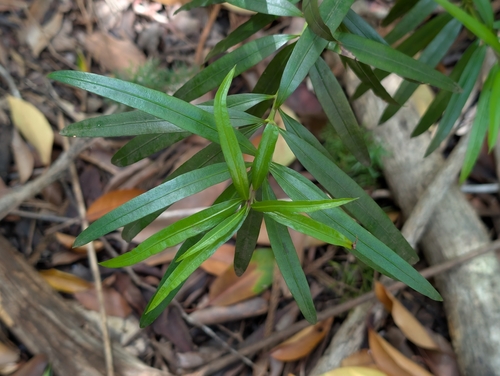
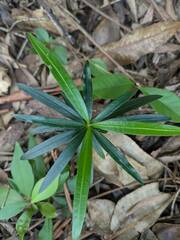
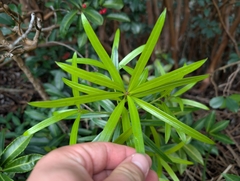
Buddhist pine (Podocarpus macrophyllus) is an evergreen conifer in the Podocarpaceae family, native to southern Japan, southern China and Taiwan. Long confused with yews, it has much longer flat, linear leaves than Taxus and fleshy red-purple fruits on swollen stalks. Male and female cones grow on separate plants. It is grown as both a clipped hedge and a bonsai.
Read moreBuddhist pine, Yew plum pine, Kusamaki, Fern pine, Japanese yew and Luóhàn sōng
Give plenty of ambient light without direct sun on the leaves.
Full sun to partial shade; tolerates partial shade well




© photo
Damien Wallace · cc0
Kevin Faccenda · cc-by
Taken Nov 16, 2019 by Pierre Bonnet (cc-by-sa)
Taken Feb 9, 2017 by vini (cc-by-sa)
© copyright of the Board of Trustees of the Royal Botanic Gardens, Kew.




Global distribution
Buddhist pine is native to southern Japan (Honshū, Kyūshū, Shikoku and the Ryūkyū Islands), southern China and Taiwan. Variety maki extends into northern Myanmar. Widely cultivated beyond its native range since its introduction to Europe in the early 19th century, the species has also become widespread as a hedge and garden tree in the southeastern United States.
Identity
Buddhist pine (Podocarpus macrophyllus (Thunb.) Sweet, 1818), also called yew plum pine or kusamaki, is an evergreen conifer in the Podocarpaceae family. Native to southern Japan, southern China and Taiwan, it is the northernmost species of Podocarpus, a useful distinction in a genus largely associated with more southerly regions. 1 7
A historical link to yews explains a lasting source of confusion. Carl Peter Thunberg originally described the tree in 1784 as Taxus macrophylla. Only in 1818 did Robert Sweet formally transfer it to Podocarpus, establishing the combination still used today. The similar appearance of its foliage does not make it a true yew. 2 1
Recognition
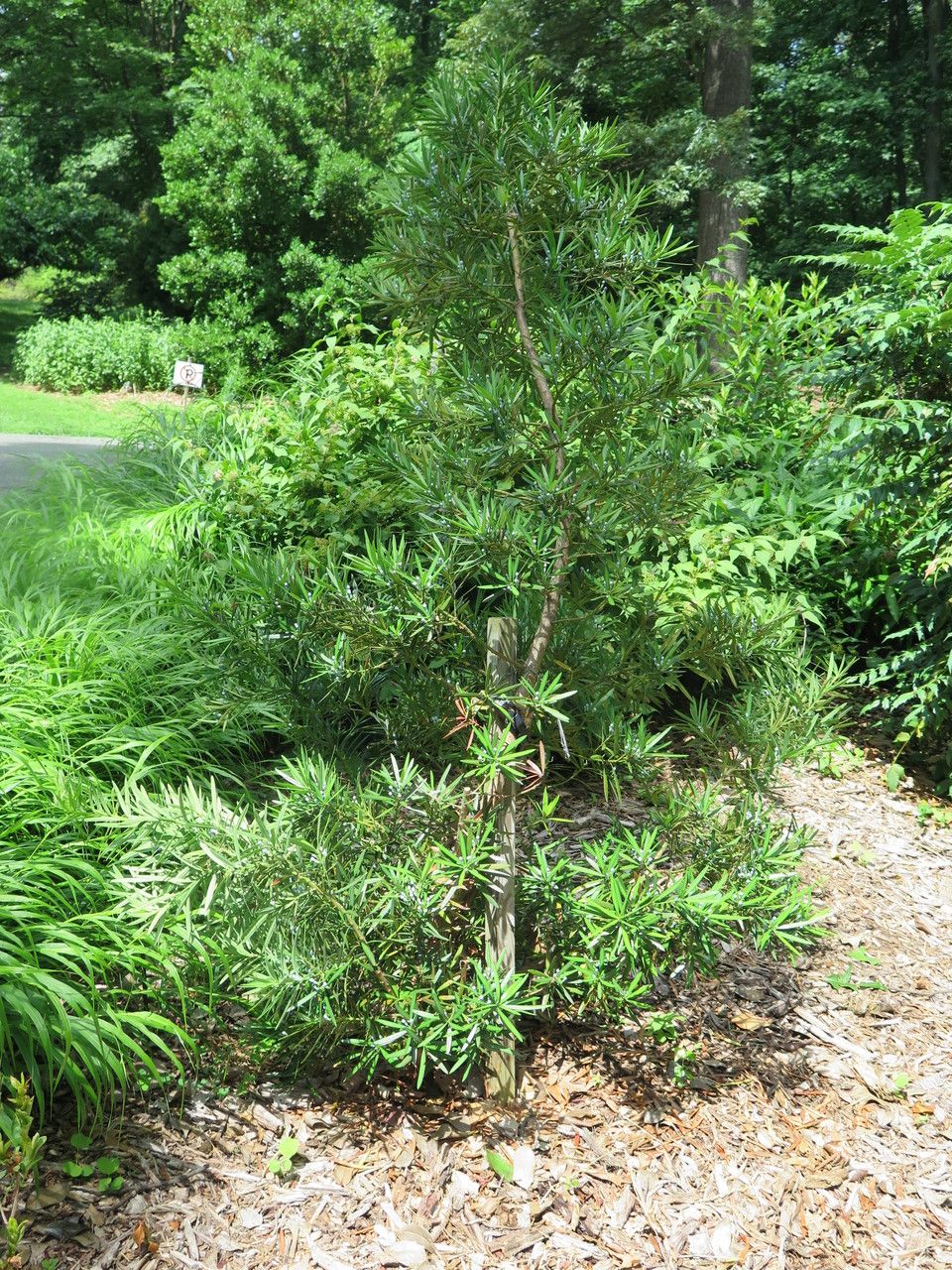
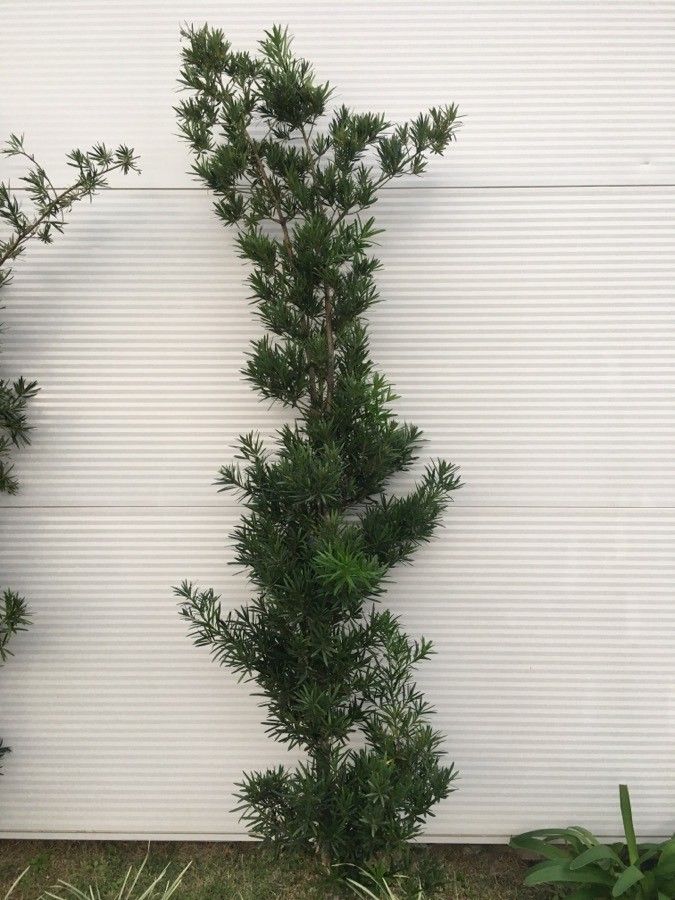
Slow-growing Buddhist pine can reach 20 m (66 ft) in its natural habitat. Repeated clipping in hedges or containers keeps most cultivated plants at 2–6 m (6.5–20 ft). Flat, linear leaves measure 5–15 cm (2–6 in) long and about 1 cm (0.4 in) wide, with a prominent midrib. They are glossy dark green above and paler, bluish-green beneath, arranged in a dense spiral around the twig. 3 7
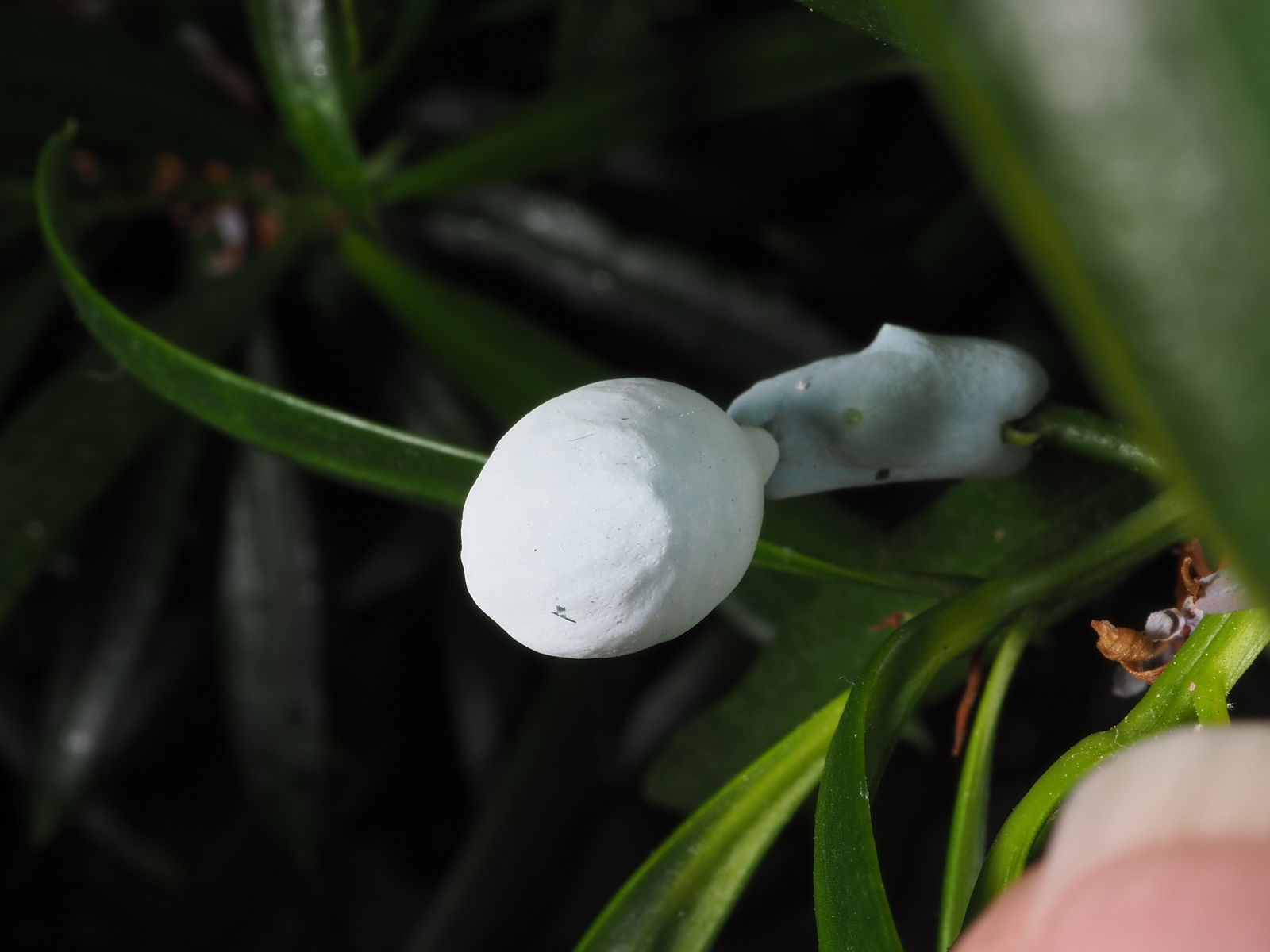
Male and female Buddhist pines are separate plants: the species is dioecious. Male cones resemble small catkins. On a pollinated female tree, the female cone is reduced to a fleshy receptacle that becomes a red-purple, drupe-like fruit 1–2 cm (0.4–0.8 in) long, borne on a swollen fleshy stalk. Birds eat it and disperse the seed, allowing seedlings to establish away from the parent tree. 7 4
Useful taxonomy
POWO/WCVP recognizes Podocarpus macrophyllus (Thunb.) Sweet as the accepted name. Several dozen species make up Podocarpus, mostly in the Southern Hemisphere, making this species' northerly position particularly distinctive. 1 Two botanical varieties are recognized, with partly overlapping ranges:
- Podocarpus macrophyllus var. macrophyllus occurs in southern China, Taiwan and Japan (Honshū and Shikoku).
- Podocarpus macrophyllus var. maki Siebold & Zucc. extends to northern Myanmar.
Botanical synonyms still encountered include narrow-leaved Podocarpus macrophyllus var. angustifolius Blume and white-margined Podocarpus macrophyllus var. albovariegatus Pilg.. These names help explain some of the foliage differences seen in cultivation. 1
Habitat and range
Southern Japan, including Honshū, Kyūshū, Shikoku and the Ryūkyū Islands, southern China and Taiwan form its native range. Forests, open thickets and roadsides provide habitat from sea level to about 1,000 m (3,300 ft). The range of variety maki extends farther to northern Myanmar. 7 1
Conservation assessments distinguish the typical species, classified as Least Concern, from variety maki, classified as Near Threatened. The species remains widespread despite some local decline. Illegal removal of old trees for the feng shui trade, particularly in Hong Kong, puts additional pressure on maki. 6
European cultivation began in the early 19th century. The tree later became a familiar ornamental in the southeastern United States and many temperate gardens. Widely planted variety maki has even naturalized in parts of China and Japan, with birds carrying seeds beyond its documented original range. Cultivated occurrence and native distribution therefore need to be distinguished. 7 6
Life cycle and reproduction
Spring pollination requires a male plant nearby. An isolated female can flower each year without setting fruit, as happens with other dioecious trees such as bay laurel and ginkgo. After pollination, the fruits take several months to ripen, turning red-purple in autumn rather than immediately after flowering. 7 3
Seeds and cuttings are the principal propagation methods. Germination is slow and irregular, extending over several months under warm cover. Semi-ripe twig cuttings are taken in late summer. Either method produces slow growth, helping explain why old, already shaped specimens command much higher prices than young plants. 4
Uses and risks
Ripe fleshy arils are eaten raw or cooked in some East Asian regions, but the seed must not be eaten. In Japan, the timber is traditionally used in construction, particularly in Okinawa, because it resists termites and moisture. The edible fleshy part and the seed must be clearly distinguished when discussing the fruit. 4 7
The ASPCA lists Buddhist pine as toxic to cats, dogs and horses. Although its toxic principle remains unknown, ingestion causes vomiting and diarrhea, with colic in horses. The ASPCA specifically warns against confusing it with true Taxus yews, a caution closely connected to its taxonomic history and yew-like appearance. 5
Bonsai training is another established ornamental use. Once acclimated, Buddhist pine tolerates full sun and repeated foliage pruning, a useful combination in a conifer with such dense growth. Its willingness to accept clipping also helps explain its use as a hedge. 7
Hong Kong's feng shui market gives well-shaped old trees a value equivalent to several thousand euros. In 2004, marine police intercepted a boat carrying 14 uprooted trees valued at about HK$100,000. That documented theft illustrates the pressure on old wild specimens behind the commercial demand. 8
Varieties, look-alikes and related plants
Compact variety maki, with narrower foliage than the typical variety, dominates Western horticultural trade under several labels. Narrow-leaved angustifolius and white-margined albovariegatus forms are less common and are chiefly documented in botanical synonymy. Their descriptive names should not be mistaken for evidence of separate species. 1
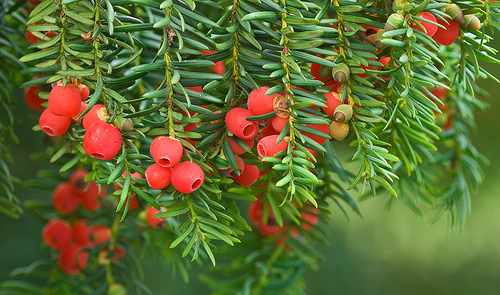
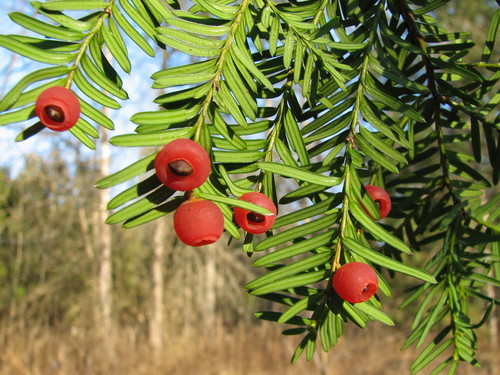
Three other conifers often cause confusion. Taxus baccata and Taxus cuspidata have shorter leaves arranged flat in two rows rather than in a dense spiral. Cephalotaxus harringtonia has a similar fleshy fruit, but it is larger, about 2.5 cm (1 in) long. Longer leaves and fruit borne on a swollen stalk, rather than set in a cup as in true yews, remain the most reliable clues to Buddhist pine.
Main sources
- Plants of the World Online / Kew, Podocarpus macrophyllus (Thunb.) Sweet
- Plants of the World Online / Kew, Taxus macrophylla Thunb. (basionym)
- Missouri Botanical Garden Plant Finder, Podocarpus macrophyllus
- Plants For A Future, Podocarpus macrophyllus
- ASPCA, Buddhist Pine toxicity entry
- Threatened Conifers of the World / RBGE, Podocarpus macrophyllus (IUCN assessment)
- Wikipedia (EN), Podocarpus macrophyllus
- Hong Kong Government News, Buddhist pine theft case (2004)
Frequently asked questions
Is Buddhist pine a true yew?
No, although it was first described as Taxus macrophylla in 1784. Transferred to Podocarpus in 1818, it differs from true Taxus yews in its longer leaves and fleshy fruit on a swollen stalk.
Is Buddhist pine toxic to cats and dogs?
Yes. The ASPCA lists it as toxic to cats, dogs and horses, with vomiting and diarrhea after ingestion. Its toxic principle is unknown. True yews are also toxic, but through a different mechanism, and should not be confused with this species.
Can you eat Buddhist pine fruit?
The ripe red-purple fleshy aril is eaten raw or cooked in some parts of East Asia. The seed must not be eaten, and unripe fruit is not recommended.
Why does my Buddhist pine never produce fruit?
The species has separate male and female plants. An isolated plant may never fruit if it is male or if a female has no nearby male to provide pollen.
How can I recognize variety maki?
Podocarpus macrophyllus var. maki has a more compact habit and narrower leaves than the typical variety. IUCN assesses it as Near Threatened because old trees are illegally removed for the feng shui trade.
Is Buddhist pine suitable for bonsai?
Yes. It tolerates severe, repeated pruning and full sun once acclimated. Repot every two to three years in a well-drained substrate. Chokkan, with an upright trunk, and neagari, with exposed roots, are commonly practiced styles.
Why are the leaves turning yellow?
Soil that is too alkaline causes iron chlorosis in the foliage. An iron-rich fertilizer and a more acidic substrate generally correct the problem.
Similar plants
If you are unsure about a plant’s toxicity, ask a botanist or veterinarian for advice.