
Sour cherry (Prunus cerasus, )
Sour cherry (Prunus cerasus L.), also called tart cherry, is a small deciduous tree in the Rosaceae family, native to Europe and western Asia. Its red to purplish-black fruits are much more acidic than sweet cherries. The edible ripe flesh must be distinguished from the stones, leaves and stems, which carry a cyanogenic risk.
Read moreSour cherry, Tart cherry, Morello cherry and Amarelle
Allow a few hours of direct sun per day, preferably morning or evening.
Full sun; light partial shade tolerated



© photo
Stephen James McWilliam · cc0
zebedeugalinha · cc-by
Taken Mar 29, 2021 by ECO_ECO_CC (cc-by-sa)
Taken Jul 4, 2020 by Fabrice Ainamor (cc-by-sa)
Taken Jul 23, 2021 by Éliandre Fleurdepom (cc-by-sa)
Taken Mar 27, 2022 by Jacques Zuber (cc-by-sa)
Taken Aug 1, 2022 by Oğuzhan (cc-by-sa)
© copyright of the Board of Trustees of the Royal Botanic Gardens, Kew.




Global distribution
POWO/WCVP places its origins around the Caucasus; genomic studies extend the native area to Europe and western Asia. Wikipedia notes that truly wild populations probably no longer exist, while subspecies acida readily escapes cultivation.
- Native3
- Introduced2
- Caucasus
- Southeastern Europe
- Western Asia
- United States
- Russia
Hexagons: regions where the plant occurs. Green dots: native range.1
Identity
Sour cherry (Prunus cerasus L., 1753), also known as tart cherry, is an accepted species of Prunus in the Rosaceae family. POWO/WCVP places its origins around the Caucasus; recent genomic studies extend that area to Europe and western Asia. 1 7
Morello and amarelle describe the two main cultivar groups. Morellos have dark flesh and juice; amarelles have clear juice and are less acidic than morellos. The English name sour cherry emphasizes taste, contrasting with sweet cherry, Prunus avium. 7 2
A label saying only “cherry” cannot identify this species: the word also covers sweet cherries and ornamental cherries without edible fruit. The binomial Prunus cerasus resolves that ambiguity when ordering a fruit tree from a nursery.
Recognition
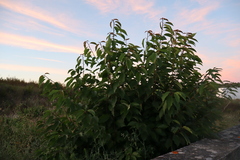
A modest deciduous tree, sour cherry reaches up to 9 m (30 ft) untrained according to NC State, with a spreading to rounded crown. RHS gives a mature height and spread of 4–8 m (13–26 ft). Sweet cherry can exceed 12 m (39 ft) according to both sources, so height often helps distinguish standing trees before tasting any fruit. 3 2
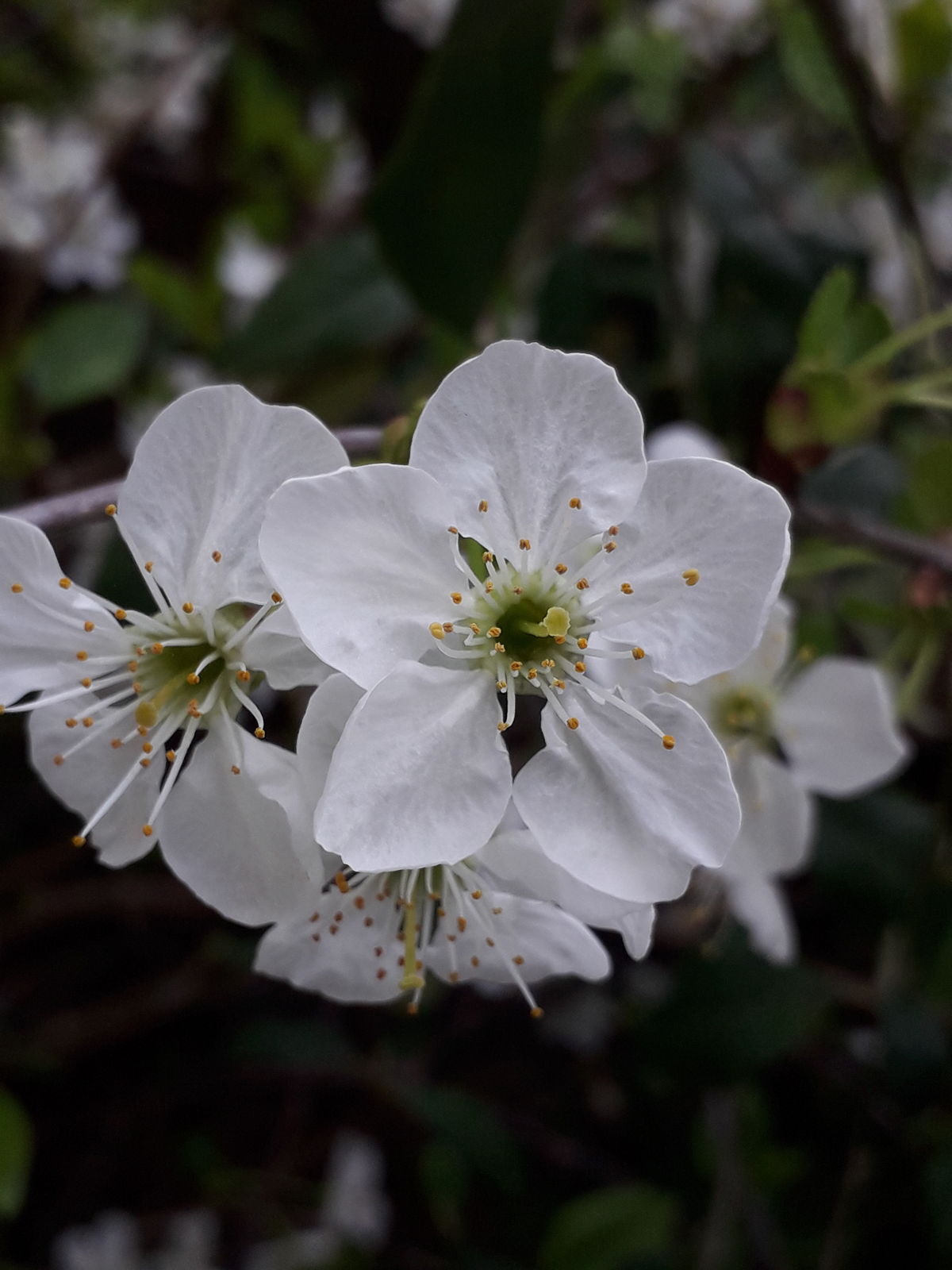
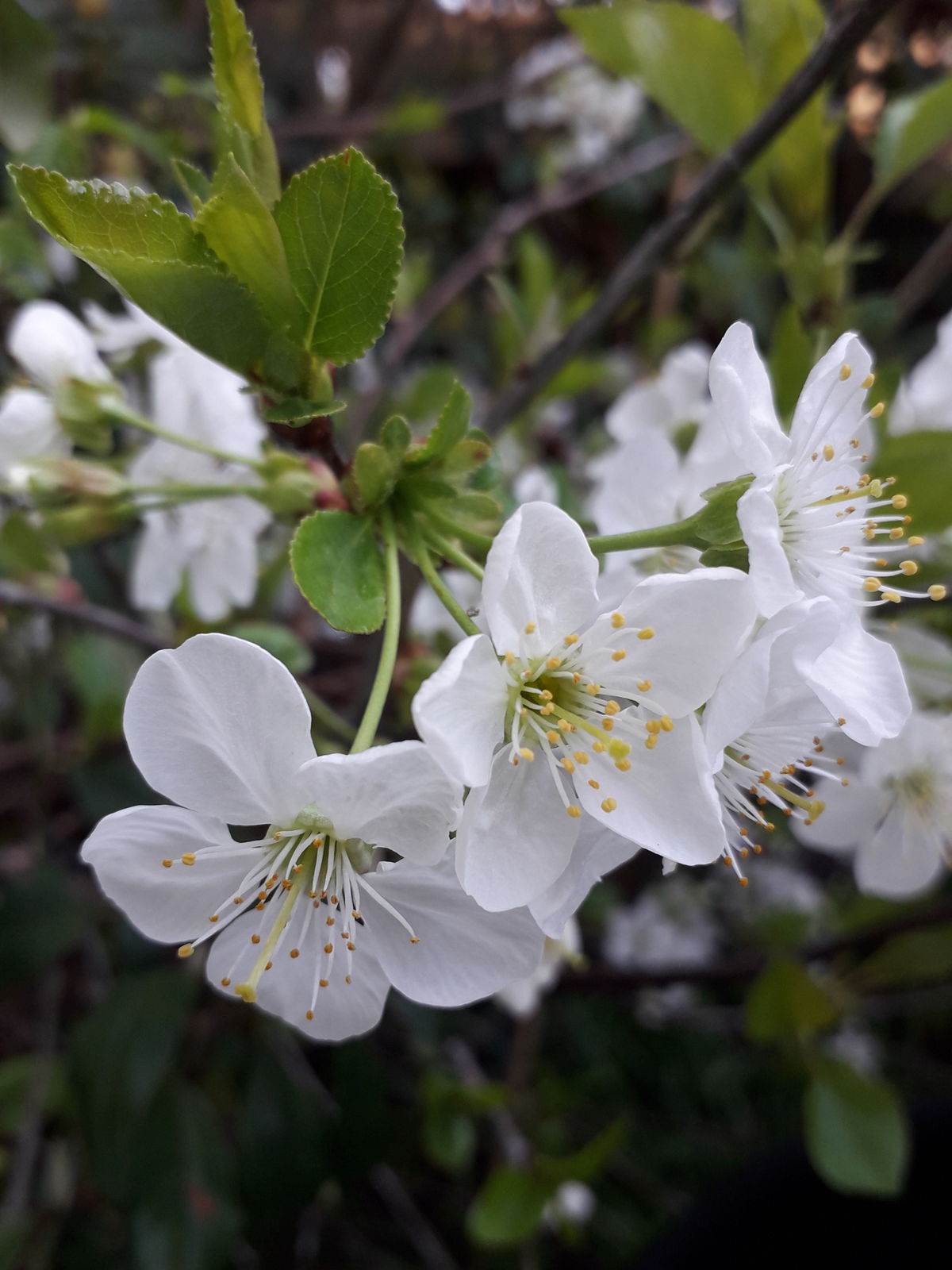
Late spring brings flowers a little after those of Prunus avium. RHS describes dense clusters of pure white flowers; NC State specifies five-petaled white flowers in groups of 3–5. 2 3
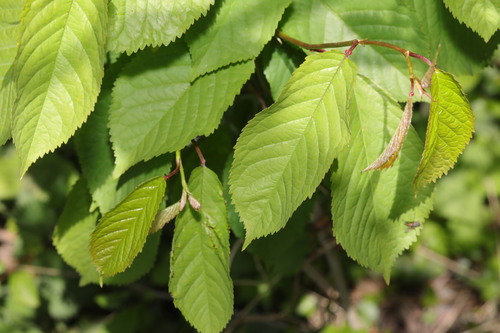
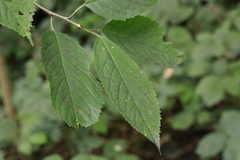
Glossy green leaves are oval to elliptical, with toothed margins, and measure 5–13 cm (2–5 in) long according to NC State. Young bark is reddish brown, smooth and shiny, with horizontal lenticels that become more conspicuous with age. 3 2
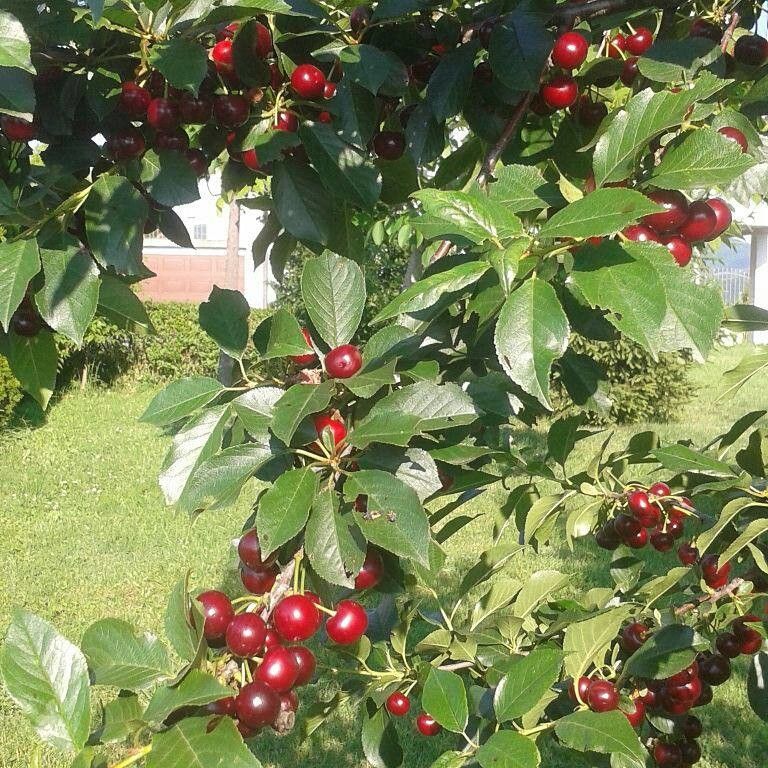
Red to purplish-black fruit develops as a drupe less than 2.5 cm (1 in) across according to NC State. Its distinctly acidic taste separates sour cherry from sweet cherry even when the fruits have similar colors. 3 7
Useful taxonomy
Linnaeus published Prunus cerasus in 1753, and POWO accepts that name. Like sweet cherry, it belongs to the subgenus Cerasus, but it has more chromosomes: sour cherry is tetraploid, whereas Prunus avium is diploid. 1 7
Recent genomic analyses identify sour cherry as an allotetraploid hybrid from an ancient cross between sweet cherry (Prunus avium) and steppe cherry (Prunus fruticosa). The cultivated genome, studied in 'Montmorency', retains evidence of both origins in a trigenomic structure. 6 7
That mixed ancestry also helps explain a common nursery confusion. Duke cherries (Prunus × gondouinii) cross sour and sweet cherries, with intermediate size, flavor and flowering. Check the cultivar label before buying: a Duke has its own name and is not simply a synonym of either parent.
Habitat and range
For sour cherry, POWO/WCVP locates the original range around the Caucasus. Wikipedia extends the native area across much of Europe and western Asia, while noting that truly wild populations probably no longer exist. Subspecies acida readily escapes cultivation, blurring the distinction between native and naturalized populations in different regions. 1 7
RHS cultivation guidance favors moist but drained clay or loam, in sun or light partial shade. The species accepts acidic, neutral or alkaline soil. NC State adds that organic-rich soil encourages faster growth. 2 3
Cold tolerance and summer warmth both shape cultivation. RHS gives a temperature range of −20 to 35 °C (−4 to 95 °F) and USDA hardiness zones 3–8, supporting cultivation in eastern European continental climates and temperate oceanic climates along the Atlantic. 2
Cultivation is widespread today in France, Germany, the United Kingdom, several eastern European countries and Russia. No particular invasive status is published for those regions in the sources cited here. 1
Life cycle, flowering and fruit
White flowers in late spring mark the visible seasonal cycle, followed by fruit set and summer ripening, generally later than sweet cherry. Red to purplish-black drupes have flesh and juice whose color varies with the cultivar group. 3 7
Commercial production centers on two groups: morellos, with dark flesh and juice and 'Morello' as the European reference, and amarelles, with paler juice and 'Montmorency' dominant in North American commercial production. 7
Seed-grown fruit trees do not reliably preserve cultivars: a seed produces a young Prunus, never a guaranteed copy of 'Montmorency' or 'Morello'. Sour cherry also produces root suckers around its trunk. These can propagate a rootstock, but they also require seasonal mowing or removal around the tree. 4 2
Cultivation and uses
Fruit production supplies the main use. Jam, pastries, preserves and drinks such as Belgian kriek, Portuguese ginjinha and Turkish vişne suyu make use of the marked acidity, which suits processing better than eating fresh compared with sweet cherry. 7 4
Historical secondary uses recorded by PFAF include bark infusions for their astringent and fever-reducing properties, and chewing gum collected from the trunk. These uses are minor beside modern fruit production. 4
For fruit crops, RHS recommends full sun, fertile moist soil and summer pruning under pruning group 1, reducing the risk of silver leaf and bacterial canker. Fan-training against a wall remains a classic approach for 'English Morello' in cool climates. 2
Toxicity, animals and food safety
Edible flesh does not make the whole tree safe. Ripe fruit flesh may be edible, while other plant parts remain hazardous. NC State and PFAF describe fruit as edible raw or cooked but also note a cyanogenic risk elsewhere in the plant. 3 4
Cyanogenic glycosides, notably amygdalin and prunasin, occur in stones, leaves and stems. NC State flags risks to dogs, horses and cats; the ASPCA classifies Prunus cherries as toxic to the same animals, with particular concern for wilted foliage, where cyanogenic compounds become more concentrated. 3 5
Pitted sour cherry jam cannot establish the safety of stones, leaves or stems for a dog, cat, horse or child. Remove stones before crushing or mechanical processing, since breaking the hard shell exposes the seed. 5
Cultivars, rootstocks and look-alikes
Among the most widespread fruit selections, RHS and horticultural catalogs list 'Montmorency', 'Morello' and 'English Morello'. These are grafted fruit cultivars, rather than separate species or botanical varieties. 2 7
Comparing Prunus cerasus with sweet cherry, Prunus avium, reveals the most common identification problem. Sour cherry is smaller, suckering and markedly acidic; sweet cherry is larger and often sweeter. Duke cherries (Prunus × gondouinii) are intermediate hybrids, while various ornamental cherries are grown for flowers rather than fruit.
When selecting a fruit tree, check the botanical name, cultivar, group (morello or amarelle), rootstock and intended use, fresh or processed. For a spontaneous tree outside an orchard, useful clues include height below 10 m (33 ft), suckers around the trunk, shiny reddish-brown bark and distinctly acidic fruit. 2 3
Main sources
- Plants of the World Online / Kew, Prunus cerasus L.
- Royal Horticultural Society, Prunus cerasus - morello cherry
- NC State Extension Gardener Plant Toolbox, Sour Cherry Prunus cerasus
- Plants For A Future, Prunus cerasus
- ASPCA, Cherry toxicity entry
- Horticulture Research / PubMed, genome of tetraploid sour cherry Prunus cerasus 'Montmorency'
- Wikipedia, Prunus cerasus (production, cultivar groups, history)
Frequently asked questions
Can you eat Prunus cerasus fruit?
Yes. NC State and PFAF describe the ripe flesh as edible raw or cooked, commonly used in jam, baking and preserves. This does not make the stones or leaves edible.
Is sour cherry toxic to dogs and cats?
Yes. The ASPCA classifies Prunus cherry plants as toxic to dogs, cats and horses, chiefly because of stems, leaves and crushed stones. Edible ripe fruit flesh does not make the rest of the plant safe.
Are Prunus cerasus and Prunus avium the same plant?
No. Prunus avium is sweet cherry, usually a larger tree with sweeter fruit. Prunus cerasus is sour cherry, a smaller tree with distinctly more acidic fruit.
Why is sour cherry considered a hybrid?
Recent genomic analyses show that Prunus cerasus is an allotetraploid hybrid resulting from an ancient cross between Prunus avium and Prunus fruticosa, the steppe cherry. The cultivated genome retains evidence of both origins.
How do morello and amarelle cherries differ?
These are the two main cultivar groups of Prunus cerasus. Morellos, such as 'Morello', have dark, acidic flesh and juice; amarelles, such as 'Montmorency', have paler juice and dominate North American commercial production.
Can I grow a sour cherry from a stone?
You can grow a young Prunus, but it will not reliably reproduce the cultivar. For a named fruit tree, a grafted plant on an identified rootstock remains the prudent horticultural choice.
Similar plants
If you are unsure about a plant’s toxicity, ask a botanist or veterinarian for advice.