
Peach (Prunus persica, )
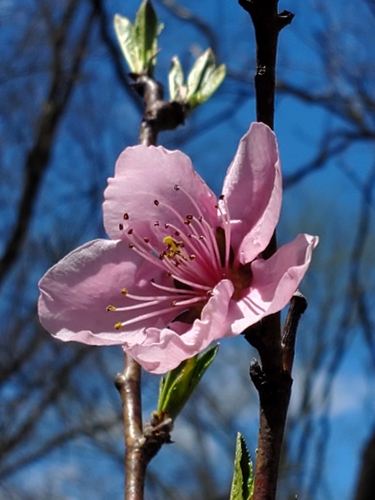

Peach (Prunus persica), also called peach tree, is a deciduous fruit tree in the Rosaceae family, regarded as a cultigen from China rather than a species confirmed in the wild. Spring flowers open before the leaves, followed by fuzzy summer drupes. Smooth-skinned nectarines belong to the same species; stones, leaves and stems remain toxic to domestic animals.
Read morePeach, Peach tree, Nectarine and Nectarine tree
Allow a few hours of direct sun per day, preferably morning or evening.
Full sun, ideally sheltered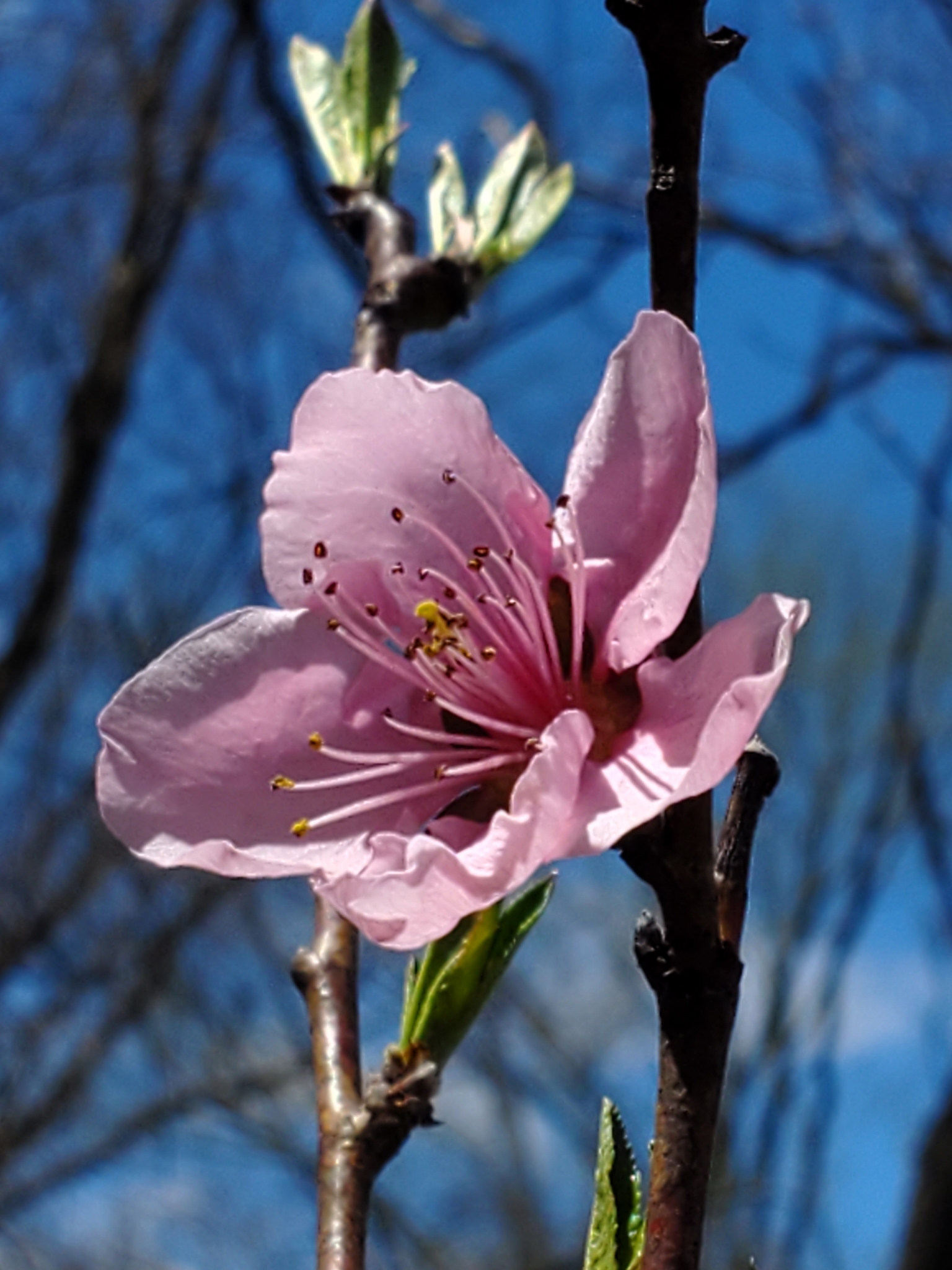



© photo
(c) Colleen, some rights reserved (CC BY-NC), uploaded by Colleen · cc-by-nc
Prince Molokomme · cc0
Evan M. Raskin · cc-by
Taken Apr 16, 2013 by Tela Botanica − Yoan MARTIN (cc-by-sa)
Taken Mar 29, 2015 by Tela Botanica − Isabelle Nault (cc-by-sa)
Taken Dec 13, 2021 by Kai Best (cc-by-sa)
Taken Jul 26, 2019 by Didier LAVOCAT (cc-by-sa)
© copyright of the Board of Trustees of the Royal Botanic Gardens, Kew.




Global distribution
PFAF states that peach is not known in a truly wild state. POWO associates it with northwestern China as a cultigen without confirmed wild populations. Cultivation later spread through Central Asia and Persia to the Mediterranean and the rest of the temperate world.
- Native1
- Introduced1
- China
- United States
Hexagons: regions where the plant occurs. Green dots: native range.1
Identity
Peach (Prunus persica (L.) Batsch, 1801) belongs to the genus Prunus in the Rosaceae family. POWO places it in the subgenus Amygdalus with almond, Prunus dulcis. Their flowers and hard stones are similar, but fruit texture separates the two trees. 1 2
The name peach refers to both the fruit and the peach tree. Its epithet persica recalls Persia, through which it reached the Mediterranean, although its botanical origin remains Chinese. 5 6
POWO treats Prunus persica as a cultigen, a cultivated plant without confirmed wild populations. This distinguishes it from most Prunus species known in the wild. PFAF suggests Prunus davidiana as a possible wild ancestor without settling the question. 1 6
Recognition
A small deciduous fruit tree, peach reaches 3–8 m (10–26 ft) tall with a comparable spread, a rounded to spreading crown and rapid growth. Garden trees are often fan-trained against a wall, which limits their actual height. 3 5
Look for simple, alternate, lance-shaped leaves with fine teeth and two small glands at the blade base. NC State identifies these glands as the best feature for distinguishing peach from plum. The blade often curves inward along the central vein. 5
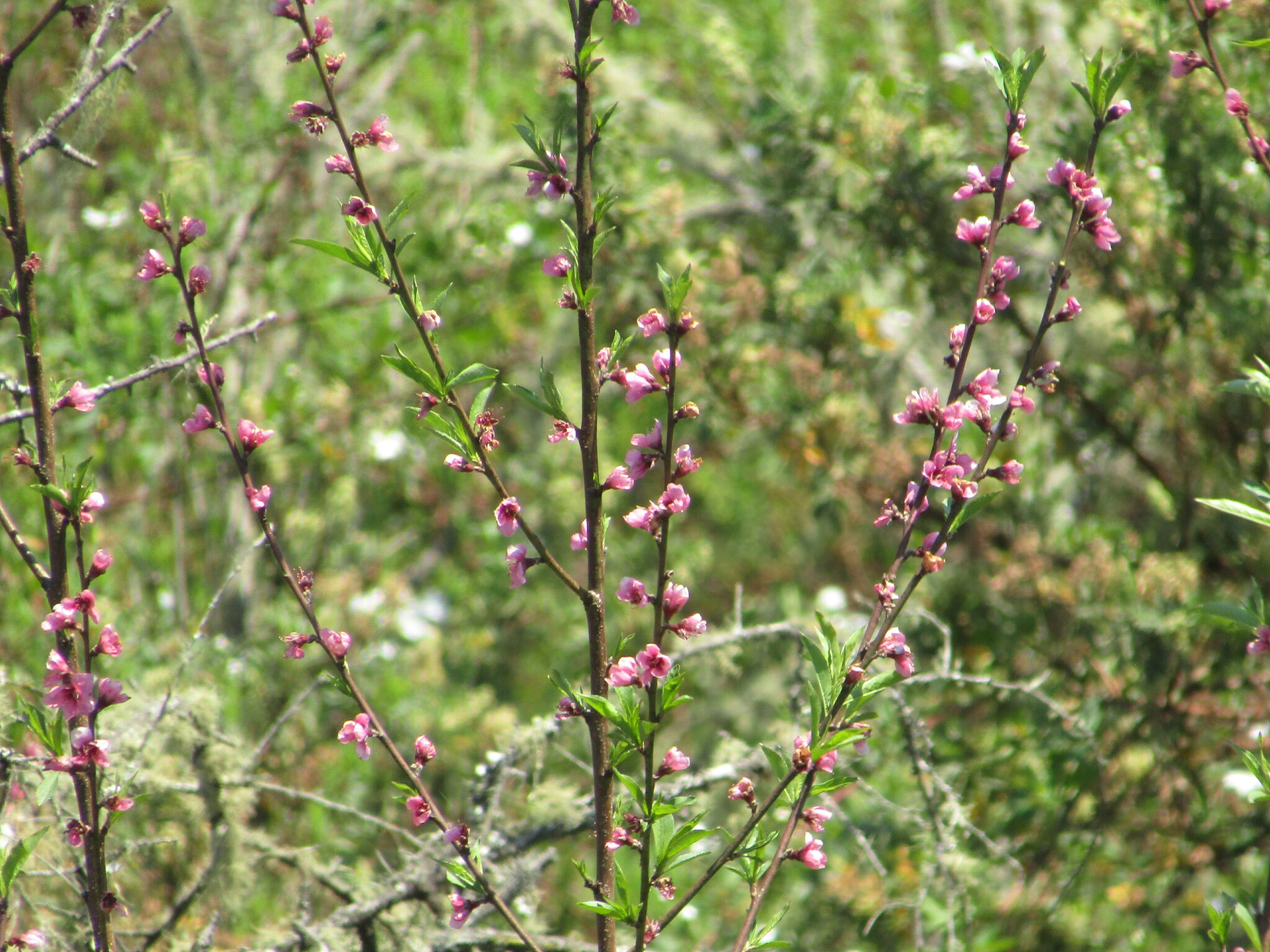
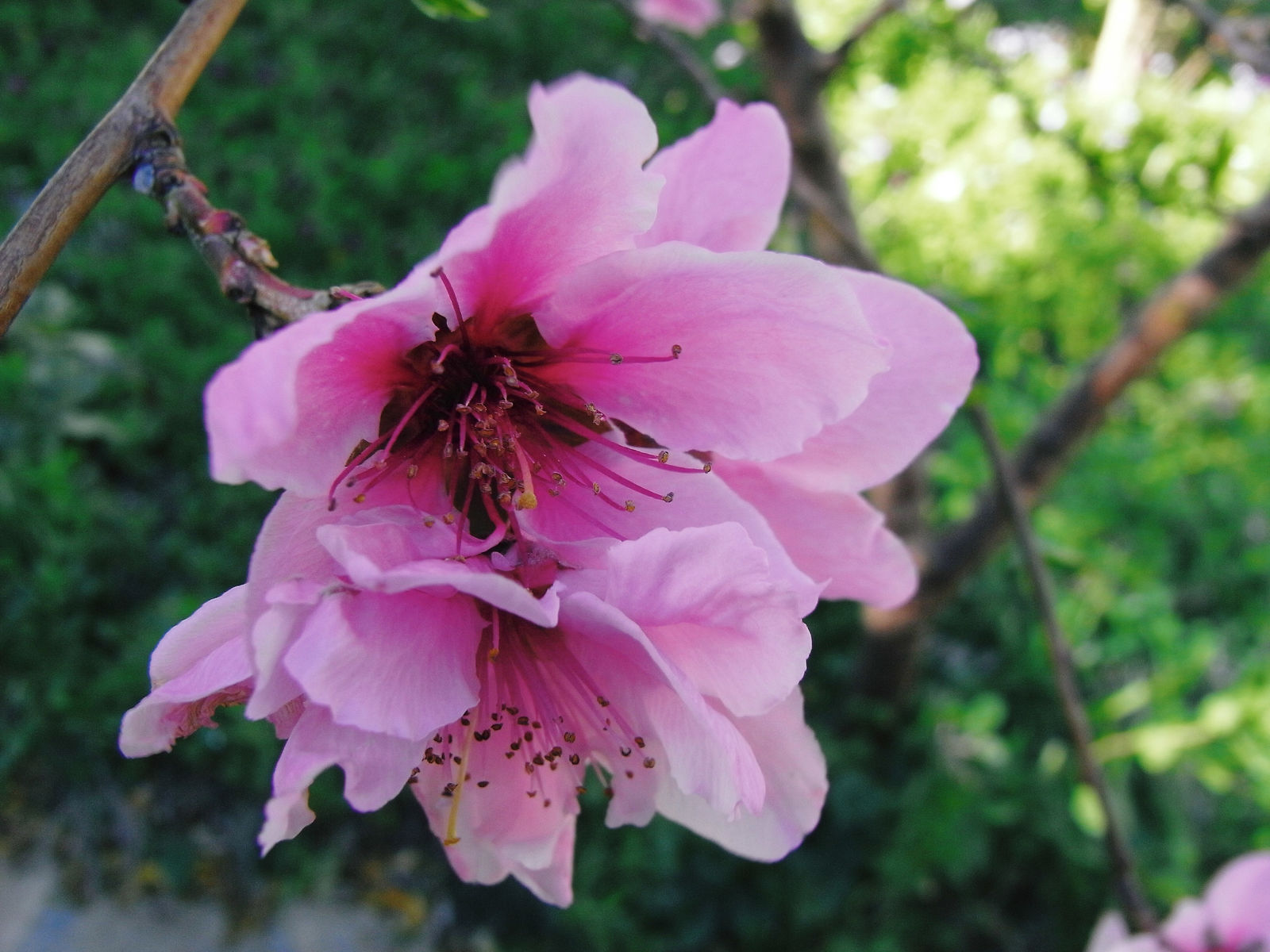
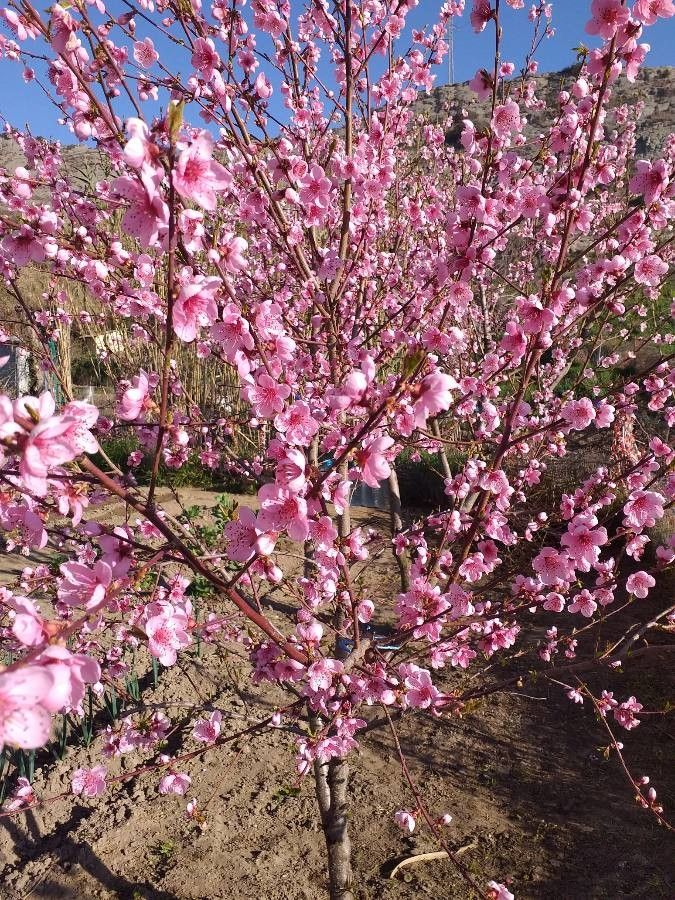
Spring flowers open before the leaves. Cup-shaped and pink to red, occasionally white, they measure 2.5–4 cm (1–1.6 in) across. Late frost can blacken open flowers and young fruits alike. 3 4
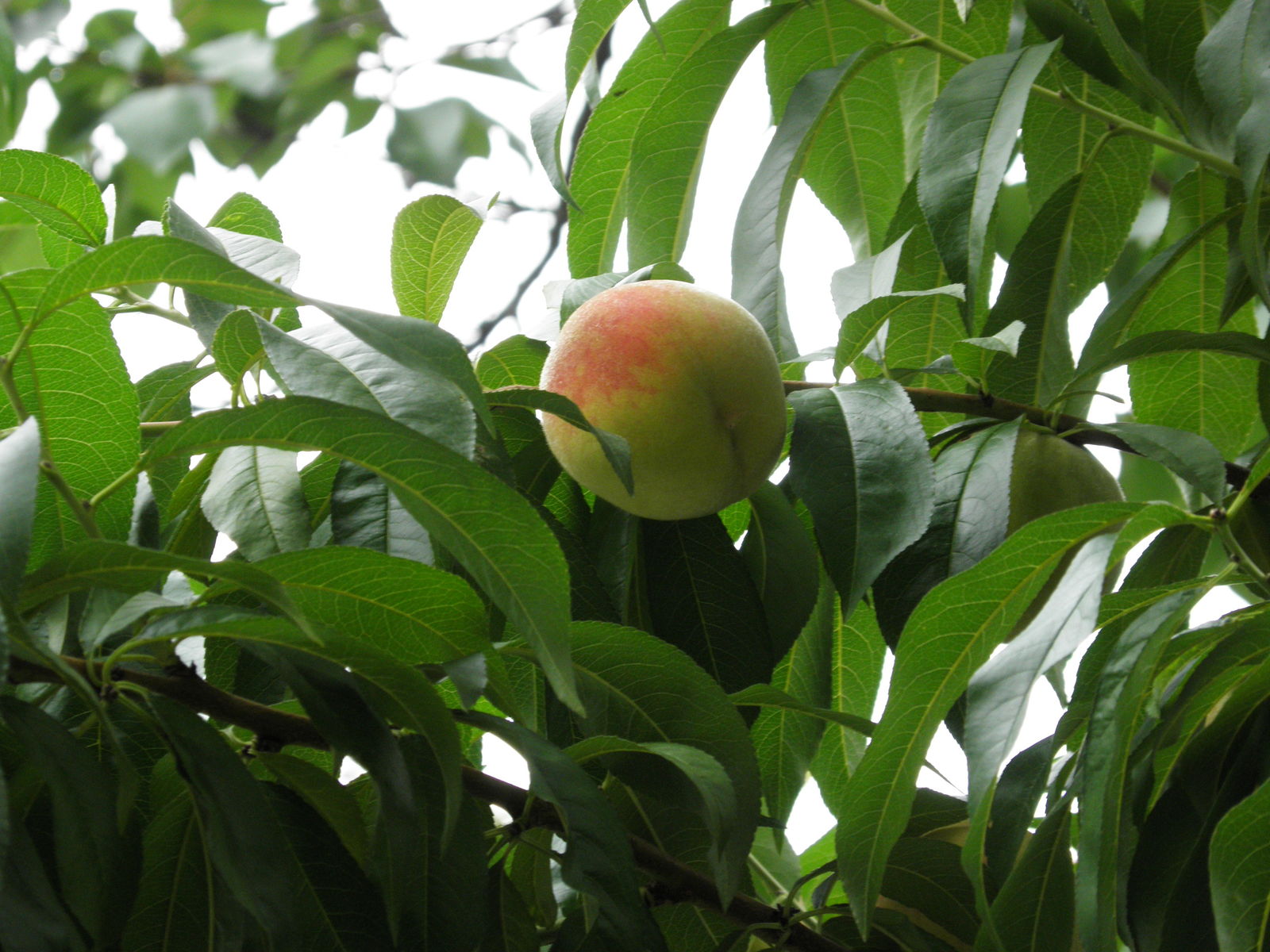
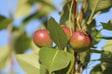
Fuzzy drupes have yellow or orange skin flushed with red and contain a large, rough, furrowed stone. Gray bark bears horizontal lenticels, while young reddish shoots become gray with age. 5
Useful taxonomy
The POWO-accepted combination is Prunus persica (L.) Batsch. Linnaeus first described it as Amygdalus persica in 1753, before Batsch transferred it to Prunus in 1801, one of the taxonomic shifts familiar among stone-fruited Prunus. 1
Subgenus Amygdalus brings peach and almond together. Similar flowers and foliage contrast with different fruits: thick, juicy flesh in peach and a dry covering around an almond in Prunus dulcis. 1
A nectarine, or nectarine tree, belongs to Prunus persica itself, rather than a separate species or hybrid. A recessive mutation in a single gene produces smooth, hairless skin, while fuzzy skin is dominant. 5
Habitat and range
PFAF explicitly states that peach is not known in a truly wild state. It associates the species with China and suggests Prunus davidiana as a possible close ancestor. POWO likewise describes a cultigen origin centered on northwestern China. 6 1
Cultivation spread from China through Central Asia and Persia to the Mediterranean, then later to the Americas and Oceania. Today the species occurs almost entirely in orchards, fruit gardens and cultivated temperate areas. 5 6
For cultivation, choose deep, fertile, well-drained soil, preferably around pH 6–7.5. RHS also lists chalk, clay, loam and sand as suitable if drainage is adequate. Waterlogged soil can suffocate roots regardless of its texture. 4 6
Life cycle, flowering and fruit
A stone sown after cold stratification can produce a seedling, but commercial fruit trees are almost always grafted onto rootstocks. Grafting preserves the chosen cultivar's fruit characteristics, which seed cannot guarantee. PFAF reports very poor success with semi-ripe cuttings. 6
Early spring blossom precedes leaf growth. In cool climates, hand pollination with a brush can compensate for a lack of active insects so early in the season. Fruits develop through summer; RHS gives a July–September harvest window, varying by cultivar, for its Northern Hemisphere context. 4
Growers distinguish clingstone peaches from freestone peaches according to whether flesh adheres to the stone. This horticultural distinction has no taxonomic standing. 5
Cultivation and uses
Fruit production is the main use: summer peaches are eaten fresh, made into jam or canned. RHS also lists the tree as useful to pollinators because its early flowers open when few other fruit trees are blooming. 4 3
In cool climates such as the United Kingdom, fan training against a south- or southwest-facing wall concentrates warmth for ripening. Compact varieties also suit containers on sunny patios or under glass. The wall orientation described here reflects the Northern Hemisphere setting. 4
Pruning belongs in spring or summer, never winter, to reduce silver leaf and bacterial canker infections through cut surfaces. Peach leaf curl, caused by Taphrina deformans, is another frequently cited disease, producing distorted, blistered leaves. 4
Less familiar uses recorded by PFAF include edible peach flowers, raw or cooked in salads or infusions, and traditional use of the leaves as an astringent and expectorant. 6
Toxicity, animals and food safety
Food safety depends on the part: ripe fruit flesh is edible, but the whole tree is not. The ASPCA lists peach as toxic to cats, dogs and horses. 7
Cyanogenic glycosides occur in stems, leaves and especially stones, with greater danger as foliage wilts. Reported signs after concerning ingestion include brick-red mucous membranes, dilated pupils, respiratory distress and shock. 7
PFAF confirms that the seed inside the stone can contain high levels of hydrogen cyanide and flags bitterness as a warning against consumption. Crushing or chewing a stone creates more exposure than leaving the fruit intact. 6
Large ingestions of foliage, twigs or broken stones call for professional advice. Contact a veterinarian or poison center and identify the exposed species; no home treatment is proposed here. 7
Varieties, look-alikes and related plants
Horticultural catalogs chiefly distinguish fruit types: smooth-skinned nectarines, doughnut-shaped flat peaches, and clingstone or freestone peaches. None represents a species separate from Prunus persica. 5
Peach and plum, Prunus domestica, are frequently confused. NC State recommends checking the curved leaf blade and paired basal glands. These specific details distinguish them more reliably than the general tree outline. 5
Almond, Prunus dulcis, shares subgenus Amygdalus, similar spring flowers and comparable fruit architecture. Its dry covering around an almond clearly differs from juicy peach flesh. 1
When buying a young tree, check its botanical name, rootstock, vigor and flowering period. To identify an established tree, leaf glands and stone shape remain useful clues. In harvested fruit, flesh that releases easily from the stone identifies a freestone, while clingstone flesh stays attached. 3 5
Main sources
- Plants of the World Online / Kew, Prunus persica (L.) Batsch
- Consulted WCVP record, Prunus persica
- Royal Horticultural Society, Prunus persica plant details
- Royal Horticultural Society, How to grow peaches
- NC State Extension Gardener Plant Toolbox, Prunus persica
- Plants For A Future, Prunus persica
- ASPCA, Peach toxicity entry
Frequently asked questions
Did peach originate in Persia?
No. POWO and PFAF place its botanical origin in northwestern China. The epithet persica refers to the route through Persia by which it reached Europe.
Is a nectarine a different species from peach?
No. Nectarines belong to Prunus persica. NC State explains that their smooth skin results from a recessive mutation in one gene, rather than a cross.
Is peach toxic to cats and dogs?
The plant as a whole is. The ASPCA lists peach as toxic to cats, dogs and horses because of cyanogenic glycosides in stems, leaves and stones.
When should I prune a peach tree?
Only in spring or summer. RHS advises against winter pruning because it increases the risk of bacterial canker and silver leaf disease.
Why do peach leaves curl and turn red in spring?
This is the most common sign of peach leaf curl, caused by the fungus Taphrina deformans, a disease frequently cited by RHS.
Can peach be confused with plum or almond?
Yes. NC State notes confusion with Prunus domestica, the plum. Almond, Prunus dulcis, shares the subgenus Amygdalus but produces a dry covering around an almond.
Can I grow a peach tree in a container?
RHS recommends compact varieties for containers on sunny patios or under glass, with regular repotting and consistent watering.
Similar plants
If you are unsure about a plant’s toxicity, ask a botanist or veterinarian for advice.