
Rhubarb (Rheum rhabarbarum, )
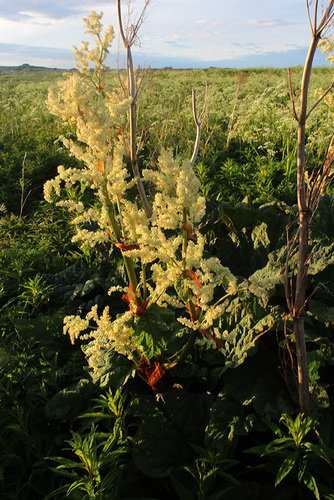

Rhubarb (Rheum rhabarbarum L., 1753) is an herbaceous perennial in the Polygonaceae family, native to southern Siberia and northern China. Grown since the 18th century for its tart leaf stalks, it forms a broad clump of heart-shaped leaves on fleshy red to green stalks that die back each winter. Only the cooked leaf stalks are eaten; the leaf blades and roots contain concentrated oxalates that make them toxic.
Read moreRhubarb, Garden rhubarb and Pie plant
Allow a few hours of direct sun per day, preferably morning or evening.
Full sun to light partial shade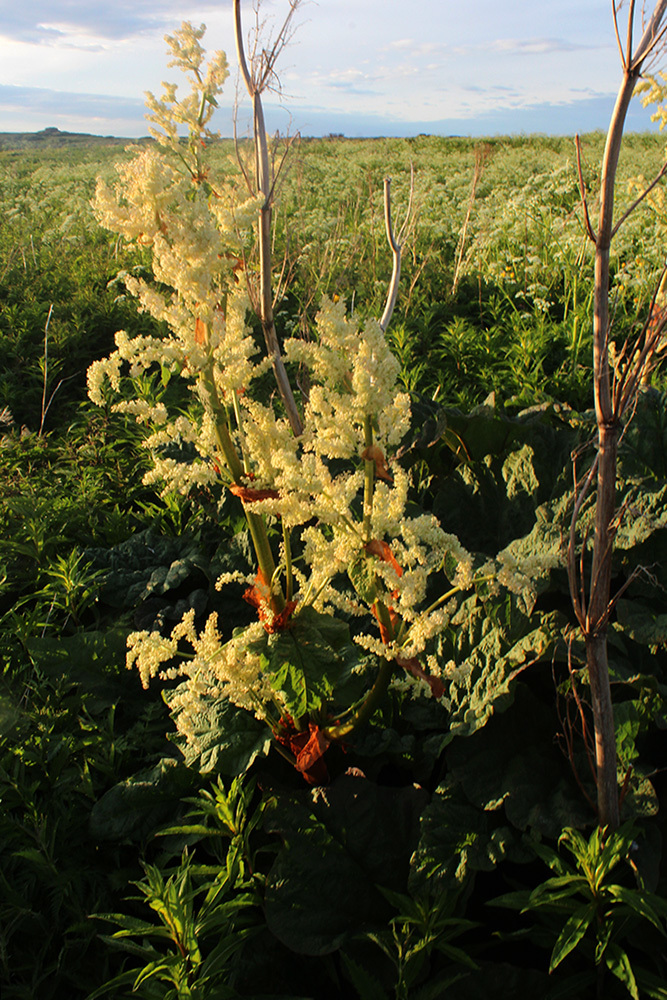


© photo
Dmitriy Bochkov · cc-by
Wikimedia Commons · CC BY-SA or Public Domain
Wikipedia · CC BY-SA
Taken Jun 27, 2019 by Becki Becki (cc-by-sa)
Taken Apr 18, 2020 by friedl (cc-by-sa)
Taken Apr 12, 2021 by Oosaagi (cc-by-sa)
© copyright of the Board of Trustees of the Royal Botanic Gardens, Kew.


Global distribution
Rheum rhabarbarum is native from southern Siberia around Lake Baikal to northern and central China. In Europe and North America it is nearly always cultivated; the few reports of naturalization chiefly concern the British Isles and Norway.
- Native3
- Introduced3
- Russia (Siberia)
- China
- Mongolia
- United Kingdom
- Ireland
- Norway
Hexagons: regions where the plant occurs. Green dots: native range.1
Identity
Rhubarb (Rheum rhabarbarum L., 1753), also called garden rhubarb or pie plant, is an herbaceous perennial in the genus Rheum, family Polygonaceae. Its name comes from medieval Latin rheubarbarum, derived from Greek rha barbarum, literally “root of the barbarians,” referring to foreign merchants who brought it to Europe from distant lands. 7 6
The genus name Rheum preserves another trace of that journey: it derives from “Rha,” the old name of the Volga, beside which wild rhubarb grew and was used in antiquity for medicinal roots rather than stalks. By the 18th century, English cultivation had shifted the emphasis to a spring vegetable grown for tart pie stalks, moving away from the medicinal root that had given the plant its name. 6 7
Recognition
Broad, herbaceous clumps of Rheum rhabarbarum die down each winter and regrow from a rhizomatous crown in spring. Large heart-shaped, wavy leaves sit on fleshy, grooved, red to green stalks, reaching 50 cm (20 in) long and 3–7 cm (1.2–2.8 in) thick. These colorful leaf stalks are a more immediate recognition feature than leaf shape alone, even for a new gardener. 3 2
A mature rhubarb clump commonly stands 60 cm to 1 m (2–3.3 ft) tall and spreads 80 cm to 1.5 m (2.6–5 ft). It becomes taller and bulkier if the flower stalk remains in place. 3
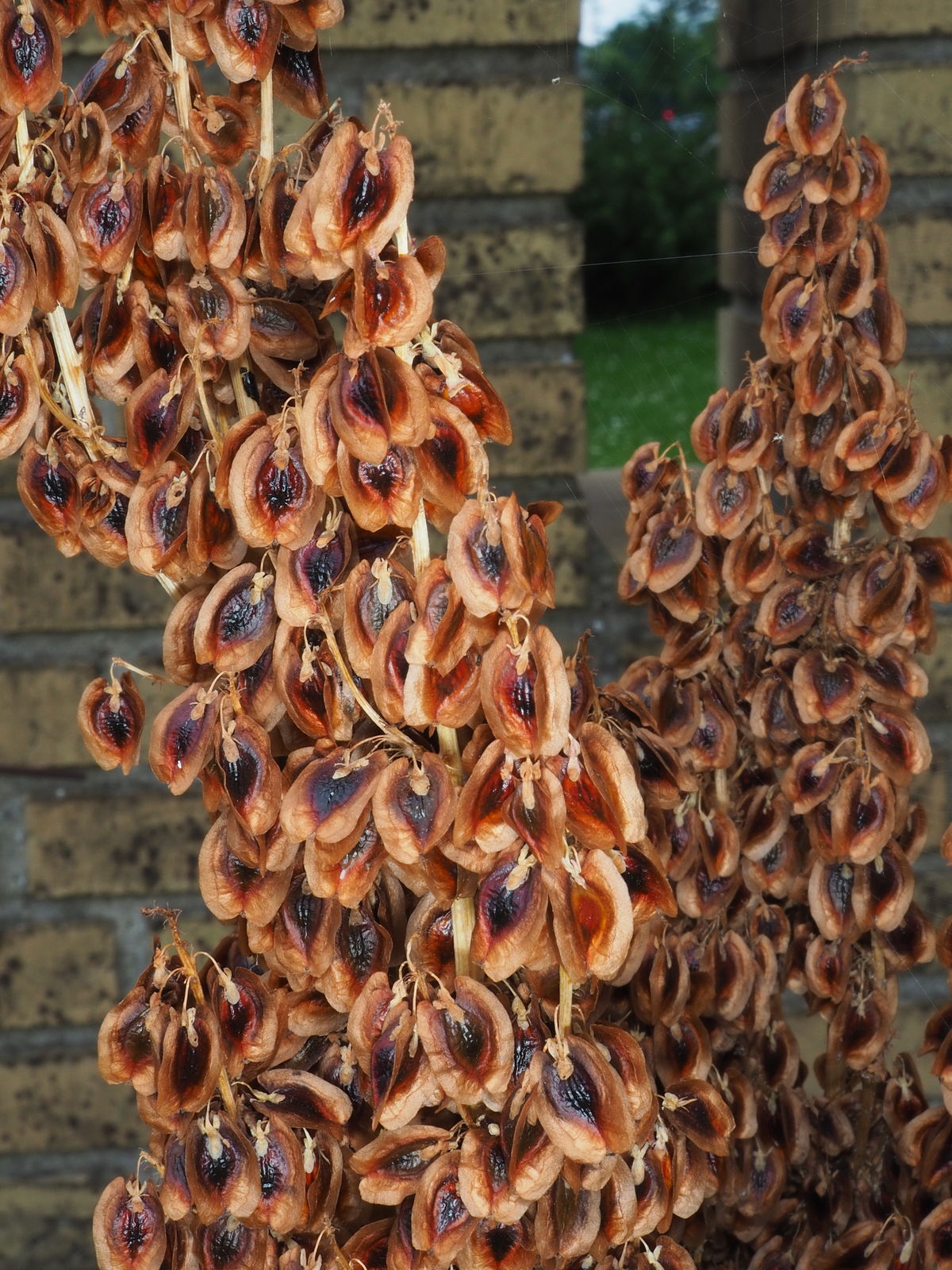
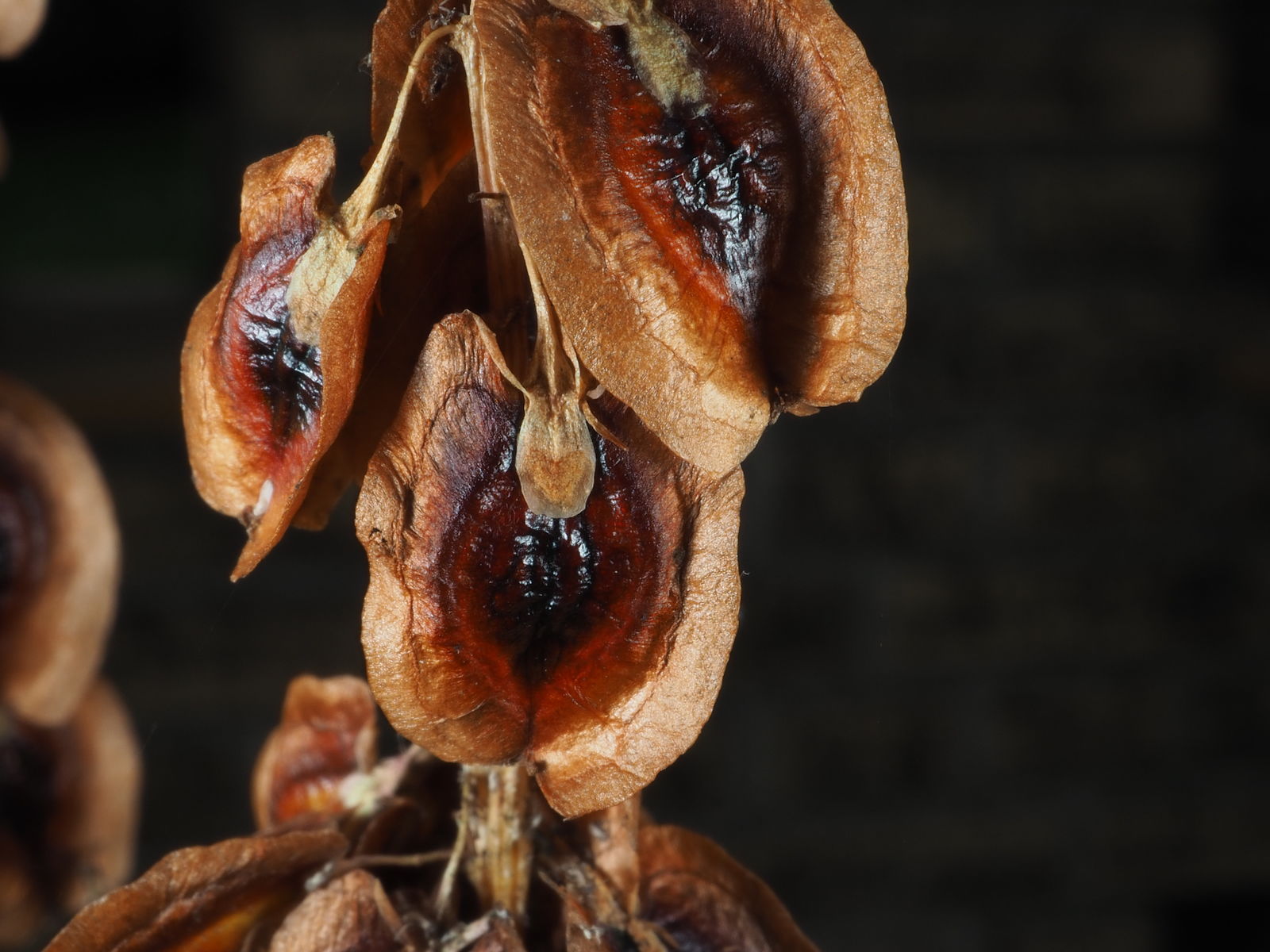
Once each summer, a branching flower stalk may rise well above the leaves, carrying dense clusters of small greenish-white flowers. The fruit is a reddish-brown, three-angled winged achene less than 1 cm (0.4 in) long. 6
Useful taxonomy
Cultivated rhubarb appears under several names, accounting for much nursery confusion. Its principal recorded botanical synonyms include the following names:
- Rheum undulatum L. (botanical synonym)
- Rheum sanguineum Meisn. (botanical synonym)
- Rheum franzenbachii Münter (botanical synonym)
- Rheum macropterum Mart. (botanical synonym)
- Rheum muricatum Blanco (botanical synonym)
Another widely used name, Rheum × hybridum, describes garden rhubarb derived from old crosses between Rheum rhabarbarum, Rheum rhaponticum and sometimes Rheum palmatum. All three hybridize readily, making the exact ancestry of most cultivars almost impossible to trace with certainty. Modern cultivated rhubarb is tetraploid, with twice as many chromosomes as wild Rheum rhabarbarum, further complicating genetic comparisons between cultivated and wild populations. 6 1
Habitat and range
Southern Siberia around Lake Baikal and northern and central China form the native range, including Hebei, Shanxi and Shaanxi provinces. Rhubarb grows there on mountain slopes at 1,000–1,600 m (3,280–5,250 ft), as well as sandy steppes and Siberian woodland edges. 6 1
Arab and Persian merchants brought rhubarb to Europe along the Silk Road as early as the 10th century. It remained largely in medicinal gardens before becoming an English vegetable crop in the 18th century. 7
Outside its original range, Rheum rhabarbarum seldom grows spontaneously. Euro+Med Plantbase records naturalization only in the United Kingdom, Ireland and Norway, with introduced or casual occurrences elsewhere in Europe. In North America it very rarely escapes gardens and remains largely confined to cultivated plots. 8 5
Life cycle and reproduction
Vegetable growers usually propagate rhubarb by dividing the crown, about every five years, choosing a piece of rhizome with at least one viable bud. Seed propagation is possible, but seedlings establish more slowly and vary genetically from the parent plant. 2
Newly planted crowns need their first year to build reserves, so harvesting is not recommended then. From the second or third year, harvest up to one-third of the leaf stalks from each crown, twisting them away at the base rather than cutting; this reduces the risk of wound rot. 2
Winter forcing beneath an opaque cover excludes light and accelerates stalk elongation, producing tender pink stalks in about five weeks. Timperley Early is a standard choice for this technique. Forcing exhausts the crown, which needs a rest the following season. 2
Uses and risks
Only the cooked leaf stalks are eaten, in pies, stewed fruit or jam; their pronounced tartness usually calls for added sugar. Red stalks have a reputation for tenderness, but color alone does not indicate actual acidity. 3 6
By contrast, leaf blades and roots concentrate oxalic acid and anthraquinone glycosides, causing mouth burns, salivation, vomiting and, in large amounts, kidney damage. Poisonings were documented in Britain during the First World War after eating the leaves was mistakenly recommended to ease food shortages. The ASPCA lists rhubarb as toxic to dogs, cats and horses, with signs including salivation and tremors. 6 4 3
A 1947 tariff ruling illustrates rhubarb’s unusual culinary status. In C.J. Tower & Sons v. United States, the US Customs Court ruled that fresh rhubarb should be taxed as fruit rather than a vegetable: its culinary role was overwhelmingly in pies and desserts rather than savory dishes. 9
Varieties, look-alikes and related plants
Among widely sold cultivars, Victoria remains a historic English standard from the 19th century, while Timperley Early suits early forcing. Raspberry Red and Fulton’s Strawberry Surprise have been recognized by the Royal Horticultural Society for their color and balanced flavor. 2
The closest commonly confused species is Rheum rhaponticum L., also cultivated as rhubarb and involved in the hybrid ancestry of many garden cultivars. Large Rumex species and young Gunnera can also mislead an inexperienced observer through leaf size and shape, but neither has garden rhubarb’s characteristic fleshy red stalks. 1 6
Main sources
- Plants of the World Online / Kew, Rheum rhabarbarum L.
- Royal Horticultural Society, Rhubarb - grow your own
- NC State Extension, Rheum rhabarbarum plant profile
- ASPCA, Rhubarb toxicity entry
- Flora of the Southeastern United States, Rheum rhabarbarum
- English Wikipedia, Rheum rhabarbarum
- Chevalier, 1942, Rhubarb cultivated in Europe and its origins
- Euro+Med Plantbase, Rheum rhabarbarum
- C.J. Tower and Sons v. United States, 1947, rhubarb tariff ruling
Frequently asked questions
Is rhubarb a fruit or a vegetable?
Botanically it is a vegetable, and the stalk is eaten. In 1947, however, a US customs court classified it as a fruit for tariff purposes because it is almost always prepared and eaten as a dessert.
Why are rhubarb leaves toxic?
They contain much higher concentrations of oxalic acid and anthraquinone glycosides than the leaf stalks. In quantity these compounds cause mouth burns and vomiting and can damage the kidneys.
When can I harvest rhubarb without weakening it?
Avoid harvesting in the first year after planting. From the second or third year, take up to one-third of the stalks, twisting them off rather than cutting them.
How do I force rhubarb for an early harvest?
Cover the crown with an opaque forcing pot in midwinter. Darkness accelerates stalk elongation, producing tender pink stalks in about five weeks.
Should I remove rhubarb flower stalks?
Yes, remove them as soon as they appear. Left in place, they use the crown’s reserves and reduce the vigor of the following year’s stalk harvest.
How do Rheum rhabarbarum and Rheum rhaponticum differ?
The species look very similar and hybridize readily. Most modern garden rhubarb descends from crosses between them, making its exact origin difficult to establish.
How long does a rhubarb plant live?
Around ten years of regular production is common, provided the clump is divided roughly every five years to renew its vigor.
Similar plants
If you are unsure about a plant’s toxicity, ask a botanist or veterinarian for advice.