
Strawberry (Fragaria × ananassa, )


Strawberry (Fragaria × ananassa) is a cultivated perennial hybrid in the rose family, grown for its fleshy, sweet fruit. Its runners root to form new plants, while the tiny achenes on each strawberry are the true botanical fruits. It mainly descends from Fragaria chiloensis and Fragaria virginiana.
Read moreStrawberry and cultivated strawberry
Allow a few hours of direct sun per day, preferably morning or evening.
Full sun or light shade


© photo
Wikimedia Commons · CC BY-SA or Public Domain
(c) Николай Соболев, some rights reserved (CC BY) · cc-by
(c) Tony Wills, some rights reserved (CC BY-SA) · cc-by-sa
Global distribution
Cultivated hybrid derived mainly from American parent species and grown widely in temperate regions.
- Cultivated6
- France
- United Kingdom
- United States
- Canada
- Chile
- Europe (horticultural cultivation)
Hexagons: regions where the plant occurs. Green dots: native range.1
Identity
Strawberry, also called cultivated strawberry, is Fragaria × ananassa, a perennial hybrid in the Rosaceae. Plants of the World Online accepts it as an artificial hybrid that can become naturalized in temperate regions. Its main parents are Fragaria chiloensis and Fragaria virginiana. 1
The International Plant Names Index records the authorship (Weston) Duchesne ex Rozier and publication in 1785. Its basionym, Fragaria chiloensis var. ananassa Weston, dates from 1771. 2
The name strawberry can refer to both the plant and its harvested fruit. The ripe fruit is the familiar food crop; leaves, runners and crowns are distinct plant parts and should not be treated as interchangeable foods. 3 7
Recognition
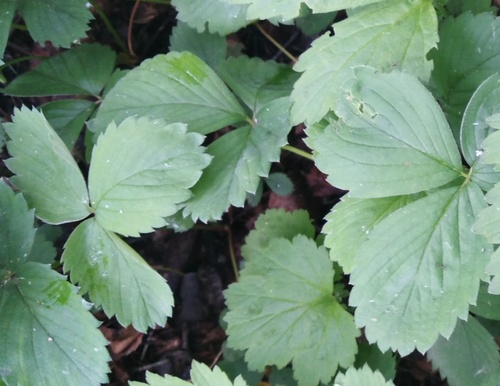
This low perennial forms a short crown near ground level and sends out runners that root at their nodes. Its leaves have three leaflets, often with a paler, hairy underside. These rooted connections gradually produce a spreading patch. 4 3
Flowers usually have five white petals surrounding yellow stamens and numerous pistils. Some ornamental selections have pink or red flowers. Flower color alone does not change their identity as cultivated strawberries. 4 3
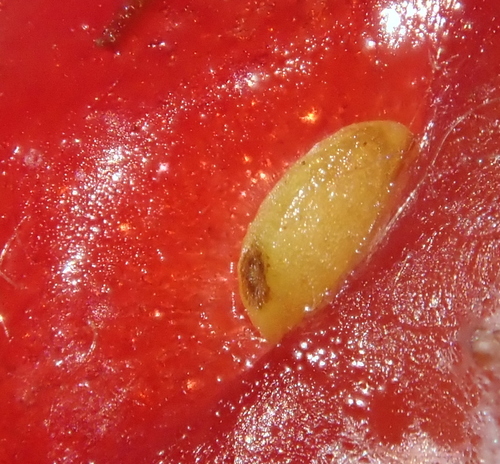
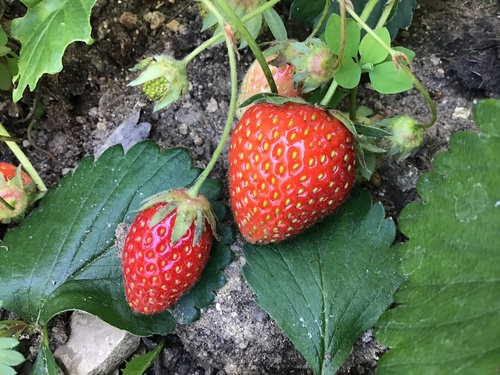
The strawberry develops from the enlarged fleshy receptacle. Each small achene on its surface comes from an ovary and is itself a true fruit. A red, fleshy structure alone is therefore insufficient to identify a strawberry among superficially similar plants. 4
Useful taxonomy
The multiplication sign in Fragaria × ananassa marks its hybrid origin. Kew, the RHS and IPNI use this name for the cultivated strawberry, whose ancestry combines the two American parent species. 3 1 2
Older names and alternative nomenclatural treatments include:
- Fragaria chiloensis var. ananassa Weston, the basionym.
- Fragaria × ananassa (Weston) Guédès, an alternative authorship.
- Fragaria ananassa Duchesne in older accounts, rather than a separate wild species.
The botanical name remains useful across cultivars with different production seasons, flower colors and runner habits. Cultivar choice determines many of the practical differences between plants sold under this hybrid name. 2 4
Habitat and range
The hybrid developed from American parent species and spread through horticulture. It should not be assigned a single native country in the same way as a wild species. Today it is grown widely in temperate fruit-producing regions. 6 1
Choose fertile, moist but well-drained soil in full sun or light shade. Plants generally stand 0.1–0.5 m (4–20 in) high. Its horticultural hardiness range is USDA zones 5–9, although cultivar performance and winter conditions still matter. 3 4
Runners make useful fruiting ground cover and provide replacement plants. In a cropping bed or container, control their spread to preserve spacing, air movement and access to the fruit, rather than allowing every new crown to remain. 3 5
Life cycle, cultivation and harvest
June-bearing types give a concentrated crop, whereas everbearing and day-neutral cultivars can extend production. Flowering and fruiting continue while temperatures remain suitable. 6 5
A rooted runner produces a clone of its parent. Seed propagation recombines inherited traits and does not reliably preserve a named cultivar. Use vegetative multiplication when retaining that cultivar is the aim. 3 5
Plant the crown at the appropriate soil level: burying it encourages rot, while exposing it can leave it dry. Water, mulch, ventilation and periodic bed renewal help manage gray mold on fruit, root problems and the decline of older plantings. 5 3
Uses and risks
Ripe strawberries are a food crop. That use does not extend automatically to leaves, runners or an unidentified plant with strawberry-like fruit. Identification still matters before collecting fruit outside a known planting. 3 4
The ASPCA lists Fragaria spp. as non-toxic to cats, dogs and horses. This does not make large quantities of plant material or sugary fruit suitable for every animal; individual digestive upset can still occur. 7
In mainland France, spreading runners in a vegetable bed are a cultivation issue rather than an invasive-species status. Manage them according to the space available and whether the planting is intended for fruit production or ground cover. 3
Cultivars, look-alikes and related plants
Named cultivars include Albion, Camarosa, Chandler, Galletta, Jewel, Pink Panda and Red Ruby. Regional cultivar guides distinguish production types and suitability; a cultivar recommended in one growing region need not perform identically elsewhere. 4 6
Pink- or red-flowered ornamental strawberries may be chosen for display as well as fruit. Check cropping habit, hardiness and disease considerations against the intended use: a fruit bed, container, hanging display or ground-cover planting. 4 3
Mock strawberry, Potentilla indica, also spreads by runners and bears red fruit. Its yellow flowers and usually smaller, dry, bland fruits distinguish it from garden strawberry. Identify the flowers and whole plant before eating an unfamiliar fruit. 8
Main sources
- Plants of the World Online / Kew, Fragaria × ananassa
- International Plant Names Index, Fragaria × ananassa
- Royal Horticultural Society, Fragaria × ananassa
- NC State Extension Gardener Plant Toolbox, Fragaria x ananassa
- University of Minnesota Extension, Growing strawberries in the home garden
- Oregon State University Extension, Strawberry cultivars for Western Oregon and Washington
- ASPCA, Strawberry toxicity entry
- NC State Extension, Indian mock strawberry
Frequently asked questions
Is garden strawberry a native wild species?
No. Fragaria × ananassa is an accepted artificial hybrid, mainly derived from Fragaria chiloensis and Fragaria virginiana, and spread through cultivation.
Is a strawberry a true botanical fruit?
The fleshy red part is an accessory fruit. The small dots on its surface are achenes, the true fruits formed from the ovaries.
Is garden strawberry toxic to cats and dogs?
The ASPCA lists Fragaria spp. as non-toxic to dogs, cats and horses. This classification does not mean that the leaves should be used as food.
Why does my plant produce many runners but few strawberries?
Depending on the cultivar type, runners can divert energy from fruiting. Restrict runners when the aim is a crop rather than new plants.
How do June-bearing and day-neutral strawberries differ?
June-bearing types concentrate their crop into a short period. Day-neutral types can flower and fruit for longer while temperatures remain suitable.
How can I distinguish mock strawberry?
Potentilla indica resembles a strawberry in habit and red fruit, but its flowers are yellow and its fruits are usually smaller, drier and bland.
Similar plants
If you are unsure about a plant’s toxicity, ask a botanist or veterinarian for advice.