
Cloudberry (Rubus chamaemorus, )
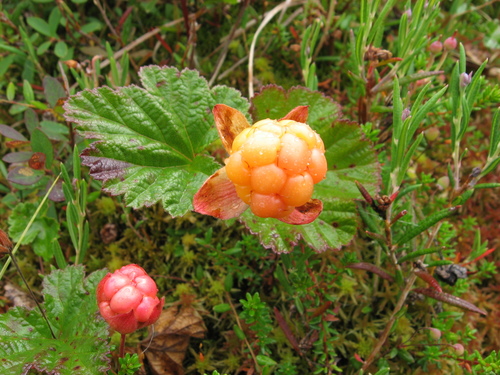

Cloudberry (Rubus chamaemorus L., 1753) is a low herbaceous perennial in the Rosaceae family, native to acidic bogs and circumboreal tundra. It has no prickles, bears male and female flowers on separate plants, and produces fruit that turns from red to amber when ripe.
Read moreCloudberry, Bakeapple, Baked apple berry, Knotberry, Arctic berry and Lowbush salmonberry
Place in full sun, with intense direct light all day long.
Full sun required; does not tolerate shade


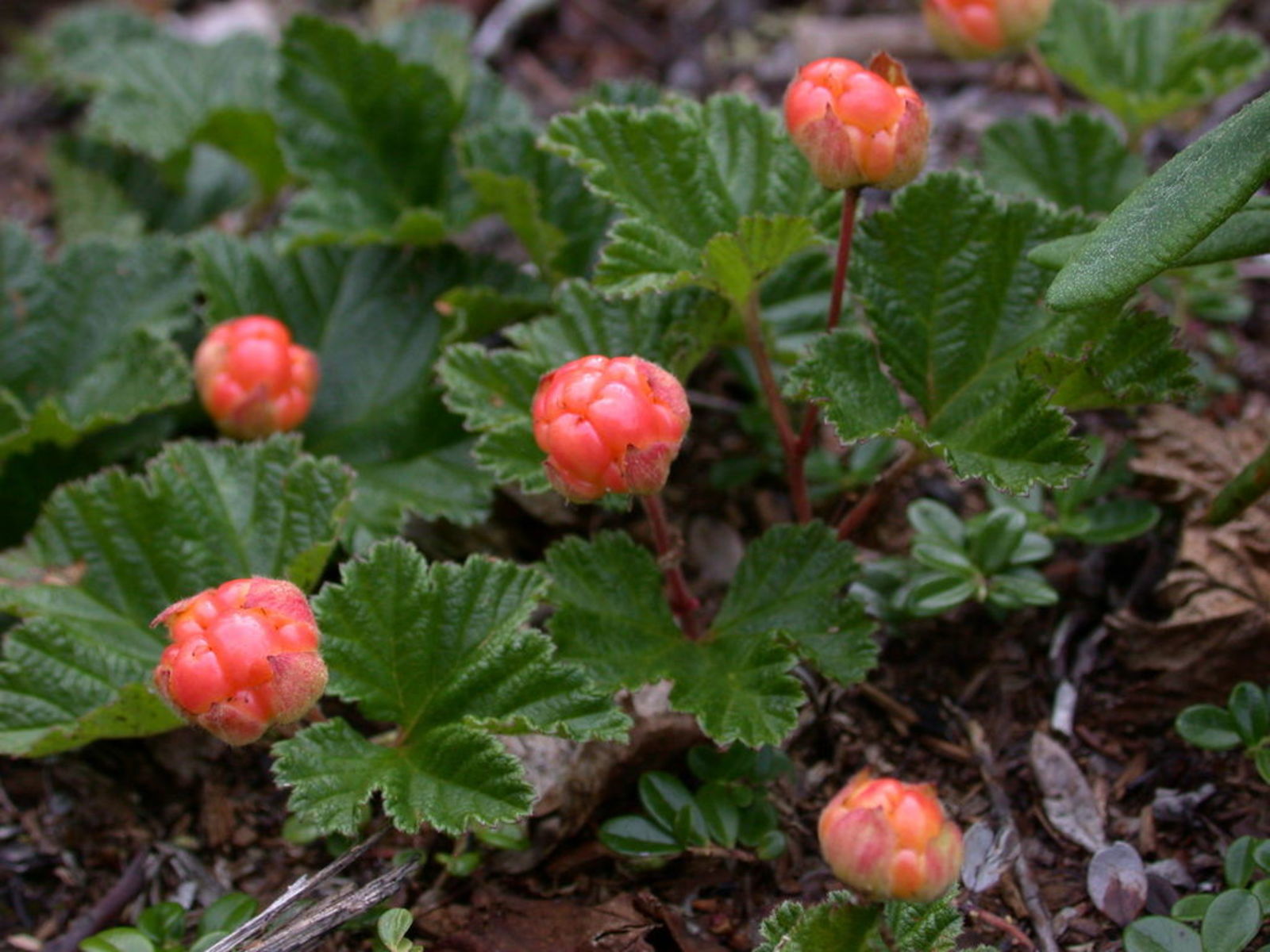


© photo
(c) vladimir_korotkov, some rights reserved (CC BY-NC), uploaded by vladimir_korotkov · cc-by-nc
Wikimedia Commons · CC BY-SA or Public Domain
Wikipedia · CC BY-SA
© copyright of the Board of Trustees of the Royal Botanic Gardens, Kew.




Global distribution
POWO and the IUCN describe a circumboreal native range, from Arctic and subarctic bogs in cold Eurasia to Canada and the northern United States. Absent from mainland France, it occurs naturally in French territory only on Saint-Pierre and Miquelon in North America.
- Native6
- Scandinavia and boreal Russia
- British Isles and Ireland
- Canada and Alaska
- Northern United States
- Siberia and northern Japan
- Saint-Pierre and Miquelon
Hexagons: regions where the plant occurs. Green dots: native range.1
Identity
Cloudberry (Rubus chamaemorus L., 1753), published by Linnaeus in Species Plantarum, is an accepted species of Rubus in the Rosaceae family. Unlike common brambles, it has no prickles and remains herbaceous, making its growth habit a useful first clue to identification. 1 2
French regional names preserve a different naming history. Plaquebière, recorded by Duhamel du Monceau in 1755 as “plat de bièvre,” is thought to refer to beaver food rather than a drink. The form plate-bière remains in use on Saint-Pierre and Miquelon, the only French territory where the species grows. 5
Quebec’s name chicouté derives from the Montagnais shikuteu, meaning “fire,” after the vivid red immature fruit. The origin of the English name cloudberry remains debated: it may refer to misty Scottish summits or derive from “clod-berry,” with clod meaning a lump of peat. 7
Recognition
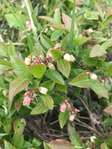
A creeping underground rhizome produces the single, unbranched stem of this low herbaceous perennial, 10–30 cm (4–12 in) tall. The stem has no thorns or prickles, distinguishing it from young raspberries and brambles growing on the same peat. 6 3
Rounded to kidney-shaped leaves grow alternately along the stem. They measure 4–9 cm (1.6–3.5 in) across and have five to seven shallow lobes. Each stem carries one terminal white flower, 2–3 cm (0.8–1.2 in) across, with five petals. 6
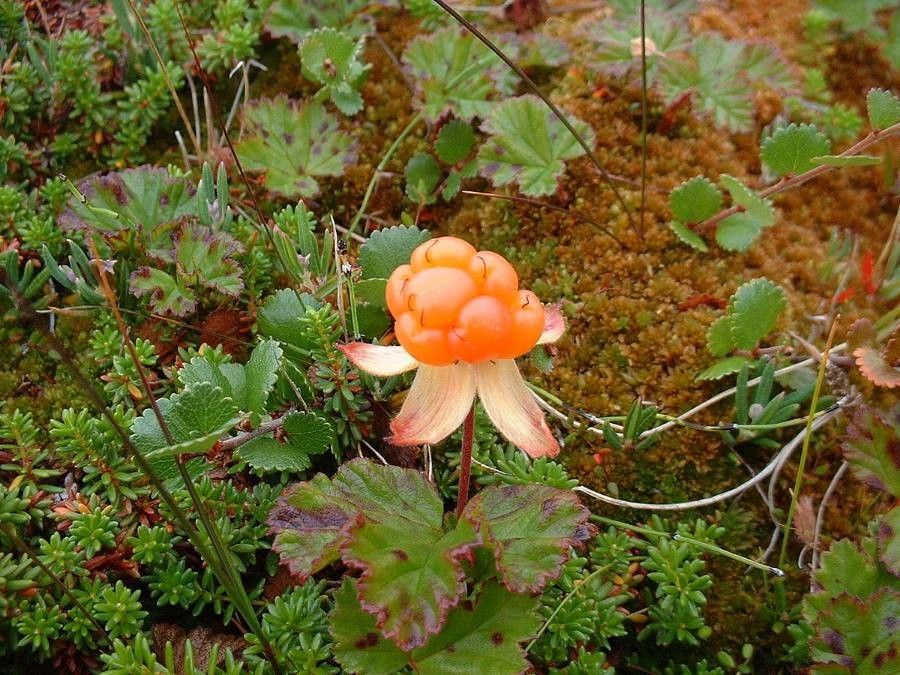
Separate plants bear male and female flowers: cloudberry is strictly dioecious, an unusual feature in Rubus. Its aggregate fruit consists of fused drupelets, measures 15–20 mm (0.6–0.8 in) and changes from firm red to soft golden amber at full ripeness. 6 7
Useful taxonomy
Within Rubus, POWO places cloudberry in subgenus Chamaemorus, once treated as a separate genus under Chamaemorus chamaemorus (L.) House. Historical synonyms include Rubus nubis Gray and Rubus yessoicus Kuntze. 1
This separate placement reflects an unusual combination of traits: the plant is herbaceous, dioecious and entirely unarmed, whereas most Rubus are prickly shrubs with clustered bisexual flowers. 1 2
The Russian Far Eastern variety Rubus chamaemorus var. pseudochamaemorus (Tolm.) Hultén remains included within the typical species rather than recognized as a distinct taxon. For identification, the accepted name Rubus chamaemorus provides the stable reference. 1
Habitat and range
Across its circumboreal range, cloudberry occupies acidic bogs and Arctic tundra in cold Eurasia, from Scandinavia and boreal Russia to Japan, as well as Canada, Alaska and the northern United States. The IUCN lists it globally as Least Concern, despite local declines associated with wetland drainage. 4
British populations mainly occupy upland peat above 600 m (1,970 ft), reaching more than 1,160 m (3,800 ft) in Scotland, on acidic, base-poor soils. Conservation status varies sharply around the range margins: Critically Endangered in Ireland, Near Threatened in Wales and a priority species in Northern Ireland. 7
Mainland France has no native cloudberry populations. Within French territory, the plant occurs only on Saint-Pierre and Miquelon, near the southern edge of its North American range. Its soil must remain acidic, at pH 3.5–5; higher pH causes rapid leaf chlorosis and prevents a lasting mat from establishing. 5 3
Life cycle and reproduction
From June to August, depending on latitude, each stem bears a single white flower. Fruit production requires male and female plants nearby. A colony without a partner of the opposite sex can flower abundantly every summer yet never produce fruit. 6
Ripening takes place from July to September, as the fruit softens from firm red to amber and becomes distinctly sweeter. Spread occurs mainly through creeping underground rhizomes. Large sterile patches can therefore be descendants of a single individual, all of the same sex. 7
Nordic breeding programs have addressed the need for both sexes by pairing the female clones Fjellgull and Fjordgull with the male pollinators Apollen and Apolto. The Finnish hermaphrodite clone Nyby remains a rare exception to the species’ dioecy.
Uses and risks
Ripe cloudberries are edible raw or cooked. Arctic peoples traditionally gathered them for their high vitamin C content when other fresh fruit was scarce. The fruit also contains ellagitannins, anthocyanins and benzoic acid, a natural preservative that allows storage without added sugar. 8
Habitat strongly influences fruit chemistry. Berries gathered in full sun contain more citric acid, while those from cooler, wetter sites accumulate more anthocyanins. 8
No source reports toxicity to humans or domestic animals. Leaves and roots have occasional traditional use as fever remedies, without established modern medical validation. 3
Norwegian public access rules allow cloudberry picking on unenclosed land, although in some northern counties only local residents may carry berries out of the municipality where they were gathered. These local restrictions reflect the economic value of the wild fruit.
Varieties, look-alikes and related plants
Commercial production remains limited, although a few Nordic breeding clones exist: the females Fjellgull and Fjordgull, male pollinators Apollen and Apolto, and Finnish hermaphrodite Nyby.
Young bramble and raspberry seedlings on the same peat are the likeliest look-alikes. They have prickles and compound leaves with several leaflets, whereas cloudberry has neither prickles nor divided leaves: its leaf is simple and rounded. 6
The English name “salmonberry” can sometimes refer to cloudberry, but usually denotes Rubus spectabilis, a prickly North American shrub with a very different habit. The scientific binomial resolves this ambiguity. 1
Main sources
- Plants of the World Online / Kew, Rubus chamaemorus L.
- International Plant Names Index, Rubus chamaemorus L.
- Plants For A Future, Rubus chamaemorus
- IUCN Red List, Rubus chamaemorus assessment
- INPN, Rubus chamaemorus L., 1753, cloudberry
- Go Botany / Native Plant Trust, Rubus chamaemorus
- Botanical Society of Britain and Ireland, Rubus chamaemorus
- Jaakkola et al. 2012, Chemical composition of ripe fruits of Rubus chamaemorus grown in different habitats
Frequently asked questions
Is cloudberry poisonous?
No. Ripe fruit is edible raw or cooked and rich in vitamin C. No veterinary source classifies the plant as toxic to humans, cats or dogs.
Why does my cloudberry never produce fruit?
The species is dioecious, with strictly male or female plants. Without a plant of each sex nearby, pollination cannot occur and a colony will not fruit, even if it flowers abundantly.
Does cloudberry grow in France?
It does not grow in mainland France. In French territory, it occurs naturally only on Saint-Pierre and Miquelon, near the southern edge of its North American circumboreal range.
How does cloudberry differ from raspberry?
Cloudberry is a low, thornless, dioecious herbaceous plant with one flower per stem and amber ripe fruit. Raspberry (Rubus idaeus) is a prickly shrub with many clustered flowers and red fruit.
Can cloudberry grow in a garden?
Yes, but only in permanently wet, acidic bog conditions, with male and female plants. It tolerates hot summers poorly and is suited to cold climates, USDA zones 2 to 4.
Where does the name chicouté come from?
This Quebec name comes from the Montagnais word shikuteu, meaning fire, referring to the bright red fruit before it ripens to amber.
When should I harvest cloudberries?
Judge by color rather than size alone. Ripe fruit changes from firm red to golden amber and becomes much softer; picked too early, it remains hard and sour.
Similar plants
If you are unsure about a plant’s toxicity, ask a botanist or veterinarian for advice.