
Snake fruit (Salacca zalacca, )


Snake fruit (Salacca zalacca) is a spiny palm with a very short or underground stem, in the Arecaceae family, native to southern Sumatra and southwestern Java in Indonesia. Grown across Southeast Asia for its edible ripe fruit with reddish-brown, scaly skin, it forms dense clumps of suckers and bears male and female flowers on separate plants.
Read moreSnake fruit, Salak and Sala
Place in indirect light or in a shaded room.
Partial shade; deep shade when young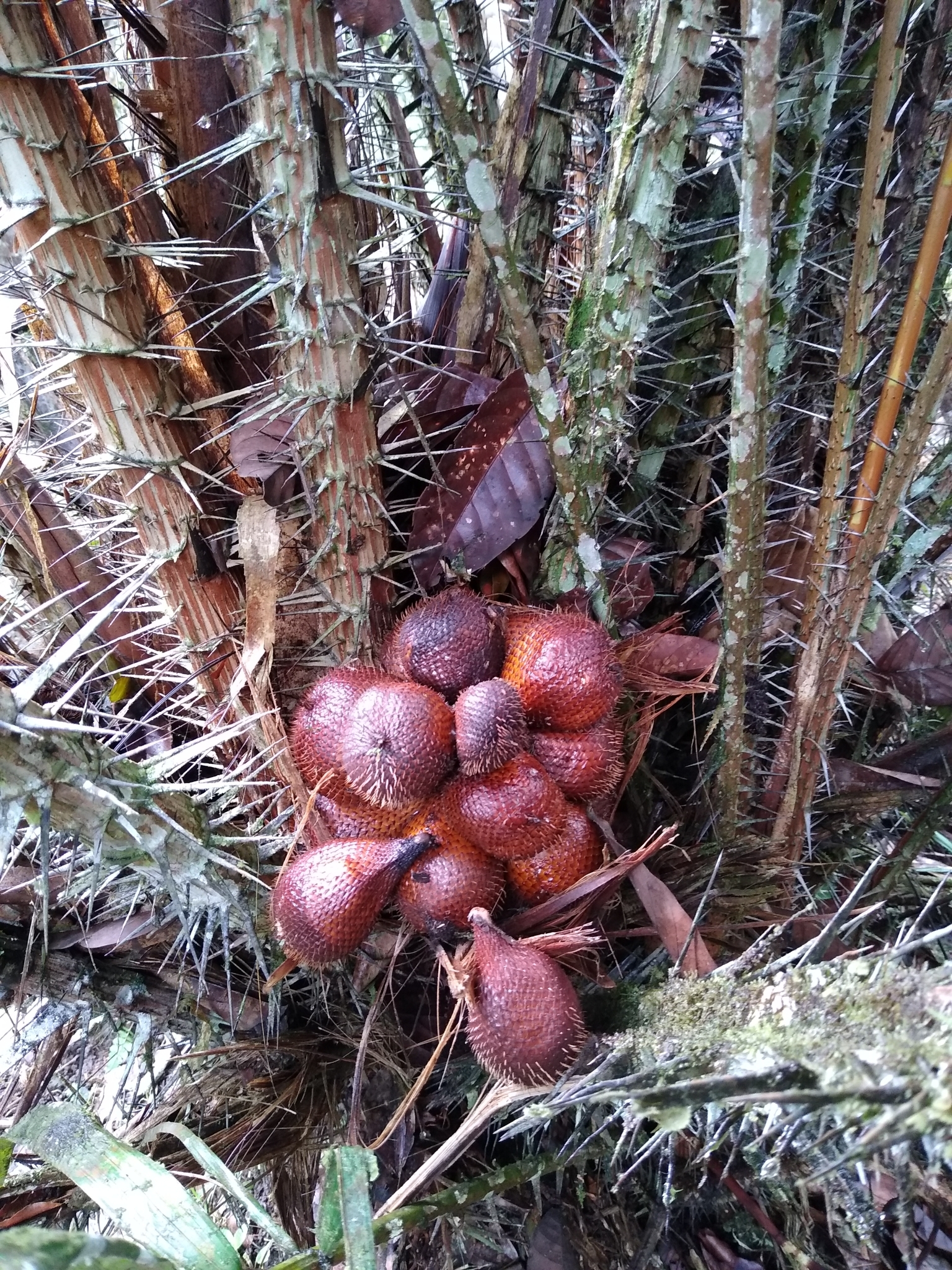


© photo
(c) Rafael Ferro, some rights reserved (CC BY-NC), uploaded by Rafael Ferro · cc-by-nc
Wikimedia Commons · CC BY-SA or Public Domain
Taken May 2, 2018 by Daniel Barthelemy (cc-by-nc)
© copyright of the Board of Trustees of the Royal Botanic Gardens, Kew.




Global distribution
Salacca zalacca is native only to southern Sumatra and southwestern Java, Indonesia. It is widely grown beyond this range across mainland and island Southeast Asia as a major commercial fruit crop.
- Native1
- Introduced1
- Indonesia
- Malaysia
Hexagons: regions where the plant occurs. Green dots: native range.1
Identity
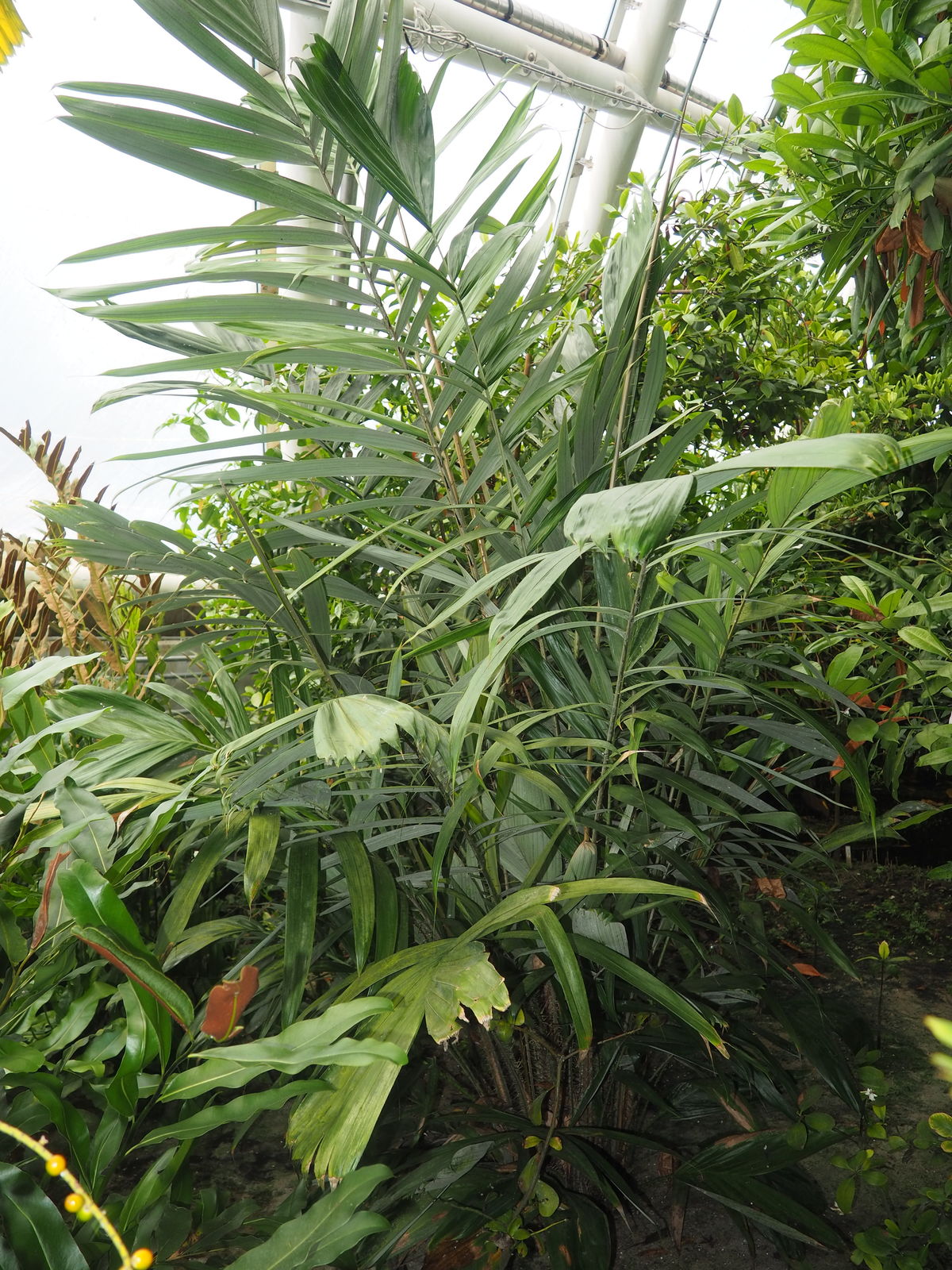
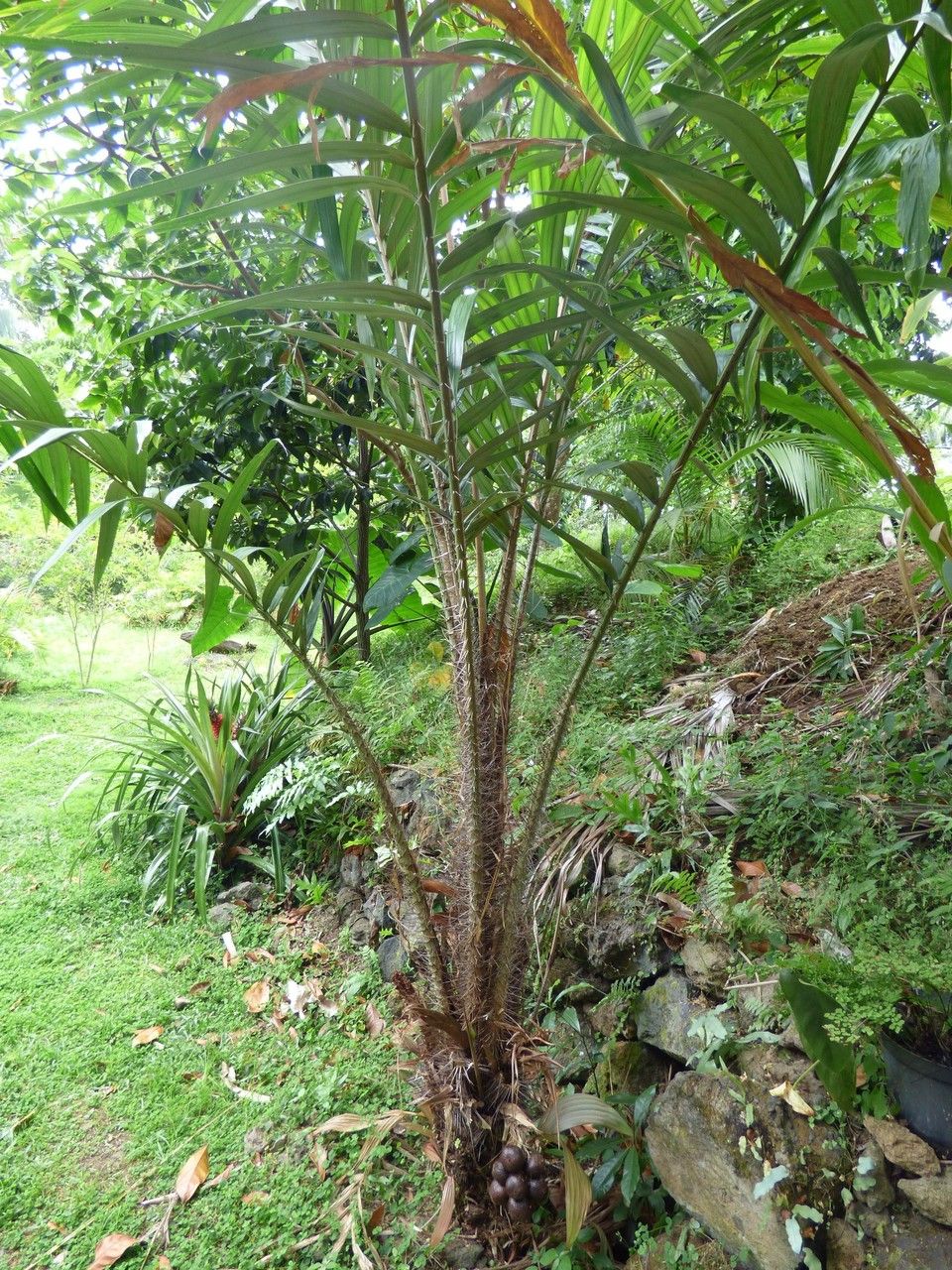
Snake fruit (Salacca zalacca (Gaertn.) Voss, 1895), also called salak, is a spiny palm in the genus Salacca and the Arecaceae family. A mature plant reaches 2–7 m (6.5–23 ft) despite having a short, sometimes entirely underground stem. Without a visible trunk, it forms a dense clump of long fronds, giving it a squat outline that immediately distinguishes it from slender-trunked palms in the same understory. 2 4
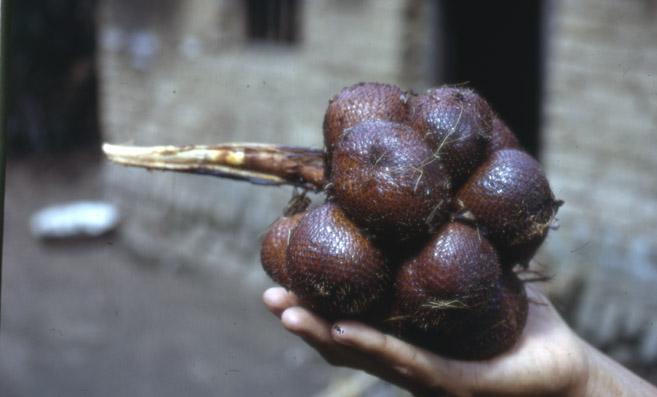
Overlapping reddish-brown scales cover the skin of the ripe fruit, resembling a snake’s skin. This gives snake fruit its widely used English name outside Indonesia; the French fruit-serpent directly translates it. 4
Recognition
Each sucker remains short and stocky, bearing pinnate fronds 3–7 m (10–23 ft) long. Long black spines cover both the leaf stalks and sheaths, posing an injury risk to anyone approaching without gloves. 4 3
Narrow, lance-shaped leaflets are dark green above and silvery green underneath. This clear contrast helps distinguish snake fruit from other spiny palms of the forest understory. 4
Tightly packed fruit clusters develop near ground level, unlike the high-borne crops of most other fruiting palms. Each egg-shaped to round fruit measures 5–10 cm (2–4 in) long, with overlapping scales that change from reddish-brown to dark red when fully ripe. 4 3
Useful taxonomy
Voss made the combination Salacca zalacca (Gaertn.) Voss in 1895, the name now accepted by POWO/WCVP. Its basionym, Calamus zalacca Gaertn., dates to 1791, when the species was still placed among the rattans in Calamus. 1 2
Several synonyms still appear in horticultural and scientific literature:
- Calamus salakka Willd. ex Steud., a historical name
- Salacca edulis Reinw., a familiar synonym
- Salacca blumeana Mart., a historical synonym
- Salacca rumphii Wall., an illegitimate name
- Salacca zalacca var. amboinensis (Becc.) Mogea, a historical variety
Of these names, Salacca edulis has persisted particularly strongly in the literature. A reference study on ripening in cultivar Pondoh still used it in 2002, more than a century after the basionym and long after its treatment as a synonym. 6 5
Habitat and range
Southern Sumatra and southwestern Java, in Indonesia, form the native range, where the species grows in lowland tropical forests and swampy ground. 2 4
Beyond those strict native limits, snake fruit has become a major crop across Southeast Asia. Orchards grow elsewhere in Indonesia and in Malaysia, Thailand, the Philippines and Singapore. The palm requires a consistently equatorial climate, with annual rainfall of 1,700–3,100 mm (67–122 in). Below this range, growth weakens and fruit production drops noticeably. 3 7
Life cycle and reproduction
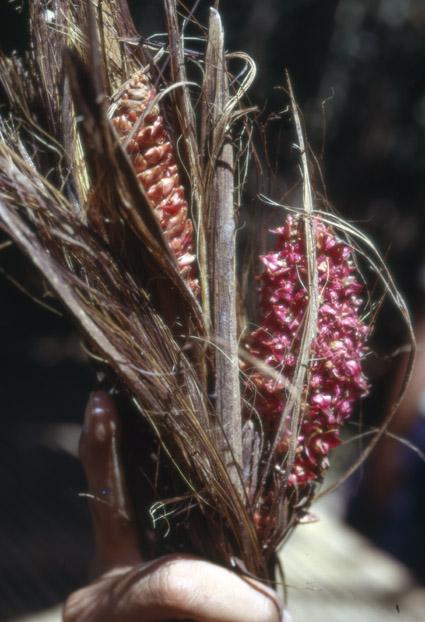
Separate plants normally carry the male and female flowers: snake fruit is dioecious. Male inflorescences measure 50–100 cm (20–39 in) long, with 4–12 spikes of reddish, tubular flowers bearing six stamens. Female inflorescences measure 20–30 cm (8–12 in) and have just one to three spikes. Their flowers are yellow-green outside and dark red within. 4
Where natural pollinators are insufficient, female flowers often abort without fertilization. Growers then pollinate them by hand; a single male plant can serve about ten female plants. The Balinese cultivar is an exception, carrying both flower types on one plant, a flowering pattern unique within the genus. 3
In cultivar Pondoh, full fruit ripening takes 5–6 months after pollination. During that period, glucose and fructose replace sucrose as the dominant sugars, aroma compounds change, and the flesh shifts from a firm texture to a yielding one. 6
Seed sowing is the main propagation method. Fresh seed can germinate within a few days or take several months, depending on moisture in the growing medium. Division of rooted suckers, however, is the only reliable way to preserve the traits of cultivars such as Pondoh and Bali. 4 3
Uses and risks
Fully ripe fruit is the principal food product. It is eaten fresh after the scales separate readily from the white, crisp flesh beneath. Unripe fruit is acidic and astringent, making it more suitable for spicy salads, pickles or candied preparations. 3
No food toxicity is documented for humans or common domestic animals. The clear hazard is physical injury: the many black spines on leaf stalks and sheaths readily puncture skin. Growers therefore wear gloves whenever they handle the palm. 3
Leaf-stalk fibers traditionally supply material for mats, and leaves can cover rustic roofs. Both uses are secondary to commercial fruit production, which remains the palm’s main economic role. 3
Varieties, look-alikes and related plants
Three cultivars dominate trade: Pondoh, from Sleman near Yogyakarta, with dry, sweet flesh and little astringency; Bali, the only known monoecious form in the genus; and Gula Pasir, a Balinese variety reputed to be the sweetest and sometimes fermented into salak wine. 3
Close relatives include Salacca affinis and Salacca wallichiana, whose similar edible fruit is rarely marketed outside Southeast Asia. Market names can also create confusion with spiny rattans in Calamus or Daemonorops. These climbing palms were formerly grouped with Salacca before taxonomic revision clearly separated them. 5
Main sources
- Plants of the World Online / Kew, Salacca zalacca (Gaertn.) Voss
- International Plant Names Index, Salacca zalacca (Gaertn.) Voss
- Plants For A Future, Salacca zalacca
- NParks Flora & Fauna Web (Singapore), Salacca zalacca
- Integrated Taxonomic Information System (ITIS), Salacca zalacca
- Supriyadi et al., 2002, Journal of Agricultural and Food Chemistry, ripening of salak cv. Pondoh
- USDA-ARS GRIN Global, Salacca zalacca taxonomy record
Frequently asked questions
Is snake fruit toxic to cats and dogs?
No food toxicity is documented for the fruit. The main hazard is the numerous black spines on the leaf stalks and sheaths, which readily cause injuries on contact.
Why does my snake fruit palm never produce fruit?
Salacca zalacca is dioecious, with male and female flowers on separate plants. Without a nearby male plant, natural pollination often fails; growers then hand-pollinate the female flowers.
Can you eat snake fruit skin?
No. Always remove the tough, scaly skin before eating the flesh. Only young seeds of cultivar Pondoh are sometimes eaten, an exception specific to that variety.
What is the difference between Pondoh and Bali snake fruit?
Pondoh, from Sleman near Yogyakarta, has dry, sweet flesh with little astringency. Bali differs mainly in its flowering biology: it is the only known monoecious form in the genus Salacca.
Why is it called snake fruit?
The fruit is covered in overlapping reddish-brown scales that resemble a snake’s skin. This distinctive skin gives snake fruit its English name.
Can snake fruit grow indoors in a temperate climate?
Only in a warm, humid greenhouse kept above 12 °C (54 °F), with high air humidity. A typical home, even a bright one, is too dry and cool for this species.
How long does snake fruit take to ripen?
In cultivar Pondoh, full ripening takes about 5–6 months after pollination. The dominant sugars gradually change and the flesh softens from firm to yielding.
Similar plants
If you are unsure about a plant’s toxicity, ask a botanist or veterinarian for advice.