
White sassafras (Sassafras albidum, )
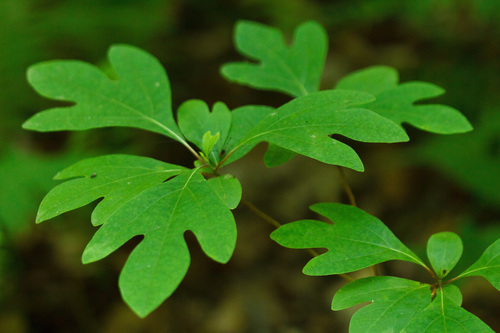
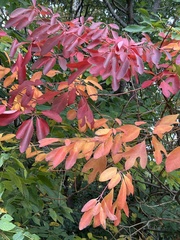
White sassafras (Sassafras albidum) is a dioecious tree in the Lauraceae family, native to eastern North America. All its parts have a distinctive spicy scent, and a single twig can carry three leaf shapes: unlobed, mitten-shaped and three-lobed. A fast-growing pioneer, it readily colonizes woodland edges and disturbed ground through root suckers. Its foliage turns yellow, orange and red in fall.
Read moreWhite sassafras, Sassafras, Mitten tree and Ague tree



© photo
(c) Tom Potterfield, some rights reserved (CC BY-NC-SA) · cc-by-nc-sa
Austin Pursley · cc0
Alan Weakley · cc0
Taken Jul 5, 2013 by EOL − scparks (cc-by-nc)
Taken Nov 18, 2015 by EOL − rpruitt (cc-by-nc)
Taken Nov 20, 2015 by EOL − cmcallister (cc-by-nc)
Taken Nov 24, 2014 by EOL − person136793 (cc-by-nc)
© copyright of the Board of Trustees of the Royal Botanic Gardens, Kew.




Global distribution
Sassafras albidum is native to eastern North America, from southeastern Canada (Ontario) through the central and eastern United States, from Iowa to eastern Texas and central Florida. It formerly occurred in southern Wisconsin, where it is locally extinct. Elsewhere it is mainly cultivated as an ornamental tree, with no documented invasive status.
Identity
White sassafras (Sassafras albidum (Nutt.) Nees, 1836), also known as sassafras, mitten tree or ague tree, is a dioecious tree in the Lauraceae family native to eastern North America. It is grown for its aromatic foliage and fall color. Every part, including leaves, bark and roots, releases a distinct spicy scent when crushed, a feature said to have guided early European settlers to the tree. 8 9
The origin of the word sassafras remains disputed. Some authors see a Spanish adaptation of an Indigenous Floridian word; others connect it with Latin saxifraga, a botanical association now considered mistaken. Its French name, meaning “Iroquois laurel,” recalls a much older relationship: Indigenous peoples of eastern North America used its bark and roots long before European colonization. 9
Recognition
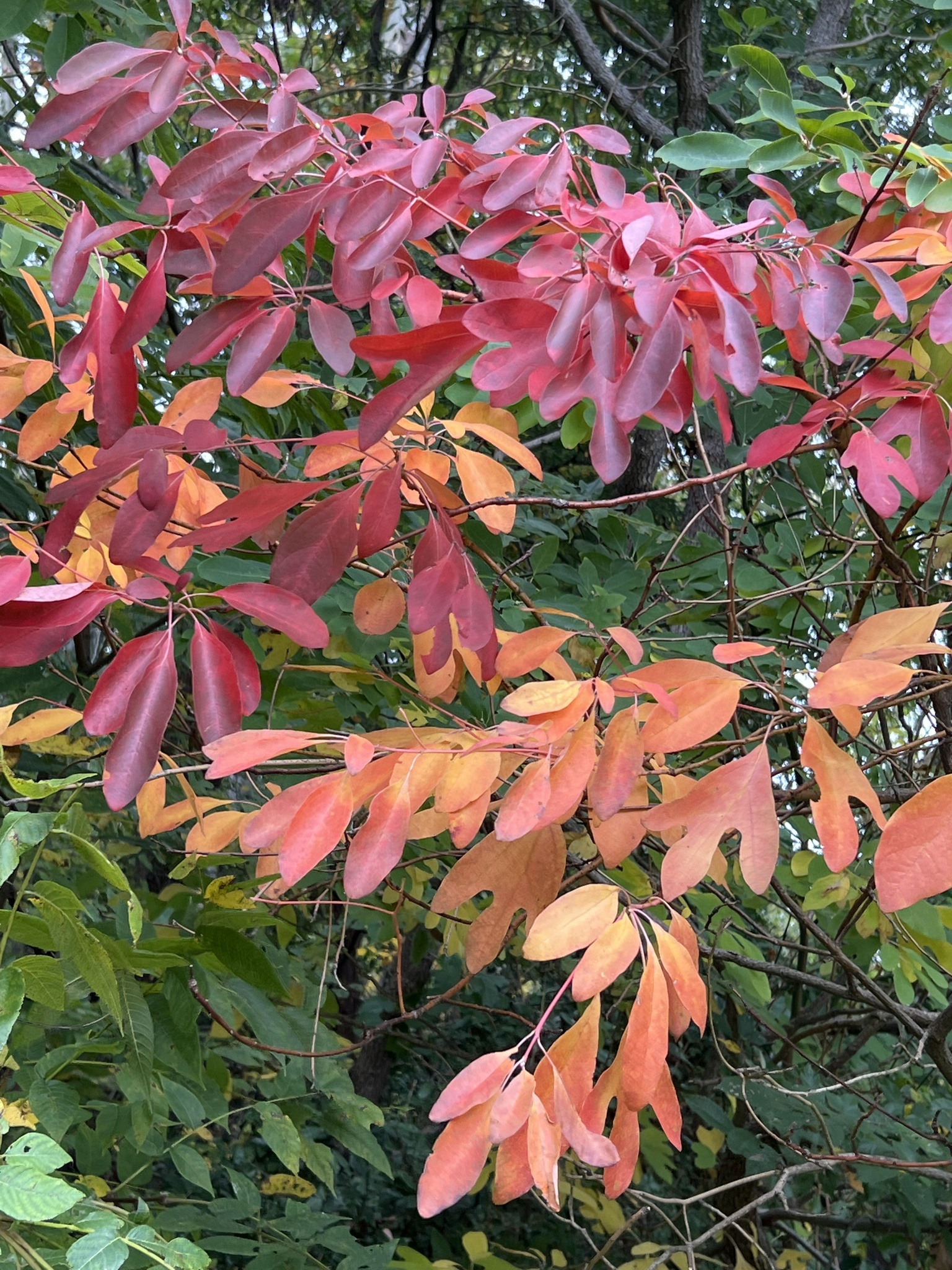
Three different leaf shapes can occur together on a single Sassafras albidum twig: unlobed elliptical leaves, two-lobed mitten-shaped leaves and three-lobed leaves. Each leaf measures 10–15 cm (4–6 in) long and 5–10 cm (2–4 in) wide. Bright green above, they turn yellow, orange and red in fall, often with several colors on the same branch. 8 2
A typical tree reaches 9–18 m (30–60 ft) tall with a spread of 7–12 m (23–39 ft). Young plants are bushy, developing a denser pyramidal outline as they mature. Thick reddish-brown bark becomes deeply furrowed into corky ridges with age; young twigs remain bright green and smooth, with a mucilaginous feel. 3 4
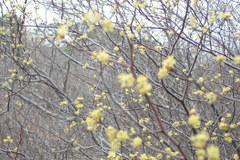
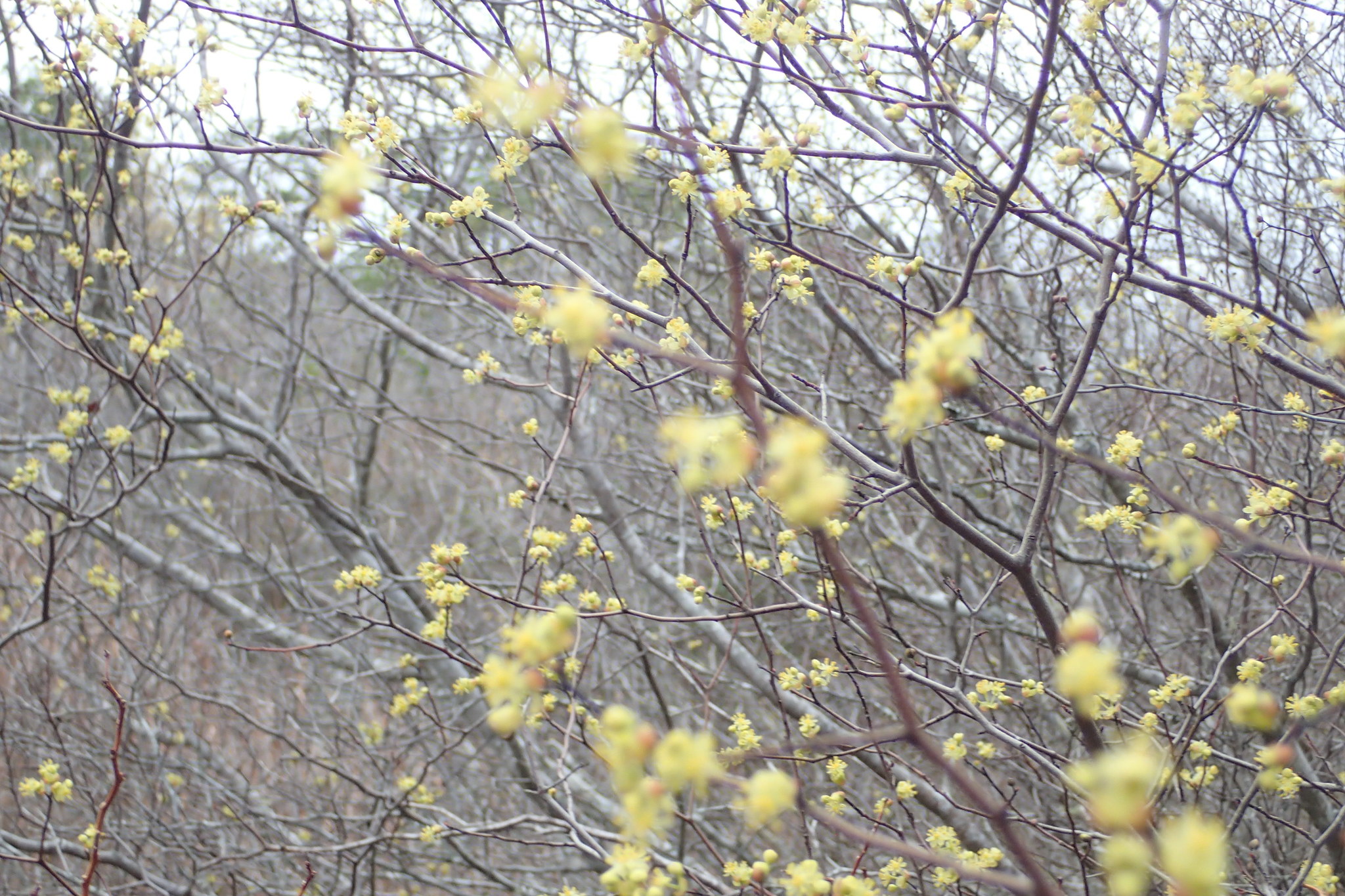
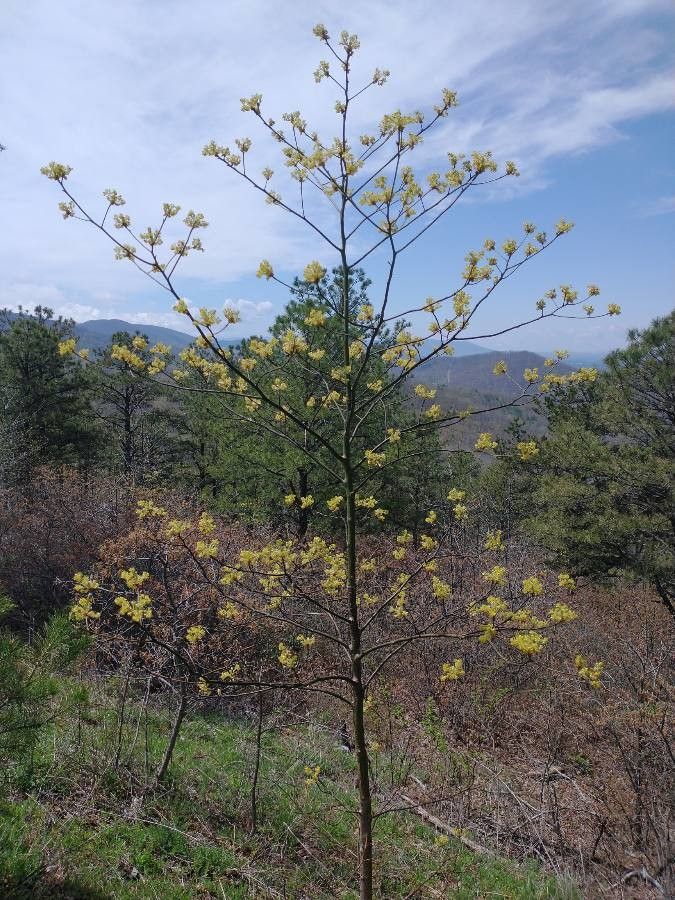
Because the species is dioecious, male and female flowers grow on separate trees. The small greenish-yellow flowers form loose clusters about 5 cm (2 in) long before the leaves open in spring. On pollinated female trees, each flower produces a blue-black drupe about 1 cm (0.4 in) long, borne on a fleshy red, club-shaped stalk. 8 4
Useful taxonomy
POWO/WCVP recognizes Sassafras albidum (Nutt.) Nees as the accepted name. Thomas Nuttall first described it, and Christian Gottfried Nees von Esenbeck transferred it to Sassafras in 1836. The genus contains only two or three accepted species, including the East Asian Sassafras tzumu, its close relative across a disjunct distribution between China and North America. 1
Several historical names are treated as synonyms of the same accepted taxon:
- Sassafras officinale var. albidum (Nutt.) S.F.Blake, a historical synonym
- Sassafras variifolium var. albidum (Nutt.) Fernald
- Sassafras albidum var. molle (Raf.) Fernald
- Sassafras albidum f. moldenkei Oswald
The downy young twigs and leaf undersides of variety molle make it the best-documented of these secondary forms. It does not warrant a separate horticultural status. 1
Habitat and range
Eastern North America is the home of Sassafras albidum, from southeastern Canada (Ontario) through the central and eastern United States, from Iowa to eastern Texas and central Florida. It colonizes deciduous woods, woodland margins, disturbed ground and sunny roadside banks as a pioneer on sandy, well-drained soils. 3 9
The IUCN lists Sassafras albidum as Least Concern because of its broad range and generally stable population, despite documented local extinction in southern Wisconsin. Reported cold tolerance to about −20 °C (−4 °F) allows cultivation in suitable European oceanic climates; the tree is also widely grown in temperate North America. 6 9
A new threat emerged in 2002: laurel wilt, a fungal disease transmitted by an Asian bark beetle introduced into Georgia. The disease can kill sassafras in weeks to months and has spread from Florida to Kentucky. 7 8
Life cycle and reproduction
Spring flowers open before the leaves, from March to May in its native Northern Hemisphere range. Fruits on pollinated female trees ripen from summer into early fall, changing from green to blue-black. Their stalks and cups remain bright red after the drupes fall, a contrast that helps birds find the fruit and disperse its seeds. 4 8
Natural spread relies mainly on root suckers. Spreading roots repeatedly send up new stems, so one tree can develop into a whole clonal colony around the original trunk. Seed propagation is possible but irregular, since the seed needs cold stratification to break dormancy. 8 5
The tree also hosts caterpillars of around forty species of butterflies and moths, including the cecropia moth. Its ecological value therefore extends well beyond its ornamental appeal. 8
Uses and risks
Root bark drove a turbulent trade in white sassafras. In the early 17th century, it became the second most valuable export of British North American colonies after tobacco, fueled by the belief that it cured syphilis during a European epidemic. The trade collapsed almost as quickly as it arose, since bark could be harvested only once from each tree. 8
Dried, ground leaves produce filé powder, a traditional ingredient in Louisiana Creole gumbo, while the root long flavored tea and root beer. These uses encountered US regulation: safrole, an aromatic compound found carcinogenic in laboratory animals after prolonged exposure, has been prohibited by the FDA as a food additive since 1960. 8 4
White sassafras is toxic to cats and dogs, through the same safrole found in its bark and roots. In humans, the documented risk concerns regular, concentrated consumption rather than occasional ingestion of leaves or bark. 4
Varieties, look-alikes and related plants
No stable horticultural cultivar is widely marketed for white sassafras. Major entries in its synonymy, such as variety molle with downy young twigs, remain botanical curiosities rather than garden selections. 1
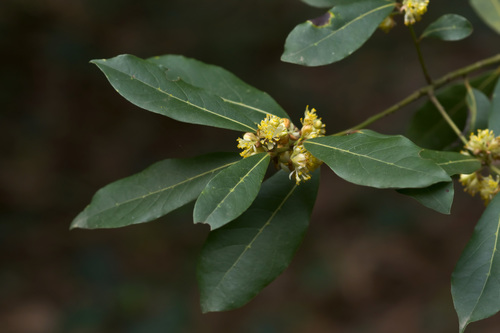
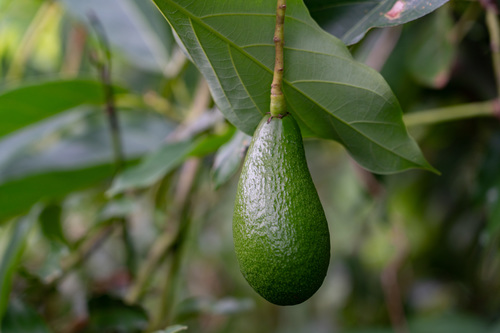
Young trees on disturbed ground or woodland edges may resemble sumac (genus Rhus). Their simple, never compound leaves and spicy scent when crushed readily distinguish them. Within the Lauraceae, bay laurel (Laurus nobilis) and avocado (Persea americana) also have aromatic foliage. Avocado shares vulnerability to laurel wilt, which first affected Persea before reaching sassafras. 7
Main sources
- Plants of the World Online / Kew, Sassafras albidum (Nutt.) Nees
- Royal Horticultural Society, Sassafras albidum details
- NC State Extension, Sassafras albidum
- Missouri Botanical Garden Plant Finder, Sassafras albidum
- Plants For A Future, Sassafras albidum
- IUCN Red List, Sassafras albidum assessment
- University of Kentucky Forestry Extension, Laurel wilt
- Wikipedia EN, Sassafras albidum
- Wikipedia FR, Sassafras albidum
Frequently asked questions
Is white sassafras toxic to cats and dogs?
Available information reports toxicity to cats and dogs, associated especially with safrole in the bark and roots. The documented human risk mainly concerns regular, concentrated use rather than occasional contact with the plant.
Can you still drink sassafras tea or root beer?
The US FDA has prohibited safrole as a food additive since 1960, after prolonged exposure was found to cause cancer in laboratory animals. Modern commercial root beers use sassafras flavoring with the safrole removed.
Why do sassafras leaves have different shapes?
Sassafras albidum naturally produces three leaf shapes: unlobed, two-lobed like a mitten, and three-lobed, often on the same twig. This normal variation does not indicate disease or stress.
What is laurel wilt, and can white sassafras get it?
Laurel wilt is a fungal disease transmitted by an Asian bark beetle introduced to the United States in 2002. White sassafras is among the most vulnerable members of the Lauraceae, with decline possible within weeks and no known curative treatment.
Is white sassafras invasive?
No invasive status is documented outside its native range. Root suckers readily form colonies in its original habitat, but it remains little planted and little naturalized elsewhere, including France, where it is rare in cultivation.
What is the source of the filé powder used in gumbo?
Filé powder is made from dried, ground sassafras leaves. This use originated with Indigenous peoples of eastern North America and became central to Louisiana Creole gumbo.
How can you tell young sassafras from sumac?
Sassafras has simple leaves, never compound ones, and a clear spicy scent when crushed. Sumac has compound leaves with several leaflets and lacks that scent. These two checks resolve most field confusion.
Similar plants
If you are unsure about a plant’s toxicity, ask a botanist or veterinarian for advice.