
Bittersweet nightshade (Solanum dulcamara, )
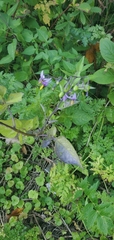
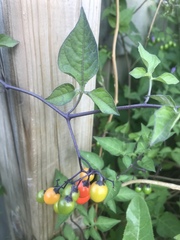
Bittersweet nightshade (Solanum dulcamara) is a perennial scrambling vine in the Solanaceae family, common in hedges, riverbanks and wetlands across Europe, North Africa and temperate Asia. Its violet star-shaped flowers and berries that turn from green to bright red make it a conspicuous poisonous wayside plant, often confused with deadly nightshade or black nightshade.
Read moreBittersweet nightshade, Bittersweet and Woody nightshade
© photo
(c) Alexander Baransky, some rights reserved (CC BY-NC), uploaded by Alexander Baransky · cc-by-nc
Amayes Touabi · cc0
Allan Harris · cc0
(c) moxostoma, some rights reserved (CC BY) · cc-by
no rights reserved · cc0
Global distribution
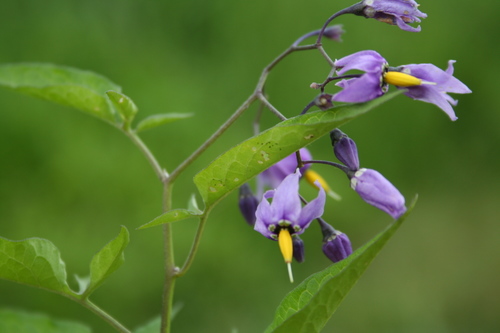
Solanum dulcamara is native to Europe, northwestern Africa and temperate Asia as far as northern Indochina, including the Azores. It has been widely introduced beyond this range and is sometimes classed as invasive in wetlands.
- Native4
- Introduced2
- Invasive2
- Mainland France
- United Kingdom
- Portugal (Azores)
- Morocco
- Canada
- Australia
- United States
- New Zealand
Hexagons: regions where the plant occurs. Green dots: native range.1
Identity
Bittersweet nightshade (Solanum dulcamara L., 1753) is a perennial scrambling vine in the Solanaceae family, alongside tomato, potato and eggplant. Its species name comes from the Latin dulcis, sweet, and amara, bitter. When chewed, a young stem initially gives a hint of sweetness before a distinctly bitter taste takes over within seconds. 1 9
The English names bittersweet and woody nightshade describe its taste and structure. The latter reflects a real botanical feature: stem bases become woody with age while the rest of the plant retains an herbaceous habit. Regional French names include morelle douce-amère, vigne de Judée, herbe à la fièvre and bronde. 7
Recognition
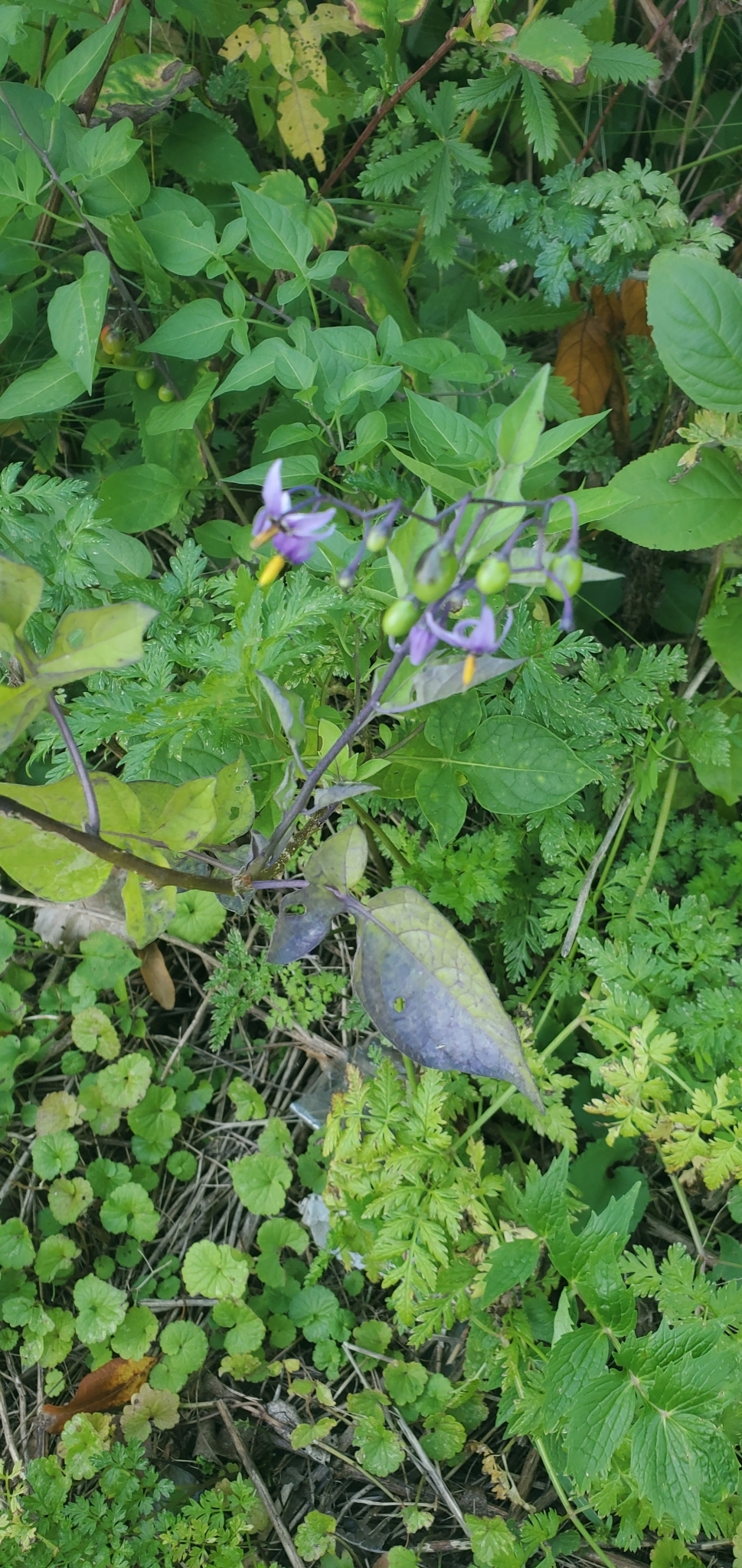
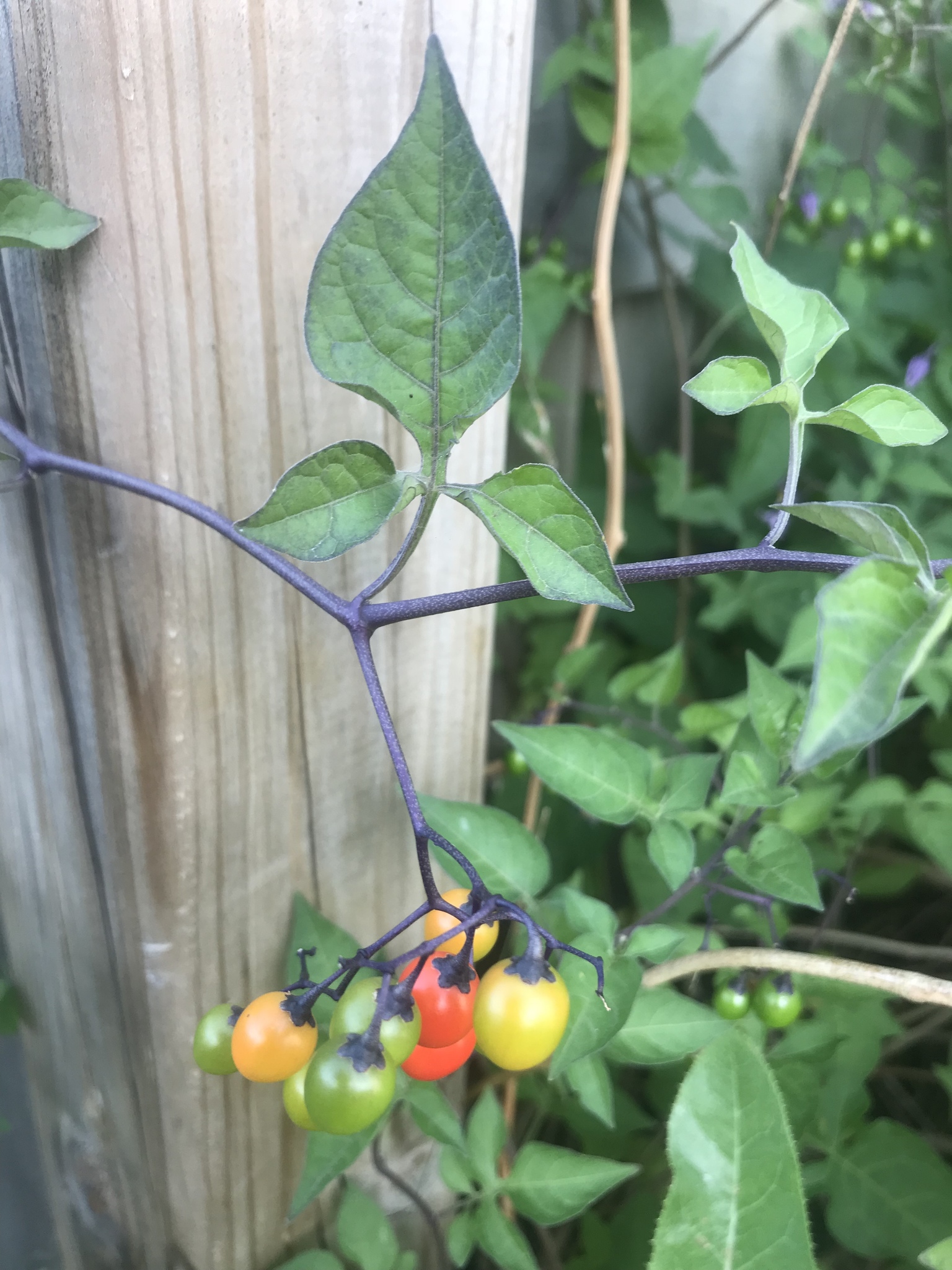
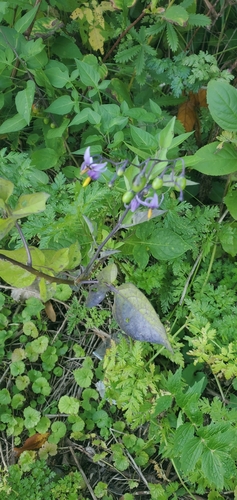
Without tendrils, Solanum dulcamara climbs by leaning on surrounding vegetation, reaching 1–4 m (3–13 ft) depending on the support. Young purple stems become greenish brown and partly woody. Alternate, arrow-shaped leaves often have two small basal lobes and release an unpleasant smell when crushed. 4 6
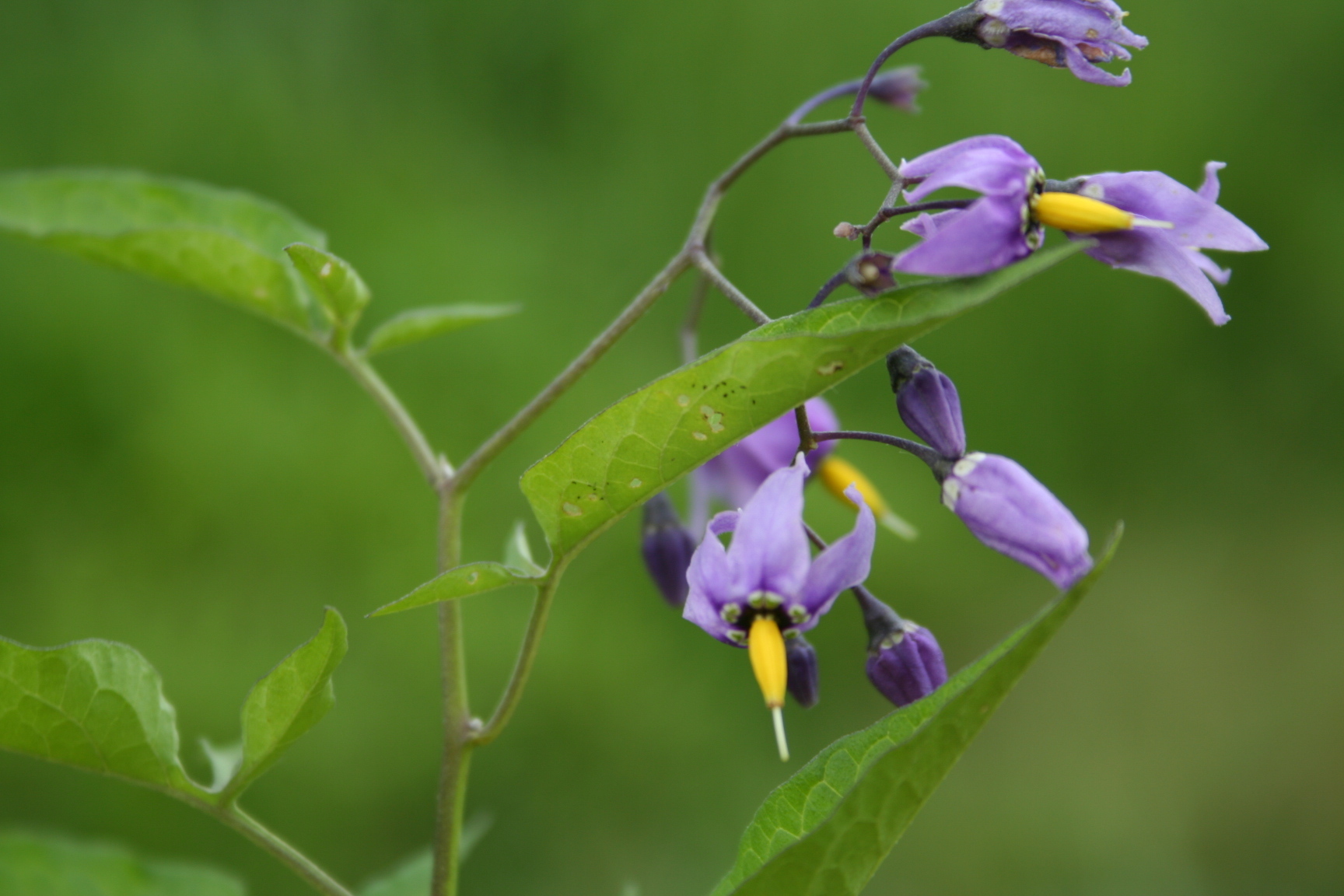
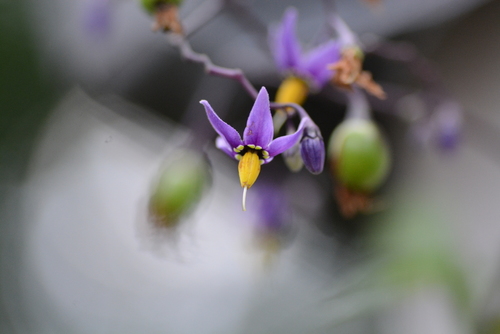
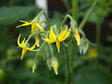
Drooping clusters carry flowers about 1–1.5 cm (0.4–0.6 in) across. Five backward-curved violet petals surround a cone of joined yellow stamens, immediately recalling the flower of its close relative, tomato. 9 2
Oval berries change from green through yellow-orange to shiny bright red when fully ripe in late summer and fall. This differs sharply from the dull black berries of black nightshade (Solanum nigrum) and the solitary black berries of deadly nightshade (Atropa belladonna). A tendril-free climbing habit together with clusters of red berries provides a quick identifying combination. 6 4
Useful taxonomy
Linnaeus published Solanum dulcamara L. in 1753, and it remains the accepted name. The species belongs to the Solanaceae and the large genus Solanum, which also includes tomato, potato and eggplant. Their shared family explains the resemblance between bittersweet nightshade flowers and those of these vegetable crops. 1
Historical literature and herbarium collections retain several earlier names and synonyms:
- Lycopersicon dulcamara (L.) Medik., an earlier combination;
- Dulcamara flexuosa Moench, a historical synonym;
- Solanum scandens Neck., another earlier name;
- Solanum littorale Raab, a synonym in botanical literature;
- Solanum dulcamara var. variegatum Sweet, the variegated form.
For both plant sales and herbarium records, Solanum dulcamara is the single accepted reference name. These synonyms and horticultural varieties all refer to the same species under different historical, regional or trade labels. 1
Habitat and range
Its original range spans Europe, northwestern Africa and temperate Asia as far as northern Indochina, including the Azores. It occupies hedges, riverbanks, pond margins, wetlands and waste ground, chiefly avoiding very acidic soils. It tolerates harsh winters down to USDA zone 4, or about -20 °C (-4 °F). 1 3
Throughout Britain and Ireland it is common almost everywhere except the far north. It grows in clay, loam or sandy soil and tolerates partial shade, helping explain this broad distribution. 9 8
Outside its original range, particularly in North America, bittersweet nightshade has naturalized in wetlands and appears on invasive species lists in several US states. It is also reported as naturalized or invasive in Australia and New Zealand. 4
Life cycle and reproduction
Temperate-climate flowering runs from early summer into early fall. Bumblebees pollinate the yellow-stamened flowers by vibrating the anthers to release pollen. This technique, called buzz pollination, also occurs in other Solanaceae with pollen released through anther pores. 9 2
Berries slowly ripen from green to red and are eaten by several birds, which disperse the seeds along hedges and watercourses. The persistent woody base lets the plant tolerate temporary flooding as well as drought and produce new shoots after cutting or frost. 6 4
Beyond natural seed dispersal, a cut stem can root directly in wet soil. This helps explain the dense colonies often found along a single stretch of riverbank. 3
Uses and risks
Dried stems harvested in fall historically went into traditional remedies for skin conditions, rheumatism and bronchial complaints. Herbal sources still document these uses, but they are no longer recommended without medical supervision because the gap between an active and a toxic dose is narrow. 3
The entire plant is poisonous. Stems, leaves and berries contain solanine and related steroidal alkaloids, most concentrated in unripe green berries. Ingestion causes nausea, vomiting and diarrhea. More rarely, severe cases occur in young children attracted to the colorful berries. 6 3
The ASPCA lists Solanum dulcamara as toxic to cats, dogs and horses, with similar digestive symptoms, sometimes accompanied by drowsiness or low blood pressure. Vegetable gardeners should also recognize it as a documented reservoir host for potato and tomato diseases and keep it away from vegetable plots. 5 4
Varieties, look-alikes and related plants
Stable horticultural forms are few. The variegated var. variegatum was occasionally grown as a Victorian garden curiosity; white-flowered f. albiflorum is mainly encountered in botanical synonymy. Neither form reduces the plant’s toxicity. 1
Two other nightshades most often cause confusion in the field:
- Solanum nigrum, black nightshade, an upright, non-climbing annual herb with dull black berries rather than red ones;
- Atropa belladonna, deadly nightshade, a much more toxic upright shrub with solitary black berries, no climbing habit and no violet star-shaped flowers.
Use three features together: scrambling stems without tendrils, violet star-shaped flowers with a yellow stamen cone, and berries held in clusters rather than singly. Berry color alone is unreliable because the fruit remains green or yellow-orange through much of summer before turning red. 4 9
Main sources
- Plants of the World Online / Kew, Solanum dulcamara L.
- Royal Horticultural Society, Solanum dulcamara - bittersweet
- Plants For A Future, Solanum dulcamara
- North Carolina Extension Gardener Plant Toolbox, Solanum dulcamara
- ASPCA, European bittersweet toxicity entry
- Greenfield Community College, Climbing Nightshade identification sheet
- INPN / MNHN, Solanum dulcamara L., 1753
- Info Flora, Solanum dulcamara L.
- First Nature, Solanum dulcamara - Bittersweet / Woody Nightshade
Frequently asked questions
Is bittersweet nightshade poisonous?
Yes. All parts contain solanine, most concentrated in unripe green berries. The ASPCA lists Solanum dulcamara as toxic to cats, dogs and horses, causing nausea, vomiting and diarrhea if eaten.
Can bittersweet nightshade be confused with deadly nightshade?
Both are toxic Solanaceae, but deadly nightshade (Atropa belladonna) is an upright, non-climbing shrub with solitary black berries in a cup-shaped calyx. Bittersweet nightshade climbs without tendrils and bears clusters of red berries.
Are red bittersweet nightshade berries dangerous to cats and dogs?
Yes. Like the rest of the plant, they contain solanine. The ASPCA recommends contacting a veterinarian after ingestion, although fatal poisoning remains rare in adult animals.
Where does the name bittersweet come from?
The name describes the taste perceived when a young stem is chewed, initially slightly sweet and then distinctly bitter. This characteristic is also reflected in the Latin epithet dulcamara, from dulcis and amara.
Where does bittersweet nightshade grow in France?
It is common in rural hedges, riverbanks, pond margins and damp waste ground across almost all mainland France, chiefly avoiding very acidic soils.
Is bittersweet nightshade invasive?
In its native Europe it is a common plant without invasive status. Introduced to North America, Australia and New Zealand, it colonizes wetlands and sometimes appears on invasive species lists.
How can you tell bittersweet nightshade from black nightshade?
Solanum nigrum is an upright, non-climbing annual herb with dull black berries. Bittersweet nightshade is a perennial scrambling vine with shiny red berries and a partly woody base.
Similar plants
If you are unsure about a plant’s toxicity, ask a botanist or veterinarian for advice.